Why White Sands National Park stands out
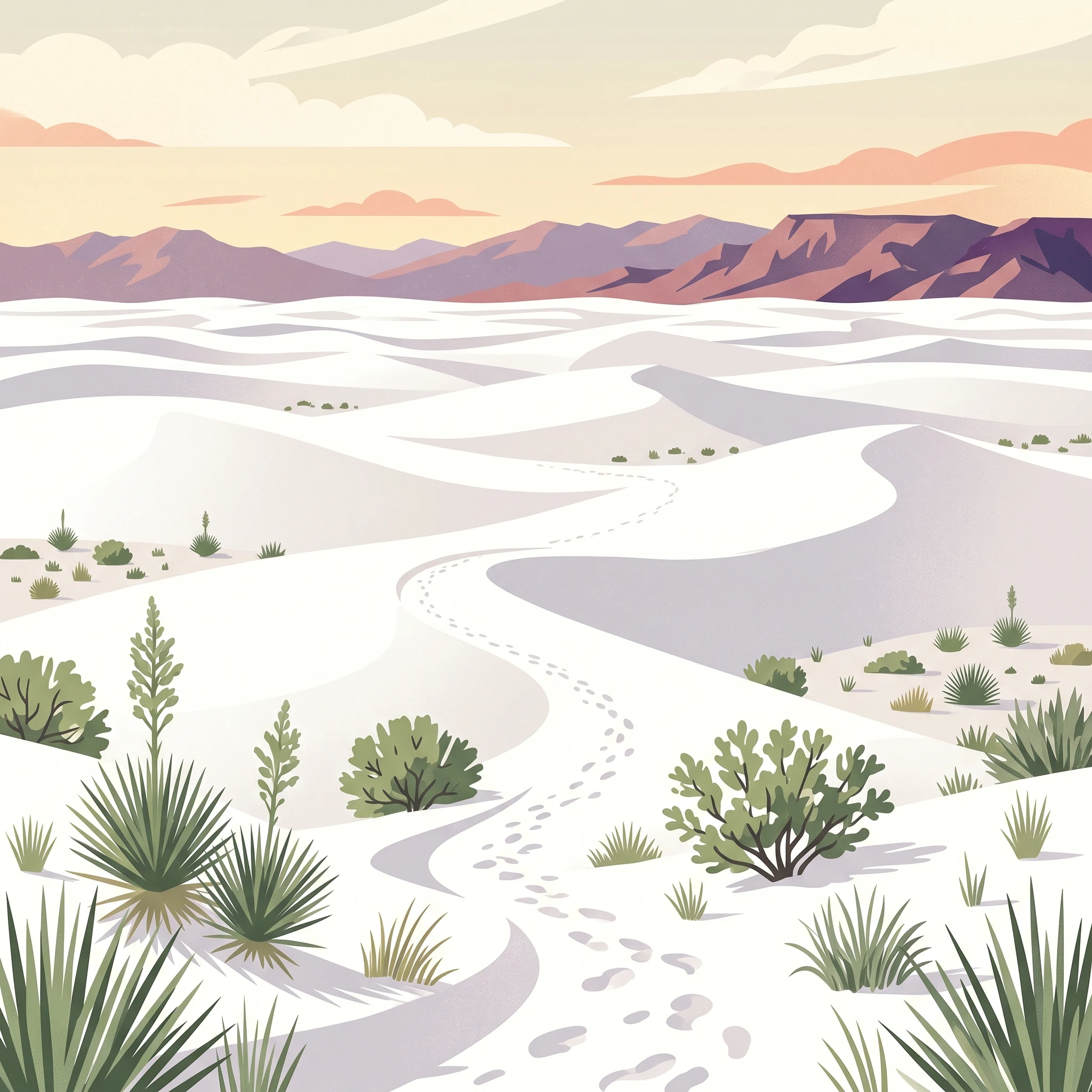
White Sands is best known for its extraordinary gypsum dunefield, the largest of its kind on Earth. The bright white dunes, composed of calcium sulfate crystals rather than typical silica-based sand, create a surreal landscape that shifts and moves with the wind. The park is also famous for its paleontological significance, housing some of the oldest known human footprints in North America, dating back 21,000 to 23,000 years, alongside fossil tracks of Ice Age megafauna including mammoths, ground sloths, and saber-toothed cats. The unique white coloration of many endemic species, from reptiles to moths, has evolved to blend with the bleached landscape.
White Sands National Park history and protected-area timeline
The human history of White Sands National Park spans tens of thousands of years, beginning with Paleo-Indians who inhabited the shores of Lake Otero around 12,000 years ago. These early inhabitants left behind not only stone tools and projectile points but also the oldest known human footprints in North America, discovered preserved in the gypsum soil of the basin. The Archaic people arrived approximately 4,000 years ago, followed by the Jornada Mogollon who established permanent settlements around 200 CE. Apache peoples arrived over 700 years ago, establishing territorial claims that they defended fiercely against colonial encroachment. The Battle of Hembrillo Basin in 1880 represents the closest archaeological evidence of the Apache Wars within the region. The area remained largely avoided by Spanish colonists due to limited water sources and Apache presence, though salt-gathering expeditions traveled to the salinas north of Alkali Flat beginning in 1647. Hispanic farming communities emerged at Tularosa in 1861 and La Luz in 1863, where residents used gypsum sand mixed with water to create plaster for their adobe homes. The concept of protecting the white sands dates to 1898, though the national monument was only established on January 18, 1933, by President Herbert Hoover. Tom Charles became the first custodian, and the WPA-built visitor center and support buildings constructed between 1936 and 1938 were added to the National Register of Historic Places in 1988. The redesignation to national park occurred on December 20, 2019, when President Donald Trump signed legislation that also added approximately 2,029 acres to the park.
White Sands National Park landscape and geographic character
The physical landscape of White Sands National Park is defined by its extraordinary gypsum dunefield, which stretches across the Tularosa Basin in a sea of white that contrasts dramatically with the surrounding desert. The dunes vary significantly across the park, with the tallest exceeding 50 feet along the western margins and progressively decreasing in height toward the eastern boundary where they come to an abrupt stop. Several distinct dune types are present: dome dunes along the southwest margins, transverse and barchan dunes in the central field, and parabolic dunes along the northern, southern, and northeastern margins. The underlying geology includes the Alkali Flat, a large flat area of selenite crystals remaining from the evaporated Lake Otero, and Lake Lucero, an ephemeral lake in the southwest corner that periodically fills with gypsum-laden water. The San Andres Mountains rise beyond the park's western boundary, while the Twin Buttes rock formation lies to the south on Bureau of Land Management territory. Groundwater lies only a few feet below the surface throughout most of the dunefield, and the dunes themselves create a cooler, wetter microclimate than the surrounding desert soils.
White Sands National Park ecosystems, habitats, and plant life
The ecological character of White Sands National Park is defined by a harsh yet remarkably biodiverse desert environment where specialized species have evolved to thrive in conditions that would be inhospitable to most life. The park supports over 800 animal species and more than 300 plant species, with a particular concentration of endemic organisms that exist nowhere else on Earth. At least 45 species are endemic to the park, including 40 moth species, the Apache pocket mouse, the White Sands woodrat, and the bleached earless lizard. The gypsum-rich alkaline soils present challenges for plant life, yet drought-tolerant species including cacti, desert succulents, and specialized grasses have adapted to survive in temperatures ranging from sub-freezing to over 100 degrees Fahrenheit. Many plants are gypsophiles, thriving specifically in the gypsum-rich soils. The dunefield creates distinct habitat zones, with the more vegetated eastern dunes supporting different species assemblages than the sparsely vegetated western margins where dunes move most rapidly. The park's ecological significance extends to its function as a biological island within the larger desert ecosystem, with species adapting unique camouflage strategies to match the white landscape.
White Sands National Park wildlife and species highlights
White Sands National Park hosts an remarkable diversity of wildlife, with more than 800 animal species inhabiting the dunefield and surrounding desert environments. Several species have evolved distinctive white or off-white coloration as camouflage against the gypsum sand, including the Apache pocket mouse, bleached earless lizard, sand-treader camel cricket, sand wolf spider, and numerous moth species. Invertebrates form the largest group with over 600 species, including spiders, wasps, beetles, and the notably toxic Maricopa harvester ant, whose venom is among the most toxic in the insect world. Bird species number over 246, with common visitors including mourning doves, turkey vultures, red-tailed hawks, and Chihuahuan ravens, though most bird activity occurs in vegetated areas away from the heart of the dunefield. Mammals include coyotes, bobcats, badgers, kit foxes, desert cottontails, black-tailed jackrabbits capable of speeds up to 40 miles per hour, and Merriam's kangaroo rats that can jump up to 10 feet when frightened. Reptiles include the bleached earless lizard, little white whiptail, several snake species including the venomous rattlesnake and massasauga, and the desert box turtle. The White Sands pupfish represents the only fish species endemic to the Tularosa Basin.
White Sands National Park conservation status and protection priorities
White Sands National Park holds significant conservation value as the protector of the world's largest gypsum dunefield and the unique species that have evolved within this specialized environment. The park's designation as an IUCN Category V protected landscape recognizes its cultural and ecological significance, while the presence of 45 endemic species underscores its irreplaceable biodiversity value. The National Park Service has implemented specific conservation measures, including the construction of a 67-mile boundary fence in 1996 to prevent invasive oryx from the adjacent missile range from competing with native species for forage. The park's paleontological resources, including the oldest known human footprints in North America and extensive Ice Age megafauna tracks, represent irreplaceable scientific and cultural heritage requiring careful preservation. The redesignation to national park status in 2019 added approximately 2,029 acres of land and provided enhanced protection mechanisms, while also requiring careful coordination with the surrounding military installations to balance public access with defense-related operations.
White Sands National Park cultural meaning and human context
The cultural landscape of White Sands National Park encompasses thousands of years of human habitation, from Paleo-Indian hunter-gatherers to contemporary communities. The Tularosa Basin was home to the Jornada Mogollon people who established permanent agricultural settlements around 200 CE, leaving behind adobe structures and pottery that remain visible in the archaeological record. Apache peoples, particularly the Mescalero Apache, maintain an active cultural affinity to the landscape of their ancestors and supported the park's redesignation as a national park. Hispanic communities that settled in Tularosa and La Luz during the 1860s developed distinctive building practices using gypsum sand to create white plaster for adobe homes, a tradition that gave the landscape its characteristic architectural identity. The park's visitor center and support buildings, constructed in the Pueblo Revival style by the Works Progress Administration between 1936 and 1938, represent significant historical architecture and were added to the National Register of Historic Places as the White Sands National Monument Historic District.
Top sights and standout views in White Sands National Park
White Sands National Park offers visitors a distinctive combination of geological wonder, paleontological significance, and recreational opportunities centered around its extraordinary gypsum dunefield. The eight-mile Dunes Drive provides vehicle access into the heart of the white sand landscape, while five marked trails totaling nine miles allow exploration on foot through varying dune formations. The park's unique recreation options include sledding on the dunes, a practice that has occurred for generations and remains popular despite the park's closure of alcohol possession from February through May. Ranger-guided programs include sunset strolls year-round, monthly Lake Lucero hikes from November through April, and full moon guided hikes from April through October. The backcountry campground offers overnight stays within the dunefield itself, providing an immersive experience of the ever-shifting landscape. Paleontological resources include the White Sands fossil footprints, representing potentially the oldest known human footprints in North America, alongside extensive Ice Age megafauna trackways.
Best time to visit White Sands National Park
White Sands National Park can be visited year-round, though the experience varies considerably by season. The busiest periods occur during March and July, each receiving more than 60,000 visitors, while November through February see the fewest visitors with less than 30,000 monthly. Summer months from June through August bring afternoon temperatures averaging around 97 degrees Fahrenheit, though the gypsum sand remains surprisingly cool to the touch due to its low thermal conductivity. Winter months from November through March feature cooler temperatures with average highs in the 50s and 60s Fahrenheit, though nighttime temperatures can drop below freezing. The park is completely surrounded by White Sands Missile Range, and periodic missile tests may require temporary closures of Dunes Drive and all visitor activities, sometimes with as little as 24 hours notice. Photography is popular throughout the year, with the white dunes providing striking contrast against blue skies and colorful sunsets. Visitors seeking fewer crowds should consider visiting during the cooler months from November through February.