Why Coorong National Park stands out
Coorong National Park is best known for its extraordinary coastal lagoon ecosystem that forms a critical habitat for migratory birds and aquatic life. The Coorong supports significant populations of waterbirds including Australian pelicans, black swans, chestnut teal, and numerous shorebird species, many of which travel from as far as Siberia and Japan to winter in the wetlands. The park's 194-kilometre beach along Younghusband Peninsula is Australia's longest, creating a distinctive landscape where the lagoon meets the Southern Ocean. The area gained cultural prominence through its depiction in Colin Thiele's novel Storm Boy and the subsequent films that showcased the bond between a young boy and an orphaned pelican.
Coorong National Park history and protected-area timeline
Coorong National Park was formally proclaimed on 9 November 1967 under the National Parks Act 1966, encompassing land in sections 17 and 60 in the Hundred of Glyde and section 6 in the Hundred of Santo. The park's boundaries were expanded and consolidated through subsequent legislation, particularly with the commencement of the National Parks and Wildlife Act 1972 on 27 April 1972, which added additional sections to the protected area. A significant expansion occurred on 14 January 1993 when the Coorong Game Reserve, which had been purchased by the South Australian government in 1968, was abolished and its lands incorporated into the national park. This game reserve had covered approximately 68.4 square kilometres of the Coorong lagoon west of Salt Creek. The park continues to be managed by the South Australian Department for Environment and Water. In February 2013, a lifeboat from the cargo ship MS Oliva, which had foundered in the South Atlantic in 2011, washed ashore within the national park, illustrating the park's connection to broader maritime activity.
Coorong National Park landscape and geographic character
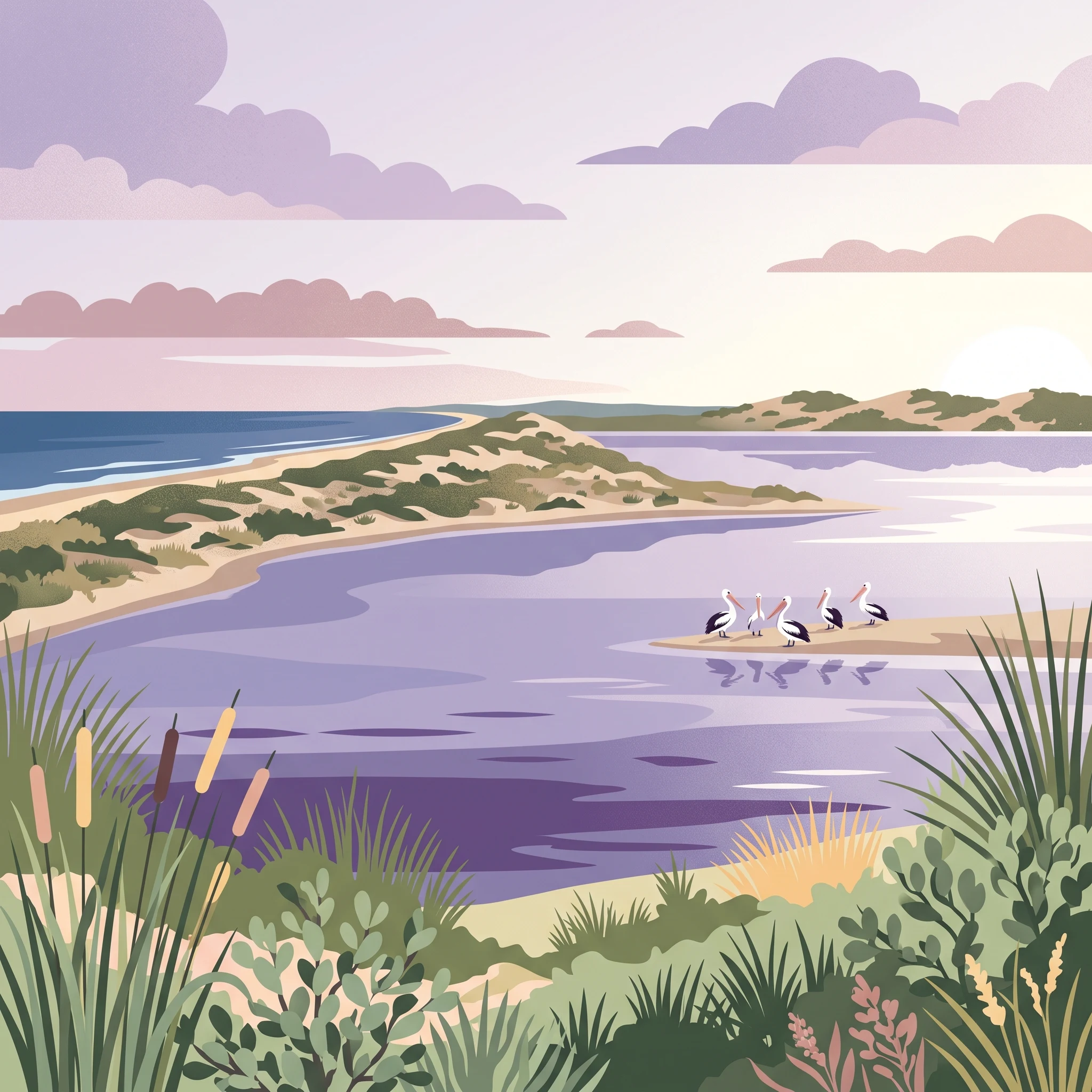
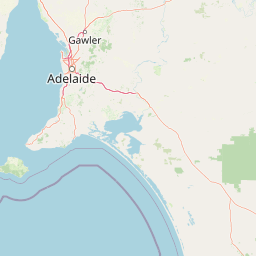
The Coorong National Park presents a striking landscape defined by the interplay between a long coastal lagoon and a narrow sand peninsula. Younghusband Peninsula runs parallel to the coastline for much of the park's length, separating The Coorong lagoon from the crashing waves of the Southern Ocean. This peninsula supports extensive coastal dune systems that have been shaped by prevailing winds and ocean currents over millennia. The lagoon itself varies dramatically in character along its length, with the northern sections holding more freshwater influenced by groundwater and rainfall, while the southern portions become increasingly saline as evaporation concentrates salts. The park's western end near the Murray Mouth features a more open connection to the ocean, while the interior sections are more enclosed and protected. The surrounding terrain is relatively flat coastal plain, with low relief broken only by the dunes of the peninsula and occasional rocky outcrops. The 194-kilometre beach on the ocean side of the peninsula represents Australia's longest continuous stretch of sand, a remarkable feature that defines the park's coastal character.
Coorong National Park ecosystems, habitats, and plant life
The Coorong lagoon system represents a complex ecological environment where freshwater, estuarine and hypersaline conditions exist in close proximity, creating a gradient of habitats that support remarkable biodiversity. The wetlands within the park form part of a critically endangered coastal lagoon ecosystem according to the IUCN Red List of Ecosystems, primarily due to the loss of natural freshwater flows and the subsequent decline of characteristic submerged aquatic plants. The interaction of seawater from the Southern Ocean with Murray River water, rainfall and groundwater creates a layered environmental system where different species occupy different zones based on their salinity tolerance. Freshwater inflows support the survival of various animal species while the more saline areas provide essential habitat for much of the park's birdlife. The vegetation around the lagoon includes coastal samphire communities in the more saline areas, freshwater reeds and rushes in sheltered bays, and dune-adapted species along the peninsula. This mosaic of habitats makes the Coorong exceptionally valuable for maintaining biological diversity in a region where water availability fluctuates dramatically with seasonal and climatic conditions.
Coorong National Park wildlife and species highlights
Coorong National Park supports an extraordinary concentration of birdlife, earning recognition as an Important Bird Area by BirdLife International. The park provides crucial habitat for waterbirds including chestnut teal, Australian shelduck, sharp-tailed sandpiper, red-necked stint, banded stilt, red-necked avocet, pied oystercatcher and red-capped plover. Migratory species travel from distant northern hemisphere locations to winter in the Coorong, utilizing the lagoon as a resting and feeding ground along the East Asian Australasian flyway. The largest pelican rookery in Australia is located at Jack Point, where Australian pelicans breed from August through January on islands in the lagoon. North Pelican Island also supports significant breeding colonies. The park has historically supported populations of critically endangered orange-bellied parrots, fairy terns and hooded plovers, though numbers have declined due to reduced freshwater inflows affecting habitat quality. The waters of the Coorong support commercially and recreationally important fish species including Coorong mullet, mulloway and bream.
Coorong National Park conservation status and protection priorities
The Coorong National Park represents a critical conservation asset for South Australia and the broader region, protecting a wetland ecosystem that has been recognized as critically endangered due to anthropogenic changes to its hydrology. The construction of the Goolwa Barrages severely disrupted the natural flow of freshwater into the lagoon, leading to salinization and the loss of submerged aquatic vegetation that once characterized the system. The Australian and South Australian governments launched the Healthy Coorong, Healthy Basin program in December 2018 to address environmental degradation and restore ecological function to this important wetland. The Ngarrindjeri Aboriginal Corporation is actively involved in this partnership, contributing traditional ecological knowledge to landcare practices and environmental management. The park's designation as an Important Bird Area underscores its international significance for migratory waterbirds, making conservation efforts here relevant beyond Australia's borders. The protection of the Coorong also preserves the longest beach in Australia and the unique coastal dune systems that line the Younghusband Peninsula.
Coorong National Park cultural meaning and human context
The Coorong holds profound cultural significance for the Ngarrindjeri people, whose traditional lands encompass this coastal lagoon system. The name Coorong is believed to derive from the Ngarrindjeri word kurangk or Kurangh, meaning a long or narrow lagoon or neck. The Ngarrindjeri maintain songlines and creation stories connected to the landscape, reflecting a long history of sustainable living and environmental stewardship in this complex coastal environment. Camp Coorong, situated about 11 kilometres south of Meningie, was established in 1985 by brothers Tom and George Trevorrow as a place for cultural learning where visitors could engage with Ngarrindjeri culture, history and traditional crafts including basket-weaving. The camp was run by Ngarrindjeri people and aimed to provide employment opportunities for community members while sharing cultural knowledge. Although the camp was officially closed to the public in 2018, it remains an important site in the region's cultural landscape. The Coorong also appears in literature, most notably in Colin Thiele's novel Storm Boy and Lucy Treloar's award-winning novel Salt Creek, which is set in the area around Salt Creek in 1855.
Top sights and standout views in Coorong National Park
Coorong National Park protects Australia's longest beach at 194 kilometres along the Younghusband Peninsula, a landscape feature of national significance. The coastal lagoon supports the largest pelican rookery in Australia at Jack Point, where thousands of Australian pelicans breed annually. The park serves as a critical refuge for migratory waterbirds traveling the East Asian Australasian flyway, with species arriving from Siberia, Japan and other distant locations. The unique combination of freshwater, estuarine and hypersaline habitats creates exceptional ecological diversity within a relatively compact area. Ngarrindjeri cultural connections to the landscape add depth beyond the purely natural values, with the area featuring in traditional stories and contemporary cultural practices. The Storm Boy legacy has made the Coorong culturally iconic in Australian literature and film, connecting generations of readers and viewers to this distinctive coastal environment.
Best time to visit Coorong National Park
The Coorong can be visited throughout the year, though different seasons offer distinct experiences. Summer months bring warmer conditions and lower water levels in the lagoon, concentrating wildlife in remaining deeper pools and creating excellent birdwatching opportunities as species become more visible and accessible. Autumn and spring coincide with the migratory bird season, when the Coorong hosts significant populations of shorebirds traveling between their northern breeding grounds and southern wintering areas. The Australian pelican breeding season runs from August through January, with peak activity at Jack Point during the spring and early summer months. Winter brings cooler temperatures and often higher water levels in the lagoon, creating a different atmosphere across the landscape. The park's coastal location means weather can change rapidly, and visitors should be prepared for wind and occasional storms. The Ngarrindjeri cultural center at Meningie provides context for understanding the human dimension of this landscape regardless of when visitors arrive.