
Why Dębina Nature Reserve stands out
Dębina is best known for its ancient oak-hornbeam grąd forest, which represents one of the few surviving examples of natural lowland woodland in the Wielkopolska region. The reserve's most striking feature is a stand of roughly three-hundred-year-old oaks, including ninety-three trees whose trunks exceed three metres in circumference, giving the woodland an unusually mature and monumental character compared with surrounding managed forests. The reserve is also notable as a refuge for grey herons, whose breeding colony is one of the defining wildlife features of the site. In addition, Dębina holds a special place in Polish mycology as the only known location in the country for the tiny field mushroom Agaricus minutulus, adding a unique scientific dimension to its identity.
Dębina Nature Reserve history and protected-area timeline
The history of Dębina Nature Reserve is rooted in mid-twentieth-century efforts to protect remnants of natural forest in the Wielkopolska region, an area where most original woodland had long since been replaced by farmland and managed timber stands. In 1957, the Polish Minister of Forestry and the Timber Industry issued an order establishing the reserve on a stretch of old oak-hornbeam forest west of Wągrowiec, specifically to safeguard its monumental oaks, its diverse understorey, and the breeding colony of grey herons nesting within it.
The original designation recorded the reserve area as approximately 30.39 hectares, while the currently recognised size is 31.30 hectares. The 1957 legal act remains the foundational basis for the reserve's existence. In 2001, the Governor of Greater Poland issued an announcement confirming the reserve's status among those established by the end of 1998, integrating it into the regional environmental protection framework.
In 2009, the Regional Director for Environmental Protection in Poznań issued a comprehensive management order for the reserve, defining its current protective arrangements. That order was amended in 2018 to update administrative details. Across these successive acts, the core purpose of Dębina has remained consistent: to preserve an exceptionally old, natural oak-hornbeam forest and the species communities it supports within Wielkopolska.
Dębina Nature Reserve landscape and geographic character
The landscape of Dębina is defined by the highest terrace of the Wełna River, a sandy-gravelly elevated landform that rises above the present floodplain. This terrace substrate is infertile and well-drained, conditions that discourage more demanding tree species and instead favour oak and hornbeam, the defining trees of the reserve's grąd woodland. The reserve sits within the broader Gniezno Lake District mesoregion, a region shaped by glacial processes, but locally the terrain is relatively flat and dry, lacking the lakes, kettles, and hummocky moraines that characterise surrounding areas.
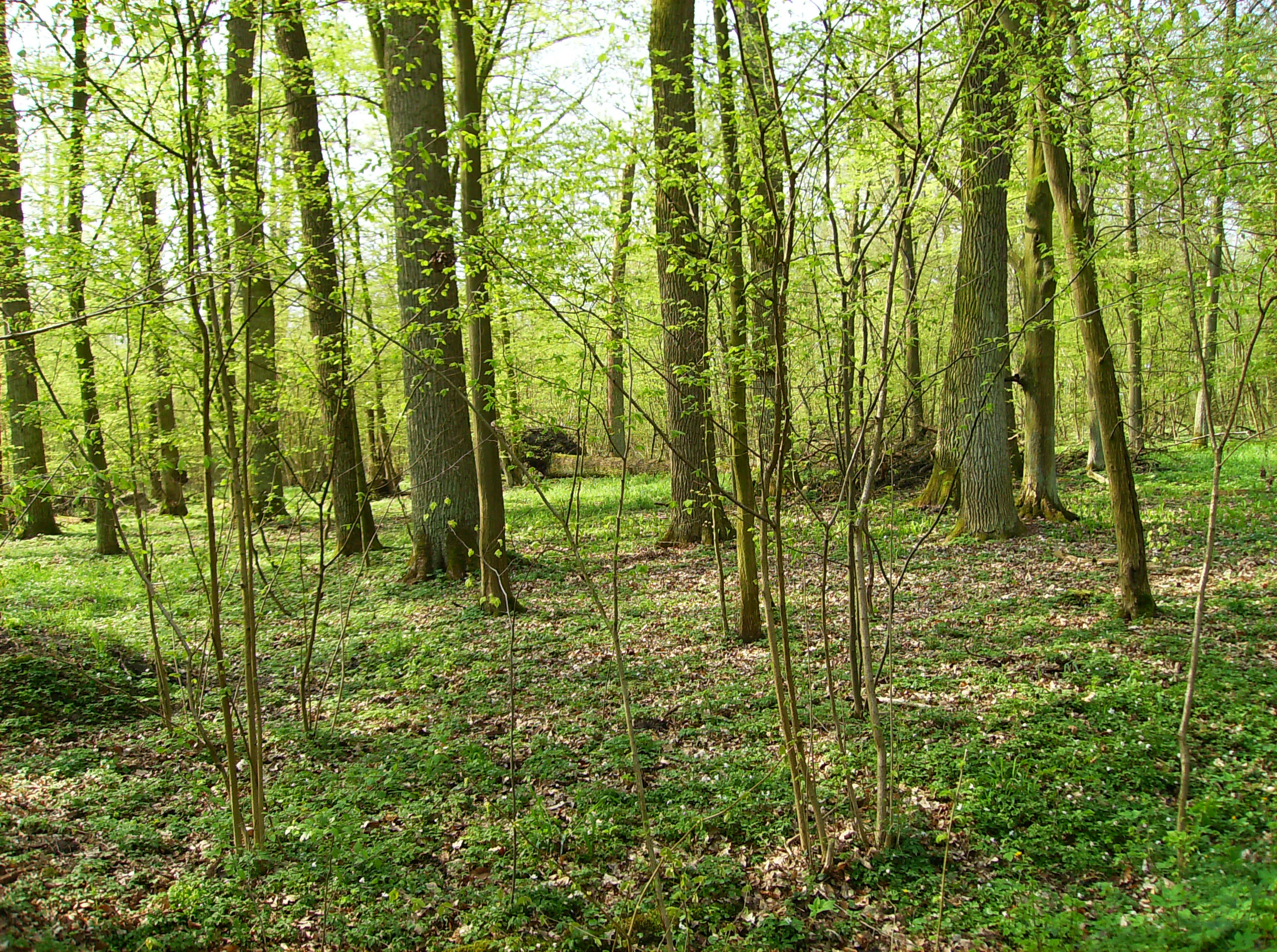
Within the reserve itself, the topography is gentle, but the visual character is strongly shaped by the age and scale of the trees. Massive oaks with broad crowns tower above a multi-layered canopy of hornbeam and other broadleaves, while the understorey and ground layer vary seasonally, producing distinct spring and summer aspects. The combination of a stable, dry substrate and centuries of uninterrupted forest cover has produced an unusually mature woodland landscape that contrasts sharply with the open agricultural fields surrounding the reserve.
Dębina Nature Reserve ecosystems, habitats, and plant life
Ecologically, Dębina is a textbook example of a Central European grąd, the natural oak-hornbeam forest that once dominated much of the lowland landscape but has been reduced to scattered fragments across most of Poland. About ninety percent of the reserve's surface is occupied by this forest type, while eleven other plant communities occupy the remaining ten percent. Among these, three are classified as natural forest communities, while the rest represent transitional or edge habitats. Anthropogenic plant communities are largely confined to the verges of forest tracks, leaving the interior of the reserve essentially free of disturbance-related vegetation.
The botanical richness of the reserve is striking for its size. Surveys have recorded 448 species of vascular plants, 55 species of bryophytes, 40 species of lichens, 233 species of fungi, and 68 species of algae. Spring brings a particularly visible display of flowering plants in the herb layer, including widespread woodland species such as lily of the valley that regularly dominate the forest floor. This level of diversity reflects both the age of the woodland and the continuity of natural processes that have not been disrupted by intensive forestry.
Particular scientific importance attaches to the reserve's fungal flora. Dębina is the only known site in Poland for the tiny field mushroom Agaricus minutulus, a rare species whose presence here makes the reserve an important reference locality for Polish mycology. The combination of diverse tree species, stable microclimate, and long-undisturbed soils has produced a fungal community of unusually high richness and conservation interest.
Dębina Nature Reserve wildlife and species highlights
The wildlife profile of Dębina is closely tied to its old-growth forest character. The reserve's most prominent faunal feature is its breeding colony of grey herons, whose presence was specifically cited among the reasons for the reserve's establishment in 1957 and continues to be a defining element of its ecological identity. The mature canopy of large oaks provides secure nesting sites, and the surrounding woodland, river terrace, and wider agricultural landscape supply feeding habitat for these birds.
Beyond the heronry, the continuity and structural complexity of the woodland support a broad community of forest-dwelling bird species typical of mature oak-hornbeam stands in the Polish lowlands. The dense, multilayered vegetation, rich understorey, and undisturbed leaf litter also sustain populations of small mammals, insects, and other invertebrates that depend on long-established forest conditions. Together, these animal communities contribute to the functioning of the reserve as a relatively intact fragment of the once widespread lowland forest ecosystem.
Dębina Nature Reserve conservation status and protection priorities
From a conservation perspective, Dębina is significant as one of the few surviving remnants of natural oak-hornbeam lowland forest in the Greater Poland region, an area otherwise dominated by agricultural land and production forestry. By protecting a stand of trees that in some cases are around three centuries old, along with the herb layer, microhabitats, and breeding birds that depend on them, the reserve preserves a reference example of what Wielkopolska forests were like before widespread human transformation.
The exceptionally high biodiversity recorded within a small area, including hundreds of vascular plant species, a rich bryophyte, lichen, and algal flora, and an outstanding fungal diversity, gives the reserve significant scientific and conservation value beyond its modest size. Its status as the only known Polish site for Agaricus minutulus further elevates its national importance. Successive protective orders issued in 1957, 2001, 2009, and 2018 reflect ongoing administrative commitment to maintaining the reserve's integrity, ensuring that this small but ecologically dense forest patch remains a functioning refugium within a heavily used lowland landscape.
Dębina Nature Reserve cultural meaning and human context
Dębina's cultural context is closely tied to the broader forest heritage of Wielkopolska, a region in which historical woodland cover has been substantially reduced over the centuries. The reserve takes its name from the Polish word for oak forest, 'dąb', reflecting the deep local association between oak woodlands and regional identity. While the site has no specific built heritage or indigenous cultural claims documented in this source, it stands as a recognised natural landmark within the Wągrowiec area and is referenced in regional botanical literature as an important natural feature of central Wielkopolska.
Top sights and standout views in Dębina Nature Reserve
The most compelling highlights of Dębina Nature Reserve centre on the age and richness of its oak-hornbeam forest. The presence of ninety-three oaks with trunk circumferences greater than three metres, set within stands that average around three hundred years old, gives the reserve an unusually monumental character for such a small protected area. The grąd community that dominates the site represents one of the best-preserved examples of natural Wielkopolska lowland forest.
Equally distinctive are the reserve's biological highlights, including a long-established grey heron breeding colony and an exceptional overall biodiversity count that spans hundreds of vascular plants, dozens of bryophytes and lichens, and more than two hundred recorded fungal species. The reserve's status as the only known Polish locality for the rare mushroom Agaricus minutulus adds a unique scientific dimension, while its accessibility near Wągrowiec makes it both a practical field site and a meaningful natural landmark in the region.
Best time to visit Dębina Nature Reserve
The most rewarding time to experience Dębina is during spring, when the herb layer of the oak-hornbeam forest comes into full display. Late April typically brings a flowering aspect dominated by woodland ground flora such as lily of the valley, producing the season's most photogenic and botanically interesting conditions within the reserve.
Late spring and early summer also offer the best opportunity to observe the woodland in full leaf, when the layered structure of the canopy, the broad crowns of ancient oaks, and the shaded interior are most apparent. Autumn can also be rewarding, particularly for visitors interested in fungi, given the reserve's nationally significant mycoflora. Visiting at quieter times of day can improve the chances of observing forest birds, including the grey herons whose colony is one of the reserve's defining features.