Why Kościół w Górkach Wielkich stands out
The site is best known as a protected bat roost: the attic of the historic church hosts significant summer colonies of the greater mouse-eared bat and the lesser horseshoe bat, giving a small religious building regional importance for European bat conservation.
Kościół w Górkach Wielkich history and protected-area timeline
The site takes its identity from a church whose origins go back to the 15th century, when a Gothic sanctuary was constructed on the foundations of an earlier chapel in Górki Wielkie. The building was remodeled in 1662 and again during the 19th century, accumulating later architectural features on top of its Gothic core.
During the period of the Marklowski family's patronage in 1779, the church was restored. The Marklowski connection also left a visible mark on the site: the tombstone of Erdman Marklowski, dated 1765, remains near the church. After the Second World War the building underwent a thorough renovation, and in 1980 the Morawiec brothers repainted the interior polychromy that visitors still see inside.
The site's modern legal history belongs to ecological conservation rather than religious or architectural history. Because bats roost in the church attic, the building and its immediate surroundings were entered into the Natura 2000 network as the habitat Special Area of Conservation 'Kościół w Górkach Wielkich' (PLH240008), shifting its protected status from purely cultural heritage to include formal nature protection.
Kościół w Górkach Wielkich landscape and geographic character
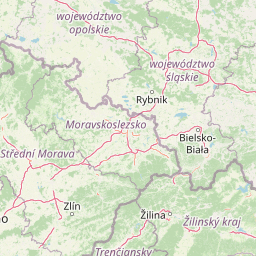
The protected zone is essentially a compact cultural and natural site rather than a wide landscape. It sits in the village of Górki Wielkie, on the right bank of the Brennica river, in the Brenna commune of Cieszyn Silesia. The terrain is shaped by the foothills of the Silesian Beskids, with the church and its small grounds forming a focal point within the river valley.
Adjacent to the church, on a low elevation known as Kępka Prochaskowa, lies the local Catholic cemetery, founded in 1858 and marked by a stone cross from 1900. Together, the church, the walled entrance with its memorial slabs, and the cemetery hill define the visual character of this small protected area.
Kościół w Górkach Wielkich ecosystems, habitats, and plant life
Ecologically, Kościół w Górkach Wielkich is a roost-centric habitat site rather than a broad landscape reserve. Its protected value centers on the warm, sheltered attic space offered by the church building, which provides suitable conditions for cave-dwelling bat species that depend on such structures as summer refuges.
The directly protected zone covers the church and its immediate surroundings, meaning the natural character of the site is intertwined with a built, human-maintained environment. Grassland and trees on the small hill of the cemetery and along the river valley contribute to the local habitat matrix, but the actual designation of PLH240008 rests on the breeding and resting conditions the church offers bats.
Kościół w Górkach Wielkich wildlife and species highlights
The wildlife profile of the site is narrowly but distinctly defined by bats. The church attic supports one of the most valuable bat assemblages in the region, including a summer colony of the greater mouse-eared bat, an August count of which numbered around 190 individuals. A second notable colony, of the lesser horseshoe bat, was estimated at about 75 individuals in the same period.
These two species are the principal reason the site was added to the Natura 2000 network. Their strong, recurring presence in the roof space of a small parish church gives the village-scale site a regional role in the conservation of European bat populations.
Kościół w Górkach Wielkich conservation status and protection priorities
The protected status of Kościół w Górkach Wielkich is rooted in the European Natura 2000 program. It is listed as a habitat Special Area of Conservation under the code PLH240008, with the designation tied directly to the bat fauna of the church attic. This puts the site within the same legal framework that protects many of Europe's most sensitive habitat fragments and obliges authorities to maintain favorable conditions for the species that triggered its listing.
Because the conservation target is a building rather than a large wilderness area, protection in practice means managing human activity around and within the church in ways that keep the bat colonies intact. The convergence of cultural heritage value and ecological protection makes this a small but representative example of Natura 2000 sites where a single historic structure anchors a meaningful conservation outcome.
Kościół w Górkach Wielkich cultural meaning and human context
The site has a layered human story. Its architectural forms combine late-Gothic structural elements with Baroque furnishings and later 19th-century additions, including a Baroque pulpit from the 18th century and a 19th-century main altar. A 17th-century baptismal font, originally donated by Jan Górecki, now functions as a holy water font in the church.
Memorial elements add further cultural depth. The walled entrance to the church grounds contains the tomb slab of Henryk Górecki, a village owner who died in 1682, and the nearby cemetery contains graves associated with Polish literary life. These include the writer Zofia Kossak and her family, as well as the folk writer Walenty Krząszcz, giving the site a regional cultural resonance that sits alongside its ecological designation.
Top sights and standout views in Kościół w Górkach Wielkich
The site's outstanding feature is the combination of a continuous 15th-century Gothic parish church with one of the most important bat roosts in Cieszyn Silesia, recognized at the European level through the Natura 2000 network. Its compact protected radius around the church and the adjacent 19th-century cemetery gives the site a tight, readable footprint on the landscape.