Why Małe Gołoborze Nature Reserve stands out
Małe Gołoborze is best known for its small but well-defined quartzite boulder field, a classic Świętokrzyskie gołoborze formed of Cambrian-era quartzite sandstone blocks resting on a forested ridge flank. The reserve showcases the tight interplay between geological heritage, in the form of Cambrian outcrops with hematite mineralization, and a surviving beech-fir woodland typical of the Holy Cross Mountains. The site is also recognized for the way its valley exposes ancient Cambrian bedrock within the floor of an otherwise heavily forested landscape, providing an unusually clear cross-section of the bedrock geology of the Pasmo Jeleniowskie. This combination of relict boulder slope, rock exposures, and mature native forest in a compact, easy-to-interpret area is what sets the reserve apart from many other small forest reserves in the region.
Małe Gołoborze Nature Reserve history and protected-area timeline
The reserve was designated at the close of 1993 and formally came into existence in 1994, by order of the Minister of Environmental Protection, Natural Resources, and Forestry. Its legal foundation is recorded in the Polish Journal of Laws (Monitor Polski) of 1994, and it carries the regional conservation registry number 049 issued by the regional nature conservation officer (Wojewódzki Konserwator Przyrody).
Its foundation was driven by a desire to protect the most scenic and geologically interesting fragment of the Pasmo Jeleniowskie, particularly the valley with Cambrian rock outcrops and the associated small quartzite boulder field. The founding area was listed in the establishment document as 20.44 hectares, but later measurements brought the official size to 21.58 hectares, reflecting more accurate modern surveying rather than any change in the reserve's boundaries.
Since then, the reserve has continued to operate as a partial reserve, meaning that nature protection is partial and access is permitted under defined conditions, and it has remained open to visitors in practice. Its location along a section of the Main Holy Cross Trail has helped maintain its visibility for hikers who pass through the Jeleniowskie Range.
Małe Gołoborze Nature Reserve landscape and geographic character
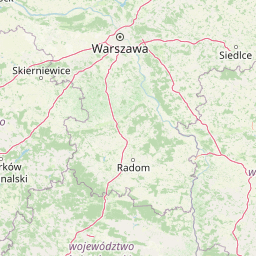
The landscape of Małe Gołoborze is shaped by the rolling, mid-elevation terrain typical of the Holy Cross Mountains, without dramatic peaks but with steady changes in elevation between ridges, slopes, and valley floors. The reserve spans the main ridge crest of the Pasmo Jeleniowskie, descends across its northern flanks, and reaches down into the upper part of a north-trending valley, giving the protected area a clear three-dimensional structure despite its small size.
The most visually distinctive element of the terrain is the small boulder field, or gołoborze, known from the reserve's name. It is composed of angular blocks of Cambrian quartzite sandstone, a rock type that weathers into large, flat slabs and chunky fragments. These blocks have collected on the slope in a pattern that, even at the reserve's modest scale of roughly 0.25 hectares, reproduces the classic boulder-strewn character of larger Świętokrzyskie gołoborza. The boulder field sits amid rather than above the surrounding woodland, gradually being enclosed by advancing forest.
In the valley floor that lies within the reserve, Cambrian bedrock reaches the surface in a series of natural outcrops. These exposures reveal ancient sedimentary rocks that are otherwise buried beneath soil and forest cover across most of the range, and they carry small mineralogical traces of hematite. The combination of ridge, slope, valley, exposed bedrock, and overgrown boulder field is what gives the reserve its concentrated landscape identity.
Małe Gołoborze Nature Reserve ecosystems, habitats, and plant life
Ecologically, Małe Gołoborze belongs firmly to the deciduous woodland zone of central Poland. The reserve's forests are dominated by beech, with a significant presence of fir and admixture of beech and fir that reflects climate and soil conditions of the ridge. The tree stand is described as being 50 to 130 years old, placing it in the mature-forest category that supports rich understory development.
The understory is well developed and species-rich. It includes beech, sycamore maple, fir, hornbeam, rowan, and hazel, forming a multi-layered shrub and small-tree layer. This dense understory has a clear tendency to gradually colonize the open spaces between the quartzite boulders, slowly reclaiming the boulder field and binding its rocky surface with soil and roots.
Among the more noteworthy plants, the reserve hosts several species that are protected or considered regionally rare in Poland. Documented species of conservation interest include denticulate barrenwort (żywiec gruczołowaty), broad-leaved male fern (nerecznica szerokolistna), wood loosestrife (tojeść gajowa), angular Solomon's seal (kokoryczka okółkowa), common wild ginger (kopytnik pospolity), and common ivy (bluszcz pospolity). Together these give the reserve a strong plant-conservation value well beyond its size.
Małe Gołoborze Nature Reserve wildlife and species highlights
The available source material does not document specific animal species, breeding populations, or notable fauna occurrences within Małe Gołoborze. As a mature beech-fir forest with a dense understory and an unusually rocky substrate, the reserve offers a structurally rich habitat typical of the Świętokrzyskie forests, which would be expected to support a range of woodland birds, small mammals, and invertebrates characteristic of old-growth deciduous and mixed forests in central Poland.
Because detailed wildlife descriptions are not part of the documented source, this section is left light to avoid attributing specific species records to the reserve that are not clearly supported.
Małe Gołoborze Nature Reserve conservation status and protection priorities
The conservation value of Małe Gołoborze is rooted in the way it concentrates several important natural features in a very small area: a representative fragment of the Jeleniowskie Range's main ridge and northern slopes; a small, partially overgrown Cambrian quartzite boulder field; exposed Cambrian rock with traces of hematite mineralization; and a mature, beech-dominated forest with a notable fir component.
Its designation as a partial reserve (rezerwat częściowy) reflects a balanced management approach: protection of the underlying natural systems is paramount, while controlled public access remains possible. Its position inside the broader Jeleniowskie Landscape Park further embeds it in a wider regional conservation network, where it serves as a small but representative protected node supporting both habitat and geological conservation in the Holy Cross Mountains.
Top sights and standout views in Małe Gołoborze Nature Reserve
Małe Gołoborze's standout qualities include its compact Cambrian quartzite boulder field, the rare surface exposures of Cambrian bedrock with hematite traces in the valley floor, and the well-preserved beech-fir forest that surrounds both. The reserve is also notable for sitting directly along a section of the Main Holy Cross Trail named after Edmund Massalski, which links Gołoszyce with Kuźniaki, allowing the reserve to function both as a protected natural site and as a meaningful stop for hikers exploring the Pasmo Jeleniowskie.
Best time to visit Małe Gołoborze Nature Reserve
As a forested reserve with a boulder field and rock outcrops, Małe Gołoborze is best appreciated when the ground is firm, the foliage is not fully leafed out, and the boulders are easy to see. Late spring through early autumn offers pleasant conditions for walking the main ridge and the valley, while autumn adds the visual interest of beech and mixed-deciduous coloration across the reserve. Winter can also be a rewarding time for visitors equipped for snow and cold, when the open spaces between the quartzite blocks stand out clearly against the bare forest.