
Why Mittelberg bei Hofgeismar stands out
Mittelberg bei Hofgeismar is best known for its exceptionally rich calcareous dry grassland (Kalkmagerrasen) flora on a sun-exposed slope, including ten recorded orchid species and a large population of the rare Einknollige Honigorchis. It is also valued for the botanical rarity Lothringer Lein, and for hosting a dense community of grasshoppers, butterflies (with many Red List species), and breeding dry-grassland birds such as the Neuntöter and Braunkehlchen. In the regional context of northern Hesse, the reserve is a textbook example of a small but ecologically significant dry grassland hotspot embedded in an otherwise agricultural landscape, and it stands out as one of the most important sites of its type in the Kassel area.
Mittelberg bei Hofgeismar history and protected-area timeline
The Mittelberg bei Hofgeismar site has a long prior history as open, grazed calcareous grassland typical of the limestone slopes around Hofgeismar, where traditional low-intensity livestock use maintained open swards and prevented forest encroachment. The area's ecological value was recognized formally when it was designated as a Hessian Naturschutzgebiet on 3 December 1991, under site number 1633028, formally anchoring its protection within the regional nature conservation framework.
After its designation, the site was subsequently incorporated into the European Natura 2000 network as an FFH (Habitats Directive) area, with site code 4522-301, highlighting the importance of its calcareous grassland habitats at the European level. In parallel with this international recognition, the Regierungspräsidium Kassel commissioned a comprehensive baseline habitat survey (Grunddatenerfassung) in March 2005, followed by a formal management plan (Maßnahmenplan) in January 2011. Together, these documents established the current approach to managing the grassland, controlling scrub encroachment, and protecting the site's most sensitive orchids and other rare plant and animal species. A short section of the slope also preserves visible traces of a former small quarry, whose exposed, calcareous ground provides habitat for pioneer plant communities and adds to the reserve's habitat diversity.
Mittelberg bei Hofgeismar landscape and geographic character
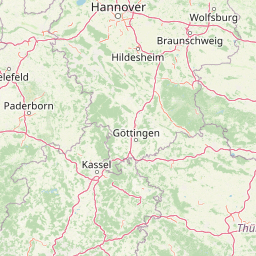
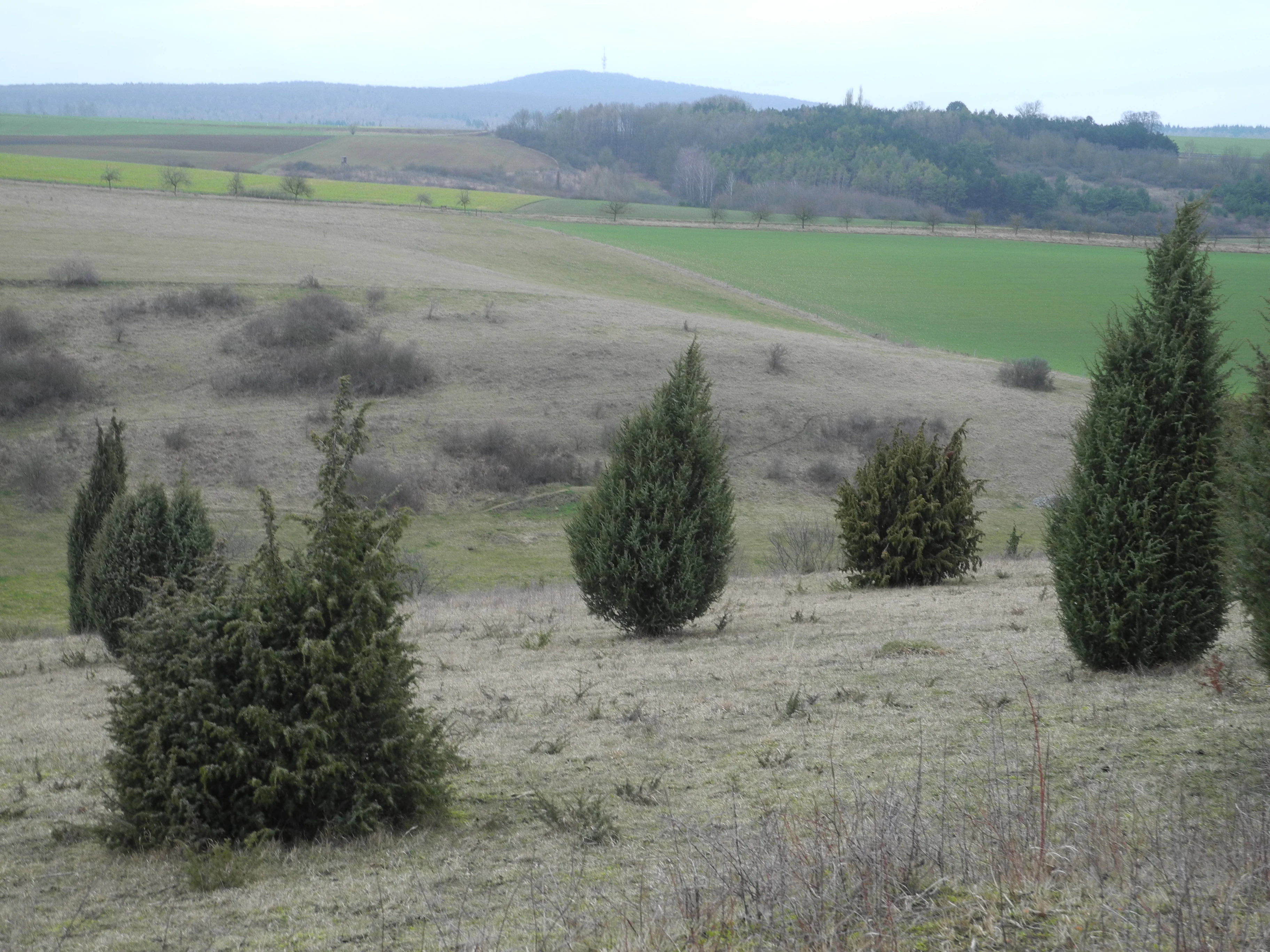
The Mittelberg bei Hofgeismar reserve occupies a sloping hillside on the western edge of Hofgeismar, oriented in such a way that it receives strong sunlight, a key factor in its dry, warm microclimate. The terrain is varied but never large-scale: gentle to moderately steep slopes give way to small flat ledges and exposed patches, where thin, lime-rich soils overlie the underlying calcareous substrate. The result is a mosaic of short, herb-rich swards, scattered low shrubs, and occasional woody patches, with some parts transitioning into light scrubland.
A particularly distinctive landscape feature is a small area of former quarry ground, where disturbance and extremely thin soils have produced open pioneer communities with bare, stony patches and a very different plant assemblage from the surrounding closed grassland. This micro-landscape adds structural diversity to an otherwise continuous slope habitat and supports a separate set of specialist plants, including several therophytes and low-growing chamaephytes typical of open calcareous ground.
Although the reserve itself is only about 43 hectares, its landscape setting is striking: two parcels of open, sunny, flower-rich slope almost completely surrounded by closed, level agricultural land. This sharp visual and ecological boundary, between intensively used fields and a richly structured dry grassland, is a hallmark of the Mittelberg experience and explains why such a small site punches far above its weight in regional conservation importance.
Mittelberg bei Hofgeismar ecosystems, habitats, and plant life
Ecologically, Mittelberg bei Hofgeismar is a textbook example of central European calcareous dry grassland, with two main habitat types recognized under the EU Habitats Directive. The larger part of the reserve is dominated by sub-Mediterranean semi-dry grassland (LRT 6212), characterized by a herb-rich turf of grasses and flowering herbs with strong affinities to warmer, more southerly European plant communities. On the slope and especially in the former quarry area, smaller patches of pioneer calcareous grassland (LRT 6110) occur, with very open vegetation, abundant lichens, mosses, and low-growing pioneer plants that exploit the shallow, stony soils.
Between these open habitats are scattered shrubs and small woody patches, some of which represent natural or successional transitions toward woodland, while others have developed as a result of reduced grazing pressure. This varied structural mosaic is essential for many of the species the reserve protects; open grassland specialists depend on the short turf, while peripheral shrubs and woody edges provide nesting sites, song posts, and shelter for birds and insects.
An important feature of the site's ecology is the persistence of warm-loving plant communities far to the north of their main distribution range. Species such as Deutscher Fransenenzian, Gewöhnlicher Fransenenzian, Sumpfherzblatt, Echte Schlüsselblume, and others are remnants of past warmer periods and of traditional land use, and today the reserve is one of their northern strongholds in Hesse. The combination of thin calcareous soils, slope orientation, and traditional land management history is what allows this unusual assemblage to survive in an otherwise agricultural-dominated region.
Mittelberg bei Hofgeismar wildlife and species highlights
The dry, warm conditions and the structural diversity of the slope at Mittelberg support an unusually rich fauna for a site of this size. The reserve is home to a community of grasshoppers and butterflies that is strongly tied to calcareous grassland, including 29 species of day-flying butterflies (Tagfalter) and four species of burnet moths (Widderchen). Several of these are Red List species, including butterflies such as the Kleiner Sonnenröschen-Bläuling, Zwerg-Bläuling, Silbergrüner Bläuling, Quendel-Ameisenbläuling, Kleiner Würfel-Dickkopffalter, Mattscheckiger Braun-Dickkopffalter, Weißbindiges Wiesenvögelchen, and Schwalbenschwanz, along with burnet moths including the Esparsetten-Widderchen and Thymian-Widderchen.
The birdlife reflects the open, dry-grassland character of the site. Typical breeding or regularly occurring species include Wachtel (quail), Kuckuck (cuckoo), Neuntöter (red-backed shrike), Braunkehlchen (whinchat), Dorngrasmücke (Dartford warbler-like whitethroat relative), and Feldlerche (skylark). Red and Black Kites (Rotmilan and Schwarzmilan) use the area as a feeding habitat, and the Wiesenweihe (Montagu's harrier) has been observed there during certain periods, indicating the site's value as a foraging area for open-country raptors.
Reptiles are also part of the site's fauna, with the Zauneidechse (sand lizard) being a characteristic species of the warm, stony slope. The combination of dense butterfly populations, specialized grassland birds, and reptiles such as the sand lizard emphasizes the role of Mittelberg as an invertebrate-rich, warm-slope refuge in an otherwise intensively farmed landscape.
Mittelberg bei Hofgeismar conservation status and protection priorities
The primary conservation significance of Mittelberg bei Hofgeismar lies in the protection of two priority calcareous grassland habitat types under the EU Habitats Directive, 6212 sub-Mediterranean semi-dry grassland and 6110 pioneer calcareous grassland, both of which are rare and declining across central Europe. The site's formal status as a Hessian Naturschutzgebiet, established in 1991, is reinforced by its inclusion in the European Natura 2000 network as FFH site 4522-301, which brings both additional obligations and additional support for habitat management.
Conservation management here is focused on preserving open grassland conditions against encroachment by shrubs and trees, retaining the warm microclimate that supports the orchid-rich flora, and monitoring the population viability of key rare species. A formal baseline survey (Grunddatenerfassung) was completed in 2005, and a management plan (Maßnahmenplan) was adopted in 2011, both prepared by the Regierungspräsidium Kassel, providing a long-term framework for grazing, scrub control, and species monitoring.
Beyond its own footprint, the reserve plays an outsized role for the surrounding agricultural landscape, acting as a population source for many calcareous grassland species that would otherwise not survive in such an intensively farmed setting. The unusually high density of orchid species and the presence of large populations of strongly declining plants such as the Einknollige Honigorchis and the Gewöhnliches Katzenpfötchen mean the site's protection is of statewide relevance for the conservation of dry grassland biodiversity in Hesse.
Mittelberg bei Hofgeismar cultural meaning and human context
Mittelberg bei Hofgeismar sits in a landscape with deep historical roots of pastoral and agricultural use, on the western edge of Hofgeismar, a long-established small town in northern Hesse. The dry, sun-exposed slopes around Hofgeismar have likely been grazed for centuries, and the persistence of species-rich calcareous grassland here is itself a reflection of that long cultural interaction: open, short-turf habitats maintained by low-intensity grazing, mowing, and the deliberate clearance of woody plants that would otherwise colonize the slope.
The presence of a former small quarry within the reserve, mentioned in the baseline habitat survey, also speaks to small-scale historical use of the underlying limestone, which for a long time served local building and lime-burning needs. After the quarry's abandonment, the disturbed ground was gradually colonized by a unique set of pioneer plants and lichens, so that an old economic feature of the landscape has become, in effect, a secondary conservation asset.
In the broader regional context, Mittelberg is one of several protected calcareous grassland and FFH sites (such as Siechenberg bei Liebenau, Festberg bei Philippinenthal, and Stahlberg und Hölleberg bei Deisel) that form a vital network of semi-natural habitats inherited from centuries of traditional land management in the Kassel district. The very fact that such a small, slope-bound reserve carries so much ecological weight is intimately linked to the cultural history of low-intensity farming in this part of Hesse.
Top sights and standout views in Mittelberg bei Hofgeismar
A 43-hectare calcareous grassland reserve west of Hofgeismar, established in 1991 and now part of the Natura 2000 network, protecting slope and former-quarry habitats of the Reinhardswald area. Highest-profile features include ten recorded orchid species, an unusually dense Hessian population of Einknollige Honigorchis, the regional significance of the Lothringer Lein, and a thriving community of Red List butterflies of dry grassland.
Best time to visit Mittelberg bei Hofgeismar
Although the reserve is small and ecologically rather than recreationally oriented, the broad seasonal pattern follows that of central European calcareous dry grasslands: late spring and early summer bring the main orchid flowering period and the richest display of herb-rich grassland vegetation, while high summer (June to July) is typically the best time to observe butterflies, burnet moths, and other grassland insects at peak activity. Early mornings and warm, sunny days are by far the most rewarding for wildlife observation, given that many of the key species are sensitive to wind and cool weather. Late visits in autumn may still offer mild conditions and the chance to observe grasshopper assemblages and late-flying butterflies, while visits in winter are less rewarding for nature observation but can still illustrate the contrast between the open slope and surrounding agricultural land.