Why Modrzewina Nature Reserve stands out
Modrzewina is best known for sheltering the northernmost natural stand of the Polish larch (modrzew polski) on the Rawska Plateau. The trees grow to roughly 40 meters tall with breast-height diameters up to 120 cm, an unusually large stature for larch stands at this latitude. The reserve's significance lies as much in the rarity of this isolated subspecies population as in the size and age structure of the mature trees themselves. The reserve is also notable as a historical woodland that survived multiple ownership regimes: a private noble estate site, a pre-war conservation effort, wartime protection under the German occupation, and formal state-level protection after 1959.
Modrzewina Nature Reserve history and protected-area timeline
The forest at Modrzewina has been recognized as a special place for centuries. Historical records indicate that King Stanisław August Poniatowski visited the site on 21 July 1787 and admired the larches that grew there. The woodland remained part of the broader estate landscape of Mała Wieś, and its silvicultural value made it a focal point of local land management long before formal conservation legislation existed.
The first formal protection of the grove came in 1927, when the site was placed under protection as a small private reserve covering 7.44 hectares across forest sections 15a, b, and c. This early protection, granted with the consent of the landowners, marks Modrzewina as one of the older documented private conservation efforts in central Poland. During World War II, the same protectionist instinct continued even under very different governance: the occupying authorities recognized the significance of the larch stand for what they referred to as the Reich and shielded the trees from felling, while after the war it was confirmed that the protected area had been successfully preserved against wartime exploitation. By the end of the conflict, the protected area had been expanded to about 67 hectares.
After the war, the Polish state formalized what the site had enjoyed informally for decades. The modern Rezerwat przyrody Modrzewina was created on 5 May 1959 by Order No. 157 of the Minister of Forestry and the Wood Industry, covering 336.15 hectares. Subsequent boundary adjustments, including those issued by the Voivode of Mazowieckie in December 2001 and June 2005, refined the reserve to its current size of 332.15 hectares. The reserve is administered by the Regional Directorate of State Forests in Radom through the Grójec Forest District.
Modrzewina Nature Reserve landscape and geographic character
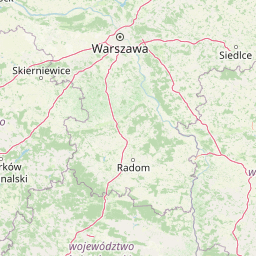
Modrzewina occupies part of the Wysoczyzna Rawska, a flat to gently undulating morainic plateau typical of central Poland. The terrain is shaped by Pleistocene glacial activity, producing broad uplands with relatively modest local relief and a substrate of postglacial deposits favorable to mixed lowland forest. Within this setting, the reserve presents a coherent forested block where gently rolling ground is clothed almost entirely by mature woodland.
The plateau's broader context is one of agricultural and forest mosaics, with arable land, small villages, and patches of managed forest surrounding the protected area. Because the Wysoczyzna Rawska is one of the warmer and drier plateaus of the region, it supports vegetation with continental tendencies, a setting that helps explain why the Polish larch can flourish here even at the northern edge of its natural range. The scattered character of the woodland stand, combined with the quiet rural setting, gives the reserve a distinctly secluded and traditional central Polish countryside atmosphere.
Modrzewina Nature Reserve ecosystems, habitats, and plant life
The ecological character of Modrzewina is defined by a single but exceptional dominant element: the Polish larch (modrzew polski), a regional subspecies of the European larch. Larch is unusual among Polish native conifers because it is deciduous, dropping its needles in autumn. The Modrzewina stand is significant because it represents a natural population rather than a planted one, meaning the trees have regenerated in place and adapted to the local substrate and climate over many generations.
The soils and microclimate of the Wysoczyzna Rawska allow the larches to grow exceptionally well at the northern edge of their ecological range. Mature individuals reach heights of about 40 meters and chest-height diameters of up to 120 cm, dimensions that are at the upper end for lowland larch in central Europe. The forest community associated with these trees includes other species typical of central European mixed and coniferous forests, consistent with the reserve's placement within the Grójec Forest District. The combination of rarity, natural regeneration, and silvicultural maturity is what makes the reserve scientifically significant in ecological terms.
Modrzewina Nature Reserve wildlife and species highlights
The source material does not describe the fauna of the reserve in any specific way. Modrzewina is described primarily as a forest reserve valued for its botanical content, particularly the Polish larch population. Any broader faunal profile would be speculative and is therefore omitted rather than fabricated.
Modrzewina Nature Reserve conservation status and protection priorities
The conservation significance of Modrzewina rests on a single but unusually valuable feature: the northernmost natural stand of the Polish larch within its geographical range. Because this subspecies has a naturally limited distribution in Poland, any preservation site for it carries exceptional scientific and ecological importance. The reserve serves as a reference point for studying how the subspecies grows and reproduces at the climatic margins of its range.
The protection history itself is striking and unusual. From early private conservation in 1927, through wartime protection that ironically saved the trees from wartime depletion, to formal state-level protection from 1959 onward, the reserve has benefited from a continuity of conservation attention exceeding a century. Its status within the state forest network, managed by the Grójec Forest District under the Radom Regional Directorate of State Forests, places it within Poland's overall protected-area framework for forests of recognized scientific value.
Modrzewina Nature Reserve cultural meaning and human context
Modrzewina has long been embedded in the cultural identity of the Mała Wieś estate landscape in Gmina Belsk Duży. The reference to King Stanisław August Poniatowski's visit in 1787 places the woodland firmly within the late-Enlightenment tradition of Polish royal interest in exemplary natural monuments, an era when unusual or stately trees were visited and recorded as part of noble estate tours.
The fact that early private protection began in 1927 shows how the site was also a focal point for interwar Polish nature conservation in private rural settings, before fully state-led conservation became standard. The reserve today retains the quiet cultural backdrop of a historically significant central Polish woodland tied to a manor estate landscape and its evolution across multiple political periods.
Top sights and standout views in Modrzewina Nature Reserve
Standout qualities of Modrzewina include its status as the northernmost natural site of the Polish larch on the Wysoczyzna Rawska; the impressive stature of the mature trees, reaching around 40 meters in height and 120 cm in diameter; the unusual continuity of conservation attention spanning nearly 150 years from the 1787 royal visit through wartime protection to modern state-level designation; and the reserve's placement in a secluded rural setting on the gentle morainic plateau south of Warsaw.
Best time to visit Modrzewina Nature Reserve
The source material does not provide direct seasonal guidance for visiting Modrzewina. As a deciduous larch forest, however, it is reasonable to expect that spring and summer bring full needle cover, while autumn provides the unusual visual experience of a conifer stand turning yellow and shedding needles, a distinctive seasonal transformation that larch forests offer compared to evergreen forests. Late autumn into winter exposes the bare structure of large mature trunks. Detailed seasonal access conditions and visitor logistics are not documented in the available source.