Why Dęby Biesiadne Nature Reserve (Mariana Pulkowskiego) stands out
The reserve is especially known for preserving one of the older oak-dominated forest fragments in the Mazovian lowlands, anchored by a 220-year-old oak old-growth stand. It is valued as a textbook example of natural Tilio-Carpinetum typicum forest, the classic oak-hornbeam community that once covered much of Poland's fertile lowlands and is now largely replaced by managed woodlands.
Dęby Biesiadne Nature Reserve (Mariana Pulkowskiego) history and protected-area timeline
Before its formal designation, the forest that now forms Dęby Biesiadne was managed as part of the Studzianki forest district of the Dobieszyn Forest Administration within the Polish state forest system. The oldest oaks in the stand had already been growing for around two centuries by the time protection was granted, indicating that the area had long been left in a relatively undisturbed state, even though it was part of an actively managed forest landscape.
The reserve was formally created on 8 August 2006, through Regulation No. 19 of the Wojewoda Mazowiecki (the Masovian Voivodeship Governor). This act placed the area under the Polish nature reserve regime, with the explicit conservation goal of preserving the natural oak-hornbeam forest (Tilio-Carpinetum typicum) typical of the Polish lowlands. The dedication of the reserve to Marian Pulkowski reflects the importance Polish forestry tradition attaches to recognizing individuals who contributed to forest knowledge and protection, while the reserve's creation itself is part of a broader national effort to safeguard surviving fragments of old-growth and near-natural lowland woodland.
Dęby Biesiadne Nature Reserve (Mariana Pulkowskiego) landscape and geographic character
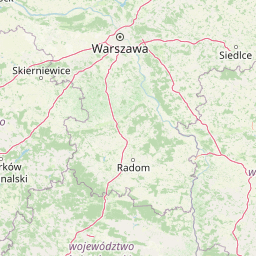
The reserve occupies a gently undulating lowland setting in the western part of the Mazovian Voivodeship, between Kozienice County and the wider Vistula river system that gives the region its characteristic flat-to-rolling terrain. There are no dramatic landforms; instead the land is shaped by subtle glacial and post-glacial processes typical of central Polish plains, producing a mostly level to slightly ridged terrain with local moist depressions where groundwater reaches the surface.
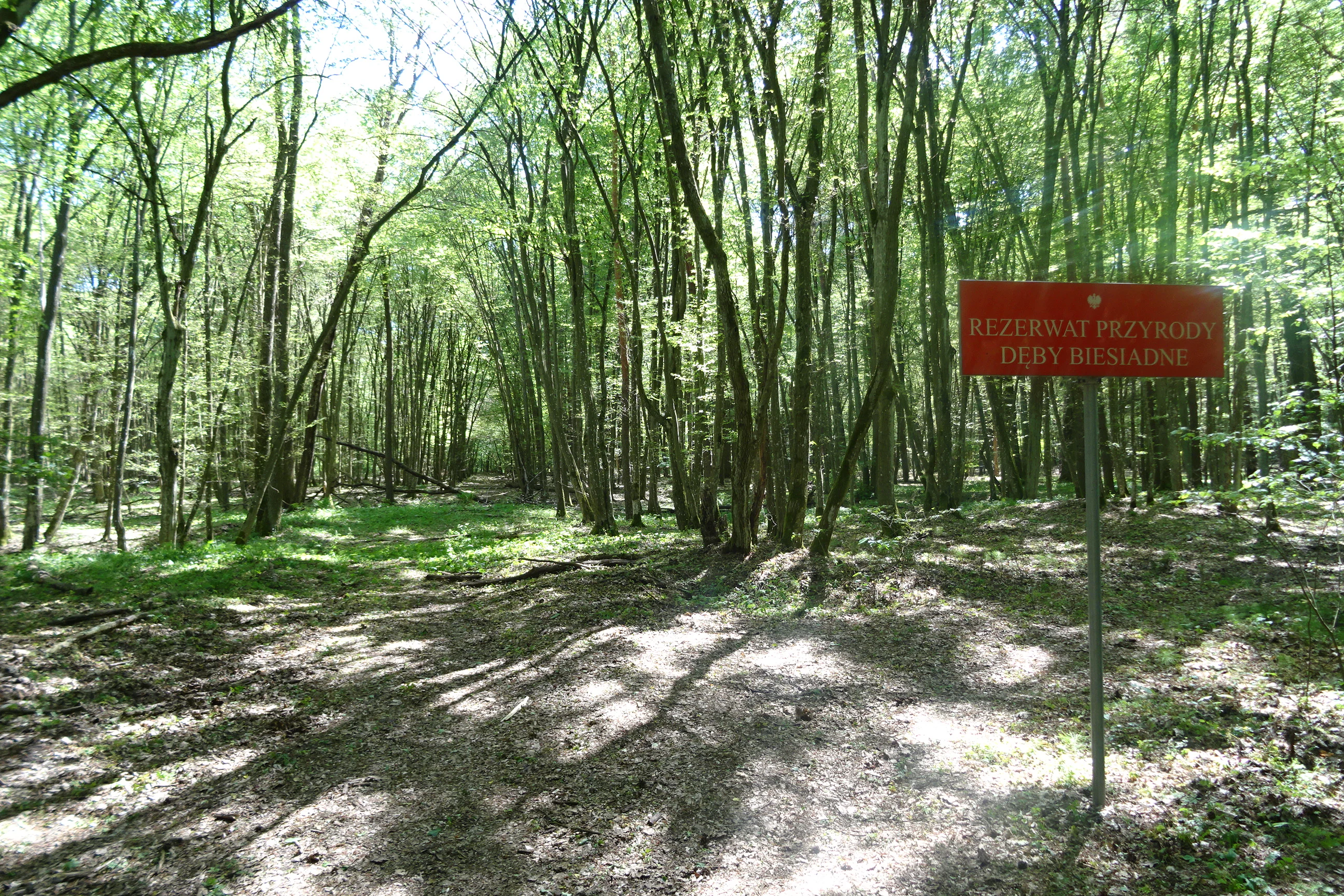
Visually, the landscape is defined almost entirely by the closed forest canopy. The dominant fresh deciduous forest habitat, locally referred to as las świeży, gives the reserve a dense, shady interior with a layered structure of mature trees, mid-canopy hornbeam, and a thick herb layer in spring. Where riparian oak-elm communities take over near small watercourses or wetter depressions, the forest takes on a softer, more moisture-rich character, reinforcing the impression of a continuous, well-structured lowland forest landscape.
Dęby Biesiadne Nature Reserve (Mariana Pulkowskiego) ecosystems, habitats, and plant life
The reserve is built around the oak-hornbeam forest community Tilio-Carpinetum typicum, a forest type once widespread across fertile Polish lowlands but now largely replaced by managed woodlands or plantations. This community is characterized by a tall overstory of pedunculate oak with a substantial admixture of hornbeam, a rich shrub layer, and a diverse herb layer that flowers strongly in early spring before the canopy closes.
Alongside the central oak-hornbeam stands, the reserve contains transitions to ług-type communities, which are floodplain-associated oak-elm forests occupying the slightly wetter parts of the site. Together these communities form a coherent mosaic of upland and lowland deciduous forest, anchored ecologically by the fresh forest habitat type (las świeży). Because the stand contains trees over two centuries old, it also preserves ecological features typical of old-growth woodland, including veteran oaks with cavities and deadwood niches, which in turn support a richer associated flora and fauna than typical managed forest.
Dęby Biesiadne Nature Reserve (Mariana Pulkowskiego) wildlife and species highlights
The 220-year-old oak stand is the reserve's most important wildlife asset, because veteran oaks provide feeding, nesting, and shelter habitat for a wide range of forest species. Cavities in old trunks and branches are used by hole-nesting birds, bats, and small arboreal mammals, while the abundance of dead and partially decaying wood supports insects, fungi, and the wider detrital food web that is rare in intensively managed forest estates.
The mixed oak-hornbeam and oak-elm forest mosaic supports typical lowland forest fauna, including common woodland birds, small mammals associated with mature broadleaf forest, and invertebrates tied to veteran trees and the spring herb layer. While the reserve's small size limits the occurrence of large mammal populations, its biological continuity with surrounding forest landscapes allows species to move through the area as part of broader forest communities.
Dęby Biesiadne Nature Reserve (Mariana Pulkowskiego) conservation status and protection priorities
From a conservation standpoint, Dęby Biesiadne is valued chiefly as a surviving example of natural lowland oak-hornbeam forest at a time when most of Europe's lowland broadleaf forests have been converted to plantations or agriculture. By protecting old oaks, hornbeam, and associated community types on a single compact site, the reserve acts as a reference point for the structure, species composition, and natural processes of forests that once dominated the Polish lowlands.
Its designation also contributes to in-situ preservation of genetic resources in veteran oaks, which is important for maintaining locally adapted tree genotypes as climate and land use change. Combined with its location within the state-managed Dobieszyn Forest Administration, the reserve forms part of the broader Masovian network of protected forest sites aimed at retaining biodiversity, supporting research, and maintaining examples of natural forest development in an otherwise heavily managed landscape.
Dęby Biesiadne Nature Reserve (Mariana Pulkowskiego) cultural meaning and human context
The reserve's dedication to Marian Pulkowski reflects a longstanding Polish forestry tradition of honoring foresters, scientists, and advocates who contributed to forest knowledge and protection. The Pulkowski dedication gives the site a distinctly local, people-centered dimension that complements its ecological purpose.
Independently, the name Dęby Biesiadne ties into a wider Polish cultural reverence for old oaks, which appear in folklore, regional literature, and the identity of forest communities across the country. Although the reserve itself is small, the symbolism of protecting named "Biesiadne Oaks" makes the site a meaningful expression of the Polish relationship between rural communities, forestry tradition, and the natural heritage of the lowland landscape.
Top sights and standout views in Dęby Biesiadne Nature Reserve (Mariana Pulkowskiego)
A 220-year-old oak old-growth stand with abundant hornbeam forms the heart of this reserve, surrounded by a coherent mosaic of upland oak-hornbeam and oak-elm forest communities. It is one of the more faithful surviving examples of the natural lowland forests that once characterized the Polish Mazovia region.
Its compact 17 hectare footprint makes the reserve an unusually concentrated reference site: every component, from the veteran oaks to the fresh forest habitat type and the riparian transitions, fits within a short walk, while the formal protection dating from 2006 gives it a clear legal identity within the Polish national reserve system.
Best time to visit Dęby Biesiadne Nature Reserve (Mariana Pulkowskiego)
Spring is generally the most rewarding season to experience the reserve's characteristic forest character, when the herb layer of the oak-hornbeam forest blooms beneath the still-bare canopy, and the structure and variation of the woodland are easiest to observe. Early summer brings a dense, leafy canopy that emphasizes the fresh, sheltered character of the forest and is favorable for listening to birdlife and enjoying the cool woodland interior.
Late autumn and winter, when deciduous oaks and hornbeam have shed their leaves, offer the best conditions for appreciating the reserve's old oaks: the dramatic trunks and crown architecture of the 220-year-old veterans become fully visible, and the mosaic between oak-hornbeam and riparian forest communities is easier to read on the ground. These wide seasonal contrasts are part of what makes a lowland oak reserve like Dęby Biesiadne meaningful to visit at different times of year.