

Mori Atlas logo
Nature reserveRezerwat przyrody Dęby Biesiadne im. Mariana Pulkowskiego

Geographic atlas of a preserved old-growth oak landscape in the Mazovia Voivodeship, Poland

Rezerwat przyrody Dęby Biesiadne im. Mariana Pulkowskiego: Protected Lowland Oak-Hornbeam Forests

Rezerwat przyrody Dęby Biesiadne im. Mariana Pulkowskiego functions as a vital representative stand of natural Tilio-Carpinetum typicum forest within the Polish lowlands. Located in Kozienice County, this protected area features a 220-year-old oak old-growth core surrounded by riparian and upland deciduous habitats. The reserve provides a concentrated reference site for understanding the forest structures that once characterized the wider Mazovia region.

oak-hornbeam forestlowland forestold-growth oaksforest reserveMazovian VoivodeshipKozienice County

Rezerwat przyrody Dęby Biesiadne im. Mariana Pulkowskiego

Nature reserve

Park overview

Structured park overview, official facts, and landscape profile for Dęby Biesiadne Nature Reserve (Mariana Pulkowskiego)

Dęby Biesiadne Nature Reserve (Mariana Pulkowskiego) park facts, protected area profile, and essential visitor context

Review the core facts for Dęby Biesiadne Nature Reserve (Mariana Pulkowskiego), including designation, size, terrain, visitor scale, habitats, and operating context in one park-focused overview.

About Dęby Biesiadne Nature Reserve (Mariana Pulkowskiego)

Dęby Biesiadne is a compact protected woodland in central-eastern Poland, located in the Mazovian Voivodeship and administered through the Studzianki forest district of the Dobieszyn Forest Administration. Although it covers only a little over seventeen hectares, the reserve carries outsized botanical and ecological significance because it preserves a particularly well-developed example of the oak-hornbeam lowland forest that historically defined much of this part of Poland.

The reserve was officially established on 8 August 2006 through Regulation No. 19 of the Masovian Voivodeship Governor, giving it formal protection under Polish nature reserve law. Its name honors Marian Pulkowski, a forester remembered in the local forestry community, while Dęby Biesiadne itself evokes the celebrated "Biesiadne Oaks," a name that has long resonated in Polish forestry folklore and that connects the site to broader traditions of protecting old oak trees across the country.

Ecologically, the site stands out for the presence of a 220-year-old oak old-growth stand, in which mature oaks strongly dominate and hornbeam forms a substantial secondary component. The surrounding forest mosaic includes both upland oak-hornbeam communities (grądy) and patches of riverside oak-elm forest (łęgi), with the dominant habitat classified as fresh mixed deciduous forest. Together these features give the reserve the feel of a lowland forest landscape that closely resembles the natural vegetation potential of the region, and they make it an unusually rich reference site for understanding the structure and species composition of historical Mazovian forests.

Quick facts and research context for Dęby Biesiadne Nature Reserve (Mariana Pulkowskiego)

Dęby Biesiadne Nature Reserve is a forest reserve (rezerwat leśny) covering about 17.20 ha in Mazowieckie Voivodeship, in Kozienice County within Głowaczów commune. It lies within the Studzianki forest district of the Dobieszyn Forest Administration. The reserve was created by Regulation No. 19 of the Masovian Voivodeship Governor, issued on 8 August 2006. Its core feature is a 220-year-old oak old-growth stand with hornbeam, within a broader matrix of oak-hornbeam and ripian oak-elm forest communities.

Park context

Deeper park guide and search-rich context for Dęby Biesiadne Nature Reserve (Mariana Pulkowskiego)

Dęby Biesiadne Nature Reserve (Mariana Pulkowskiego) history, landscape, wildlife, and travel context

Explore Dęby Biesiadne Nature Reserve (Mariana Pulkowskiego) through its history, landscape character, ecosystems, wildlife, conservation priorities, cultural context, and seasonal travel timing in a structured park guide built for atlas discovery and search intent.

Why Dęby Biesiadne Nature Reserve (Mariana Pulkowskiego) stands out

The reserve is especially known for preserving one of the older oak-dominated forest fragments in the Mazovian lowlands, anchored by a 220-year-old oak old-growth stand. It is valued as a textbook example of natural Tilio-Carpinetum typicum forest, the classic oak-hornbeam community that once covered much of Poland's fertile lowlands and is now largely replaced by managed woodlands.
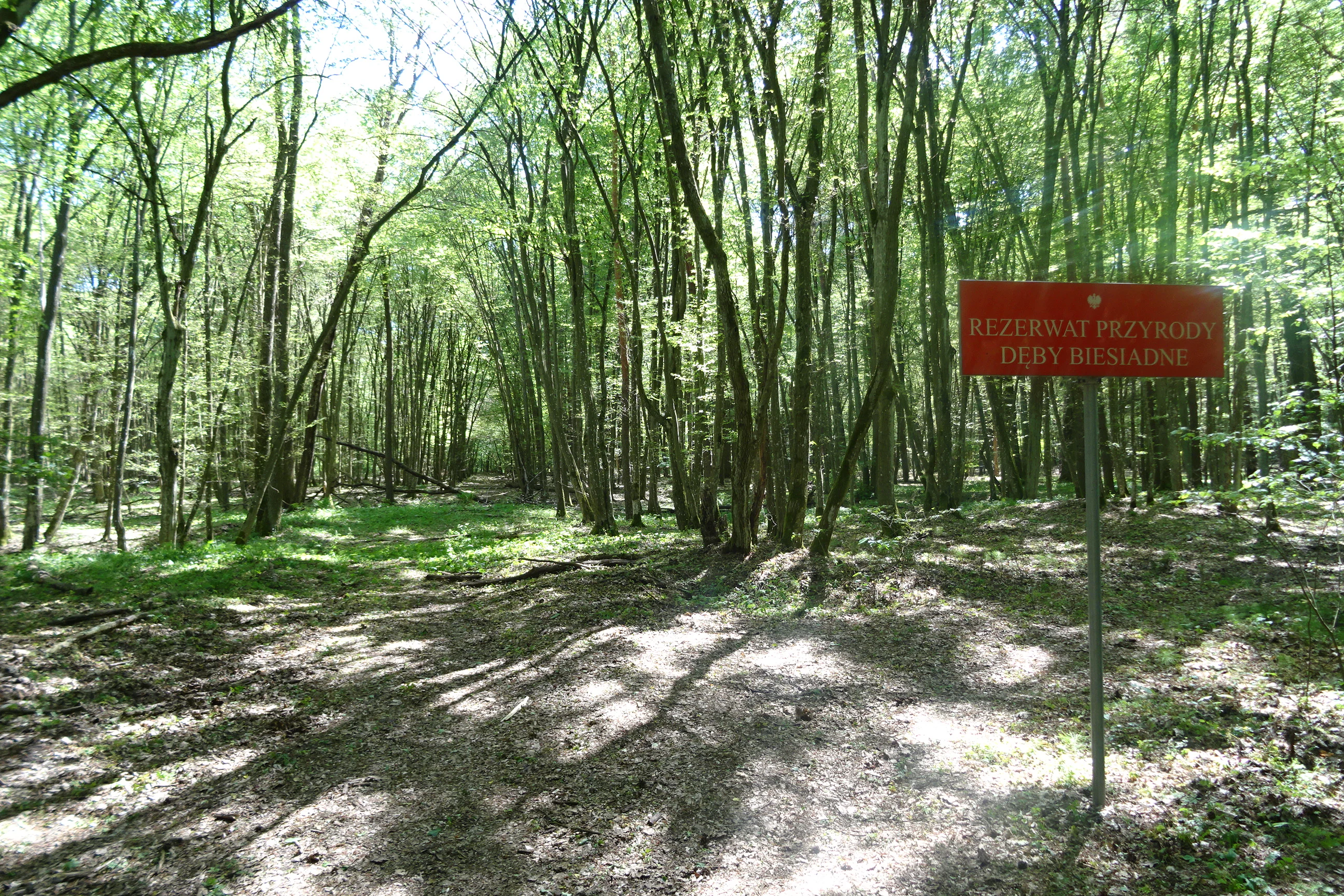
A red rectangular nature reserve sign on a metal pole stands on the right side of a forest clearing, with tall deciduous trees in the background.
A red park sign marking the entry to the Dęby Biesiadne Nature Reserve.

Dęby Biesiadne Nature Reserve (Mariana Pulkowskiego) history and protected-area timeline

Before its formal designation, the forest that now forms Dęby Biesiadne was managed as part of the Studzianki forest district of the Dobieszyn Forest Administration within the Polish state forest system. The oldest oaks in the stand had already been growing for around two centuries by the time protection was granted, indicating that the area had long been left in a relatively undisturbed state, even though it was part of an actively managed forest landscape.

The reserve was formally created on 8 August 2006, through Regulation No. 19 of the Wojewoda Mazowiecki (the Masovian Voivodeship Governor). This act placed the area under the Polish nature reserve regime, with the explicit conservation goal of preserving the natural oak-hornbeam forest (Tilio-Carpinetum typicum) typical of the Polish lowlands. The dedication of the reserve to Marian Pulkowski reflects the importance Polish forestry tradition attaches to recognizing individuals who contributed to forest knowledge and protection, while the reserve's creation itself is part of a broader national effort to safeguard surviving fragments of old-growth and near-natural lowland woodland.

Dęby Biesiadne Nature Reserve (Mariana Pulkowskiego) landscape and geographic character

The reserve occupies a gently undulating lowland setting in the western part of the Mazovian Voivodeship, between Kozienice County and the wider Vistula river system that gives the region its characteristic flat-to-rolling terrain. There are no dramatic landforms; instead the land is shaped by subtle glacial and post-glacial processes typical of central Polish plains, producing a mostly level to slightly ridged terrain with local moist depressions where groundwater reaches the surface.

Visually, the landscape is defined almost entirely by the closed forest canopy. The dominant fresh deciduous forest habitat, locally referred to as las świeży, gives the reserve a dense, shady interior with a layered structure of mature trees, mid-canopy hornbeam, and a thick herb layer in spring. Where riparian oak-elm communities take over near small watercourses or wetter depressions, the forest takes on a softer, more moisture-rich character, reinforcing the impression of a continuous, well-structured lowland forest landscape.

Dęby Biesiadne Nature Reserve (Mariana Pulkowskiego) ecosystems, habitats, and plant life

The reserve is built around the oak-hornbeam forest community Tilio-Carpinetum typicum, a forest type once widespread across fertile Polish lowlands but now largely replaced by managed woodlands or plantations. This community is characterized by a tall overstory of pedunculate oak with a substantial admixture of hornbeam, a rich shrub layer, and a diverse herb layer that flowers strongly in early spring before the canopy closes.

Alongside the central oak-hornbeam stands, the reserve contains transitions to ług-type communities, which are floodplain-associated oak-elm forests occupying the slightly wetter parts of the site. Together these communities form a coherent mosaic of upland and lowland deciduous forest, anchored ecologically by the fresh forest habitat type (las świeży). Because the stand contains trees over two centuries old, it also preserves ecological features typical of old-growth woodland, including veteran oaks with cavities and deadwood niches, which in turn support a richer associated flora and fauna than typical managed forest.

Dęby Biesiadne Nature Reserve (Mariana Pulkowskiego) wildlife and species highlights

The 220-year-old oak stand is the reserve's most important wildlife asset, because veteran oaks provide feeding, nesting, and shelter habitat for a wide range of forest species. Cavities in old trunks and branches are used by hole-nesting birds, bats, and small arboreal mammals, while the abundance of dead and partially decaying wood supports insects, fungi, and the wider detrital food web that is rare in intensively managed forest estates.

The mixed oak-hornbeam and oak-elm forest mosaic supports typical lowland forest fauna, including common woodland birds, small mammals associated with mature broadleaf forest, and invertebrates tied to veteran trees and the spring herb layer. While the reserve's small size limits the occurrence of large mammal populations, its biological continuity with surrounding forest landscapes allows species to move through the area as part of broader forest communities.

Dęby Biesiadne Nature Reserve (Mariana Pulkowskiego) conservation status and protection priorities

From a conservation standpoint, Dęby Biesiadne is valued chiefly as a surviving example of natural lowland oak-hornbeam forest at a time when most of Europe's lowland broadleaf forests have been converted to plantations or agriculture. By protecting old oaks, hornbeam, and associated community types on a single compact site, the reserve acts as a reference point for the structure, species composition, and natural processes of forests that once dominated the Polish lowlands.

Its designation also contributes to in-situ preservation of genetic resources in veteran oaks, which is important for maintaining locally adapted tree genotypes as climate and land use change. Combined with its location within the state-managed Dobieszyn Forest Administration, the reserve forms part of the broader Masovian network of protected forest sites aimed at retaining biodiversity, supporting research, and maintaining examples of natural forest development in an otherwise heavily managed landscape.

Dęby Biesiadne Nature Reserve (Mariana Pulkowskiego) cultural meaning and human context

The reserve's dedication to Marian Pulkowski reflects a longstanding Polish forestry tradition of honoring foresters, scientists, and advocates who contributed to forest knowledge and protection. The Pulkowski dedication gives the site a distinctly local, people-centered dimension that complements its ecological purpose.

Independently, the name Dęby Biesiadne ties into a wider Polish cultural reverence for old oaks, which appear in folklore, regional literature, and the identity of forest communities across the country. Although the reserve itself is small, the symbolism of protecting named "Biesiadne Oaks" makes the site a meaningful expression of the Polish relationship between rural communities, forestry tradition, and the natural heritage of the lowland landscape.

Top sights and standout views in Dęby Biesiadne Nature Reserve (Mariana Pulkowskiego)

A 220-year-old oak old-growth stand with abundant hornbeam forms the heart of this reserve, surrounded by a coherent mosaic of upland oak-hornbeam and oak-elm forest communities. It is one of the more faithful surviving examples of the natural lowland forests that once characterized the Polish Mazovia region.

Its compact 17 hectare footprint makes the reserve an unusually concentrated reference site: every component, from the veteran oaks to the fresh forest habitat type and the riparian transitions, fits within a short walk, while the formal protection dating from 2006 gives it a clear legal identity within the Polish national reserve system.

Best time to visit Dęby Biesiadne Nature Reserve (Mariana Pulkowskiego)

Spring is generally the most rewarding season to experience the reserve's characteristic forest character, when the herb layer of the oak-hornbeam forest blooms beneath the still-bare canopy, and the structure and variation of the woodland are easiest to observe. Early summer brings a dense, leafy canopy that emphasizes the fresh, sheltered character of the forest and is favorable for listening to birdlife and enjoying the cool woodland interior.

Late autumn and winter, when deciduous oaks and hornbeam have shed their leaves, offer the best conditions for appreciating the reserve's old oaks: the dramatic trunks and crown architecture of the 220-year-old veterans become fully visible, and the mosaic between oak-hornbeam and riparian forest communities is easier to read on the ground. These wide seasonal contrasts are part of what makes a lowland oak reserve like Dęby Biesiadne meaningful to visit at different times of year.

Monthly climate preview

Long-term monthly temperature ranges and precipitation patterns across the protected landscape

Rezerwat przyrody Dęby Biesiadne im. Mariana Pulkowskiego Climate and Average Temperature Normals

Measured coordinates for Rezerwat przyrody Dęby Biesiadne im. Mariana Pulkowskiego reveal a multi-month temperature range alongside steady baseline precipitation norms. Detailed monthly climate records provide a comprehensive statistical breakdown for analyzing long-term environmental patterns.
Annual mean8 °C
-4 °C20 °C
Jan-4°
Feb-2°
Mar
Apr
May14°
Jun18°
Jul20°
Aug20°
Sep14°
Oct
Nov
Dec-2°
Warmest month
July

20.4 °C

Coolest month
January

-3.5 °C

Wettest month
July

2.6 mm/day

Driest month
January

1.2 mm/day

Park location guide

Geography guide, regional context, and park location map for Dęby Biesiadne Nature Reserve (Mariana Pulkowskiego)

Dęby Biesiadne Nature Reserve (Mariana Pulkowskiego) park geography, regions, and map view in Poland

Understand where Dęby Biesiadne Nature Reserve (Mariana Pulkowskiego) sits in Poland through a broader geographic reading of the surrounding landscape, nearby location context, and its mapped position within the national park landscape.

How Dęby Biesiadne Nature Reserve (Mariana Pulkowskiego) fits into Poland

Poland, officially the Republic of Poland, is a Central European country spanning from the Baltic Sea in the north to the Carpathian Mountains in the south. It borders Germany, Czech Republic, Slovakia, Ukraine, Belarus, Lithuania, and Kaliningrad Oblast. The country has a temperate climate, diverse landscapes, and is known for its rich history, cultural heritage, and strong economic position within the EU.

Wider geography shaping Dęby Biesiadne Nature Reserve (Mariana Pulkowskiego) in Poland

Poland occupies 312,696 km2 in Central Europe, extending from the Baltic Sea coast in the north to the Sudetes and Carpathian Mountains in the south. It borders Germany to the west, Czech Republic and Slovakia to the south, Ukraine and Belarus to the east, and Lithuania and Kaliningrad Oblast to the northeast. The landscape includes lowland plains, uplands, and mountain ranges.

Map view of Dęby Biesiadne Nature Reserve (Mariana Pulkowskiego)

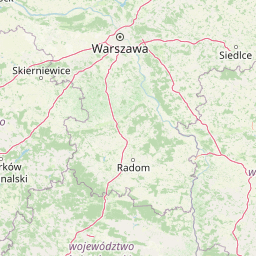
Use this park location map to pinpoint Dęby Biesiadne Nature Reserve (Mariana Pulkowskiego) in Poland, understand its exact geographic position, and read its mapped placement within the surrounding landscape more clearly.

Pigeon | © OpenStreetMap contributors

Location context for Dęby Biesiadne Nature Reserve (Mariana Pulkowskiego)

Mazovia Voivodeship

Visualizing old-growth oak forests, lowland terrain, and woodland habitats

Rezerwat przyrody Dęby Biesiadne im. Mariana Pulkowskiego Photos and Scenery

Visual documentation reveals the dense canopy, veteran trees, and ancient hornbeam stands that define the protected lowland forest. Photographic records capture the structural diversity of the oak-hornbeam ecosystem and the subtle variations in terrain across the reserve.

A red rectangular nature reserve sign on a metal pole stands on the right side of a forest clearing, with tall deciduous trees in the background.

Park atlas

Compare adjacent woodland reserves and lowland forest habitats across the surrounding region

Parks Near Rezerwat przyrody Dęby Biesiadne im. Mariana Pulkowskiego and Regional Protected Areas

Browse protected areas situated near Rezerwat przyrody Dęby Biesiadne im. Mariana Pulkowskiego to examine similar lowland forest reserves and regional woodland ecosystems. Comparing adjacent conservation landscapes reveals broader patterns in Central European forest geography and habitat distribution.
Nature reserveMasovian Voivodeship
About 35 km away#1 closest

South

Rezerwat przyrody Miodne: Protected Nature Reserve Landscape in Masovian Voivodeship

Forest geography and ecological preservation in east-central Poland.

Rezerwat przyrody Miodne offers a focused look at mixed lowland forest communities in Poland. As a nature reserve established to guard beech populations at their northern limit, it serves as a key reference for understanding how small, strictly managed forest patches function within the wider, pine-dominated matrix of the Masovian Voivodeship.

Area
0.204 km²
Established
1985
Relief
Lowland
Climate
Temperate
A pale, soft-focus watercolor painting of a wetland area with grassy banks, distant rolling hills, and a calm body of water reflecting sunset-toned light.
Nature reserveMazowieckie Voivodeship
About 44 km away#2 closest

North

Rezerwat przyrody Bagno Bocianowskie: Protected Nature Reserve and Forest Geography

Inland dune and peatland mosaics in central Poland

The nature reserve Rezerwat przyrody Bagno Bocianowskie provides a protected study of how glacial sand dunes and peat-filled depressions shape forest distribution. Located in Mazowieckie Voivodeship, this site preserves rare wetland flora and diverse woodland communities within a 69-hectare lowland forest landscape.

Area
0.689 km²
Established
1982
Relief
Lowland
Climate
Temperate
Nature reserveMasovian Voivodeship
About 46 km away#3 closest

West

Modrzewina Nature Reserve: Geographic Analysis of a Protected Polish Larch Forest

Protected forest landscape in the Masovian Voivodeship, Poland

Gain insights into the geographic and ecological structure of Modrzewina Nature Reserve. This protected area on the Wysoczyzna Rawska plateau serves as a critical site for the Polish larch, offering a unique window into the natural history and morainic terrain of central Poland.

Area
3.322 km²
Established
1959
Relief
Upland
Climate
Temperate
Protected landscapeMasovian Voivodeship
About 47 km away#4 closest

Northwest

Chojnowski Park Krajobrazowy: Atlas of Protected Landscapes and Forested Terrain

Geographic overview of the Masovian Voivodeship forest belt

Investigate the topographical complexity of Chojnowski Park Krajobrazowy, where flat glacial plains meet the dramatic Vistula escarpment. This protected area offers detailed mapping of forest stands, aquatic habitats, and riparian zones within the Masovian landscape, providing an essential look at the ecological connectivity of the region south of Warsaw.

Area
67.96 km²
Established
1993
Relief
Lowland
Climate
Temperate
Nature reserveMasovian Voivodeship
About 47 km away#5 closest

North

Rezerwat przyrody Mszar Pogorzelski: Peatland Protected Area and Wetland Landscape Mapping

Regional landscape context in Masovian Voivodeship

Located in the eastern reaches of Otwock, Rezerwat przyrody Mszar Pogorzelski preserves a rare gradient of raised bogs and pine forest edge habitats. This site offers valuable insight into the sandy lowland geography of east-central Poland and acts as a localized refuge for bog vegetation within the protected Mazovian Landscape Park zone.

Area
0.351 km²
Established
1987
Relief
Lowland
Climate
Temperate
Nature reserveMazovia Voivodeship
About 54 km away#6 closest

Northeast

Dąbrowy Seroczyńskie Nature Reserve: Protected Lowland Forest Geography and Mapped Boundaries

Regional woodland complex in Mazovia Voivodeship

Dąbrowy Seroczyńskie Nature Reserve protects a substantial sessile oak forest in central-eastern Poland. This lowland woodland area features varied topography between 175 and 192 meters above sea level, preserving significant forest floor plant communities and characteristic lowland fauna within the broader context of the Siedlce region and the Łuków protected landscape.

Area
5.502 km²
Established
1987
Relief
Lowland
Access
Access unknown
Nature reserveLublin Voivodeship
About 55 km away#7 closest

Southeast

Rezerwat przyrody Mięćmierz: Protected Xerothermic Habitats and Vistula River Geography

Nature reserve landscape and ecological atlas overview

Rezerwat przyrody Mięćmierz represents a critical fragment of xerothermic grassland in the Lublin region of Poland. Formed in 2023, this nature reserve protects calcium-rich slopes and rare plant populations overlooking the Małopolska Vistula Gorge. Examine the geography of its dual-enclave structure, where steep loess and limestone terrain creates open habitats for diverse protected species within the Kazimierski Landscape Park.

Area
0.117 km²
Established
2023
Relief
Upland
Climate
Temperate
Nature reserveMasovian Voivodeship
About 57 km away#8 closest

Northwest

Młochowski Łęg Nature Reserve: Mapping Floodplain Forests in Masovian Voivodeship

A protected wetland woodland sanctuary along the Utrata River.

Located within the flat terrain of the Łowicz-Błonie Plain, this nature reserve conserves a representative ash-alder floodplain forest. The site serves as a vital wetland woodland refugium, featuring a complex mosaic of riparian vegetation that highlights the regional ecological character of central Poland's river valleys.

Area
0.12 km²
Established
1984
Relief
Lowland
Climate
Temperate

Common questions about visiting, size, designation, and location context for Dęby Biesiadne Nature Reserve (Mariana Pulkowskiego)

Dęby Biesiadne Nature Reserve (Mariana Pulkowskiego) FAQs for park facts, access, geography, and protected area context

Find quick answers about Dęby Biesiadne Nature Reserve (Mariana Pulkowskiego), including protected-area facts, park geography, trail and visitor context, and how the park fits into its surrounding country and regional landscape.
MoriAtlas Explorer

Continue Your Protected Areas Search Across the Global Atlas

Deepen your exploration by continuing the structured search for national parks and protected areas worldwide. Utilize the comprehensive filtering capabilities to compare different conservation landscapes and refine your understanding of global park geography. Discover more about the distribution and characteristics of protected natural areas.

Global natural geography