
Why Naturwald Speckfeld stands out
Naturwald Speckfeld is best known as a strictly protected, non-harvested remnant of beech-oak-hornbeam woodland on the western slopes of the Steigerwald. Its long history of coppice-with-standards management has left a forest unusually dominated by oak, with hornbeam and small-leaved lime filling the lower and middle canopy layers, while ash, sycamore, and Norway maple cluster on the steep northern slopes below the castle ruins, and beech and spruce dominate the eastern and northern edges of the reserve. The reserve is also notable for its unusual geological setting, with south-facing steep slopes composed of easily erodible gypsum-bearing claystone and thin dolomite caprock, and for the castle ruin of Speckfeld that rises within its boundaries. Together with the surrounding FFH and bird protection zones, it forms one of the core reference areas for unharvested, near-natural broadleaf forest in the southern Steigerwald.
Naturwald Speckfeld history and protected-area timeline
Naturwald Speckfeld was first formally protected in 1978, when 18.1 hectares of state forest in the southern Steigerwald were designated as a Naturwaldreservat. As a Naturwaldreservat, the area was withdrawn from commercial timber harvesting, leaving only interventions related to forest protection and traffic safety. This early designation made Speckfeld one of the older nature forest reserves in Bavaria and established a baseline of several decades of uninterrupted forest development.
The reserve's character changed significantly after the 2019 Bavarian citizens' initiative 'Artenvielfalt & Naturschönheit in Bayern', which called for stronger protection for biodiversity and natural beauty in the state. In response, the Bavarian state government committed to removing around ten percent of the state forest from active use. As part of this political process, Speckfeld was re-designated in 2020 as a Naturwald rather than a Naturwaldreservat, and the protected area was expanded slightly to the south, bringing the total to about 19.54 hectares. Because the land is owned by the Free State of Bavaria, it was integrated into the Bavarian state forest's Naturwald network alongside the other Bavarian nature forest reserves. The site has not been formally reported to the IUCN, and its small size means it likely would not have met the IUCN size criteria, placing it in an unusual position at the international level for a nationally significant strict forest reserve.
Naturwald Speckfeld landscape and geographic character
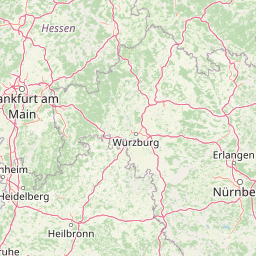
The reserve lies on the western flanks of the Steigerwald, a low mountain range of rolling forested ridges and valleys that defines much of the landscape between Bamberg and Würzburg in Lower Franconia. Within this broader setting, Speckfeld occupies a part of the Speckfelder Wald, the sectional forest area that takes its name from the historic castle site. Elevation within the reserve ranges from about 358 meters to 423 meters above sea level, with the Schloßberg rising prominently within the protected boundary.
The terrain is shaped by the underlying geology of the southern Steigerwald. The slopes are built from easily erodible, gypsum-bearing claystones capped by thin, harder dolomite beds. These south-facing slopes are unusually steep for the region, giving the reserve a pronounced relief in a relatively small area. The combination of steep terrain, unstable substrate, and the historic castle ruin nearby makes the landscape both physically distinctive and culturally layered. West of the reserve lies the wine town of Iphofen, while Markt Einersheim lies to the southwest and Birklingen to the northeast, so the forest is framed by a traditional rural Franconian cultural landscape of vineyards, villages, and small hamlets.
Naturwald Speckfeld ecosystems, habitats, and plant life
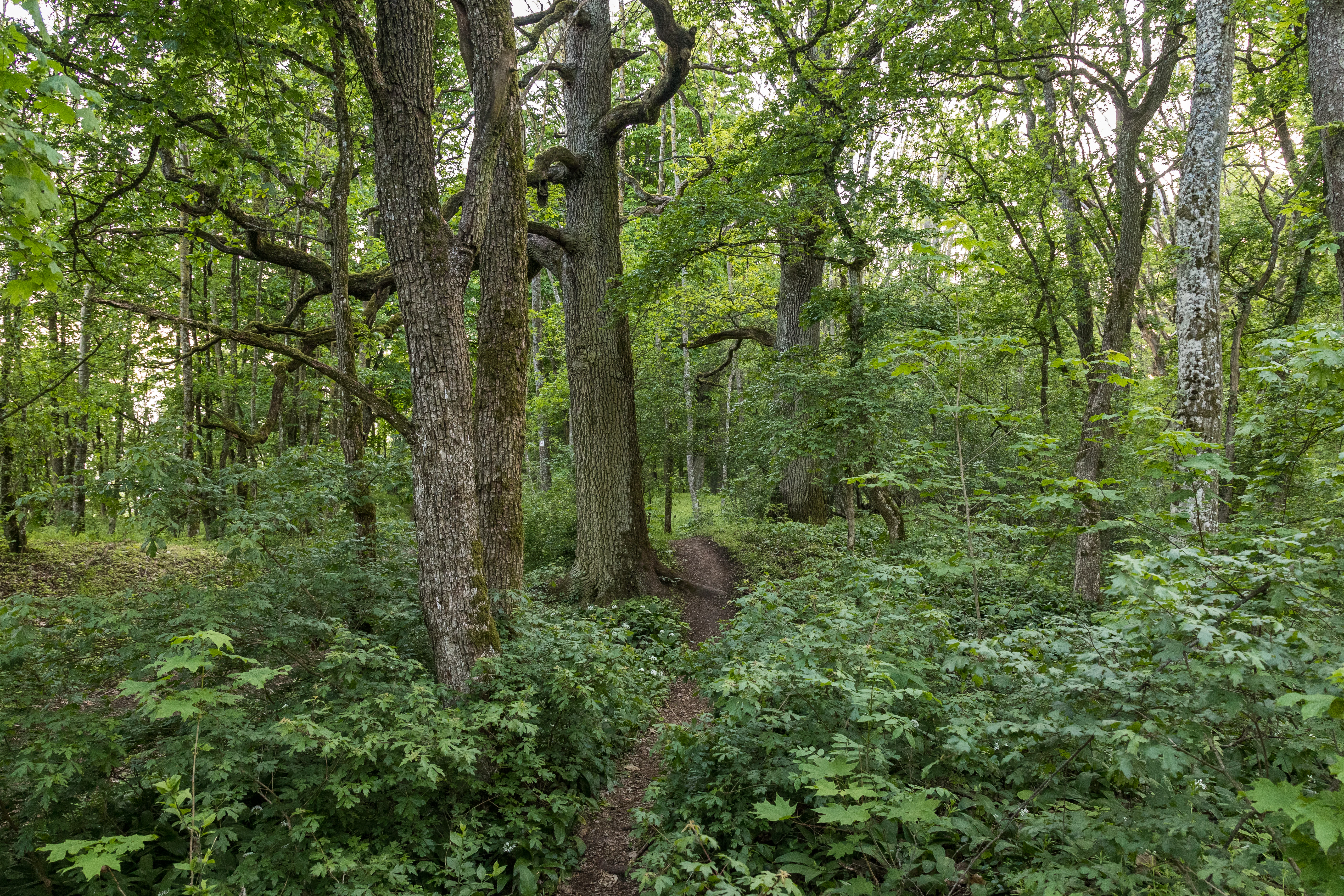
The forest at Speckfeld is a representative example of the mixed broadleaf woodland of the southern Steigerwald, dominated ecologically by oak with an important admixture of hornbeam, small-leaved lime, beech, and conifers. The stand structure reflects a long history of coppice-with-standards management, in which oaks were repeatedly favored as the overstory trees while hornbeam and lime persist from the former coppice layer, and these patterns remain clearly visible in the current species composition.
The vertical profile of the forest is unusually layered for such a small reserve. Oak occupies much of the upper canopy, while hornbeam and small-leaved lime concentrate in the lower and middle layers. On the steep north-facing slope directly below the Speckfeld ruin, ash, sycamore, and Norway maple find their main foothold, taking advantage of the more sheltered, moister conditions. Toward the eastern edge of the reserve, beech becomes a significant component, and along the northern margin spruce takes over, producing a clear transition from broadleaf-dominated core forest to more montane, conifer-influenced forest at the edges.
The geology adds another ecological dimension. The south-facing slopes of gypsum-bearing claystone with dolomite caps, combined with the protected status of the area, support specialized microhabitats: warm, dry rock and soil communities on the slopes; cooler, more mesic broadleaf communities in the shaded draws; and standing structures around the castle ruin, including clefts, cellars, and masonry, that provide roosting and overwintering refuges for bats and cavity-nesting invertebrates.
Naturwald Speckfeld wildlife and species highlights
Naturwald Speckfeld supports a small but ecologically significant assemblage of forest species, with particular importance for bats and birds associated with mature broadleaf forest and the historic castle ruin. The Schloßberg and the Speckfeld ruin within the reserve are especially important: in the winters of 1978/79 and 1979/80, barbastelle bats were recorded in the ruin, and these observations remained the only records of the species in the Landkreis Kitzingen for more than 25 years until the species was detected again in January 2006.
Bechstein's bat has also been recorded regularly, though only in small numbers, in and around the same ruin, and the greater mouse-eared bat uses the area as a winter roost. In the forest itself, middle spotted woodpeckers have been observed, a typical indicator species for mature, structurally rich broadleaf forests with plenty of old and decaying wood. Red kites have been recorded in the surrounding landscape, reflecting the broader importance of the Steigerwald for raptors. The conservation status of the overall site has been assessed as 'B', corresponding to a favorable but not optimal condition.
Naturwald Speckfeld conservation status and protection priorities
Naturwald Speckfeld's central conservation role is to allow a representative piece of southern Steigerwald broadleaf forest to develop without forestry intervention, providing a long-term reference for natural forest dynamics under Central European conditions. Strict protection means that no timber is harvested from the reserve; only measures related to forest protection and public safety are permitted, and these restrictions have been in place either continuously or in their original form since 1978.
The reserve sits inside the EU Natura 2000 network, fully overlapping with the FFH site 'Vorderer Steigerwald mit Schwanberg' and the bird protection area 'Südlicher Steigerwald'. It is also fully contained within the larger 78.2-hectare Naturschutzgebiet 'Schloßbergsattel bei Markt Einersheim', designated in 2002, whose stated objectives include preserving the natural broadleaf forest communities of the Naturwaldreservat taking into account the local geology and soils, gaining scientific insights into the dynamics of these near-natural forests, protecting the unique south-facing steep slopes of gypsum-bearing claystone together with the Speckfeld castle ruin, and safeguarding the habitats of rare and threatened species groups such as reptiles, butterflies, beetles, and hymenopterans.
By integrating these layers of formal protection with long-term state ownership by the Free State of Bavaria and inclusion in the Bavarian Naturwald network, Speckfeld serves as both a practical conservation site and a baseline area against which the development of other, managed forests in the Steigerwald can be compared. Its conservation significance extends beyond the reserve itself because the surrounding FFH and bird-protection zones rely on the strict protection of this core area to maintain their habitat quality.
Naturwald Speckfeld cultural meaning and human context
The reserve carries a clear cultural signature through the Burgruine Speckfeld, the ruined castle that rises in its southwestern part on the 423-meter Schloßberg. The ruin is not merely a scenic backdrop but is integrated into the reserve's ecological and legal framework: it is the very feature that has made the area a focus for bat conservation, and its preservation is one of the named objectives of the overarching Naturschutzgebiet. The Steigerwald itself has long been a forested borderland of the Bishopric of Würzburg, and the small castles of the Speckfelder Wald reflect that medieval territorial history.
The reserve is also part of the broader cultural landscape of Lower Franconia, framed by the wine town of Iphofen to the west, the market town of Markt Einersheim to the southwest, and the village of Birklingen to the northeast. The combination of vineyards, scattered wooded hamlets like Neubauhof, and residual medieval ruins gives the protected forest a strong sense of being embedded in a historically layered agricultural and viticultural region, where strict forest protection represents a deliberate choice to set aside part of this working landscape.
Top sights and standout views in Naturwald Speckfeld
Strict long-term forest protection: a roughly 19-hectare non-harvested forest reserve originating in 1978 and reinforced by 2020 re-designation as part of the Bavarian Naturwald network.
Mixed broadleaf woodland of the southern Steigerwald: oak-dominated stand with hornbeam, small-leaved lime, beech, and conifer influences, with sharp contrasts across a very small area between warm south-facing slopes and cooler shaded draws.
Geological and cultural landmark: gypsum-bearing claystone slopes with dolomite caprock, combined with the Speckfeld castle ruin and the Schloßberg at 423 meters, give the reserve a distinctive profile within the regional forest landscape.
Multi-layered conservation status: full overlap with the FFH area 'Vorderer Steigerwald mit Schwanberg', the bird protection area 'Südlicher Steigerwald', and the Naturschutzgebiet 'Schloßbergsattel bei Markt Einersheim', supporting bats, middle spotted woodpeckers, red kite, and a mosaic of rare invertebrate habitats.
Best time to visit Naturwald Speckfeld
Naturwald Speckfeld is best appreciated in the warmer months when the broadleaf canopy is fully leafed and the steep south-facing slopes are at their most visible. Late spring and early summer bring the strongest contrast between the sun-exposed southern slopes of gypsum-rich claystone, which appear warm and dry, and the cooler, shadier eastern and northern parts of the reserve where beech and spruce dominate. Summer visits also maximize the chance of encountering the dragonfly and butterfly fauna of the surrounding dry grasslands and forest edges, while autumn offers the oak-dominated canopy in full color, which is one of the most distinctive visual signatures of the site. Winter visits have a particular significance for bat interest, as the historic ruin within the reserve has long served as a winter roost for barbastelle, Bechstein's, and greater mouse-eared bats.