
Why Sande am Tannenbusch bei Kleinlangheim stands out
The reserve is best known for protecting a rare mosaic of sand-magerrasen (sand-poor grassland) and sandgrasheide (sand grass heath) habitats typical of the Albertshofener Flugsandgebiet inland sand landscape. Beyond its botanical importance, the site is regionally recognized as one of the most important Bavarian strongholds of the ortolan (Emberiza hortulana), a farmland bird whose population has declined sharply across much of central Europe. The combination of dry sand openings, meadows, forest edges, and small wetland patches in close proximity makes the reserve a notable example of small-scale habitat diversity in the Steigerwaldvorland.
Sande am Tannenbusch bei Kleinlangheim history and protected-area timeline
The protected area was formally established by ordinance (Verordnung) of the government of Unterfranken on 30 June 1995, creating the Naturschutzgebiet Sande am Tannenbusch bei Kleinlangheim as an IUCN Category IV habitat and species management area.
Its designation reflects long-standing recognition of the region's unusual inland sand habitats around the Albertshofener Flugsandgebiet and the broader Steigerwaldvorland. The forested setting within the Klosterforst had historically been managed as woodland, but conservation interest in this period shifted toward the open sand habitats, forest edges, and adjacent waldnahe areas that the new reserve was designed to safeguard. A further important step came with the area's inclusion in the EU-wide Natura 2000 network, where the characteristic habitat mosaic was incorporated into the FFH area Sandgebiete bei Schwarzach, Klein- und Großlangheim.
Sande am Tannenbusch bei Kleinlangheim landscape and geographic character
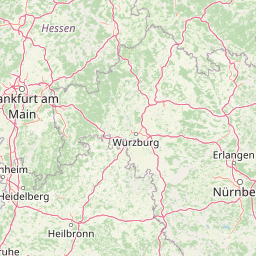
Sande am Tannenbusch bei Kleinlangheim occupies a gently undulating position within the Steigerwaldvorland, the broad transitional landscape between the Main valley and the higher Steigerwald uplands in Lower Franconia.
The reserve's underlying character is defined by sandy substrates, a legacy of the Albertshofener Flugsandgebiet, which have produced open, dry terrain that contrasts with the surrounding farmland and forest. The protected area comprises two main sections linked by a thin belt of woodland, giving the site a slightly fragmented footprint. The southern portion of the reserve is the source of the Rodenbach, a small tributary of the River Main whose course helps shape the local drainage and supports moist microhabitats amid the otherwise dry sand soils.
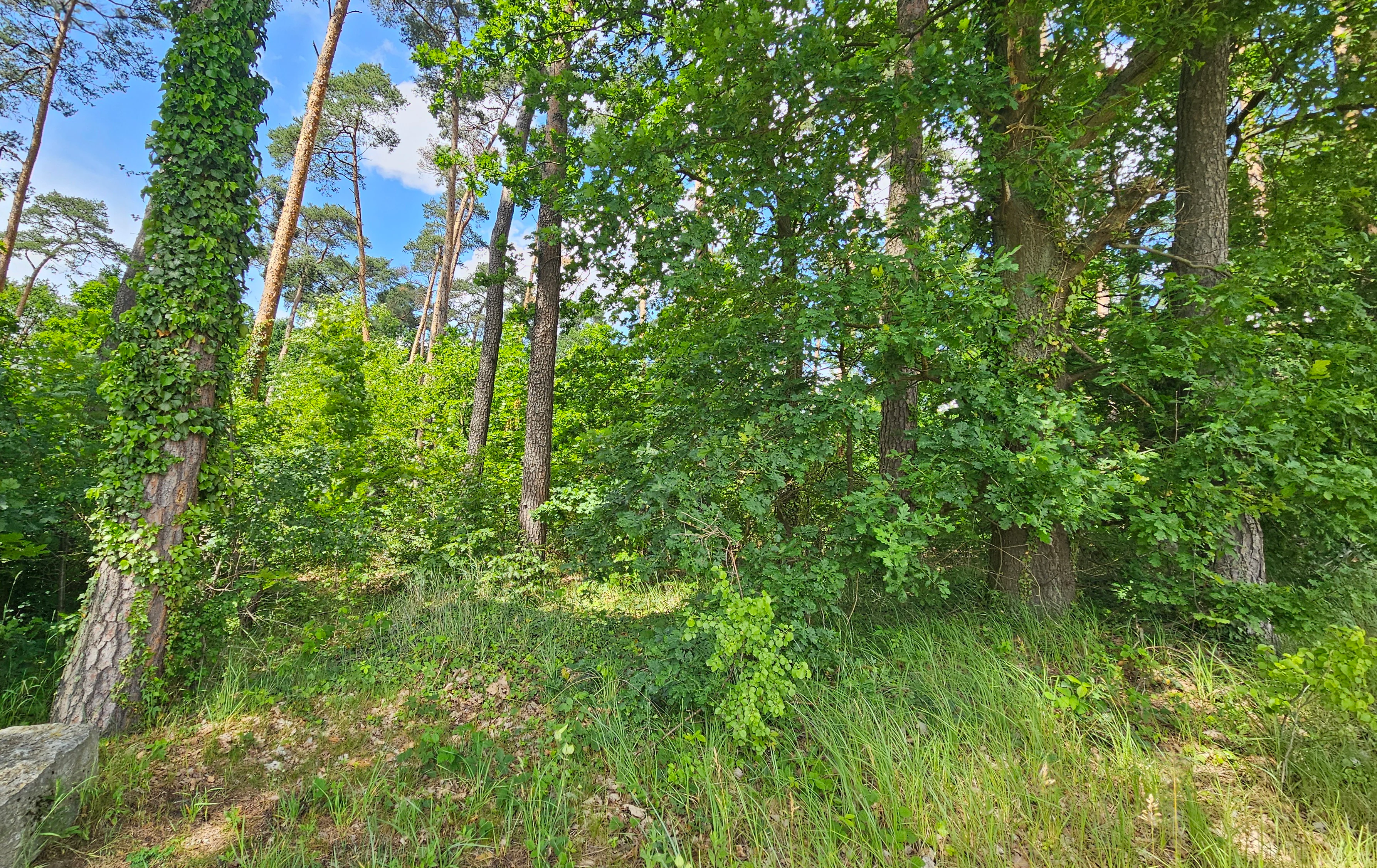
The supporting forest belongs to the Klosterforst, a large, historically managed woodland complex in the Kitzingen district. While the wooded interior of the Tannenbusch gives the site its name, the actual conservation interest lies in the transitions: sun-exposed forest margins, sandy clearings, and adjoining meadows. The southern boundary is defined by the now-closed Kitzingen-Schweinfurt railway, while the northern edge approaches the busy Bundesautobahn 3, framing the reserve within a noticeably human-influenced landscape.
Sande am Tannenbusch bei Kleinlangheim ecosystems, habitats, and plant life
The reserve's biotope complex is anchored by sandmagerrasen and sandgrasheiden, dry, species-rich grassland communities that thrive on the nutrient-poor, acidic inland sands of the Albertshofener Flugsandgebiet. These habitats support characteristic specialist flora of the region's sand landscape and have become a conservation priority because they depend on continuing low-intensity land management.
What distinguishes the site ecologically is the close interconnection of contrasting habitats. Dry sandy openings are interspersed with moist patches, small wetland areas, meadows, and forest edges, creating a fine-grained mosaic within a compact footprint. This juxtaposition of xeric and mesic conditions within a short distance supports a higher diversity of invertebrates and ground-nesting birds than any single habitat type would on its own.
The forest itself, part of the wider Klosterforst, plays a supporting role rather than being the main focus. It frames the open habitats, provides shelter and perches for woodland and edge species, and links the two main sections of the reserve through the narrow wooded corridor between them. The combination of these elements is what allows the site to function as an FFH area as well as a national nature reserve.
Sande am Tannenbusch bei Kleinlangheim wildlife and species highlights
Birdlife is the most conspicuous ecological asset of the reserve. The entire area lies within the Südliches Steigerwaldvorland bird protection zone, and its mosaic of field, edge, and open sand habitats supports a diverse community of breeding and migrating species.
The site's most notable ornithological feature is its role as one of the main Bavarian strongholds of the ortolan (Emberiza hortulana), a farmland and edge species that has suffered major declines across much of central Europe. Beyond the ortolan, many other protected and noteworthy resident and migratory birds regularly use the area, drawn by the combination of open sandy ground, low vegetation, meadows, and adjacent woodland.
The reserve's mix of dry sand, wet ground, and forest-margin habitats also supports a varied invertebrate fauna typical of inland sand ecosystems, which in turn underpins the food supply for ground-foraging birds. Although the site is small, the structural diversity of habitats gives it a disproportionately rich wildlife profile relative to its size.
Sande am Tannenbusch bei Kleinlangheim conservation status and protection priorities
The reserve was specifically created to protect a group of increasingly threatened habitat types: sandmagerrasen and sandgrasheiden associated with the inland sand landscapes around the Albertshofener Flugsandgebiet. These communities are highly sensitive to changes in land use, nutrient input, and shrub encroachment, and have become conservation priorities within the Lower Franconian and Bavarian protected-area network.
Its status as an IUCN Category IV site underlines that management, not just strict preservation, is central to its purpose. The explicit protection goals include both the conservation of the dry sandy habitats and the safeguarding of threatened plant and animal species that depend on the broader habitat mosaic of dry, moist, and wooded patches. By also being part of the FFH area Sandgebiete bei Schwarzach, Klein- und Großlangheim, the reserve is integrated into the EU-wide Natura 2000 framework, reinforcing its role in pan-European habitat conservation.
Sande am Tannenbusch bei Kleinlangheim cultural meaning and human context
The reserve sits within a landscape shaped by centuries of woodland management and monastic landholding. The surrounding Klosterforst takes its name from the historical monastic forest administration associated with the region's former abbeys, and the forest remains a defining element of local identity in the Kitzingen district.
The village of Kleinlangheim, on whose municipal territory the reserve lies, and the neighboring Haidt area give the reserve its name and connect it to a long-established rural community pattern in Lower Franconia. The now-disused Kitzingen-Schweinfurt railway, which forms part of the southern boundary, also marks a layer of 19th- and 20th-century transport history running through the Steigerwaldvorland. Together these features place the reserve within a working cultural landscape rather than a remote wilderness setting.
Top sights and standout views in Sande am Tannenbusch bei Kleinlangheim
A defining highlight of the reserve is the rare coincidence of sand-magerrasen and sandgrasheide communities within a compact, formally protected area, set against the broader Albertshofener inland sand landscape. Equally notable is the site's dual designation as both a national Naturschutzgebiet and a Natura 2000 FFH area, tying local protection to European habitat conservation priorities.
The reserve's ornithological profile is another strong highlight: it acts as a Bavarian center of distribution for the ortolan and supports a varied community of migratory and resident birds in a very small footprint. The visual contrast between the open sandy habitats and the surrounding Klosterforst woodland, together with the small Rodenbach spring in the southern part of the reserve, gives the site a particularly expressive micro-landscape for those exploring the Steigerwaldvorland.
Best time to visit Sande am Tannenbusch bei Kleinlangheim
The reserve is most rewarding in late spring and early summer, when the open sand-magerrasen and sandgrasheide communities are in active growth and their characteristic flora is most visible. This is also the period when breeding birds, including the ortolan, are most active along the forest edges and open sandy ground, making it the strongest season for birdwatching.
Late summer and early autumn can still provide good sightings of post-breeding and migrant birds using the habitat mosaic, while the surrounding woodland and forest margins of the Klosterforst take on more visual prominence in the cooler months. Because the reserve is a small protected site embedded in working agricultural and infrastructural surroundings, visiting in mild, settled weather tends to give the best experience of its open sandy habitats.