Why Toarcien National Nature Reserve stands out
The reserve is best known for housing the stratotype of the Toarcian, a globally referenced geological stage of the Early Jurassic. This single, tightly defined locality anchors the international definition of the Toarcian, first established by Alcide d'Orbigny in 1849 and later refined by Eugène Eudes-Deslongchamps, Jules Welsch, and Jean Gabilly. The exposures also allow the Toarcian to be divided into 34 ammonite-based horizons, each representing roughly 260,000 years, giving the site an outsized importance in stratigraphy and paleontology despite its very small footprint.
Toarcien National Nature Reserve history and protected-area timeline
The scientific history of the site reaches back to the mid-nineteenth century, when Alcide Dessalines d'Orbigny used a quarry near the Rigollier farm in Sainte-Verge, between the villages of Vrines and Pompois, to establish the Toarcian as a formal stage of the geological time scale in 1849. The definition of the stage at this locality was subsequently refined in the late nineteenth century by Eugène Eudes-Deslongchamps and later by Jules Welsch.
A decisive twentieth-century contribution came in 1962, when Jean Gabilly used the exposures to subdivide the Toarcian into a hierarchy of horizons based on changes in ammonite faunas, a system still used today in Jurassic stratigraphy. The significance of the site, combined with growing concern for the conservation of geologically important outcrops, led to the creation of the national nature reserve by decree on 23 November 1987, formalizing long-standing scientific protections of the quarry faces and their fossils. Since then, management has been delegated by convention to the Communauté de Communes du Thouarsais, which oversees interpretation, conservation, and public education at the site.
Toarcien National Nature Reserve landscape and geographic character
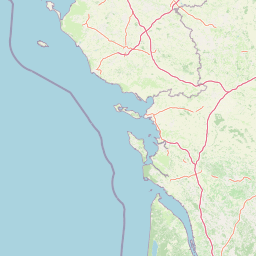
The reserve's landscape is small-scale but geologically dramatic, set within the gentle valley of the Thouet river west of Thouars. The protected area consists of two former open-pit quarries a few hundred meters apart. The first lies at the locality known as les Groies, and the second, roughly 500 meters to the south, at les Hauts-Côteaux. Together they expose a sequence of Jurassic sediments, including ferruginous sandstones, oolitic bioclastic limestones, and marly limestones alternating with marls, totaling only a few meters of vertical section.
The Hauts-Côteaux quarry is the more complete exposure and shows, from base to top, ferruginous sandstones and sandy limestones with bivalves, gastropods, and belemnites as well as abundant worm burrows; about 1.20 meters of bioclastic limestones with ferruginous ooliths that are extraordinarily rich in fossil debris and ammonites, representing the lower and middle Toarcian; and roughly 6.90 meters of clayey limestones alternating with marls containing pelagic fossils such as ammonites, nautili, and belemnites, spanning the upper middle Toarcian into the lower Aalénien. The combination of the open quarry faces and the encompassing rural landscape of the Thouet valley gives the reserve its distinctive character as a working scientific window into a Jurassic seafloor.
Toarcien National Nature Reserve ecosystems, habitats, and plant life
Ecologically, the reserve is primarily a geological and paleontological site rather than a habitat-focused protected area, and its nature is defined by the fossil record rather than by living ecosystems. The protected formations document a marine sedimentary environment from the Early Jurassic, when what is now western France lay beneath a shallow sea. The exposed rocks preserve rich assemblages of marine organisms, including more than 80 species of ammonites, alongside foraminifera, ostracods, bivalves (lamellibranchs), gastropods, belemnites, and nautili.
The surrounding landscape is part of the rural Thouet valley, with exposures of Jurassic, Cretaceous, and Mio-Quaternary sediments that together illustrate long-term changes in sea level, sedimentation, and tectonic uplift in this part of the Nouvelle-Aquitaine region. The angular unconformity between the Cenomanian clays of the Upper Cretaceous and the Aalénien limestones of the Middle Jurassic, and the unconformity beneath the upper terrace alluvium of the Thouet, make the reserve an unusually compact showcase of regional geological evolution.
Toarcien National Nature Reserve wildlife and species highlights
The reserve's "wildlife" is overwhelmingly paleontological rather than biological. Its principal faunal interest lies in the abundance and diversity of Jurassic marine fossils, especially ammonites, of which more than 80 species have been recorded in the Toarcian strata of the reserve. Ammonites are joined by foraminifera, ostracods, bivalves, gastropods, belemnites, and the rarer nautili.
Because ammonites evolved rapidly, their successive appearances and disappearances serve as finely resolved biostratigraphic markers. Each of the 34 horizons recognized in the Toarcian section is characterized by one or several diagnostic ammonite species, providing an unusually detailed biostratigraphic framework for a single small site. The fossils of the Hauts-Côteaux and Groies quarries are therefore the reserve's living, if deeply ancient, "wildlife," and they remain the focus of scientific study and public interpretation.
Toarcien National Nature Reserve conservation status and protection priorities
From a conservation perspective, the reserve is unusual in that its principal value is the long-term protection of a globally designated geological reference section, rather than a particular habitat or species assemblage. The 1987 decree explicitly prohibits any form of damage to the quarry face, the mineral substances, and the fossils of the reserve, ensuring that the stratotype remains accessible and intact for future generations of geologists and paleontologists.
The protected area also conserves a remarkable concentration of stratigraphic features in a very small footprint: three successive Jurassic stages, major unconformities linking the Jurassic, the Upper Cretaceous, and the Mio-Quaternary alluvial terraces of the Thouet, and a dense fossil record rich enough to anchor the international definition of an entire geological stage. By safeguarding these elements in situ, the reserve preserves not only French scientific heritage but a reference point of global importance for the geological time scale.
Toarcien National Nature Reserve cultural meaning and human context
The reserve's cultural identity is tightly bound to the town of Thouars, from which the Toarcian geological stage takes its name, and to the long French tradition of stratigraphic research that began with Alcide d'Orbigny in the mid-nineteenth century. The quarries at les Groies and les Hauts-Côteaux, in the commune of Sainte-Verge, are inseparable from the history of geology in the Thouarsais area, a region that has been central to European Jurassic stratigraphy for more than 170 years.
Interpretation panels and numbered poles at the quarry site mark the different strata and explain the geological succession to visitors, linking the local industrial past of small limestone quarries to a present-day role as a teaching and heritage site. Management by the Communauté de Communes du Thouarsais reflects this local cultural stewardship and the integration of the reserve into the regional identity of the Thouet valley.
Top sights and standout views in Toarcien National Nature Reserve
The Toarcien reserve's standout quality is the global stratotype of the Toarcian, protected in an area almost unbelievably small by national-reserve standards. Highlights include the exposures at the Groies and Hauts-Côteaux quarries, a Toarcian section rich in more than 80 ammonite species, the 34 ammonite-based horizons defined by Jean Gabilly in 1962, and the rare opportunity to walk across three successive Jurassic stages and major regional unconformities within a single hectare-scale site.
Best time to visit Toarcien National Nature Reserve
Because the reserve's principal interest is its permanent rock exposures and fossils rather than seasonal scenery, it can be informative year-round for visitors interested in geology. Spring and autumn typically offer the most comfortable conditions for walking between the two quarries and reading the interpretation panels along the quarry faces, while the open exposures make features of the stratotype visible regardless of season. Researchers and classrooms often favour periods when the rock surfaces are dry, since the fossil-bearing layers and the unconformities are then easiest to observe in detail.