
Mori Atlas logo
Nature reserveRezerwat przyrody Miranowo

Discover the unique calcareous peatlands and rich relict flora within the Krzywińskie Lake District

Rezerwat przyrody Miranowo: A Rare Botanical Wetland and Protected Nature Reserve in Poland

Rezerwat przyrody Miranowo is a vital nature reserve in west-central Poland, established to protect a specialized ecosystem of lime-loving plants and moss-rich wetlands. Situated along the shore of Lake Dolskie Wielkie, the reserve functions as a critical refuge for rare botanical species, including diverse bryophytes and charophyte algae within its calcareous peatland boundaries. The landscape features a mosaic of open mires and groundwater-fed marshes, serving as a primary reference site for peatland biodiversity conservation in the region.

peatlandcalcareous peatlandmoss peatlandquaking-grass meadowwetlandrelict flora
A digital illustration of a peaceful lake surrounded by a forest and reeds, with reflections of the trees in the calm water.

Rezerwat przyrody Miranowo

Nature reserve

Park overview

Structured park overview, official facts, and landscape profile for Miranowo Nature Reserve

Miranowo Nature Reserve park facts, protected area profile, and essential visitor context

Review the core facts for Miranowo Nature Reserve, including designation, size, terrain, visitor scale, habitats, and operating context in one park-focused overview.

About Miranowo Nature Reserve

Miranowo Nature Reserve is a compact but ecologically significant protected area in west-central Poland, established specifically to preserve a relict plant community that occupies a narrow belt of wetland along the shore of Lake Dolskie Wielkie. The reserve sits in the Krzywińskie Lake District, a gently undulating post-glacial landscape characterized by small lakes, peat-filled basins, and mixed forest patches. Its location, just outside the small town of Dolsk in Śrem County, places it within an agricultural and forested matrix typical of the Wielkopolska lowlands.

The reserve's defining character comes from its geology and hydrology. The protected wetlands developed on calcareous, spring-fed substrates that favor lime-demanding plant species, producing a habitat mosaic of moss-rich peatlands, calcareous peatlands, and quaking-grass meadows. These are considered relict communities, meaning they reflect ecological conditions that were once more widespread in the region. Their survival here, on a narrow ribbon of land only 50 to 100 meters wide but extending roughly half a kilometer along the lakeshore, makes the reserve a small but unusually coherent refuge for this kind of flora.

Beyond its botanical importance, Miranowo illustrates a broader pattern of peatland protection in Poland, where small nature reserves serve as the primary conservation tool for fragile wetland habitats that cannot easily be absorbed into larger national parks. The combination of strict and active conservation zones allows managers to protect sensitive core areas while still carrying out interventions needed to maintain open wetland conditions against natural succession. The reserve is therefore best understood as a focused ecological stronghold rather than a recreational or scenic destination, and its importance rests on the rare species and habitat types it preserves within the Wielkopolska landscape.

Quick facts and research context for Miranowo Nature Reserve

Miranowo Nature Reserve is a peatland-type nature reserve located in Gmina Dolsk, Śrem County, in the Wielkopolskie Voivodeship of west-central Poland. It lies west of the town of Dolsk, near the forest settlement of Miranowo, and is part of the Krzywińskie Lake District mesoregion.

The reserve was created in 1972 to protect a relict plant community of lime-loving phloem species, originally encompassing about 4.78 hectares of wet meadow bordering a section of Lake Dolskie Wielkie. It was enlarged in 2017 to its present area of 9.89 hectares, with the majority under strict protection and the remainder under active conservation management. The site is recognized for its calcareous peatlands, moss-rich peatlands, and quaking-grass meadows harboring rare flora, and it is not part of a larger national park system.

Protection and recognition

Documented terrestrial protection scope, designation year, and management framework

Rezerwat przyrody Miranowo Protection Status and Designation History

Rezerwat przyrody Miranowo features a documented terrestrial protection status established in 2017. Structured conservation records outline the official designation history and management scope associated with this protected area.

Protection details

Protection scope
Terrestrial
Designated year
2017
Transboundary protection
No
Core area
0.08 km²
Park context

Deeper park guide and search-rich context for Miranowo Nature Reserve

Miranowo Nature Reserve history, landscape, wildlife, and travel context

Explore Miranowo Nature Reserve through its history, landscape character, ecosystems, wildlife, conservation priorities, cultural context, and seasonal travel timing in a structured park guide built for atlas discovery and search intent.

Why Miranowo Nature Reserve stands out

Miranowo is best known for its protection of a relict, lime-loving plant community that has survived in a small wetland setting near Lake Dolskie Wielkie. The reserve is recognized in Poland as a reference site for calcareous and moss-rich peatland habitats, and for its unusual concentration of rare vascular plants, bryophytes, and charophyte algae within a very small area. Its scientific and conservation value lies less in dramatic scenery than in the ecological rarity of its flora. Species such as lipiennik Loesela, sit tępokwiatowy, turzyca Davalla, and the distinctive kosatka kielichowa give the reserve a significance that is disproportionately large for its size, marking it as an important local stronghold for peatland biodiversity in the Wielkopolska region.
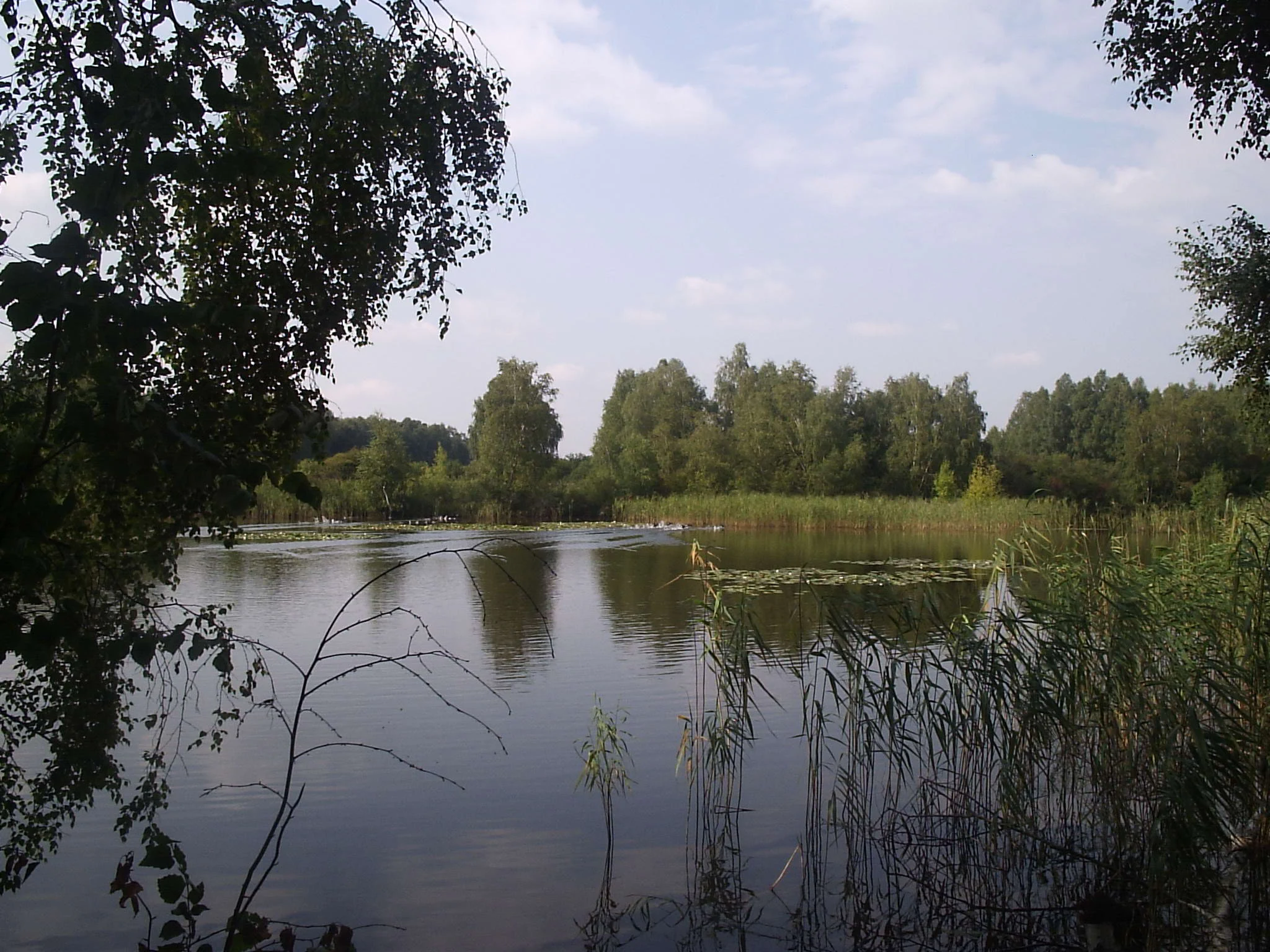
A peaceful pond reflecting trees and a cloudy sky, framed by foliage and reeds in the foreground.
A view of a quiet pond surrounded by trees and reeds at Rezerwat przyrody Miranowo.

Miranowo Nature Reserve history and protected-area timeline

Miranowo Nature Reserve was designated in 1972 through the publication of its founding legal act in the official Polish monitor, making it one of many small nature reserves established in Poland during a period of active expansion of the country's protected-area network. The original designation covered approximately 4.78 hectares of wet meadow bordering Lake Dolskie Wielkie and was intended specifically to protect a relict community of lime-loving phloem plants unique to this part of the Krzywińskie Lake District.

For several decades the reserve functioned essentially as it was originally defined, with its core ecological value tied to the narrow lakeshore fringe where calcareous groundwater influences support the distinctive flora. In 2017 the reserve was expanded to incorporate adjacent private land with comparable ecological character, increasing the total area to 9.89 hectares. At the same time, the management regime was clarified to distinguish between a strict-protection core of around 7.71 hectares and an actively managed zone of about 2.18 hectares, allowing conservation actions to be directed where they are most needed while preserving the most sensitive habitat in an undisturbed state.

Miranowo Nature Reserve landscape and geographic character

The landscape of Miranowo Nature Reserve is defined by a narrow strip of open wetland that hugs the western shore of Lake Dolskie Wielkie. The reserve sits in a gently rolling post-glacial terrain shaped by the broader Krzywińskie Lake District, where small lakes, peat-filled hollows, low moraine ridges, and mixed woodland alternate across a relatively flat but subtly varied surface.

Within the reserve itself, the scenery is dominated by open, waterlogged ground rather than elevation or rock. The protected zone runs as a band roughly 50 to 100 meters wide and extends for about half a kilometer along the lakeshore, creating a soft, meadow-and-mire landscape framed by surrounding forest. Calcareous springs and groundwater seepage along the lakeshore sustain the moderately rich peatland soils, while the lake itself forms a quiet backdrop to the otherwise low, green, and often moss-dominated terrain.
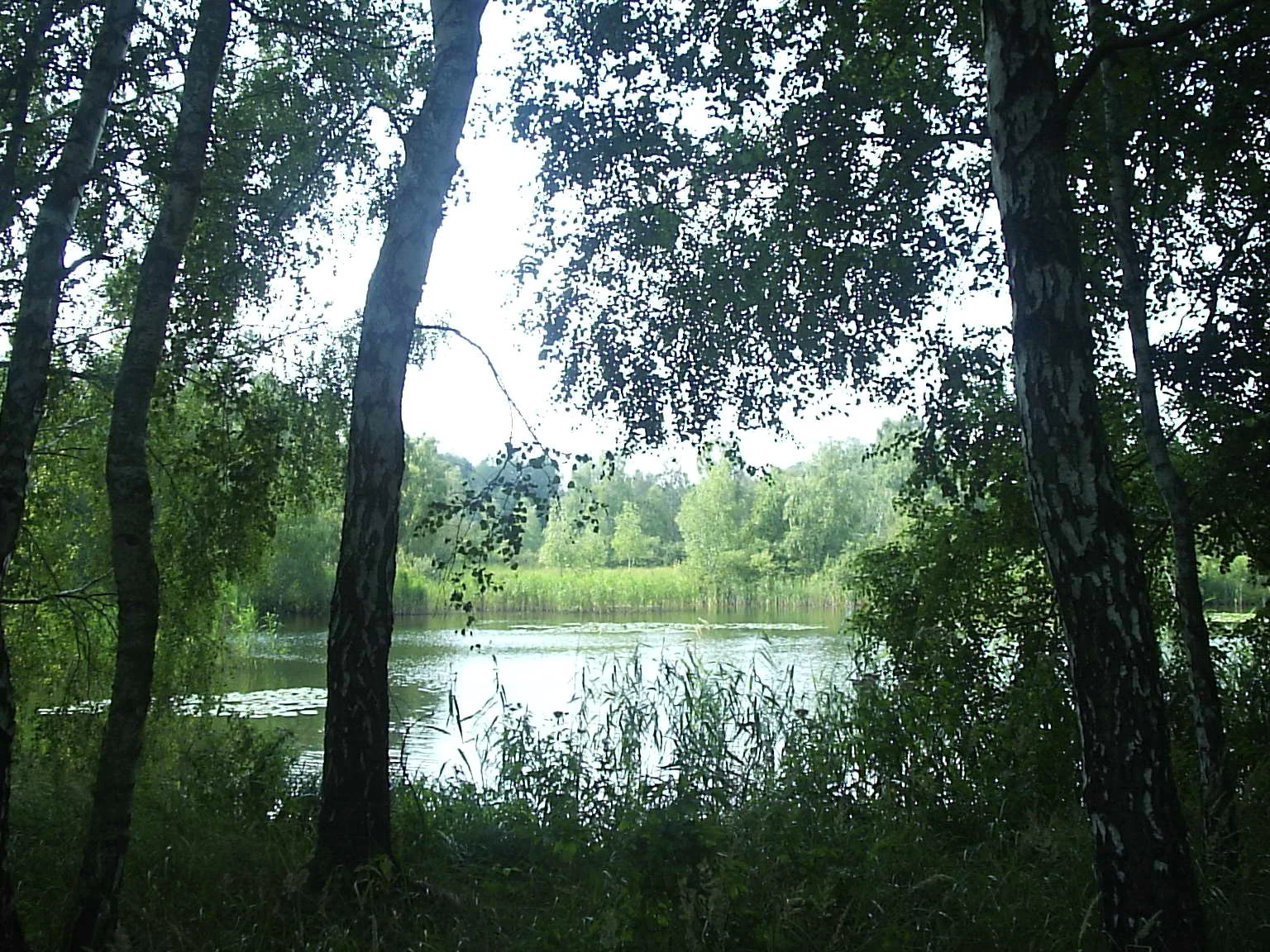
A view from within a forest looking out at a pond surrounded by trees, framed by silver birch trunks in the foreground.
A view through the birch forest at Rezerwat przyrody Miranowo looking toward a pond.

Miranowo Nature Reserve ecosystems, habitats, and plant life

Ecologically, Miranowo is distinguished by the combination of moss-rich peatland, calcareous peatland, and quaking-grass meadow communities developed on lime-influenced wetland soils. These habitats reflect a particular hydrogeological setting in which calcareous groundwater feeds the peat-forming system, producing conditions favorable to a relict plant community that has largely disappeared elsewhere in the region.

The reserve supports an unusually dense concentration of botanical diversity for its size. Surveys have recorded more than 230 species of vascular plants, around 57 species of bryophytes, and several species of charophyte algae within the protected area. The flora reflects the transition between aquatic, mire, and meadow environments of the lakeshore fringe, with characteristic species that depend on the openness, moisture, and chemistry of the peatland for their survival.
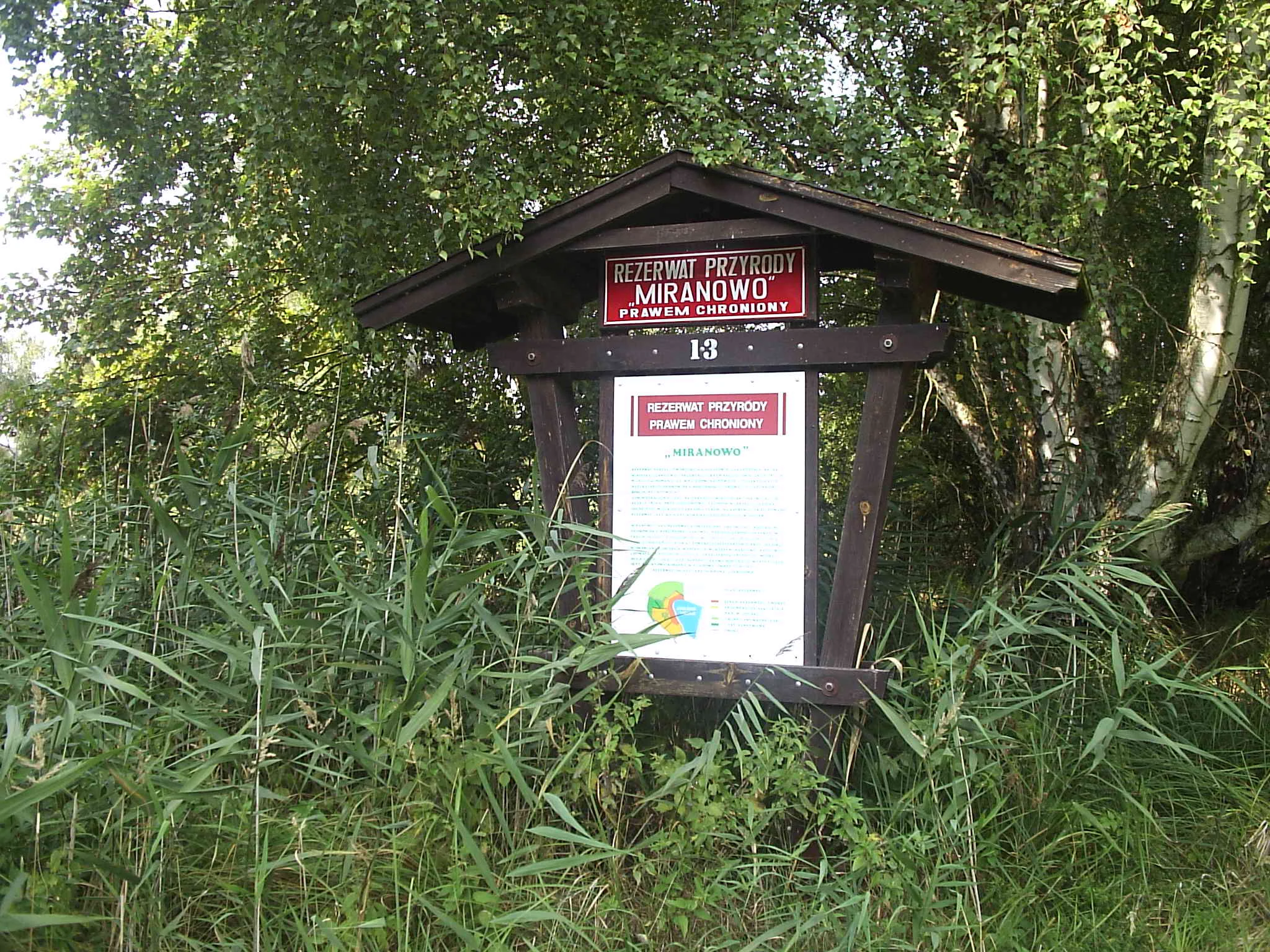
A wooden information sign with a red and white header reading Rezerwat przyrody Miranowo, standing in tall green reeds and surrounded by dense trees.
Information board at the entrance to Rezerwat przyrody Miranowo.

Miranowo Nature Reserve wildlife and species highlights

The wildlife profile of Miranowo is shaped primarily by its wetland and lakeshore habitats. The reserve supports the fauna communities typical of calcareous peatlands, open wet meadows, and the marginal zone of a mesotrophic lake, rather than large charismatic mammal species.

Such transitional peatland landscapes are typically important for invertebrates, amphibians, and wetland-associated birdlife, and the mosaic of open mire, meadow, reed fringe, and adjacent woodland provides habitat structure for species dependent on small-scale variation in moisture and vegetation. Bryophyte and charophyte diversity documented in the reserve also points to a functioning hydrological and chemical environment that supports a broad base of small, often overlooked fauna linked to these specialized plant communities.

Miranowo Nature Reserve conservation status and protection priorities

Miranowo is significant from a conservation perspective as one of the few protected sites in the Wielkopolska region where relict calcareous and moss-rich peatland plant communities still survive in a coherent form. The reserve's designation specifically targets the preservation of łąka trzęślicowa and related calcareous peatland vegetation, habitats that have become increasingly rare across the Polish lowlands due to drainage, agricultural intensification, and natural succession.

The 2017 enlargement and the division of the reserve into strict and active protection zones reflect a modern conservation approach that combines preservation of the most sensitive core with active management of the surrounding buffer. This structure allows the reserve to maintain its open wetland character, counteract terrestrialization of the peatland, and safeguard the rare flora for which Miranowo was originally established. Its importance is therefore not only local: as a reference site for relict lime-loving plant communities, the reserve contributes to the broader understanding and protection of calcareous peatland biodiversity in Poland.

Top sights and standout views in Miranowo Nature Reserve

Miranowo Nature Reserve is a compact peatland reserve distinguished by its protection of a relict, lime-loving plant community along the shore of Lake Dolskie Wielkie. Its over 230 vascular plant species, diverse bryophytes, and presence of charophyte algae make it a botanically dense site relative to its small size.

The reserve combines nearly 8 hectares of strict protection with a smaller zone of active conservation management, allowing both undisturbed refuge conditions and targeted habitat maintenance. Notable species recorded here include lipiennik Loesela, turzyca Davalla, sit tępokwiatowy, and the striking kosatka kielichowa, alongside a healthy representation of calcareous peatland species that have become scarce elsewhere in the Wielkopolska lowlands.

Best time to visit Miranowo Nature Reserve

The character of a visit to the Miranowo area varies with the seasons in ways typical of lowland Polish peatlands. Late spring and early summer are generally the most rewarding periods for observing the meadow and peatland vegetation, when the rich flora of the łąka trzęślicowa and the surrounding wetland is most visible and the reserve is at its greenest.

Late summer and early autumn offer drier ground conditions underfoot, making the soft wetland terrain easier to traverse on nearby paths, while the surrounding deciduous woodland of the Krzywińskie Lake District begins to take on autumn color. Winter visits are generally quiet and visually subdued, but they can highlight the open, flat structure of the wetland landscape when the meadows and peatland are dusted with frost or snow.

Monthly climate preview

Long-term temperature ranges and precipitation rhythm from representative coordinates

Rezerwat przyrody Miranowo Climate Normals and Monthly Weather Patterns

Representative coordinate records show measured monthly temperature variation alongside consistent precipitation levels across the conservation area. Detailed twelve-month climate normals provide complete statistical context for long-term meteorological patterns at the site.
Annual mean9 °C
-2 °C20 °C
Jan-2°
Feb-1°
Mar
Apr
May14°
Jun18°
Jul20°
Aug20°
Sep15°
Oct
Nov
Dec-1°
Warmest month
July

20.3 °C

Coolest month
January

-2 °C

Wettest month
July

2.6 mm/day

Driest month
April

1.1 mm/day

Park location guide

Geography guide, regional context, and park location map for Miranowo Nature Reserve

Miranowo Nature Reserve park geography, regions, and map view in Poland

Understand where Miranowo Nature Reserve sits in Poland through a broader geographic reading of the surrounding landscape, nearby location context, and its mapped position within the national park landscape.

How Miranowo Nature Reserve fits into Poland

Poland, officially the Republic of Poland, is a Central European country spanning from the Baltic Sea in the north to the Carpathian Mountains in the south. It borders Germany, Czech Republic, Slovakia, Ukraine, Belarus, Lithuania, and Kaliningrad Oblast. The country has a temperate climate, diverse landscapes, and is known for its rich history, cultural heritage, and strong economic position within the EU.

Wider geography shaping Miranowo Nature Reserve in Poland

Poland occupies 312,696 km2 in Central Europe, extending from the Baltic Sea coast in the north to the Sudetes and Carpathian Mountains in the south. It borders Germany to the west, Czech Republic and Slovakia to the south, Ukraine and Belarus to the east, and Lithuania and Kaliningrad Oblast to the northeast. The landscape includes lowland plains, uplands, and mountain ranges.

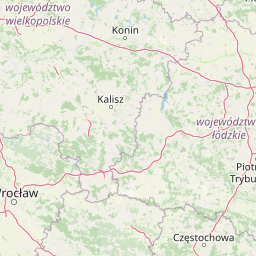
Map view of Miranowo Nature Reserve

Use this park location map to pinpoint Miranowo Nature Reserve in Poland, understand its exact geographic position, and read its mapped placement within the surrounding landscape more clearly.

Pigeon | © OpenStreetMap contributors

Visualizing calcareous peatland habitats and lakeshore terrain in west-central Poland

Rezerwat przyrody Miranowo Photos and Wetland Landscape Scenery

Visual documentation captures the open wetland terrain, moss-rich peatlands, and transitional habitats that define the protected landscape of Rezerwat przyrody Miranowo. Examining these protected area images provides clear insight into the fragile vegetation zones and unique post-glacial topography preserved along the lakeshore.

A peaceful pond reflecting trees and a cloudy sky, framed by foliage and reeds in the foreground.

A calm, still pond surrounded by lush green trees and dense reeds, with water lilies visible on the water surface under a cloudy sky.

A view from within a forest looking out at a pond surrounded by trees, framed by silver birch trunks in the foreground.

A wooden information sign with a red and white header reading Rezerwat przyrody Miranowo, standing in tall green reeds and surrounded by dense trees.

Park atlas

Compare regional wetland habitats and connected post-glacial landscapes across the Krzywińskie Lake District

Explore Other Protected Areas and Nearby Parks Like Rezerwat przyrody Miranowo

Browse adjacent wetland reserves and regional protected landscapes sharing similar post-glacial terrain characteristics. Broaden your geographic comparison by examining connected conservation areas throughout the Wielkopolska lowlands.
A horizontal watercolor painting depicting a wide river flowing through a lush landscape with distant rolling hills and a soft pink sky.
Nature reserveWielkopolska Voivodeship
About 12 km away#1 closest

North

Ostoja Rogalińska: Protected Nature Reserve and Glacial Terrain in Wielkopolska Voivodeship

Mapped riparian corridors, moraine ridges, and bird habitats.

Ostoja Rogalińska offers a detailed look at lowland glacial morphology, featuring twelve mapped lakes, wandering inland dunes, and the extensive Warta River floodplain. This protected area within Wielkopolska Voivodeship preserves ancient pedunculate oaks alongside diverse wetland and forest ecosystems, providing a clear geographic view of one of the region's most important Natura 2000 bird sanctuaries.

Area
217.63 km²
Established
2007
Relief
Lowland
Climate
Temperate
Protected areaGreater Poland Voivodeship
About 22 km away#2 closest

West

Wonieść Lake Protected Area: Geography, Wetland Habitats, and Regional Landscape Context

Postglacial water management and bird refuge in Greater Poland

Examine the geographic character of Wonieść Lake, a segmented retention reservoir reflecting the classic postglacial lowlands of western Poland. This protected area provides a significant wetland habitat within the Krzywińskie Lake District, blending historic hydraulic infrastructure with rich bird populations and forest-fringed shorelines that span across the rural Wielkopolska countryside.

Area
7.77 km²
Established
1974
Relief
Lowland
Climate
Temperate
Nature reserveGreater Poland Voivodeship
About 29 km away#3 closest

West

Rezerwat przyrody Dolinka: Protected Nature Reserve and Botanical Site in Greater Poland

A focused study of wet meadow conservation in western Poland

Rezerwat przyrody Dolinka is a key protected area in Greater Poland, dedicated to maintaining delicate molinia meadow habitats and native globeflower populations. This site highlights the importance of small-scale nature reserves in preserving botanical diversity within the post-glacial landscapes of the Krzywińskie Lakeland, offering a clear look at local environmental protection in action.

Area
0.018 km²
Established
1974
Relief
Lowland
Climate
Temperate
National parkWielkopolska Voivodeship
About 32 km away#4 closest

Northwest

Wielkopolski Park Narodowy: Protected Glacial Landscapes and Regional Geography in Poland

Post-glacial moraine systems and lake basins

Wielkopolski Park Narodowy captures a dense collection of post-glacial landforms, from rolling moraine uplands to clear kettle lakes and esker ridges. This protected area offers a deep look into the geomorphological history of the Wielkopolska region through its varied forest habitats and preserved terrain.

Area
75.84 km²
Established
1957
Visitors
1.2M annual
Relief
Lowland
A soft watercolor painting of a serene wetland landscape with scattered deciduous trees, low grassy banks, and calm water, rendered in light green and muted earth tones against a white background.
Nature reserveGreater Poland Voivodeship
About 34 km away#5 closest

East

Dębno nad Wartą Nature Reserve: Geographic Profile and Protected Landscape Boundaries

Riparian forest sanctuary in the Warta river valley.

Located in the heart of the Greater Poland Voivodeship, this faunistic nature reserve protects a vital fragment of lowland floodplain forest. The site is defined by its complex oak, ash, and elm canopy, which supports rare invertebrate populations rarely found in the broader surrounding region. This atlas entry provides a detailed look at its protected boundaries, hydrologic landscape, and integral role within the Warta river corridor.

Area
0.217 km²
Established
1974
Relief
Lowland
Climate
Temperate
Watercolor painting of a landscape with hills, a lake, and forested areas
National parkPoland
About 36 km away#6 closest

Northwest

Wielkopolska National Park: Poland's Glacial Landscape and Lake District Protected Area

Explore the mapped terrain and protected landscape.

Wielkopolska National Park is a vital protected landscape in western Poland, notable for its characteristic post-glacial terrain. Featuring a landscape defined by numerous kettle lakes nestled within mixed forests and gently rolling hills, this national park offers a representative sample of the Greater Poland lake district's natural heritage. Its mapped boundaries delineate an area of ecological importance, providing valuable context for understanding regional geography and protected area distribution through structured atlas exploration.

IUCN
II
Protected landscapeGreater Poland Voivodeship
About 39 km away#7 closest

Northeast

Żerkowsko-Czeszewski Park Krajobrazowy Protected Landscape: Map and Geographic Overview

Glacial river valleys and moraine hills in Greater Poland

The Żerkowsko-Czeszewski Park Krajobrazowy protects a diverse range of lowland terrains, from the broad Warta River floodplain to the elevated moraine ridges known locally as the Swiss Żerków. This protected area serves as a vital corridor for riparian forests and avian habitats, framed by historic cultural sites across the Greater Poland Voivodeship landscape. Access detailed geographic insights into the riverine networks, forest reserves, and moraine formations that define this notable Polish protected area.

Area
157.95 km²
Established
1994
Relief
Upland
Climate
Temperate
Nature reservePoland
About 40 km away#8 closest

Northeast

Rezerwat przyrody Dwunastak: Protected Forest Reserve and Landscape Map

Ecological mapping in the Wielkopolska region of Poland.

Located in the Warta river corridor, Rezerwat przyrody Dwunastak protects a rare mosaic of riparian and oak-hornbeam forests. This small but significant nature reserve provides a critical study site for lowland woodland habitat connectivity and regional conservation efforts within the broader Żerkowo-Czeszewski Landscape Park framework.

Established
1959

Common questions about visiting, size, designation, and location context for Miranowo Nature Reserve

Miranowo Nature Reserve FAQs for park facts, access, geography, and protected area context

Find quick answers about Miranowo Nature Reserve, including protected-area facts, park geography, trail and visitor context, and how the park fits into its surrounding country and regional landscape.
MoriAtlas Explorer

Continue Your Protected Areas Search Across the Global Atlas

Deepen your exploration by continuing the structured search for national parks and protected areas worldwide. Utilize the comprehensive filtering capabilities to compare different conservation landscapes and refine your understanding of global park geography. Discover more about the distribution and characteristics of protected natural areas.

Global natural geography