
Why Rongelap Atoll stands out
Rongelap Atoll is best known as the inhabited Marshallese community whose residents were exposed to heavy radioactive fallout from the 1954 Castle Bravo nuclear test, the detonation that produced fallout extending across the surrounding Pacific. The atoll's name became internationally associated with questions about nuclear testing ethics, informed consent, and the long-term consequences of fallout exposure on small island populations. It is also known for being the site of the 1985 Greenpeace 'Operation Exodus,' one of the most prominent examples of an environmental organization physically relocating an entire community, moving hundreds of people along with their homes and belongings to Mejato and Ebeye on Kwajalein Atoll.
Rongelap Atoll history and protected-area timeline
The Marshall Islands were originally settled by Micronesian voyagers long before European contact, with Rongelap incorporated into this broader settlement pattern. The first recorded European sighting came in 1528, when Spanish navigator Álvaro de Saavedra charted Rongelap together with neighboring atolls as the Islas de los Reyes because of the proximity of the Epiphany holiday. Fourteen years later the Spanish expedition of Ruy López de Villalobos revisited the area.
In 1885 the atoll was claimed by the German Empire alongside the rest of the Marshall Islands. After the First World War it passed to the Empire of Japan under the South Seas Mandate, and after the Second World War it became part of the United States-administered Trust Territory of the Pacific Islands.
The defining chapter of Rongelap's modern history began with the U.S. atmospheric nuclear testing program. On 1 March 1954, the Castle Bravo hydrogen device at Bikini Atoll detonated far more powerfully than predicted, and fallout drifted onto Rongelap. Inhabitants fell ill with radiation sickness, were evacuated days later, and were later subjected to medical observation under what became known as Project 4.1. Despite warnings about contamination, the U.S. government returned the population in 1957 as part of a study of long-term human radiation effects. Continued thyroid disease, leukemia, miscarriages, and stillbirths led the community to seek international help.
In 1985, with the support of the environmental organization Greenpeace, the entire Rongelapese community was relocated to Mejato and Ebeye on Kwajalein Atoll aboard the Rainbow Warrior. The resettlement, known as 'Operation Exodus,' moved roughly 350 people and around 100 metric tons of building material over ten days. In 1991 the People of Rongelap and Senator Jeton Anjain received the Right Livelihood Award for their campaign against U.S. nuclear policy affecting their homeland. Later decades brought a 1996 compensation agreement, 2014 verification measurements suggesting improved radiation levels, debate about cleanup feasibility, and a 2019 Chinese-backed lease proposal that collapsed after the investor's arrest.
Rongelap Atoll landscape and geographic character
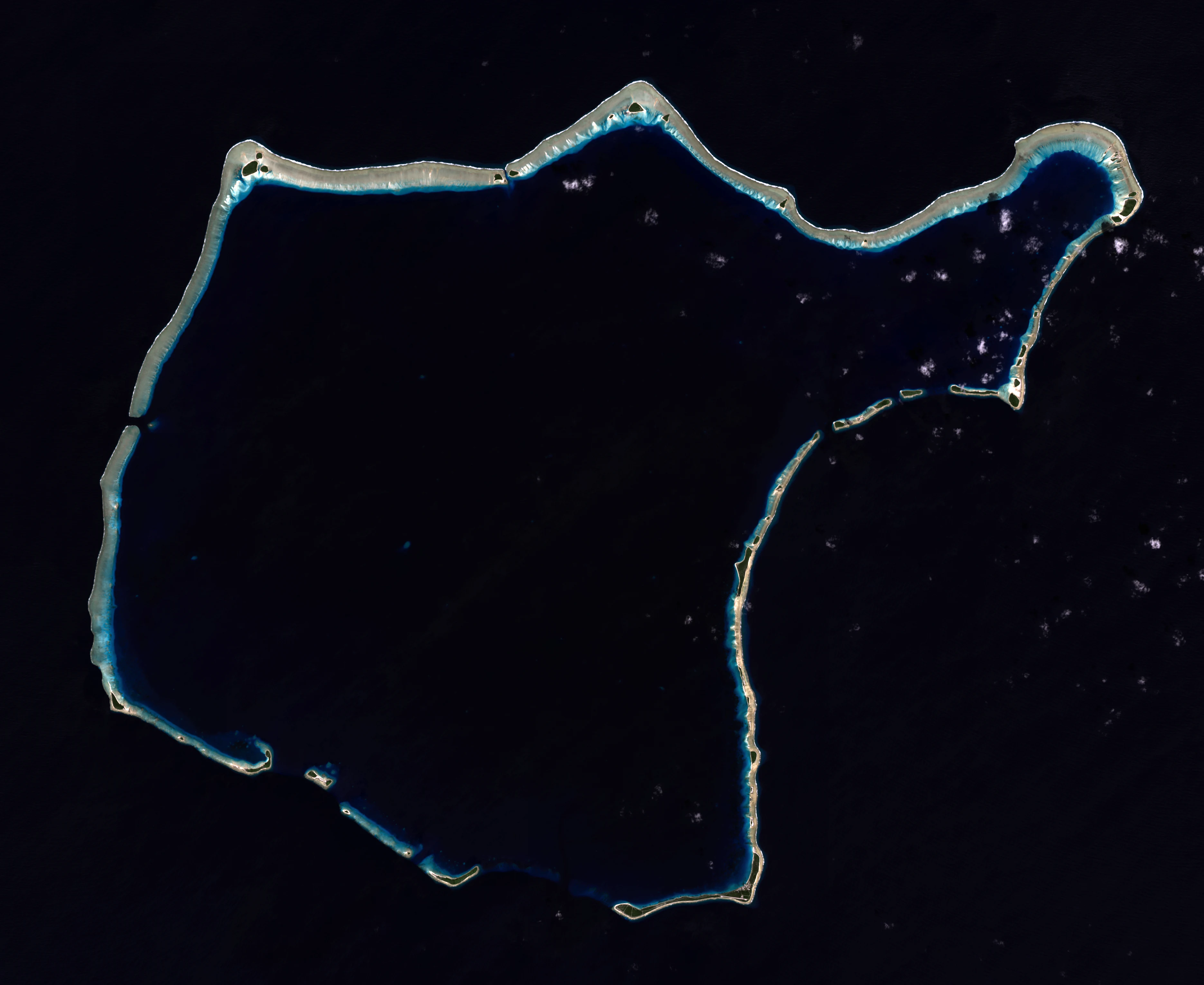
Rongelap is a classic low coral atoll, made up of 61 small islands, or motus, that together cover around 21 square kilometers of land and enclose a lagoon of roughly 2,600 square kilometers. Maximum elevation is only about 3 meters, reflecting the typical thin profile of reef-built Pacific atolls.
The motus themselves are narrow accumulations of coral sand and rubble, often vegetated with hardy coastal species adapted to salt spray and shifting substrates. Surrounding reefs shelter the lagoon and the open ocean edge, giving the atoll a structure of alternating land, reef rim, and deep lagoon typical of the Ralik Chain.
Rongelap Atoll ecosystems, habitats, and plant life
As a low-lying Pacific atoll, Rongelap is shaped primarily by its coral reef ecosystem, sandy motus, and vast enclosed lagoon. Its natural character reflects the broader ecology of the Ralik Chain: reef habitats, lagoon sand and patch-reef environments, and open ocean waters sheltering species typical of Micronesian reef systems.
The sources currently available do not provide detailed ecological inventories of atoll flora and fauna, so any deeper description of endemic or characteristic species would risk speculation.
Rongelap Atoll wildlife and species highlights
The atoll's biological context is consistent with reef and lagoon ecosystems across the Marshall Islands, including typical marine life associated with healthy Pacific coral atolls. However, the Wikipedia source does not provide documented details about specific birdlife, fish, or terrestrial fauna characteristic of Rongelap, so further species-level claims cannot be reliably made here.
Rongelap Atoll conservation status and protection priorities
Rongelap's conservation significance is fundamentally linked to its radioactive contamination history. The U.S. Department of the Interior signed a 1996 resettlement agreement with the islanders that included cleanup steps, and independent measurements in August 2014 reportedly verified safe radiation levels. However, the cleanup approach has been criticized as impractical, and debates over the atoll's long-term ecological integrity continue. Outside conservation issues, the proposal and abandonment of a large foreign-leased special economic zone illustrates how contemporary economic and geopolitical pressures intersect with the atoll's environment.
Rongelap Atoll cultural meaning and human context
Rongelap's cultural importance rests on its place within the broader Marshallese settlement of the Ralik Chain and on the community's distinctive modern history. The 1985 relocation to Mejato and Ebeye effectively transferred the Rongelapese community, including elders and newborns, into an unfamiliar atoll environment, where overcrowding and unemployment became significant challenges.
In 1991 the People of Rongelap and Senator Jeton Anjain received the Right Livelihood Award for their international advocacy. The community's resettlement and the ongoing debates over return, cleanup, compensation, and outside investment together form a major chapter in late-20th and early-21st century Marshallese political and cultural history.
Top sights and standout views in Rongelap Atoll
Rongelap Atoll stands out as a striking combination of classic Pacific atoll geography and one of the most consequential nuclear histories of the modern era. It is defined by 61 motus, a vast enclosed lagoon, and the unmistakable imprint of the Castle Bravo fallout event of 1954.
The atoll is also notable for Operation Exodus, the 1985 Greenpeace-led relocation of an entire community, and for the post-evacuation debates about compensation, radiation verification, and outside investment that continue to shape its future.