
Why Ve Farářském stands out
Ve Farářském is best known for its mesotrophic, waterlogged meadow complex on the western bank of Farářský rybník, where damp grassland grades into sedge stands, rushes, and finally shrubby willow fringes at the pond edge. It is also historically notable as a former locality for white water lily, the water plant that anchored the site's original 1988 protection but which has not been recorded on site for more than ten years. In a broader sense, the site exemplifies the small-scale, pond-margin wetland patches typical of the South Bohemian countryside, where modest protected areas safeguard ecological transitions between open water, marsh, and meadow.
Ve Farářském history and protected-area timeline
Ve Farářském has a short but distinctive administrative history. The site was originally proclaimed on 21 January 1988 under the name Farářský rybník, as a natural monument in what is now the South Bohemian Region. At that time, the pond itself was the core of the protected status, because the water lily known as white water lily was documented there, and the pond's extent broadly defined the protected area's boundary.
In the decades that followed, the white water lily population was not confirmed on the site for more than ten years, reflecting changes in the pond's ecology or in the lily's local status. To reflect this shift and refocus protection on habitat types that remained biologically significant, the territory was re-declared on 16 October 2025 under the new name Ve Farářském.
The 2025 redesignation moved the protected zone onto the western bank of Farářský rybník and changed the conservation subject from a single aquatic plant species to a broader set of mesotrophic wetland habitats. This redefinition preserves continuity for the original locality while aligning the site's legal protection with the vegetation that is actually present and ecologically meaningful today.
Ve Farářském landscape and geographic character
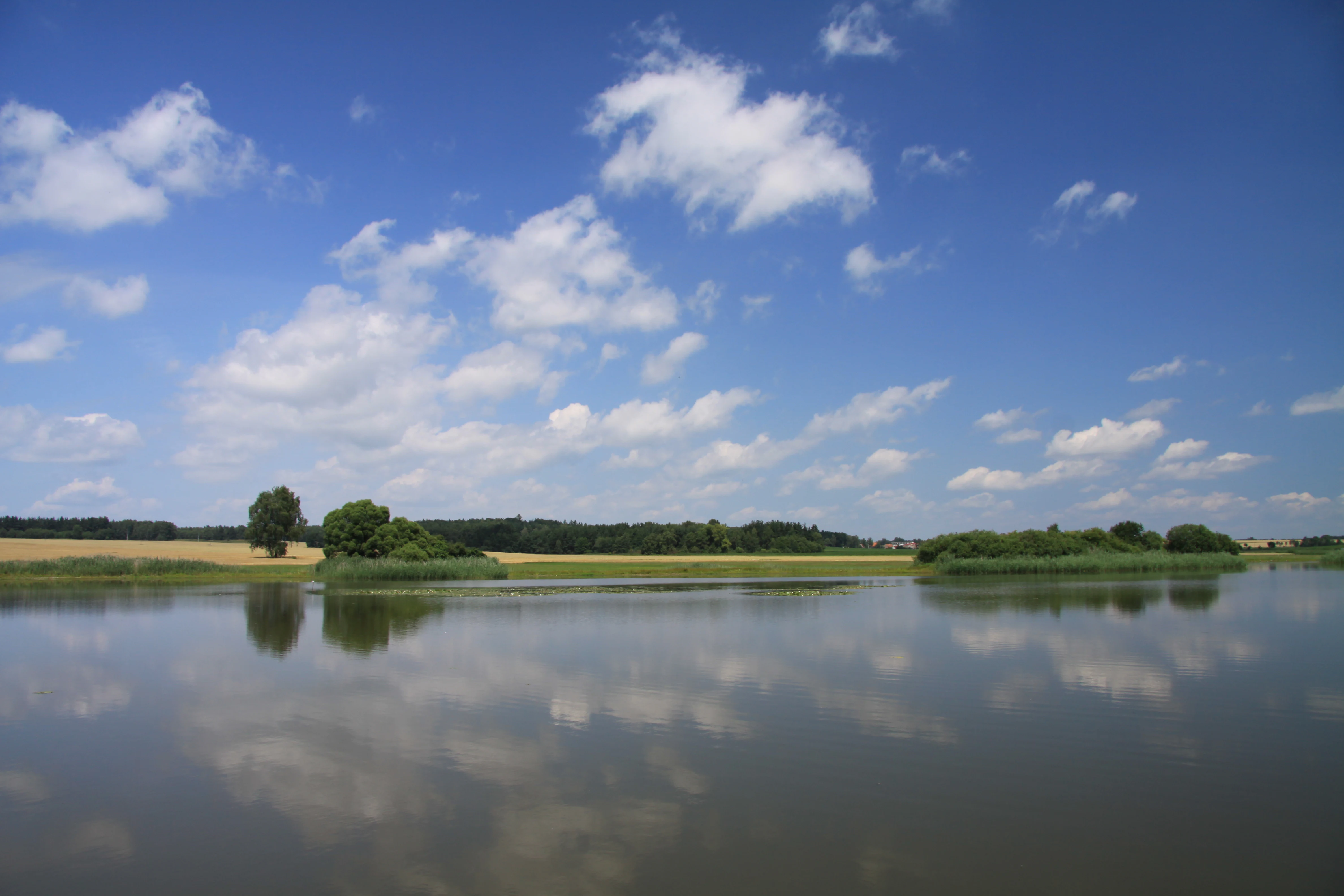
The landscape of Ve Farářském is defined by a single dominant feature: Farářský rybník, a small fishpond set in the flat to gently rolling South Bohemian countryside. The protected strip runs along the western shore of the pond, occupying the transition between open water and the surrounding agricultural land.
At ground level, the bank's vegetation forms a clear gradient. Inland from the water, damp mesotrophic meadows hold the gentle slope. Moving toward the pond, sedge-dominated stands appear, followed by rush formations in the wettest positions. At the pond margin, low shrubby willows fringe the water, creating a soft, water-bound edge that contrasts with the more open meadow further up the bank.
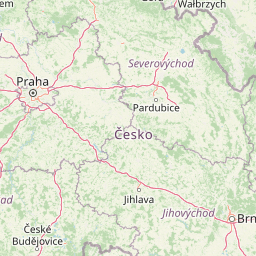
The wider setting is characteristically South Bohemian: a mosaic of fishponds, meadows, fields, small villages, and woodland patches typical of the Tábo district. The protected area sits at approximately 430 meters elevation, and its scale is small, but it captures the specific landform pattern where a pond margin becomes a wetland meadow, a configuration that recurs across this part of the Czech Republic.
Ve Farářském ecosystems, habitats, and plant life
The vegetation at Ve Farářském is the heart of the site's ecological identity. The protected meadow complex is described as mesotrophic and waterlogged, indicating soils that are consistently wet but not severely nutrient-enriched, a condition that supports a distinctive plant community often lost to drainage and intensification.
Three structural vegetation layers are recognized. Mesotrophic meadows form the inland and largest component. Sedge and rush communities occupy transitional, wetter ground, with Carex species and bulrush (Sítina) playing important roles. At the pond edge, littoral stands dominated by shrubby willows replace the herbaceous vegetation, creating a low woody fringe.
Three species are explicitly named in the conservation subject. Marsh pennywort (Hydrocotyle vulgaris) and tufted loosestrife (Lysimachia thyrsiflora) are characteristic mesotrophic-wetland plants whose continued presence anchors the site's value. White water lily (Nymphaea alba) is also named, although it has not been confirmed on the site for more than ten years, indicating ongoing monitoring interest in the pond's aquatic flora alongside the bank meadows.
Ve Farářském wildlife and species highlights
The available source material for Ve Farářském does not provide detailed wildlife information beyond the botanical focus of the site. No bird, mammal, fish, or invertebrate species are described, and no specific faunal conservation targets are named. The site's ecological story is primarily told through plant communities and habitat types rather than animal life.
This reflects a broader pattern for very small pond-margin natural monuments in the Czech Republic, where the formal protection subject is usually centered on vegetation rather than fauna, even though such habitats often support amphibians, dragonflies, and waterbirds as part of the wider landscape. For Ve Farářském, a standalone wildlife section cannot be supported without speculation, and so is not developed here.
Ve Farářském conservation status and protection priorities
Ve Farářském is protected as a přírodní památka, a natural monument under Czech nature conservation law, corresponding to IUCN category III. The designation emphasizes the protection of specific natural features, here particular plant habitats and species, rather than full ecosystem-scale protection.
Two conservation phases are visible in the site's history. From 1988, protection focused on the white water lily population in Farářský rybník. After that population was no longer confirmed, the 2025 redesignation shifted the protected territory from the pond itself to the western bank and broadened the conservation subject to cover mesotrophic waterlogged meadows, their transition through sedge and rush communities, and the littoral willow fringe.
The current legal protection explicitly hinges on three plant elements: the mesotrophic meadow complex, marsh pennywort, and tufted loosestrife, with white water lily retained as part of the conservation subject despite its absence in recent years. This combination signals a conservation approach that protects both habitat structure and indicator species, anchoring the site's long-term significance on the persistence of these particular wetland communities in the South Bohemian landscape.
Top sights and standout views in Ve Farářském
The standout features of Ve Farářském are concentrated on a few hectares of pond-margin habitat. The site's key highlights include the mesotrophic waterlogged meadows on the western bank, the visible gradient from sedge and rush stands to shrubby willow fringe, and the named plant species of conservation interest: marsh pennywort, tufted loosestrife, and historically white water lily.
Equally notable is the site's recent administrative transformation: a 1988 fishpond-centered protection was reworked in 2025 into a bank-focused designation, making Ve Farářském a small but instructive example of how Czech natural monuments evolve to track real ecological change on the ground.
Best time to visit Ve Farářském
Ve Farářském is a small natural monument whose appeal lies in observing a specific habitat, the mesotrophic wet meadow and pond margin, rather than in dramatic seasonal scenery. Late spring and summer are generally the most rewarding periods for visiting similar South Bohemian wetland sites, when meadow and marsh plants are in active growth and identification of characteristic species is easiest.
Visiting during drier spells can make wet-meadow terrain easier to walk on, while higher water levels in and around Farářský rybník may make the bank vegetation more vivid but potentially harder to approach. Because the site is small and ecologically focused, it suits short, observational visits rather than extended excursions; the quality of the experience depends primarily on the state of the meadow rather than on any specific calendar window.