
Why Weserniederung am Heiligenberg stands out
The reserve is best known for its elongated calcareous spring horizon ('Quellhorizont') with active tufa-forming springs, a relatively rare habitat type in Lower Saxony. These springs have built calcareous spring mires that harbor specialized invertebrates such as the bulgy whorl snail and the striped spring demoiselle. Equally distinctive is the way hydrology, soils, and forest types interact within a very small area: alder-ash gallery forest threaded with spring rivulets gives way to oak-hornbeam and beech forests on the slopes, while the Weser bank carries willow floodplain woodland. The concentration of woodland, wetland, and floodplain elements in one compact site, together with confirmed breeding of black stork and eagle owl, makes the reserve a notable biodiversity hotspot in the otherwise heavily cultivated Solling foreland.
Weserniederung am Heiligenberg history and protected-area timeline
The Weserniederung am Heiligenberg received formal nature reserve (Naturschutzgebiet) status under the designation NSG HA 225 on 30 June 2016, with the Landkreis Holzminden acting as the responsible lower nature protection authority. The decision brought together long-existing natural values: a calcareous spring horizon, mature mixed deciduous forests with significant old and deadwood, and floodplain sections along the Weser.
A core portion of the reserve, roughly 5.97 hectares, had already been recognized at the European level as the FFH (Habitats Directive) site 'Quellsumpf am Heiligenberg'. With the 2016 designation, this area was formally embedded into the national nature reserve framework. Most of the FFH section simultaneously forms part of the EU Birds Directive site 'Sollingvorland', integrating the site into both habitat and species protection networks.
Management of the reserve is carried out under the technical oversight of the Niedersächsischer Landesbetrieb für Wasserwirtschaft, Küsten- und Naturschutz (NLWKN). Ongoing measures include regular mowing of the open spring mire areas to keep them free of encroachment, and the long-term conversion of non-typical forest stands into ones composed of species naturally suited to these calcareous, spring-influenced soils.
Weserniederung am Heiligenberg landscape and geographic character
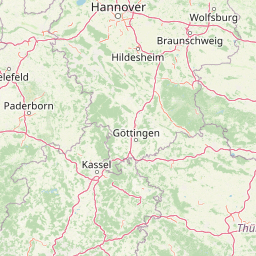
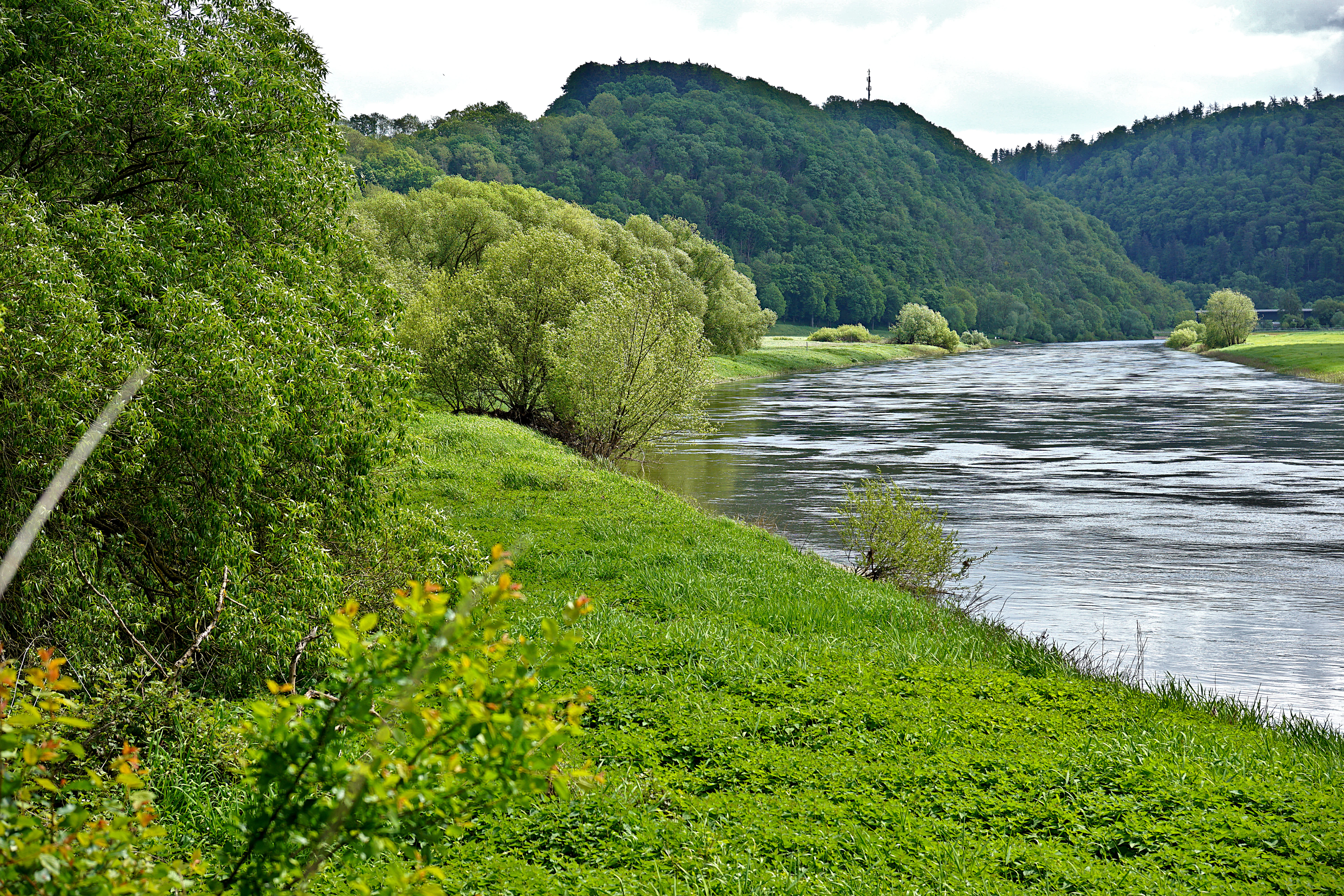
The reserve lies at the transition between the Weser floodplain and the wooded lower slopes of the Weserbergland. Its elevation runs roughly from about 72 m to 95 m above sea level, covering the gentle rise from the Weser bank up the foot of the Heiligenberg. The hill itself, characteristic of the Solling foreland, has its base tucked against the wet lowlands, producing the conditions for the site to capture and discharge groundwater along a distinct spring horizon.
Geomorphologically, the area combines three zones: the active floodplain of the Weser with its natural flood channels along the western edge, the spring-fed seepage belt on the lower slope, and the more consolidated, loamier soils higher up that support taller deciduous forest. The interplay of base-rich spring water, periodic flooding influence from the Weser, and stable forest soils on the slope is what gives the site its unusual habitat diversity within a very small footprint.
Weserniederung am Heiligenberg ecosystems, habitats, and plant life
Ecologically, Weserniederung am Heiligenberg is defined by the calcareous spring system that runs through its center. Along this line, lime-rich groundwater emerges to form actively tufa-depositing springs (Kalktuffquellen) and a chain of calcareous spring mires (Kalk-Quellmoore). These habitats are uncommon in Lower Saxony and are the principal reason the site has been included in the EU Habitats Directive network.
The forest mosaic mirrors the soil and moisture gradient. On the moister, base-rich lower slopes, oak-hornbeam mixed forest with pedunculate oak, hornbeam, and small-leaved lime forms the main cover, accompanied by a shrub and herb layer rich in woodruff, wood anemone, greater stitchwort, hairy melick, and wood melick. Higher on the slope, woodruff beech forest prevails, with beech, ash, sycamore maple, wild cherry, oak, hornbeam, and aspen. Where the spring rivulets feed the valley bottom in the northwest, an alder-ash floodplain forest has developed, characterized by common ash and black alder and notable for its high proportion of old and dead trees, including cavity-bearing individuals.
In the open wetland and floodplain zones, reed beds of common reed and reed canary grass, stands of Himalayan balsam, and tall herb flood meadows with butterbur and hedge bindweed give way to specific wet-indicator species such as narrow-leaved water parsnip and bitter cress. Along the Weser bank, willow-dominated soft floodplain woodland with fluted elm completes the habitat mosaic.
Weserniederung am Heiligenberg wildlife and species highlights
The combination of spring mires, old deciduous forest with deadwood, and floodplain woodland supports a characterful mix of fauna. The calcareous spring mires harbor the bulgy whorl snail (Bauchige Windelschnecke), an indicator of near-natural, lime-rich seepage habitats that has declined across much of central Europe. The striped spring demoiselle (Gestreifte Quelljungfer), a dragonfly of clean, well-vegetated spring brooks, also finds suitable breeding conditions here.
The forest structure, with abundant old and dead trees, makes the reserve important for cavity-nesting species. Confirmed or characteristic breeding birds include eagle owl, black stork, red kite, black kite, grey woodpecker, black woodpecker, and red-backed shrike. Grey herons forage along the floodplain, and the general richness of the Weser floodplain draws additional wading and water-associated species during migration.
Mammals and invertebrates benefit from the continuity and structural diversity of the forest stands, particularly the alder-ash floodplain woodland with its high deadwood component, which provides habitat for saproxylic beetles, bats, and other woodland specialists.
Weserniederung am Heiligenberg conservation status and protection priorities
Conservation significance at Weserniederung am Heiligenberg rests on three overlapping layers. At the national level, the site is a Naturschutzgebiet under the Lower Saxon nature protection framework, with designated management authority and rules on access; the spring mires and their surroundings are kept open through regular mowing to prevent scrub encroachment.
At the European level, the core 5.97-hectare portion is the FFH site 'Quellsumpf am Heiligenberg', recognizing its value as a representative example of calcareous spring mire habitat. Most of this section is also part of the EU Birds Directive site 'Sollingvorland', tying the reserve into the broader protection of bird populations of the Solling foreland. The reserve borders the landscape protection area 'Sollingvorland-Wesertal', extending the effective conservation landscape along the Weser.
A forward-looking management goal is the long-term conversion of forest stands composed of species not naturally suited to these calcareous, spring-influenced soils into more typical, site-appropriate forests, gradually shifting the woodland composition toward the oak-hornbeam, beech, and alder-ash communities that characterize the undisturbed hydrological conditions of the area.
Weserniederung am Heiligenberg cultural meaning and human context
The reserve sits in a landscape shaped by centuries of small-scale agriculture, forestry, and settlement along the middle Weser. The nearby town of Bodenwerder is closely associated with the literary figure of Baron Hieronymus Karl Friedrich von Münchhausen, whose fantastical tales have become a regional cultural hallmark. The Weserbergland more broadly, with its hilltop castles, half-timbered villages, and the river as a historic transport corridor, carries a long tradition of interaction between people and this particular stretch of valley, including watermills, river trade, and forest use.
The presence of officially designated landscape protection areas around the reserve reflects the regional tradition of balancing agricultural land use, forestry, and habitat protection, an approach that has helped maintain smaller, hydrologically sensitive features such as the Heiligenberg spring horizon.
Top sights and standout views in Weserniederung am Heiligenberg
A linear calcareous spring system with active tufa deposition and associated calcareal spring mires, a habitat type that is regionally uncommon and a key reason for European-level protection of the site.
An unusually compact mosaic of oak-hornbeam forest, woodruff beech forest, and alder-ash floodplain forest laced with spring brooks, complemented by willow soft floodplain woodland along the Weser itself.
High structural quality in the floodplain forest, with abundant old and dead trees providing cavity nesting sites for eagle owl, black stork, and woodpeckers, and breeding or foraging habitat for red and black kite, grey heron, and red-backed shrike.
Integration into both the EU Habitats Directive site 'Quellsumpf am Heiligenberg' and the EU Birds Directive site 'Sollingvorland', linking the reserve to wider conservation networks in the Weserbergland.
Best time to visit Weserniederung am Heiligenberg
Spring and early summer are the most rewarding seasons to experience the site, when the calcareal springs and mires are at their most active, the tall herb floodplain vegetation is in full growth, and woodland birds are establishing breeding territories. Late spring is also when many of the characteristic forest herbs, such as wood anemone and greater stitchwort, are at peak display beneath the deciduous canopy.
Autumn offers quieter conditions, the structural richness of the forests with their old and dead trees, and the chance to observe migrating raptors and waterbirds along the Weser. Winter visits can be productive for tracking waterbirds on the river, though the broader impression of the site's character comes through most clearly between April and June, when the interplay of water, woodland, and spring-fed vegetation is most vivid.