
Why White Mountain National Forest stands out
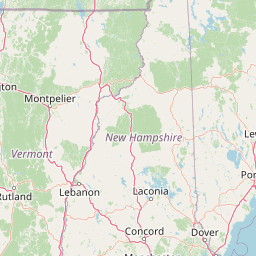
The White Mountain National Forest is best known for its dramatic alpine landscapes across the White Mountains of New Hampshire. The Presidential Range, anchored by Mount Washington, is one of the most famous mountain ridges in the eastern United States, and the nearby Franconia Notch draws visitors with its cliffs, notches, and historic sites. The Pemigewasset, Sandwich Range, and Wild River wilderness areas add expansive backcountry character to the forest, making it a flagship destination for both casual recreation and serious wilderness hiking. The forest is also widely recognized as a major outdoor recreation hub on the East Coast. It combines high-mountain scenery with a dense trail network, campgrounds, scenic highways like the Kancamagus, and active ski areas. Its proximity to Boston and other Northeastern cities has shaped its identity as a regional escape for hiking, climbing, leaf-peeping, and winter sports, while its 100-plus miles of Appalachian Trail contribute to its standing as a core piece of America's long-distance hiking tradition.
White Mountain National Forest history and protected-area timeline
The origins of the White Mountain National Forest lie in the early twentieth-century movement to reverse the environmental damage caused by unregulated logging in New England. By the late 1800s and early 1900s, the White Mountains had been heavily logged, and fires, erosion, and degraded watersheds prompted a national response.
The Weeks Act, passed by Congress in 1911, gave the federal government the authority to purchase private land to protect watersheds, navigable streams, and timber resources. Federal acquisition in the White Mountains began in 1914, and on May 16, 1918, the White Mountain National Forest was officially established as one of the earliest national forests in the East created under this authority. Conservationist and community activist Katherine Sleeper Walden played a notable role in identifying and securing threatened lands for inclusion in the forest, including significant acreage around the bowl near Wonalancet, New Hampshire.
Over the following decades, the forest's boundaries expanded and its management mandate deepened. The Federal Wilderness Protection Act of 1984 led to the formal designation of several wilderness areas within the forest, including the Presidential Range-Dry River, Great Gulf, Pemigewasset, and Sandwich Range wildernesses. The New England Wilderness Protection Act of 2006 further expanded the Sandwich Range Wilderness and created the Wild River Wilderness, strengthening the forest's standing as both a working landscape and a refuge for backcountry solitude.
White Mountain National Forest landscape and geographic character
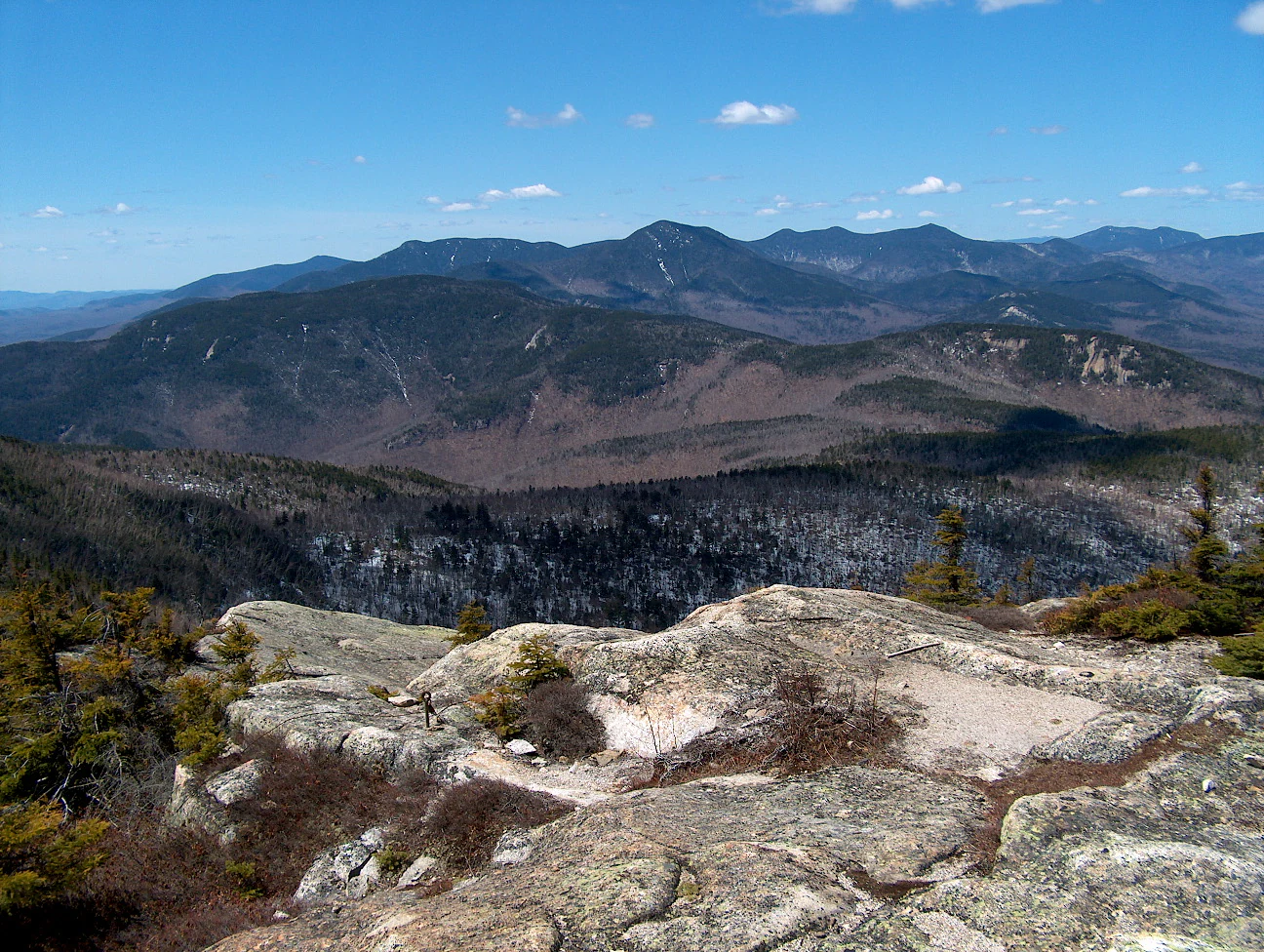
The landscape of the White Mountain National Forest is dominated by the folded ridges, deep river valleys, and alpine summits of the White Mountains. Most of the major New Hampshire peaks above 4,000 feet fall within or adjacent to the forest, creating a skyline of exposed rock, krummholz, and subarctic vegetation at higher elevations. Glaciation shaped the region's characteristic U-shaped notches, hanging valleys, and broad cirques, the most famous of which is Franconia Notch, a narrow pass framed by cliffs and traversed by I-93.
The Presidential Range is the most prominent feature of the forest, a jagged spine that includes Mount Washington, Mount Adams, Mount Jefferson, and surrounding peaks. East of the Presidential Range the terrain diversifies into the broad Franconia Range, the more rounded Twin and Bond ranges, and the remote Sandwich Range to the south. Across the forest, the Pemigewasset Wilderness offers an expansive, heavily wooded backcountry defined by tributaries of the Pemigewasset River, while the Wild River Wilderness in the east provides a steeper, more isolated riverscape along the Wild River corridor.
Forest roads and scenic byways wind through these landscapes, and the Kancamagus Highway is one of the most celebrated scenic drives in New England, threading 34 miles through the heart of the forest along the Swift River between Lincoln and Conway. River systems shaped by water flowing off the high peaks, including the Pemigewasset, Androscoggin, Saco, and Wild River, give the forest much of its hydrological character and feed into broader New England watershed systems.
White Mountain National Forest ecosystems, habitats, and plant life
The White Mountain National Forest contains a mosaic of northern hardwood, spruce-fir, and boreal-alpine forest communities that reflect both its elevation range and its northern New England climate. At lower elevations, sugar maple, American beech, yellow birch, and white ash form classic northern hardwood stands, transitioning into mixed conifer-hardwood forests as elevation increases. Higher elevations are dominated by red spruce and balsam fir, with patches of paper birch and mountain ash, giving way to stunted krummholz and alpine tundra above the tree line.
The forest's ecosystems also include river and wetland systems that sustain fisheries and aquatic life. Cold, oxygen-rich streams descending from high peaks support native brook trout and other freshwater species, while beaver activity creates wetlands that shape both wildlife habitat and downstream flow patterns. The wilderness areas, in particular, preserve older forest stands, peatlands, and other disturbed-minimal environments that contrast with the more actively managed sections of the forest.
Elevation gradients within the forest create ecological compression, allowing northern and subalpine species to occur relatively close to lower-elevation hardwood communities. This ecological layering makes the White Mountain National Forest a useful natural laboratory for studying forest response to climate change, particularly as warmer winters and shifting precipitation patterns alter the composition of high-elevation spruce-fir stands.
White Mountain National Forest wildlife and species highlights
The White Mountain National Forest supports a diverse community of mammals, birds, and other wildlife characteristic of northern New England's forests. White-tailed deer and eastern moose are among the most visible large mammals, and the forest is also home to American black bears, eastern coyotes, and bobcats. Smaller carnivores include fisher, American marten, mink, North American river otters, and both red and gray foxes. Canadian lynx have also been documented in the region, reflecting the forest's role as habitat for species associated with the broader northern boreal landscape.
Birdlife in the forest is similarly varied. Bald eagles nest in the region and can be seen along rivers and lakes, while peregrine falcons have returned to cliff habitats after historic declines. Common ravens and other boreal bird species are associated with the high elevations of the Presidential Range, while more typical forest songbirds occupy the hardwood and mixed-forest stands below.
Beavers, raccoons, and North American porcupines are among the more familiar mammals encountered in the forest, and brook trout sustain recreational fishing in cold-water streams. Because the forest spans wilderness, roadless, and managed landscapes, wildlife habitat quality varies, with wilderness and designated roadless areas providing some of the most secure habitat for species sensitive to human disturbance.
White Mountain National Forest conservation status and protection priorities
The White Mountain National Forest represents one of the success stories of early-twentieth-century conservation policy in the eastern United States. Its establishment under the Weeks Act was a direct response to deforestation, watershed degradation, and uncontrolled fires, and it demonstrated that federally managed, multi-use forests could help restore and protect damaged landscapes. Today, the forest continues to function as a major watershed protector, regulating water flow for downstream communities and contributing to regional water quality.
Six designated federal wilderness areas within or adjacent to the forest, Presidential Range-Dry River, Great Gulf, Pemigewasset, Sandwich Range, Wild River, and Caribou-Speckled Mountain, anchor the forest's conservation role. These areas are protected from logging and commercial development and are managed primarily for recreation and scientific values. Their expansion, particularly through the 2006 New England Wilderness Protection Act, reflects ongoing efforts to strengthen habitat connectivity and preservation in the region.
The forest also plays a growing role in climate-related research and management. Projected declines in winter season length are expected to alter the ski economy and recreational patterns within and around the WMNF, while warmer conditions may already be pressing on high-elevation spruce-fir forests, wildlife habitat boundaries, and aquatic systems. These pressures position the White Mountain National Forest as an important case study for adaptive forest management in a changing climate.
White Mountain National Forest cultural meaning and human context
The White Mountain National Forest sits in a region with deep cultural ties to mountain recreation, literature, and tourism. Long before its designation, the White Mountains had become a destination for nineteenth-century artists, writers, and vacationers drawn to scenery that resembled the Alps. The completion of the Mount Washington Cog Railway in 1869 and the construction of mountain hotels and inns helped embed the region in American travel culture.
The forest's management helped preserve and shape that recreational identity across the twentieth century. The Appalachian Trail, which crosses more than 100 miles of the forest, links the region to the broader long-distance hiking movement in the United States. Local communities around the forest, including Conway, Lincoln, Campton, and Gorham, developed economies tied to outdoor recreation, leaf-peeping tourism, and increasingly skiing, as ski areas proliferated within and adjacent to the national forest boundaries.
Conservationists were also central to the forest's cultural history. Figures such as Katherine Sleeper Walden played an important role in advocating for protective land acquisition at a time when much of the White Mountains was still privately owned. Today, the coexistence of small mountain communities, working forestry, and federally managed land continues to define the cultural landscape of the region.
Top sights and standout views in White Mountain National Forest
The White Mountain National Forest stands out for its unusual combination of scale, accessibility, and ecological diversity in the eastern United States. Few eastern landscapes combine rugged four-thousand-foot mountains, designated federal wilderness, and such a dense trail network within a single federally managed unit. The forest's relationship with Mount Washington, the Presidential Range, and the Appalachian Trail gives it a recognizable identity that extends far beyond New Hampshire.
At the same time, the forest's role as a working landscape distinguishes it from more strictly protected eastern parks. The integration of timber management, watershed protection, wilderness preservation, ski areas, and recreation offers a distinctive model of multi-use forest management. Add to that six formal wilderness areas, celebrated scenic drives like the Kancamagus Highway, and wildlife ranging from moose and black bears to peregrine falcons, and the White Mountain National Forest emerges as one of the most landscape-rich and experience-rich public forest lands in the East.
Best time to visit White Mountain National Forest
The White Mountain National Forest offers sharply different experiences depending on the season. Late spring through early fall is generally the most accessible period, with the highest peaks typically free of snow by mid to late summer and the full trail network open. Autumn is especially well known for fall foliage, when the northern hardwood stands of sugar maple, birch, and beech turn shades of orange, red, and gold, drawing visitors along the Kancamagus Highway and other scenic drives.
Winter transforms the forest into a destination for skiing, snowshoeing, and winter mountaineering, particularly around the Presidential Range and the many ski areas that operate within or adjacent to the forest. High summits, including Mount Washington, have notoriously severe weather; the U.S. Forest Service notes that the area has been called home to the worst weather in America, with extreme winds and rapidly changing conditions. Visitors planning a winter trip, especially one involving high-elevation terrain, should expect sub-freezing temperatures, deep snow, and short daylight hours, conditions that historically have contributed to a long record of incidents on Mount Washington and the Presidential Range.