Mori Atlas logo
National parkBadlands National Park

Explore the mapped terrain and unique geologic formations of this National Park.

Badlands National Park: South Dakota's Iconic Protected Landscape for Geographic Discovery

Badlands National Park represents a significant protected landscape within South Dakota, offering unparalleled opportunities for atlas-driven geographic exploration. This National Park is defined by its distinct geological features and expansive mapped terrain, providing a unique context for understanding regional natural landscapes. Users can delve into the park's protected boundaries and discover the rich geographic tapestry that makes this area a cornerstone for natural landscape study.

BadlandsNational ParkSouth DakotaMixed Grass PrairieFossil SitesGreat Plains

Badlands National Park

National park

Park overview

Structured park overview, official facts, and landscape profile for Badlands National Park

Badlands National Park park facts, protected area profile, and essential visitor context
Review the core facts for Badlands National Park, including designation, size, terrain, visitor scale, habitats, and operating context in one park-focused overview.

About Badlands National Park

Badlands National Park occupies a unique position among American protected areas, combining extraordinary geological and paleontological significance with deep Native American cultural heritage. The park's landscape developed over approximately 33 million years of geological time, as ancient seas, rivers, and volcanic activity deposited layers of sediment that have since been dramatically eroded by wind and water to create the distinctive buttes and spires visible today. The White River Badlands have attracted scientific attention since the 1840s, when fossil collectors first recognized the area's remarkable paleontological potential. Today, the park contains fossils representing dozens of species of ancient mammals, including early horses, camels, rhinoceroses, and titanotheres. The mixed grass prairie surrounding the badlands formations represents the largest remaining example of this ecosystem type in the United States, supporting diverse wildlife including bison, bighorn sheep, pronghorn, and endangered species such as the black-footed ferret and whooping crane.

Quick facts and research context for Badlands National Park

Badlands National Park spans Jackson, Oglala Lakota, and Pennington counties in southwestern South Dakota. The park was established as a national monument in 1939 and redesignated as a national park in 1978. It protects the White River Badlands, a region internationally recognized for its rich Oligocene fossil deposits dating back approximately 33 million years. The Badlands Wilderness covers 64,144 acres of the North Unit as a designated wilderness area. The South Unit encompasses 133,300 acres of land within the Pine Ridge Indian Reservation, managed under agreement with the Oglala Lakota tribe. The park is home to a bison herd that has grown from 50 individuals introduced in 1963 to over 1,200 animals today.

Park context

Deeper park guide and search-rich context for Badlands National Park

Badlands National Park history, landscape, wildlife, and travel context
Explore Badlands National Park through its history, landscape character, ecosystems, wildlife, conservation priorities, cultural context, and seasonal travel timing in a structured park guide built for atlas discovery and search intent.

Why Badlands National Park stands out

Badlands National Park is best known for its extraordinary geological formations, comprising hundreds of square miles of eroded buttes, pinnacles, and layered sedimentary cliffs. The park protects the White River Badlands, which contain the richest known deposits of Oligocene mammal fossils in the world, providing invaluable scientific insight into prehistoric life 33 million years ago. The park is also renowned as the site of one of the last Ghost Dances in 1890 and is closely associated with the Wounded Knee Massacre. Additionally, Badlands serves as a critical conservation area for the endangered black-footed ferret, one of North America's most endangered mammals, which has been successfully reintroduced within the park.

Badlands National Park history and protected-area timeline

The history of Badlands National Park reflects both geological discovery and complex human narratives spanning thousands of years. Native Americans have inhabited this region for approximately 11,000 years, with the Lakota people giving the area its name, Makȟóšiča, meaning bad lands, reflecting the challenging terrain and extreme temperatures. Following the 1868 Treaty of Fort Laramie, which promised the Badlands would remain Sioux territory, the land was confiscated in 1889. In the late 19th century, the area became the site of the Ghost Dance movement, with one of the last ceremonies conducted on Stronghold Table in 1890. The park was authorized as Badlands National Monument on March 4, 1929, by President Calvin Coolidge and formally established on January 25, 1939. Under the Mission 66 program, the Ben Reifel Visitor Center was constructed in 1957-58. The monument was redesignated as Badlands National Park on November 10, 1978. During World War II, portions of the South Unit were used as a military bombing and gunnery range, with over 125 families forcibly relocated from the area.

Badlands National Park landscape and geographic character

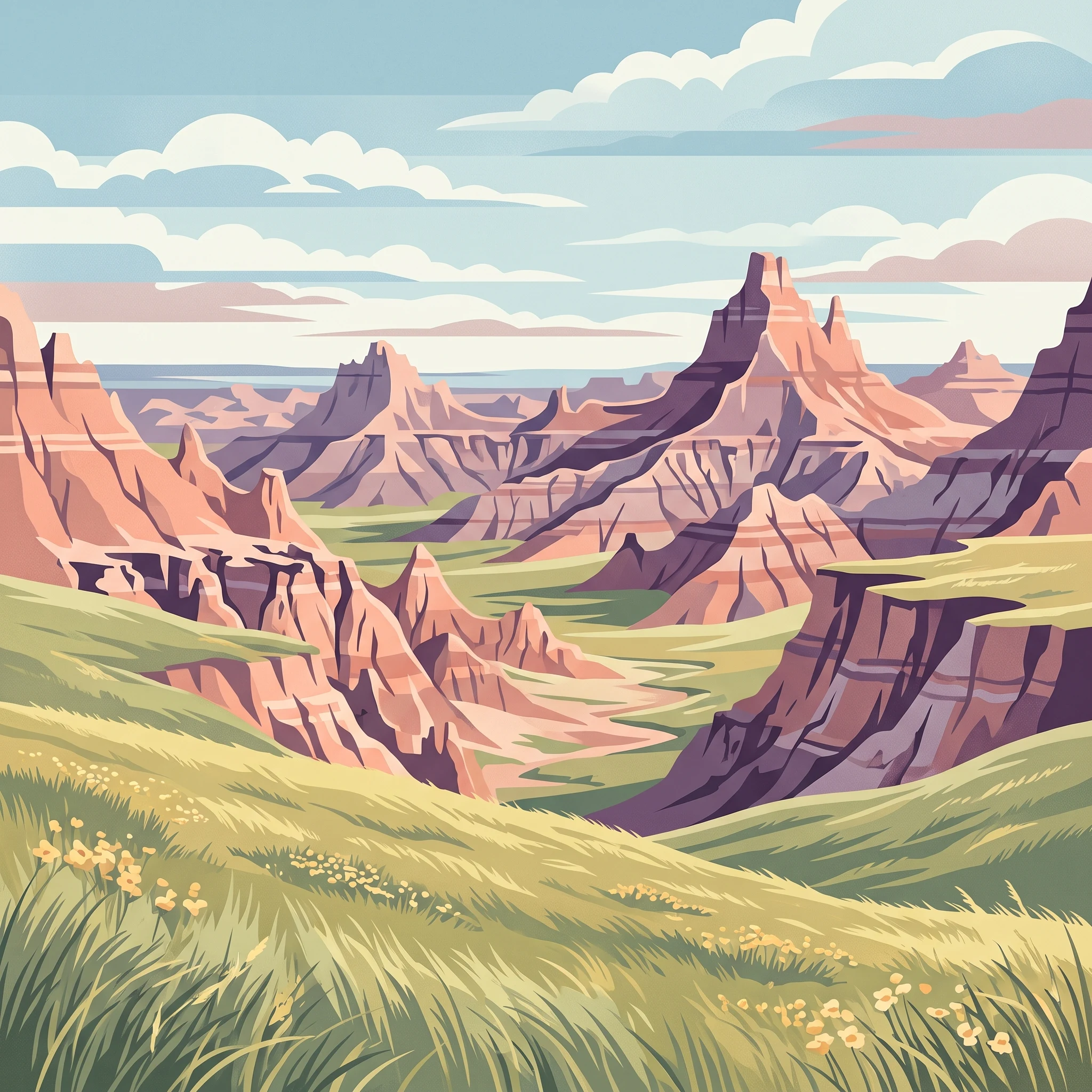
The Badlands landscape presents one of the most distinctive geological formations in North America. The park protects an extensive network of sharply eroded buttes, pinnacles, spires, and cliffs that rise dramatically from the surrounding mixed grass prairie. These formations display striking horizontal banding of sedimentary layers in shades of tan, orange, gray, and white, representing millions of years of geological deposition and subsequent erosion. The terrain is characterized by deep ravines, steep-walled canyons, and broad table formations. The White River, a tributary of the Missouri River, drains the park and has played a significant role in shaping the contemporary landscape. The highest point in the park is Red Shirt Table at 3,340 feet, located in the South Unit. The Badlands Wilderness area within the North Unit preserves 64,144 acres of the most rugged and undeveloped terrain, where the characteristic butte and pinnacle formations are most dramatically exposed.

Badlands National Park ecosystems, habitats, and plant life

Badlands National Park protects the largest remaining expanse of undisturbed mixed grass prairie in the United States. This grassland ecosystem represents a transition between the tall-grass prairies of the eastern United States and the short-grass prairies of the west, supporting grasses that range from ankle-high to waist-high depending on moisture conditions. Western Wheatgrass serves as the most common grass species and is the state grass of South Dakota. The park's vegetation includes twenty-three distinct plant community types, ranging from grassland associations to riparian zones along the White River. Despite the seemingly harsh environment, the Badlands support remarkable biodiversity, with the combination of grassland, rock formations, and riparian corridors creating diverse microhabitats. The park's location within the White River drainage system provides crucial habitat connections for migratory species and supports ecological processes that have shaped the Great Plains for millennia.

Badlands National Park wildlife and species highlights

Badlands National Park supports a diverse community of Great Plains wildlife. The park is home to approximately 70 species of mammals, including bison, bighorn sheep, pronghorn, elk, mule deer, white-tailed deer, coyote, bobcat, and the endangered black-footed ferret. The bison herd, established with 50 individuals transferred from Theodore Roosevelt National Park in 1963, has grown to over 1,200 animals and occupies dedicated habitat expanded to 80,193 acres in 2019. Birdlife includes the endangered whooping crane, black-billed magpie, and numerous prairie species. Prairie dog colonies occupy significant portions of the grassland, creating habitat complexes that support predator species including the black-footed ferret. The park's wildlife populations reflect the ecological health of the mixed grass prairie ecosystem and represent one of the most intact Great Plains wildlife communities remaining in North America.

Badlands National Park conservation status and protection priorities

Badlands National Park represents a critical conservation area for both geological and biological resources. The park protects internationally significant Oligocene fossil deposits that continue to yield scientific discoveries about prehistoric mammal evolution and ecology. The Badlands Wilderness, designated in 1976, preserves 64,144 acres of the most rugged terrain as designated wilderness under the 1964 Wilderness Act, ensuring permanent protection from development. The park has played a pivotal role in black-footed ferret recovery, with approximately 100 individuals now inhabiting the park following reintroduction efforts. The mixed grass prairie ecosystem, representing the largest remaining example of this habitat type in the United States, requires ongoing conservation management to maintain its ecological integrity. The co-management arrangement for the South Unit with the Oglala Lakota tribe represents an innovative approach to conservation that integrates tribal land stewardship with national park management.

Badlands National Park cultural meaning and human context

Badlands National Park holds profound cultural significance for the Oglala Lakota people and other Native American communities. The region has been inhabited for approximately 11,000 years, with the Lakota being the dominant tribe in the area by approximately 150 years before European contact. The 1868 Treaty of Fort Laramie established the Badlands as Sioux territory in perpetuity, though the treaty was broken in 1889 when the land was confiscated by the United States government. The South Unit, known as the Stronghold District, encompasses lands that were the scene of the Ghost Dance movement in 1890, including the last known Ghost Dance ceremony conducted on Stronghold Table. The park landscape remains deeply tied to Lakota cultural identity, with the area regarded as a sacred ceremonial site rather than a living space. The park also administers the nearby Minuteman Missile National Historic Site, adding a layer of Cold War history to the area's complex human narrative.

Top sights and standout views in Badlands National Park

The most compelling features of Badlands National Park include its dramatic eroded buttes and pinnacles visible from scenic drives and overlooks, the internationally significant Oligocene fossil beds that have yielded discoveries for nearly two centuries, the successful recovery of the endangered black-footed ferret within the park, and the largest remaining mixed grass prairie in North America. The Ben Reifel Visitor Center provides museum exhibits and educational programming, while the White River Visitor Center in the South Unit focuses on Lakota heritage. Hiking trails including Door Trail, Notch Trail, Window Trail, and Cliff Shelf Nature Trail offer access to the geological formations. The park's two campgrounds, Cedar Pass and Sage Creek, provide overnight accommodations, with Cedar Pass Lodge offering cabins and dining. The stark visual contrast between the layered rock formations and the grassland creates one of the most distinctive landscapes in the American West.

Best time to visit Badlands National Park

Badlands National Park can be visited throughout the year, though each season offers distinct experiences. Summer months bring warm temperatures and the most crowded conditions, but also provide the best opportunities for wildlife viewing, particularly early morning and evening when animals are most active. The spring and fall seasons offer milder temperatures and fewer visitors, making them ideal for those seeking a quieter experience. Winter transforms the landscape with snow on the badlands formations, creating dramatic photographic opportunities, though some roads and facilities may have limited access. The park experiences a semi-arid continental climate with significant temperature variation between seasons. Visitors should be aware that extreme temperatures, both hot and cold, are possible, and that the park's exposed terrain offers limited shade or shelter. The shoulder seasons of late spring and early fall typically provide the most comfortable conditions for hiking and exploration.
Park location guide

Geography guide, regional context, and park location map for Badlands National Park

Badlands National Park park geography, regions, and map view in United States of America
Understand where Badlands National Park sits in United States of America through a broader geographic reading of the surrounding landscape, nearby location context, and its mapped position within the national park landscape.

How Badlands National Park fits into United States of America

The United States of America is a federal presidential republic and one of the world's largest countries by area and population. It consists of 50 states across a vast territory spanning multiple time zones, with its capital in Washington, D.C. and largest city in New York City. The nation has a diverse economy, influential political system, and significant cultural and military presence globally.

Wider geography shaping Badlands National Park in United States of America

The United States occupies a vast territory in North America, bordered by Canada to the north and Mexico to the south. The 48 contiguous states stretch from the Atlantic to the Pacific Ocean, while Alaska occupies the northwestern region and Hawaii is an archipelago in the Pacific. The country encompasses diverse terrain including the Rocky Mountains, Appalachian Mountains, Great Plains, and extensive river systems.

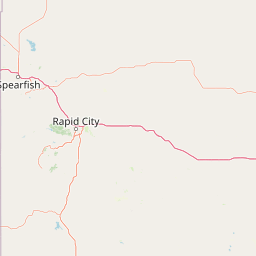
Map view of Badlands National Park

Use this park location map to pinpoint Badlands National Park in United States of America, understand its exact geographic position, and read its mapped placement within the surrounding landscape more clearly.

Pigeon | © OpenStreetMap contributors

Location context for Badlands National Park

South Dakota
Park atlas

Browse adjacent protected areas and mapped park geography across South Dakota and the wider Great Plains.

Discover More Parks Near Badlands National Park, Explore the Great Plains' Protected Landscapes
Explore other national parks and protected areas that share geographic context with Badlands National Park, tracing diverse terrain from fossil-rich badlands to expansive mixed-grass prairies. Uncover a comprehensive atlas view of protected landscapes, enabling direct comparison of geological formations, ecological zones, and conservation efforts across the surrounding region.
National parkCuster County

Wind Cave National Park: A National Park with Distinct Protected Landscape and Geographic Identity

Explore the mapped terrain and regional context of this US protected area.

Wind Cave National Park represents a key protected area within Custer County, offering users a deep dive into its unique geography and landscape characteristics. As a designated national park in the United States, its mapped boundaries provide crucial context for understanding its ecological and geological significance. This MoriAtlas entry facilitates detailed exploration, focusing on the protected land's identity and its role within the wider regional geography and natural landscape.

Area
136.97 km²
Established
1903
IUCN
II
Visitors
489.4K annual
National parkNorth Dakota

Theodore Roosevelt National Park: Mapped Protected Landscape in North Dakota

Explore the geography and protected natural boundaries.

Theodore Roosevelt National Park represents a distinct protected landscape within North Dakota, offering a valuable entry point for exploring its unique geographic setting. This page provides a concentrated view of the park's mapped boundaries and its contribution to regional natural context. It is designed for users seeking detailed atlas-level information and a clear understanding of the park's protected-area status and geographic significance within the United States.

Area
285.08 km²
Established
1978
IUCN
II
Visitors
668.7K annual
National parkColorado

Rocky Mountain National Park: National Park Protected Landscape in Colorado

Explore its mapped boundaries and regional geographic context.

Rocky Mountain National Park is a designated National Park within Colorado, crucial for understanding the distribution and geographic context of protected areas in the United States. This detail page provides an atlas-oriented perspective, emphasizing the park's mapped boundaries and its place within the natural landscape of the region. It is designed to facilitate a clear understanding of the park's protected status and its contribution to the atlas of natural landscapes, offering factual insights for geographic discovery.

Area
1,074.28 km²
Established
1915
IUCN
II
Visitors
4.2M annual
National parkWyoming

Yellowstone National Park: US National Park Protected Landscape & Geographic Atlas

Explore mapped boundaries and regional natural landscape context.

Yellowstone National Park represents a significant protected landscape within Wyoming, designated as a US national park. This entry offers detailed insight into its geographic scope, mapped boundaries, and the unique natural terrain that defines it. Understand its role in regional geography and discover its protected-area identity through a structured atlas exploration, providing context for its conservation landscape.

Area
8,983.18 km²
Established
1872
IUCN
II
Visitors
4.7M annual
National parkUnited States of America

Grand Teton National Park: Protected Landscape and Geographic Atlas Exploration

Explore the mapped terrain and regional park geography.

Grand Teton National Park is a protected landscape offering rich geographic discovery opportunities within the United States of America. This detailed entry facilitates an atlas-style exploration of its mapped boundaries, the surrounding regional geography, and its identity as a significant national park. Understand the specific landscape context and discover its placement within the broader natural terrain of North America.

Area
1,300 km²
Established
1929
IUCN
II
Visitors
2.8M annual
National parkSaskatchewan

Grasslands National Park: Saskatchewan Protected Landscape Atlas

Discover its mapped boundaries and regional geographic context.

Grasslands National Park represents a vital component of protected lands in Saskatchewan, Canada, offering rich opportunities for atlas-based geographic exploration. This detail page provides specific insights into the park's mapped boundaries, its natural terrain, and its role as a national park within the broader regional geography. Understand how this protected landscape fits into the larger atlas of Canadian conservation areas and discover its unique geographic identity.

Area
907 km²
Established
1981
IUCN
II
Visitors
19.7K annual
National parkColorado

Great Sand Dunes National Park and Preserve: Colorado's Unique Mapped Landscape

Explore the natural terrain and protected boundaries.

Great Sand Dunes National Park and Preserve offers a unique protected landscape within Colorado, characterized by its distinct natural terrain and extensive dune fields. This destination provides valuable context for atlas exploration, detailing the park's mapped boundaries and its specific geographic setting. Understand its significance as a protected area and appreciate the unique natural features that define its landscape for a richer geographic discovery.

Area
603.1 km²
Established
2004
IUCN
V
Visitors
432.5K annual
National parkMontrose County

Black Canyon of the Gunnison National Park: Protected Area Geography and Mapped Landscape

Explore the natural terrain and protected boundaries in Montrose County.

Black Canyon of the Gunnison National Park is a national park defined by its profound geological features and its status as a protected landscape. Located within Montrose County, it offers a distinct geographic profile for atlas-based exploration. Users can understand the park's mapped boundaries, its relation to the surrounding regional geography, and the unique natural terrain that defines this protected area, contributing to a structured discovery of its natural landscape identity.

Area
124.4 km²
Established
1999
IUCN
II
Visitors
357.1K annual

Common questions about visiting, size, designation, and location context for Badlands National Park

Badlands National Park FAQs for park facts, access, geography, and protected area context
Find quick answers about Badlands National Park, including protected-area facts, park geography, trail and visitor context, and how the park fits into its surrounding country and regional landscape.
MoriAtlas Explorer

Continue Your Protected Areas Search Across the Global Atlas

Deepen your exploration by continuing the structured search for national parks and protected areas worldwide. Utilize the comprehensive filtering capabilities to compare different conservation landscapes and refine your understanding of global park geography. Discover more about the distribution and characteristics of protected natural areas.

Global natural geography