
Mori Atlas logo
Nature reserveBiotopo Marocche di Dro

Explore the geography of Europe's most significant arid biotope and ancient boulder-strewn terrain.

Biotopo Marocche di Dro: An Extraordinary Postglacial Rockslide Landscape in Trentino-Alto Adige

Biotopo Marocche di Dro protects a vast and chaotic accumulation of limestone and dolomite debris within the Valle dei Laghi. This nature reserve serves as a critical geographic reference for postglacial landslide systems, characterized by an arid microclimate that supports specialized reptile populations and European black pine woodlands. The site provides a distinct alternative to typical Alpine wetlands, showcasing the complex interplay between rocky mountainous substrate and regional valley ecology.

biotopeprotected areaarid habitatpostglacial rocksliderockfall depositblack pine woodland
A vibrant, flat-style digital illustration of a valley featuring rocky debris fields, a central waterfall, and stylized trees under a soft, light-colored sky.

Biotopo Marocche di Dro

Nature reserve

Park overview

Structured park overview, official facts, and landscape profile for Biotopo Marocche di Dro

Biotopo Marocche di Dro park facts, protected area profile, and essential visitor context

Review the core facts for Biotopo Marocche di Dro, including designation, size, terrain, visitor scale, habitats, and operating context in one park-focused overview.

About Biotopo Marocche di Dro

Biotopo Marocche di Dro is a small but ecologically distinctive protected area in the lower portion of the Trentino-Alto Adige region, situated in the Valle dei Laghi area west of Lake Garda. Although modest in territorial extent, it preserves one of Europe's most remarkable examples of postglacial mass-wasting landscape, where entire slopes collapsed historically, leaving immense deposits of rock fragments that reshaped the valley floor.

The protected area was formally established in 1989 by the Autonomous Province of Trento with the specific goal of safeguarding this unusual geological and ecological heritage. It was registered in the official Italian list of protected natural areas and assigned an EUAP code, and is internationally classified under IUCN Category IV, which designates areas where conservation of particular habitats or species is the primary management objective. The area is managed directly by the provincial authority under its network of provincial biotopes.

What truly sets Biotopo Marocche di Dro apart is its character as an arid land biotope. Most of Trentino's protected biotopes revolve around lakes, fens, peatlands, or other wetland habitats; this site instead preserves a dry, rocky, sun-baked environment perched above and around the lakes of the Valle dei Laghi. The dryness is reinforced by the geology of the Marocche themselves, which consist of loose, angular blocks of stone that shed rainfall quickly, leaving thin soils that retain little moisture. The result is a pseudo-steppe-like micro-landscape incongruously tucked within a generally humid Alpine setting.

Ecologically, the site is dominated visually by black pine woodland, but the open rocky clearings and warm exposed boulder fields support a flora and fauna with strong affinities to Mediterranean and pre-Alpine dry zones. Reptiles thrive here in numbers rarely seen at this latitude and elevation, making the biotope an important reference site for understanding how geological history can shape biological communities even within a region better known for its forests, lakes, and snowy peaks.

Quick facts and research context for Biotopo Marocche di Dro

Biotopo Marocche di Dro is a protected biotope located in the municipality of Dro, in the autonomous province of Trento, within the Trentino-Alto Adige region of northern Italy. It was formally established in 1989 through a provincial decree and is managed by the Autonomous Province of Trento.

The site is classified under international IUCN Category IV, identifying it as a habitat and species conservation area. It covers a land area of roughly 251 hectares along the Valle dei Laghi area. Its defining character is the presence of the Marocche, a vast system of ancient postglacial rockfalls and debris slides that represent one of the largest such deposits in Europe by both extent and volume.

Protection and recognition

Examine the verified conservation framework, management data, and recorded designation history.

Biotopo Marocche di Dro Protection Status and Official Designated Area Records

Documented protection records for Biotopo Marocche di Dro provide essential insight into its formal conservation status and administrative framework. Verified geographic data outlines the established protected area parameters and international recognition metrics.

Protection details

WDPA ID
161996
Park context

Deeper park guide and search-rich context for Biotopo Marocche di Dro

Biotopo Marocche di Dro history, landscape, wildlife, and travel context

Explore Biotopo Marocche di Dro through its history, landscape character, ecosystems, wildlife, conservation priorities, cultural context, and seasonal travel timing in a structured park guide built for atlas discovery and search intent.

Why Biotopo Marocche di Dro stands out

Biotopo Marocche di Dro is best known for protecting the Marocche, an exceptional system of postglacial rockslide deposits recognized as one of the largest and most voluminous of its kind in Europe. The accumulation of collapsed limestone and dolomite debris forms an arid, boulder-strewn terrain that defines both the landscape and the ecological character of the protected area. The site is also distinctive within Italy's network of biotopes for being officially classified as an arid zone rather than a wetland. This dry stone environment, dominated almost entirely by European black pine, supports reptile populations uncommon elsewhere in the Trentino Alps, including wall lizards, green lizards, and two species of colubrid snakes.
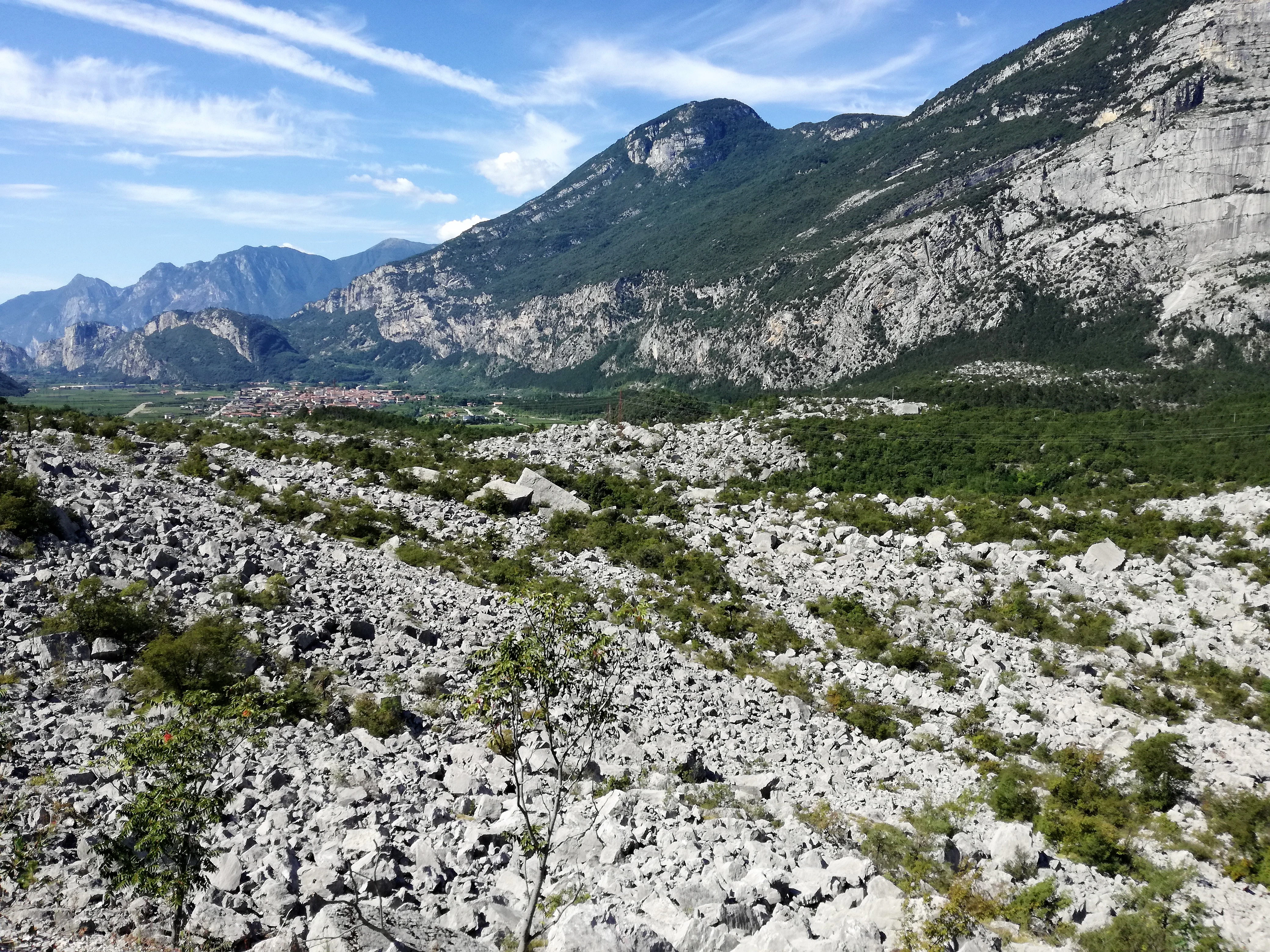
A wide, rocky landscape filled with vast amounts of grey boulders and sparse vegetation, set against a backdrop of steep mountain slopes under a blue sky.
The distinctive post-glacial landslide debris field of the Marocche di Dro nature reserve in Italy.

Biotopo Marocche di Dro history and protected-area timeline

The geological history of the Marocche di Dro predates human intervention by thousands of years. Following the retreat of Pleistocene glaciers, the freshly deglaciated valley walls became unstable, and a series of massive rock-slide and rockfall events detached enormous volumes of material from the surrounding cliffs. The accumulation progressively formed the characteristic debris tongues that today define the land surface of the protected area. The most recent of these major slope failures occurred during historical times, as confirmed by the discovery of a Roman tile during excavation work for a hydroelectric water diversion in the area.

In modern times, the area's scientific and conservation value eventually prompted the Autonomous Province of Trento to formally establish the biotope in 1989. The founding decree, D.P.G.P. 16439 dated 21 December 1989, gave the area protected status under provincial law, framing the site as a habitat conservation area within the broader system of Trentino biotopes. Since its designation, the reserve has been managed directly by the provincial authority through its protected-area program, and it has become a recognized component of the regional natural heritage network of Trentino-Alto Adige.

Biotopo Marocche di Dro landscape and geographic character

The defining landscape feature of Biotopo Marocche di Dro is the Marocche themselves: a sweeping accumulation of shattered limestone and dolomite blocks produced by ancient rock slides cascading down from the steep valley walls above. The deposits form broad tongues and aprons of coarse debris that interrupt the smoother terrain of the Valle dei Laghi below, producing a stark, chaotic, almost moon-like surface that contrasts sharply with the surrounding agricultural and forested slopes.

Within this rocky terrain, smaller-scale features include isolated boulders, dry crevices, and warm microcliffs that capture sunlight for most of the day. The presence of Lake Solo, a small body of water within the broader Valle dei Laghi system, adds a contrasting moist margin where reedbeds and sedge-dominated vegetation can establish themselves around the shoreline. The juxtaposition of dry rocky uplands against the small wetland fringe is itself part of what gives the biotope its unusual environmental complexity.

The valley setting itself, framed by the pre-Alpine slopes west of Lake Garda, gives the reserve a milder and drier local climate than more typical high-elevation Trentino parks. This combination of dry rocky substrate and a relatively sheltered valley position creates the aridity that inspired the site's official classification as an arid-zone biotope rather than a wetland.

Biotopo Marocche di Dro ecosystems, habitats, and plant life

Ecologically, Biotopo Marocche di Dro behaves more like a dry Mediterranean hillside than a typical Alpine site. The principal vegetation is an open woodland dominated by European black pine (Pinus nigra), a species well adapted to poor, coarse substrates and capable of colonizing unstable mineral soils where more demanding trees cannot survive. The open canopy and the gaps between scattered pines allow strong sunlight to reach the ground, reinforcing the dryness of the habitat.

In the damper microhabitats surrounding the small lakes of the area, plant species composition changes noticeably. Around Lake Solo, marsh vegetation characteristic of reedbeds and large-sedge communities establishes itself, with formations corresponding to Cladietum marisci, a saw-sedge community, and Phragmitetum australis, a common reed community. These wetland pockets contain some of the few moisture-loving species in an otherwise arid biotope.

The overall vegetation pattern creates a clear ecological mosaic: dry black pine-dominated slopes above, with small but well-defined wetland fringes around the water bodies below. This combination of contrasting habitats within a single protected perimeter contributes significantly to the site's ecological interest and its biodiversity value.

Biotopo Marocche di Dro wildlife and species highlights

The wildlife profile of Biotopo Marocche di Dro is heavily dominated by reptiles, which thrive in this exceptionally dry, sun-exposed environment. The reserve supports abundant populations of the common wall lizard (Podarcis muralis) and the European green lizard (Lacerta viridis), both species that depend on warm rocky basking sites that the Marocche provide in unusual abundance for an Alpine setting.

Two species of non-venomous colubrid snakes are also highlighted as characteristic of the reserve: the green whip snake or Western Whip Snake (Hierophis viridiflavus, referenced in the source as Biacco) and the Aesculapian snake (Elaphe longissima, known in Italian as Saettone). These snakes depend on the abundant lizard populations and on the network of dry stone crevices for hunting, shelter, and thermoregulation.

The absence of dense forest cover and the prevalence of open rocky ground help explain why reptile productivity here is far higher than in nearby forested Alpine environments. Although the source material does not detail mammal or bird inventories, the mosaic of dry pine woodland, open rocky outcrops, and wetland edge around the small lake likely supports a broader, less-documented fauna that includes typical species of the lower Trentino valleys.

Biotopo Marocche di Dro conservation status and protection priorities

From a conservation perspective, Biotopo Marocche di Dro is significant primarily because it protects a rare type of habitat within Trentino-Alto Adige: an arid, postglacial rockslide landscape that has no large-scale equivalents in the regional protected-area network. By safeguarding the Marocche, the reserve preserves not just a geological curiosity but an entire dry-substrate ecosystem that would otherwise be vulnerable to degradation through quarrying, afforestation with non-native species, or uncontrolled land-use change.

The site's IUCN Category IV classification underscores its role as a habitat- and species-focused conservation area rather than a broader ecosystem reserve. Its arid status makes it an important complement to the more numerous wet biotopes in the province, contributing to ecological representativeness within the wider Trentino protected-area system. Local management is conducted by the Autonomous Province of Trento, which integrates the biotope into its broader program for habitat conservation and biodiversity monitoring.

The conservation narrative is further strengthened by the presence of species assemblages that are clearly linked to the specific environmental conditions created by the rockslide deposits. Protecting the physical structure of the Marocche is effectively the same as protecting the ecological communities they support, since any disturbance to the substrate or to the open, dry microclimate would directly affect the species that have adapted to it.

Top sights and standout views in Biotopo Marocche di Dro

Biotopo Marocche di Dro stands out as one of the southernmost and ecologically least typical biotopes in Trentino, distinguished by the sheer scale of the postglacial rockfall deposits it encompasses. The site combines a dramatic geological heritage with an unusual dry-habitat ecology, making it both a scientific reference location and a regionally iconic natural landmark.

Key distinguishing features include its arid rather than wetland character, the dominance of European black pine on unstable mineral substrate, the small but ecologically meaningful wetland fringes around Lake Solo, and the unusually rich reptile fauna for an Alpine province. Together these traits give the protected area a unique profile within Italy's national network of biotopes and small protected areas.

Best time to visit Biotopo Marocche di Dro

Given the site's strong reliance on warm sun-exposed surfaces for its ecological character, late spring through early autumn is the natural window when temperatures allow both visitors and wildlife to fully experience the dry habitat. Spring supports active reptile basking and fresh growth in the sparse pine woodland, while summer brings the warmest, driest conditions and the strongest expression of the arid character that defines the reserve. Autumn remains mild enough to allow comfortable walking and continued reptile activity before the cooler months return. Winter is generally less favorable for experiencing the reserve's defining features, as cold and snow obscure the rock-slide landscape and suppress reptile activity.
Monthly climate preview

Long-term representative monthly temperature and precipitation data for Biotopo Marocche di Dro

Biotopo Marocche di Dro Climate Normals and Annual Temperature Rhythm

Biotopo Marocche di Dro records measured long-term temperature swings and monthly precipitation patterns from a representative coordinate at an elevation of 1384 meters. Examining the complete twelve-month climate profile provides detailed context on recorded meteorological averages across the protected terrain.
Annual mean6 °C
-4 °C16 °C
Jan-4°
Feb-3°
Mar
Apr
May10°
Jun14°
Jul16°
Aug16°
Sep12°
Oct
Nov
Dec-3°
Warmest month
July

16.2 °C

Coolest month
January

-4.4 °C

Wettest month
October

3.8 mm/day

Driest month
January

1.4 mm/day

Park location guide

Geography guide, regional context, and park location map for Biotopo Marocche di Dro

Biotopo Marocche di Dro park geography, regions, and map view in Italy

Understand where Biotopo Marocche di Dro sits in Italy through a broader geographic reading of the surrounding landscape, nearby location context, and its mapped position within the national park landscape.

How Biotopo Marocche di Dro fits into Italy

Italy is a unitary parliamentary republic in Southern and Western Europe, located on the Italian Peninsula with the Alps to the north. It borders France, Switzerland, Austria, Slovenia, Vatican City, and San Marino, and shares maritime boundaries with several Mediterranean countries. The country has approximately 59 million residents and uses the Euro as its currency.

Wider geography shaping Biotopo Marocche di Dro in Italy

Italy occupies a boot-shaped peninsula in southern Europe, bordered by the Alps to the north. It shares land borders with France, Switzerland, Austria, Slovenia, Vatican City, and San Marino. The country includes the Mediterranean islands of Sicily and Sardinia, along with approximately 800 smaller islands.

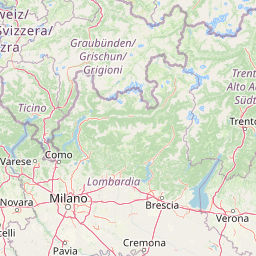
Map view of Biotopo Marocche di Dro

Use this park location map to pinpoint Biotopo Marocche di Dro in Italy, understand its exact geographic position, and read its mapped placement within the surrounding landscape more clearly.

Pigeon | © OpenStreetMap contributors

Location context for Biotopo Marocche di Dro

Trentino-Alto Adige

Visualizing the postglacial rockslide terrain and arid protected habitats of Trentino

Biotopo Marocche di Dro Photos and Landscape Scenery

Photographs capture the expansive boulder fields and postglacial debris formations that define this protected arid zone. Visual records reveal the stark limestone terrain and sparse woodland environments unique to the southern Alpine valley.

A wide, rocky landscape filled with vast amounts of grey boulders and sparse vegetation, set against a backdrop of steep mountain slopes under a blue sky.

Park atlas

Compare surrounding valley landscapes and related Alpine reserves

Explore Parks Near Biotopo Marocche di Dro and Protected Areas in the Region

Continue browsing national parks and protected areas situated near Biotopo Marocche di Dro. Regional comparisons reveal contrasting Alpine terrain, valley ecosystems, and adjacent geological formations.
Nature reserveTrentino-Alto Adige
About 5.7 km away#1 closest

West

Biotopo Lomasona Nature Reserve: Protected Landscapes and Alpine Geography in Trentino

A small-scale conservation area in the heart of Val Lomasona

Biotopo Lomasona stands as a specialized nature reserve in the Italian Province of Trento. This compact protected area focuses on habitat conservation within the alpine terrain, serving as an important ecological anchor in the valley landscape of Comano Terme and the wider Trentino-Alto Adige region.

Area
0.26 km²
Established
1987
IUCN
IV
A horizontal watercolor illustration depicting a lake framed by green rolling hills and distant purple mountain ridges.
Nature reserveTrentino-Alto Adige
About 7.7 km away#2 closest

North

Biotopo Lago di Toblino Protected Area and Regional Landscape Geography

Nature reserve featuring Alpine and sub-Mediterranean plant habitats

Biotopo Lago di Toblino acts as a sheltered basin where lake, marsh, and woodland habitats create an essential corridor for wildlife. This protected landscape is shaped by the interplay between the surrounding steep mountains and the influence of nearby Lake Garda, fostering an unusual climatic overlap that supports a wide range of native flora and waterbird populations within an important European conservation site.

Area
1.705 km²
Established
1992
IUCN
IV
Nature reserveTrentino-Alto Adige
About 8.4 km away#3 closest

Northeast

Torbiera delle Viote Nature Reserve: Alpine Wetland Plateau Geography and Protected Boundaries

A high-elevation peat bog enclave within the Monte Bondone mountain landscape

Situated on the Piana delle Viote in the Trentino-Alto Adige region, this nature reserve protects a rare alpine peat bog ecosystem. The site functions as a unique wetland basin framed by dense conifer forests, offering significant insight into high-altitude hydrology, amphibian habitats, and the specific terrain features that define this protected mountain landscape.

Area
0.13 km²
Established
2003
A watercolor painting showing a panoramic view of a green wetland landscape with soft purple mountains in the background.
Nature reserveTrentino-Alto Adige
About 8.4 km away#4 closest

West

Biotopo Fiavé: A Protected Wetland and Archaeological Landscape in Trentino-Alto Adige

Mapping glacial lake basins and ancient prehistoric heritage sites

Located at the foot of Monte Cogorna, Biotopo Fiavé functions as a vital wetland reserve characterized by extensive peat bogs and mixed willow-alder thickets. This area offers a unique intersection of natural hydrological evolution and UNESCO-protected archaeological history, serving as a rare, compact cross-section of alpine valley ecosystems and prehistoric human settlement patterns.

Area
1.373 km²
Established
1988
IUCN
IV
Nature reserveTrentino-Alto Adige
About 12 km away#5 closest

Southwest

Biotopo Monte Brione: Protected Nature Reserve and Mediterranean Landscape Map

Exploring the limestone ecology of northern Italy

Biotopo Monte Brione stands as a remarkable protected area where southern European vegetation, including holm oaks and Phoenician juniper, flourishes against a backdrop of sun-exposed limestone cliffs. Situated as a natural buffer near Lake Garda, this reserve offers a deep look into the intersection of Mediterranean floral diversity and Alpine geographic settings, providing a essential refuge for protected raptors and rare invertebrate species.

Area
0.663 km²
Established
1992
IUCN
IV
A soft watercolor painting of a wetland landscape with distant rolling hills, green grassy banks, and a calm water surface, rendered in a muted palette.
Nature reserveTrentino
About 13 km away#6 closest

South

Lago di Loppio Nature Reserve: A Protected Wetland and Archaeological Landscape in Trentino

Mapping the ecological intersection of wetlands and historical island sites.

Lago di Loppio functions as a critical provincial biotope, blending rare marshland ecology with a deep historical footprint on the Island of Sant'Andrea. Situated within a depression in the Adige valley, this protected area features a unique transitional microclimate that supports diverse flora and fauna, alongside ruins spanning Roman to medieval eras.

Area
1.126 km²
Established
1987
Relief
Upland
Climate
Temperate
A soft watercolor painting of a tranquil lake surrounded by gentle, rolling green hills and wetland vegetation.
Nature reserveTrentino-Alto Adige
About 25 km away#7 closest

Southwest

Lago d'Ampola: Mapping the Ecology of a Glacial Nature Reserve in Trentino

A critical protected wetland and montane biotope

Lago d'Ampola preserves a remarkably layered habitat of glacial origin, where water lilies, marsh vegetation, and spruce-beech forests converge. This protected site in Trentino-Alto Adige offers a focused look at the intersection of glacial geography and successful ecosystem recovery in an Alpine valley setting.

Area
0.5 km²
Established
1990
Relief
Mountain
Climate
Alpine
Nature reserveTrentino-Alto Adige
About 35 km away#8 closest

Northeast

Biotopo Prati di Monte: Nature Reserve and Protected Alpine Landscape Discovery

Geographic overview of the Dossone di Cembra alpine ridge

Biotopo Prati di Monte represents a protected nature reserve in Trentino-Alto Adige, known for its unique concentration of peatland habitats. The area encompasses the remnant Lago di Valda basin, acidic spruce forests, and diverse wetland meadows. This atlas-focused perspective highlights the reserve as a significant refugium for sub-arctic flora situated along the porphyritic mountain terrain between the Val di Cembra and the Bassa Atesina.

Area
0.06 km²
Established
1994
IUCN
IV

Common questions about visiting, size, designation, and location context for Biotopo Marocche di Dro

Biotopo Marocche di Dro FAQs for park facts, access, geography, and protected area context

Find quick answers about Biotopo Marocche di Dro, including protected-area facts, park geography, trail and visitor context, and how the park fits into its surrounding country and regional landscape.
MoriAtlas Explorer

Continue Your Protected Areas Search Across the Global Atlas

Deepen your exploration by continuing the structured search for national parks and protected areas worldwide. Utilize the comprehensive filtering capabilities to compare different conservation landscapes and refine your understanding of global park geography. Discover more about the distribution and characteristics of protected natural areas.

Global natural geography