
Mori Atlas logo
Nature reserveDąbrowa Smoszew

A vital forest refuge preserving ancient oak stands within the historic Krotoszyn region geography.

Dąbrowa Smoszew Nature Reserve: Mapped Protected Landscapes in the Greater Poland Voivodeship

(Rezerwat przyrody Dąbrowa Smoszew)

Dąbrowa Smoszew represents a significant nature reserve in the Greater Poland Voivodeship, specifically protecting a remnant of mixed deciduous forest dominated by centuries old oak trees. This geographic enclave sits within the rolling Wysoczyzna Kaliska, serving as a stable ecological refuge that transitions from oak hornbeam communities to alder riparian zones. Its status as part of the broader Dąbrowy Krotoszyńskie network integrates the site into essential conservation landscapes and regional biodiversity corridors.

oak forestnature reservemixed deciduous woodlandold-growth treeslowland forestGreater Poland
A stylized digital illustration of a mountain landscape featuring a central waterfall flowing into a river, surrounded by coniferous trees and rocky cliffs under a soft pastel sky.

Dąbrowa Smoszew

Nature reserve

Park overview

Structured park overview, official facts, and landscape profile for Dąbrowa Smoszew Nature Reserve

Dąbrowa Smoszew Nature Reserve park facts, protected area profile, and essential visitor context

Review the core facts for Dąbrowa Smoszew Nature Reserve, including designation, size, terrain, visitor scale, habitats, and operating context in one park-focused overview.

About Dąbrowa Smoszew Nature Reserve

Dąbrowa Smoszew is a compact but ecologically valuable forest reserve located in the agricultural lowlands of Greater Poland. Although its area is modest, the reserve captures the essential character of the regional oak forest landscape, with its mosaic of mature deciduous trees and varied understory that has persisted through decades of surrounding land use change. The reserve is anchored in the Wysoczyzna Kaliska geomorphological region, a gently undulating upland that supports a mix of woodland, farmland, and small settlement areas typical of this part of west-central Poland.

The core of the reserve is a natural mixed forest where oak is the dominant species, accompanied by pine, larch, hornbeam, black alder, and elm. Average tree ages range from about 120 to 150 years, indicating that the woodland includes a significant component of older-generation trees that are increasingly rare in intensively managed lowland forests. These old-growth characteristics give the reserve value beyond its small footprint, providing continuity of habitat structure, deadwood resources, and microclimate conditions that benefit many specialized forest species.

The reserve is closely embedded in a wider mosaic of protected natural areas. It sits within the Dąbrowy Krotoszyńskie Protected Landscape Area and overlaps with two Natura 2000 network designations, including the bird-oriented site Dąbrowy Krotoszyńskie (PLB300007) and the habitat site Uroczyska Płyty Krotoszyńskiej (PLH300002). Together these surrounding protections amplify the reserve's role, allowing the small fragment to function as a high-quality node within a much larger ecologically coherent landscape.

Beyond its ecological importance, the reserve is part of a region with a long cultural and historical identity tied to the Krotoszyn oaklands. Archaeological features such as clusters of prehistoric burial mounds are scattered through the nearby forests, reflecting centuries of human presence in what is today a protected landscape. This combination of natural and cultural heritage gives Dąbrowa Smoszew a layered significance, where a small forest reserve contributes both to biodiversity conservation and to the broader identity of the region.

Quick facts and research context for Dąbrowa Smoszew Nature Reserve

Dąbrowa Smoszew is a Polish forest nature reserve situated in the gmina of Krotoszyn, Krotoszyn county, within the Wielkopolskie voivodeship of west-central Poland. Created in 1963, it protects approximately 13.85 hectares of natural mixed woodland dominated by oak, with a surrounding buffer zone of about 10.41 hectares that extends the protected landscape context.

The reserve lies in the Wysoczyzna Kaliska mesoregion, roughly 8 kilometers southeast of Krotoszyn and about 13 kilometers west of Ostrów Wielkopolski, placing it within the broader cultural and ecological landscape of the Krotoszyn oaklands. It falls entirely within the Dąbrowy Krotoszyńskie Protected Landscape Area and within the Natura 2000 sites Dąbrowy Krotoszyńskie (PLB300007) and Uroczyska Płyty Krotoszyńskiej (PLH300002), confirming its role in protecting one of the region's most characteristic oak-forest habitats.

Protection and recognition

Review documented management scope and official area designations

Dąbrowa Smoszew Protection Status and Terrestrial Conservation Data

Dąbrowa Smoszew features a documented terrestrial protection status within the regional conservation network. Structured records outline the core designation framework and administrative scope assigned to the protected landscape.

Protection details

Protection scope
Terrestrial
Transboundary protection
No
Buffer area
0.1 km²
Park context

Deeper park guide and search-rich context for Dąbrowa Smoszew Nature Reserve

Dąbrowa Smoszew Nature Reserve history, landscape, wildlife, and travel context

Explore Dąbrowa Smoszew Nature Reserve through its history, landscape character, ecosystems, wildlife, conservation priorities, cultural context, and seasonal travel timing in a structured park guide built for atlas discovery and search intent.

Why Dąbrowa Smoszew Nature Reserve stands out

The reserve is best known for preserving a stand of natural oak forest that retains a notably old age structure, with trees averaging from 120 to 150 years old and reaching heights of around 30 meters. It represents one of the characteristic forest fragments of the Krotoszyn oaklands, where mixed communities transition from typical oak-hornbeam woodland toward ash-elm and alder riparian forest. The reserve is also recognized for protecting populations of rare and characteristic lowland woodland plants, including species of conservation interest such as wild service tree and woodland bulrush-adjacent flora typical of mature Central European deciduous forests.
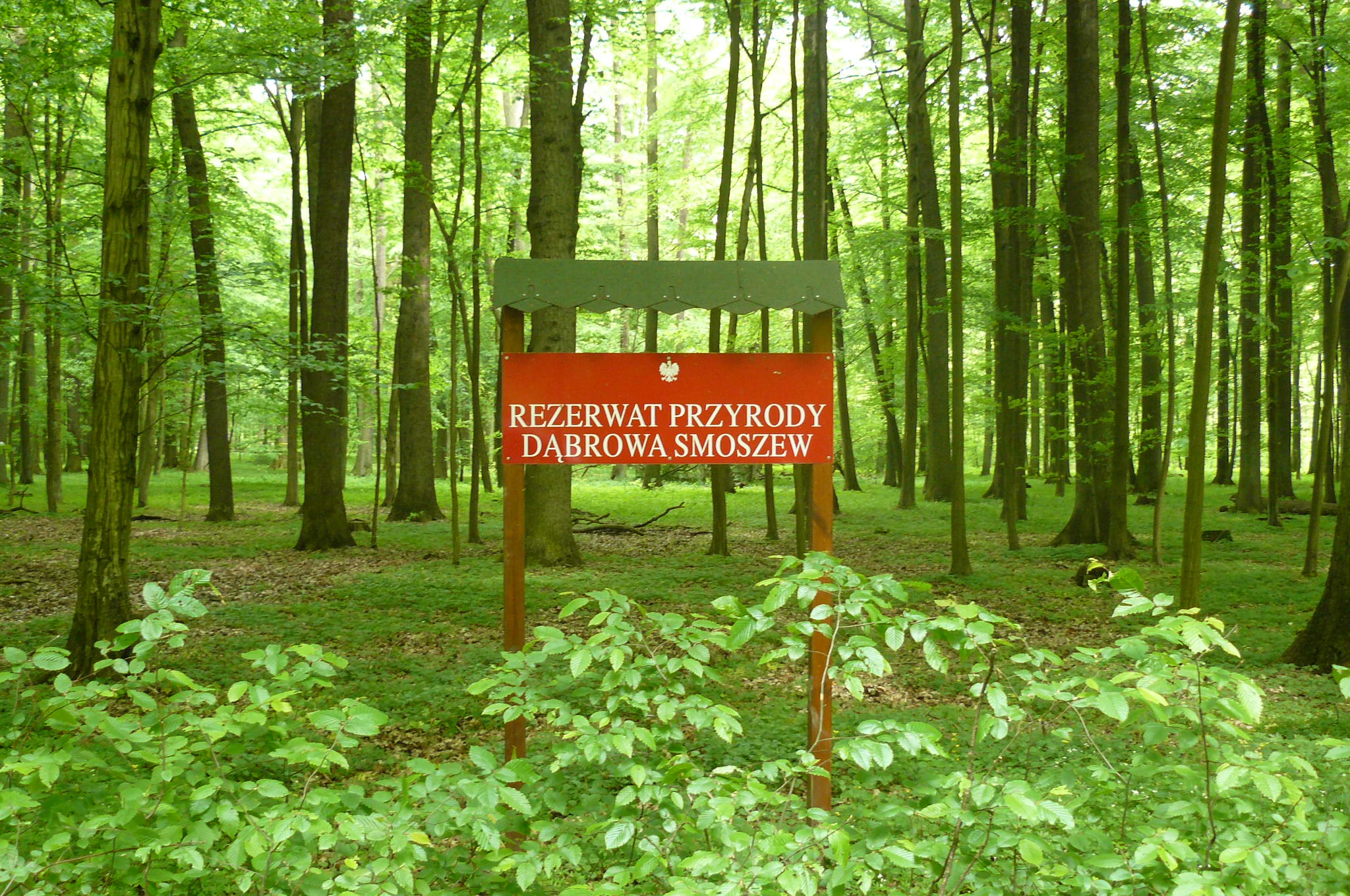
A red information sign with white text reading REZERWAT PRZYRODY DĄBROWA SMOSZEW, mounted on wooden posts in a lush green deciduous forest.
Information sign at the Dąbrowa Smoszew Nature Reserve in Poland.

Dąbrowa Smoszew Nature Reserve history and protected-area timeline

Dąbrowa Smoszew was formally designated as a nature reserve in 1963 by order of the Minister of Forestry and the Wood Industry, establishing it as one of the early postwar conservation sites dedicated to protecting natural oak forest in the Krotoszyn area. The founding legal act was published in the official Polish legal gazette Monitor Polski in 1963, marking the beginning of formal state protection for this forest fragment.

Following Poland's administrative reorganization, the reserve was reconfirmed through regional and national listings that consolidated its legal status, culminating in a detailed reaffirmation by the Regional Director of Environmental Protection in Poznań in 2011. This 2011 order formalized the modern management framework, including the active protection regime currently applied to the site.

The reserve's establishment in the early 1960s reflects a broader period in Polish conservation history when attention turned to preserving remaining patches of natural lowland forest amid expanding agriculture and forestry intensification. Dąbrowa Smoszew thus stands as a representative example of how small forested refuges were formally secured during that era to safeguard characteristic oak-dominated woodland communities that were otherwise declining across the lowlands.

Dąbrowa Smoszew Nature Reserve landscape and geographic character

The reserve occupies a gently rolling portion of the Wysoczyzna Kaliska, a low upland mesoregion in west-central Poland characterized by subtle relief, glacial-sediment parent materials, and a long history of mixed agricultural and forest use. Within this broader landform, the protected forest forms a compact green patch contrasted against surrounding farmland.

Topographically, the landscape is modest and subdued, without dramatic relief, but it supports a layered vegetation structure shaped by soil, moisture gradients, and historical forest continuity. The wooded area transitions internally between drier oak-hornbeam-influenced communities and wetter ash-elm and alder-dominated stands, producing the variegated forest mosaic from which the reserve's name is drawn.

Canopy trees in the reserve reach heights of roughly 30 meters, with oaks forming the structural backbone and other species contributing to vertical diversity. The understory, shrub layer, and herbaceous flora further define the visual character of the interior, while at the boundary near the Smoszew forest lodge, a monumental triple-stemmed linden stands as a natural monument, anchoring the landscape's cultural-natural connection to its surroundings.

Dąbrowa Smoszew Nature Reserve ecosystems, habitats, and plant life

Dąbrowa Smoszew protects a fragment of natural lowland mixed oak forest, one of the characteristic forest types of the Krotoszyn region and a habitat of significant conservation interest across Central European lowlands. The forest community is structured around oak dominance, with a mixture of accompanying broadleaf and coniferous species that reflect both local soil conditions and regional woodland history.

Ecologically, the reserve spans a transition between several forest community types. The drier, more typical component resembles oak-hornbeam forest, while wetter microsites support ash-elm riparian forest and alder swamp forest, producing internal habitat diversity despite the reserve's small size. Such gradients are important for many forest-specialist species, including woodland herbs, invertebrates, and birds that depend on structural variation rather than uniform canopy.

The site's nature conservation value is reinforced at multiple levels. It lies within the Dąbrowy Krotoszyńskie Protected Landscape Area and is part of two Natura 2000 sites, including a bird protection area and a habitat area. These overlapping designations confirm the reserve's role in representing intact oak-forest habitat within a regional ecological network, rather than functioning as an isolated patch.

Dąbrowa Smoszew Nature Reserve wildlife and species highlights

The reserve supports the typical forest fauna associated with mature, structurally diverse oak-dominated woodland in the Polish lowlands. Because the canopy includes a meaningful component of old trees and the forest mosaic contains both drier and wetter habitats, the site offers nesting, shelter, and foraging opportunities for many woodland bird species typical of Central European deciduous forest.

The reserve's inclusion in the Natura 2000 bird area Dąbrowy Krotoszyńskie (PLB300007) reflects its contribution to broader avian conservation in eastern Greater Poland, particularly for species associated with extensive lowland oak forest landscapes. Woodpeckers, cavity-nesting birds, and understory-dwelling songbirds would be expected to use the older stands, snag resources, and varied shrub layer typical of such forest conditions.

Mammals and other forest-dwelling fauna common to similar Polish oak woodlands would also find suitable habitat in the reserve, supported by the available cover, structural diversity of the forest, and continuity provided by the surrounding protected landscape. The site's primary wildlife significance lies less in any single charismatic species and more in its role as a stable refuge of mature forest conditions within a heavily human-shaped regional landscape.

Dąbrowa Smoszew Nature Reserve conservation status and protection priorities

Dąbrowa Smoszew's primary conservation importance lies in safeguarding a small but representative fragment of natural oak-dominated forest that has retained its old-growth character. Such sites are increasingly rare in intensively used European lowlands, where most woodland has been converted to production forest or replaced by agriculture.

The reserve is under active protection, meaning management interventions are applied to maintain and, where necessary, restore the site's valuable habitat features rather than simply excluding human activity. This management approach is particularly important for oak forest ecosystems, where continuity of natural processes and removal of pressure from invasive or destabilizing influences help maintain the integrity of the stand and its associated flora.

At the broader conservation level, the reserve functions as a node within a network that includes both national and European designations. The surrounding Protected Landscape Area and the overlapping Natura 2000 sites elevate the reserve's status from a local protection to part of transnational habitat conservation efforts, particularly for lowland oak forest and associated bird populations. This integrated framework strengthens the long-term viability of the site despite its small core area.

Dąbrowa Smoszew Nature Reserve cultural meaning and human context

The reserve sits within the historically significant landscape of the Krotoszyn oaklands (Dąbrowy Krotoszyńskie), a region whose identity has long been shaped by extensive oak forest and traditional rural land use. The name "dąbrowa," meaning oak forest in Polish, directly reflects this regional woodland heritage.

Archaeological evidence enriches the cultural landscape around the reserve. Scattered throughout the broader forest area are groupings of prehistoric burial mounds (kurhany), indicating that the oak-dominated landscape has supported human communities for thousands of years. These features illustrate the long coexistence of people with the forest, and today contribute to the area's significance as a place where natural and cultural heritage intersect.

Near the reserve boundary, at the Smoszew forest lodge (Leśniczówka Smoszew), stands a triple-stemmed linden that is formally protected as a natural monument. Such trees traditionally hold both ecological and symbolic-cultural value in Polish rural landscapes, marking gathering places, significant sites, or simply longstanding landmarks. Their presence near the reserve underscores the deep intertwining of natural and cultural value in the regional landscape context.

Top sights and standout views in Dąbrowa Smoszew Nature Reserve

Dąbrowa Smoszew stands out for protecting one of the older mixed oak forest fragments of the Krotoszyn region, where trees average 120 to 150 years old and reach roughly 30 meters in height, providing structural continuity that is rare in surrounding production forest.

The reserve is small but ecologically meaningful, encompassing a gradient of forest communities ranging from oak-hornbeam woodland to ash-elm and alder-dominated stands. Its overlap with both a Protected Landscape Area and two Natura 2000 sites highlights its role as a local node within a much wider conservation network.

Surrounding cultural features, including prehistoric burial mounds scattered through the broader oaklands and a protected triple linden near the Smoszew forest lodge, enhance the reserve's significance by connecting its ecological value to the region's long human-natural landscape history.

Best time to visit Dąbrowa Smoszew Nature Reserve

Late spring and early summer are typically the most rewarding periods to visit woodland reserves of this character, when the herb layer is in active growth and characteristic forest species such as lily of the valley and sweet woodruff are flowering under the warming canopy. In the case of Dąbrowa Smoszew, these seasons allow visitors to experience the reserve's understory diversity, including the rare woodland plants that are part of its formal protection rationale.

Late summer through autumn can also be appealing for visitors interested in the structural character of the mature oak forest, when changing foliage highlights the layered composition of oak, hornbeam, alder, and other broadleaf species. Cooler, quieter seasons may suit those seeking observation of the older forest atmosphere rather than peak botanical display, with crisp conditions and reduced insect activity enhancing the experience of the woodland interior.

Because the reserve is a protected natural area focused on conservation rather than recreation, any visit should be approached with respect for active protection measures and minimal disturbance to the forest floor, nest sites, and understory communities that give the site its value.

Monthly climate preview

Long-term representative temperature and monthly precipitation averages for Dąbrowa Smoszew

Dąbrowa Smoszew Climate Normals and Annual Weather Rhythm

Historical measurements from NASA POWER reveal a measured annual temperature range spanning subzero winter minimums to warm summer peaks alongside steady precipitation rhythms across twelve distinct periods. Examining the complete monthly climate breakdown provides deeper insight into long-term averages recorded at representative coordinates within the protected area.
Annual mean9 °C
-2 °C21 °C
Jan-2°
Feb-1°
Mar
Apr
May14°
Jun18°
Jul21°
Aug20°
Sep15°
Oct
Nov
Dec-1°
Warmest month
July

20.6 °C

Coolest month
January

-2.3 °C

Wettest month
July

2.6 mm/day

Driest month
April

1.1 mm/day

Park location guide

Geography guide, regional context, and park location map for Dąbrowa Smoszew Nature Reserve

Dąbrowa Smoszew Nature Reserve park geography, regions, and map view in Poland

Understand where Dąbrowa Smoszew Nature Reserve sits in Poland through a broader geographic reading of the surrounding landscape, nearby location context, and its mapped position within the national park landscape.

How Dąbrowa Smoszew Nature Reserve fits into Poland

Poland, officially the Republic of Poland, is a Central European country spanning from the Baltic Sea in the north to the Carpathian Mountains in the south. It borders Germany, Czech Republic, Slovakia, Ukraine, Belarus, Lithuania, and Kaliningrad Oblast. The country has a temperate climate, diverse landscapes, and is known for its rich history, cultural heritage, and strong economic position within the EU.

Wider geography shaping Dąbrowa Smoszew Nature Reserve in Poland

Poland occupies 312,696 km2 in Central Europe, extending from the Baltic Sea coast in the north to the Sudetes and Carpathian Mountains in the south. It borders Germany to the west, Czech Republic and Slovakia to the south, Ukraine and Belarus to the east, and Lithuania and Kaliningrad Oblast to the northeast. The landscape includes lowland plains, uplands, and mountain ranges.

Map view of Dąbrowa Smoszew Nature Reserve

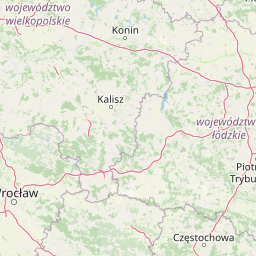
Use this park location map to pinpoint Dąbrowa Smoszew Nature Reserve in Poland, understand its exact geographic position, and read its mapped placement within the surrounding landscape more clearly.

Pigeon | © OpenStreetMap contributors

Location context for Dąbrowa Smoszew Nature Reserve

Greater Poland Voivodeship

Explore detailed imagery of canopy structures, woodland habitats, and protected lowland terrain.

Dąbrowa Smoszew Photos and Landscape: Visualizing the Old-Growth Oak Forest

Photographic documentation reveals the layered forest canopy and mature tree stands that define Dąbrowa Smoszew. Visualizing these protected lowland oak habitats provides clear insight into the ecological character of the Greater Poland region.

A red information sign with white text reading REZERWAT PRZYRODY DĄBROWA SMOSZEW, mounted on wooden posts in a lush green deciduous forest.

A dense, mature forest with tall straight tree trunks and a vibrant green mossy ground cover in spring.

Park atlas

Compare adjacent woodland reserves and regional forest habitats across the surrounding territory

Exploring Other Parks Near Dąbrowa Smoszew And Regional Protected Landscapes

Continue browsing other parks near Dąbrowa Smoszew to examine related lowland forest ecosystems and mature oak habitats across the wider regional landscape. Comparing adjacent protected areas reveals broader patterns in regional vegetation continuity and local conservation networks.
A watercolor painting showing a soft, bright, and airy landscape with a lush forest, grassy meadow, and a winding river against a light, pale sky.
Nature reserveGreater Poland Voivodeship
About 4 km away#1 closest

Northwest

Miejski Bór Nature Reserve: Mapped Protected Landscapes in the Greater Poland Voivodeship

A detailed look at lowland forest geography and botanical conservation boundaries

Miejski Bór Nature Reserve represents an essential fragment of the Wysoczyzna Kaliska, protecting a distinctive pine and broadleaf woodland mosaic. This site is valued for its protected understory plant populations and ancient burial mounds, grounding its ecological importance within the regional forest matrix of the Greater Poland Voivodeship.

Area
0.244 km²
Established
1987
Relief
Lowland
Scope
Terrestrial
A watercolor painting showing a soft landscape with trees, rolling hills, and a winding stream, rendered in light pastels.
Nature reserveGreater Poland Voivodeship
About 11 km away#2 closest

West

Rezerwat przyrody Mszar Bogdaniec: Geography and Protected Peatland Landscape Analysis

Explore wetland terrain within the Greater Poland Voivodeship.

Rezerwat przyrody Mszar Bogdaniec stands as a vital protected area in Greater Poland, featuring an elongated depression that supports transitional and raised bog elements. Enclosed by inland dunes, the reserve offers a compact study of Sphagnum-dominated micro-landscapes and wetland biodiversity that remains rare within the surrounding agricultural lowlands.

Area
0.22 km²
Established
1995
Scope
Terrestrial
Water
Major water bodies
Nature reserveWielkopolska Voivodeship
About 36 km away#3 closest

East

Rezerwat przyrody Majówka: Protected Nature Reserve and Woodland Geography

Geographic landscape mapping in Wielkopolska Voivodeship

Rezerwat przyrody Majówka offers a focused look at small-scale forest conservation in central-western Poland. Protecting approximately eight hectares of uneven-aged mixed woodland, the reserve serves as a vital ecological sentinel for silver fir and spruce populations, providing valuable data on lowland forest structure and regional biodiversity within the Kotlina Grabowska lowland mesoregion.

Area
0.08 km²
Established
1958
Relief
Lowland
Climate
Temperate
Nature reserveGreater Poland Voivodeship
About 42 km away#4 closest

Southeast

Rezerwat przyrody Jodły Ostrzeszowskie: Mapped Geography and Protected Forest Boundaries

Nature reserve study in the Greater Poland Voivodeship

Rezerwat przyrody Jodły Ostrzeszowskie functions as a critical floristic site in west-central Poland. Located in Ostrzeszów County, this protected area anchors a rare population of silver fir at the edge of its range. The site serves as a vital point for understanding lowland forest composition and range-limit ecology within the regional mosaic of the Kotlina Grabowska.

Area
0.087 km²
Established
1963
Relief
Lowland
Scope
Terrestrial
A soft watercolor painting of a serene wetland landscape with scattered deciduous trees, low grassy banks, and calm water, rendered in light green and muted earth tones against a white background.
Nature reserveGreater Poland Voivodeship
About 49 km away#5 closest

North

Dębno nad Wartą Nature Reserve: Geographic Profile and Protected Landscape Boundaries

Riparian forest sanctuary in the Warta river valley.

Located in the heart of the Greater Poland Voivodeship, this faunistic nature reserve protects a vital fragment of lowland floodplain forest. The site is defined by its complex oak, ash, and elm canopy, which supports rare invertebrate populations rarely found in the broader surrounding region. This atlas entry provides a detailed look at its protected boundaries, hydrologic landscape, and integral role within the Warta river corridor.

Area
0.217 km²
Established
1974
Relief
Lowland
Climate
Temperate
A watercolor painting showing a soft, stylized forest landscape with gentle rolling hills in the background, leafy trees in the midground, and ferns and grasses in the foreground.
Nature reserveGreater Poland Voivodeship
About 49 km away#6 closest

West

Rezerwat przyrody Dębno: A Key Protected Nature Reserve in Greater Poland, Poland

Mapping lowland forest ecosystems and ancient oak habitats

Rezerwat przyrody Dębno provides a look into the lowland ecology of Greater Poland through its protected status and renaturation initiatives. This nature reserve, characterized by its ancient oaks and Magnocaricetum communities, highlights the importance of small-scale forest conservation and provides valuable insight into the regional geography of the Kotlina Żmigrodzka.

Area
0.08 km²
Established
1961
Relief
Lowland
Scope
Terrestrial
Watercolor painting of a calm pond with green trees on the banks, reeds in the foreground, and distant rolling hills.
Nature reservePoland
About 49 km away#7 closest

Northwest

Rezerwat przyrody Miranowo: Protected Peatland Ecosystem and Botanical Nature Reserve

A preserved wetland landscape in the Polish lake country

Located near the shores of Lake Dolskie Wielkie, Rezerwat przyrody Miranowo represents a significant protected area focused on the conservation of rare calcareous peatland habitats. The reserve sustains a dense collection of over 230 vascular plant species, offering a unique opportunity to study relict vegetation in a managed wetland environment within Poland.

Area
0.099 km²
Established
1972
Relief
Lowland
Climate
Temperate
Protected landscapeGreater Poland Voivodeship
About 52 km away#8 closest

North

Żerkowsko-Czeszewski Park Krajobrazowy Protected Landscape: Map and Geographic Overview

Glacial river valleys and moraine hills in Greater Poland

The Żerkowsko-Czeszewski Park Krajobrazowy protects a diverse range of lowland terrains, from the broad Warta River floodplain to the elevated moraine ridges known locally as the Swiss Żerków. This protected area serves as a vital corridor for riparian forests and avian habitats, framed by historic cultural sites across the Greater Poland Voivodeship landscape. Access detailed geographic insights into the riverine networks, forest reserves, and moraine formations that define this notable Polish protected area.

Area
157.95 km²
Established
1994
Relief
Upland
Climate
Temperate

Common questions about visiting, size, designation, and location context for Dąbrowa Smoszew Nature Reserve

Dąbrowa Smoszew Nature Reserve FAQs for park facts, access, geography, and protected area context

Find quick answers about Dąbrowa Smoszew Nature Reserve, including protected-area facts, park geography, trail and visitor context, and how the park fits into its surrounding country and regional landscape.
MoriAtlas Explorer

Continue Your Protected Areas Search Across the Global Atlas

Deepen your exploration by continuing the structured search for national parks and protected areas worldwide. Utilize the comprehensive filtering capabilities to compare different conservation landscapes and refine your understanding of global park geography. Discover more about the distribution and characteristics of protected natural areas.

Global natural geography