

Mori Atlas logo
Nature reserveRezerwat przyrody Dębina

A strictly protected oak grąd remnant serving as a vital ecological island in the Polish landscape

Rezerwat przyrody Dębina: Mapped Protected Area and Oak Forest Landscape in Lesser Poland

Rezerwat przyrody Dębina represents a significant protected area within the Lesser Poland Voivodeship, acting as a small yet ecologically dense remnant of the historical Niepołomice Forest. This reserve preserves a mature oak-dominated woodland characterized by natural forest dynamics and a diverse community of birds and insects. By tracing the Proszowski Potok stream that defines its boundaries, visitors can better understand how this strictly protected site maintains its integrity amidst an increasingly modified regional terrain.

nature reservestrict protectionoak forestgrąd ecosystemlowland forestPuszcza Niepołomicka
A flat-style digital illustration showing a forest floor with a fallen tree, ferns, and scattered leaves in the foreground, with a waterfall and distant cliffs visible under a sunset sky in the background.

Rezerwat przyrody Dębina

Nature reserve

Park overview

Structured park overview, official facts, and landscape profile for Dębina Nature Reserve

Dębina Nature Reserve park facts, protected area profile, and essential visitor context

Review the core facts for Dębina Nature Reserve, including designation, size, terrain, visitor scale, habitats, and operating context in one park-focused overview.

About Dębina Nature Reserve

Dębina Nature Reserve is a compact forest reserve located in the Lesser Poland Voivodeship, in the Drwinia commune of Bochnia County, in southern Poland. Geographically, it lies within the Podgórze Bocheńskie mesoregion, on the southeastern edge of the large lowland forest complex known as Puszcza Niepołomicka. The protected plot is framed by the Proszowski Potok stream and one of its tributaries, while the A4 motorway runs nearby, illustrating how strongly the modern landscape has closed in on what remains a small island of older forest.

In formal terms, Dębina is a forest nature reserve (rezerwat leśny) under strict protection (ochrona ścisła). This means that the area is managed primarily to allow natural forest processes to unfold with minimal direct human intervention, rather than for timber production or recreation. The reserve is very small, covering roughly 12.66 hectares according to forest service data, but its significance is disproportionate to its size because it preserves vegetation that reflects the older character of the Niepołomice forest landscape.

Ecologically, the reserve centers on a natural grąd ecosystem dominated by mature oak trees. Grąd refers to a type of deciduous forest that combines broadleaf species such as oak with a richer understory, characteristic of fertile lowland sites in Central Europe. The old oak stands and associated natural processes make the reserve a useful scientific reference for understanding how the Niepołomice Forest once looked before centuries of land-use change.

Wildlife is part of Dębina's core identity, even though the site is tiny. The reserve is noted for its diverse forest bird community, which benefits from the structural variety of the oak stand and the edge effects created by the surrounding landscape. Insect fauna is also particularly rich, with rare species recorded here. Together, these features give Dębina a clear role as a small biodiversity anchor in an agricultural and increasingly infrastructural setting.

The broader context of Puszcza Niepołomicka is essential to understanding Dębina. The Niepołomice Forest is historically significant; it was once a royal hunting ground and has long been recognized for its natural value. Dębina captures a fragment of that historical forest in a strictly protected form, ensuring that at least one piece of the original oak forest assemblage continues to evolve under natural dynamics rather than forestry cycles.

Quick facts and research context for Dębina Nature Reserve

Dębina Nature Reserve is a strictly protected forest reserve (ochrona ścisła) established in 1957 in the Lesser Poland Voivodeship. It lies in the southeastern part of Puszcza Niepołomicka, at the fork of Proszowski Potok and one of its tributaries, within the mesoregion known as Podgórze Bocheńskie.

The reserve covers around 12.66 hectares, slightly smaller than the figure given in the original establishment act of 1957, which set the area at 13.14 hectares. It was created by order of the Minister of Forestry and the Wood Industry to preserve a scientifically valuable remnant oak stand of the historic Niepołomice Forest, and it continues to function as a strictly protected sanctuary of old-growth oak woodland.

Protection and recognition

Terrestrial conservation scope and recognized protected area data

Rezerwat przyrody Dębina Protection Status and Designated Area Record

Rezerwat przyrody Dębina holds documented terrestrial protection parameters within its regional conservation framework. Official records compile designated status metrics and management scope details for structured analysis.

Protection details

Protection scope
Terrestrial
Transboundary protection
No
Park context

Deeper park guide and search-rich context for Dębina Nature Reserve

Dębina Nature Reserve history, landscape, wildlife, and travel context

Explore Dębina Nature Reserve through its history, landscape character, ecosystems, wildlife, conservation priorities, cultural context, and seasonal travel timing in a structured park guide built for atlas discovery and search intent.

Why Dębina Nature Reserve stands out

Dębina is known above all for being a small but high-quality remnant of the historical deciduous forests that once covered much of the Niepołomice area. The reserve protects a natural oak grąd community with old trees, valued as a reference for the ecological character that the broader Puszcza Niepołomicka once had. Beyond the trees themselves, the reserve is also recognized for its rich and diverse bird and insect fauna. Forest birds and a varied entomofauna, including rare insect species, are part of what gives this small site a notable ecological profile in southern Poland.
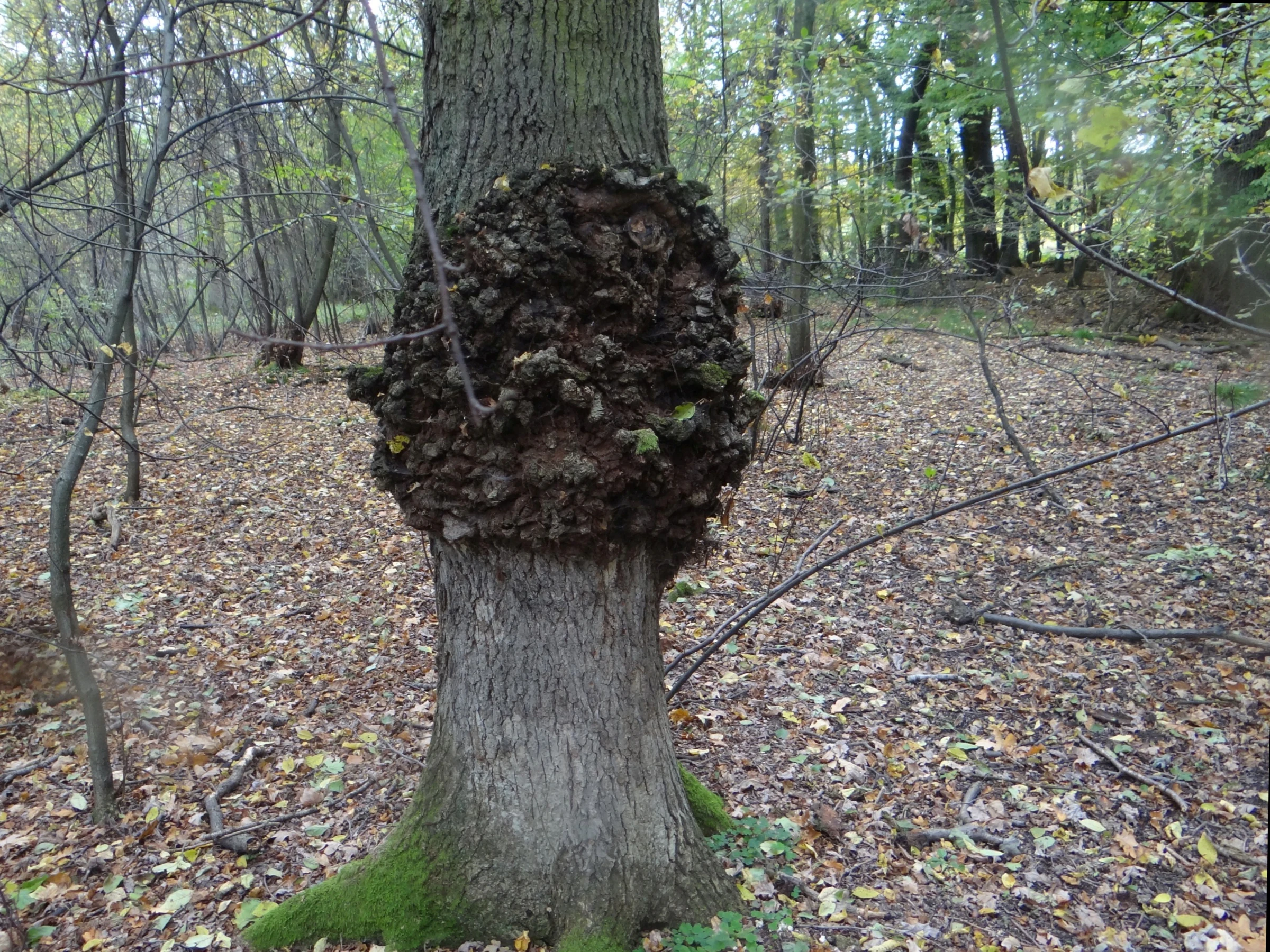
A close-up view of a large, woody burl growth on the trunk of an oak tree in an autumn forest floor covered with fallen leaves.
A prominent burl on a mature oak tree in Rezerwat przyrody Dębina, showcasing the reserve's forest ecosystem.

Dębina Nature Reserve history and protected-area timeline

Dębina Nature Reserve was established in 1957 by an order of the Minister of Forestry and the Wood Industry, which took effect when it was published in the official Polish legal monitor in early 1958. The impetus behind its creation was explicitly scientific: to protect a fragment of oak forest recognized as a remnant of the broader Puszcza Niepołomicka.

At the time of establishment, the reserve was placed under strict protection status, an unusually strong protection category for Polish nature reserves. This emphasis reflected the desire to allow natural forest dynamics to continue without interference, maintaining the site as a reference for the historical character of the regional forest.

The original founding act set the area at 13.14 hectares, but subsequent forest service measurements record a slightly smaller area of around 12.66 hectares. This modest difference reflects the kind of boundary and measurement adjustments typical of long-established reserves, rather than a fundamental change in the protected site.

Since its founding, Dębina has continued to serve as a strictly protected sanctuary of oak-dominated forest. Its existence mirrors a longer pattern in Polish nature conservation: when large historic forests like Puszcza Niepołomicka have been heavily reduced or modified, small reserves are sometimes established to preserve the last near-natural fragments in their original ecological character.

Dębina Nature Reserve landscape and geographic character

The landscape context of Dębina Nature Reserve is defined less by dramatic topography and more by a sharp ecological contrast. The reserve lies in a relatively flat to gently undulating part of the Podgórze Bocheńskie mesoregion, on soils that historically supported rich deciduous forest.

The plot is demarcated hydrologically in part by the Proszowski Potok stream and one of its tributaries, which fork around the reserve. These watercourses help define the boundaries of the protected area and contribute to the ecological conditions inside it, supporting the moisture and fertility that oak grąd forests depend upon.

Surrounding the reserve is a heavily human-modified landscape typical of this part of southern Poland: agricultural fields, settlements, and transport infrastructure. The A4 motorway runs close to the reserve, providing a clear marker of how unusual a strict-protection, old-growth oak patch has become in this region. The view from the reserve is therefore of an ecological island embedded in a working agricultural and infrastructural matrix, rather than of a continuous forest landscape.

Within the protected area itself, the landscape features are at a more intimate scale: the structural complexity of the oak stand, vertical layering of canopy trees, shrub layer, and herbaceous vegetation, along with the subtle topographic variation typical of lowland forest soils. Old trees and natural regeneration patterns shape the spatial feel of the site.
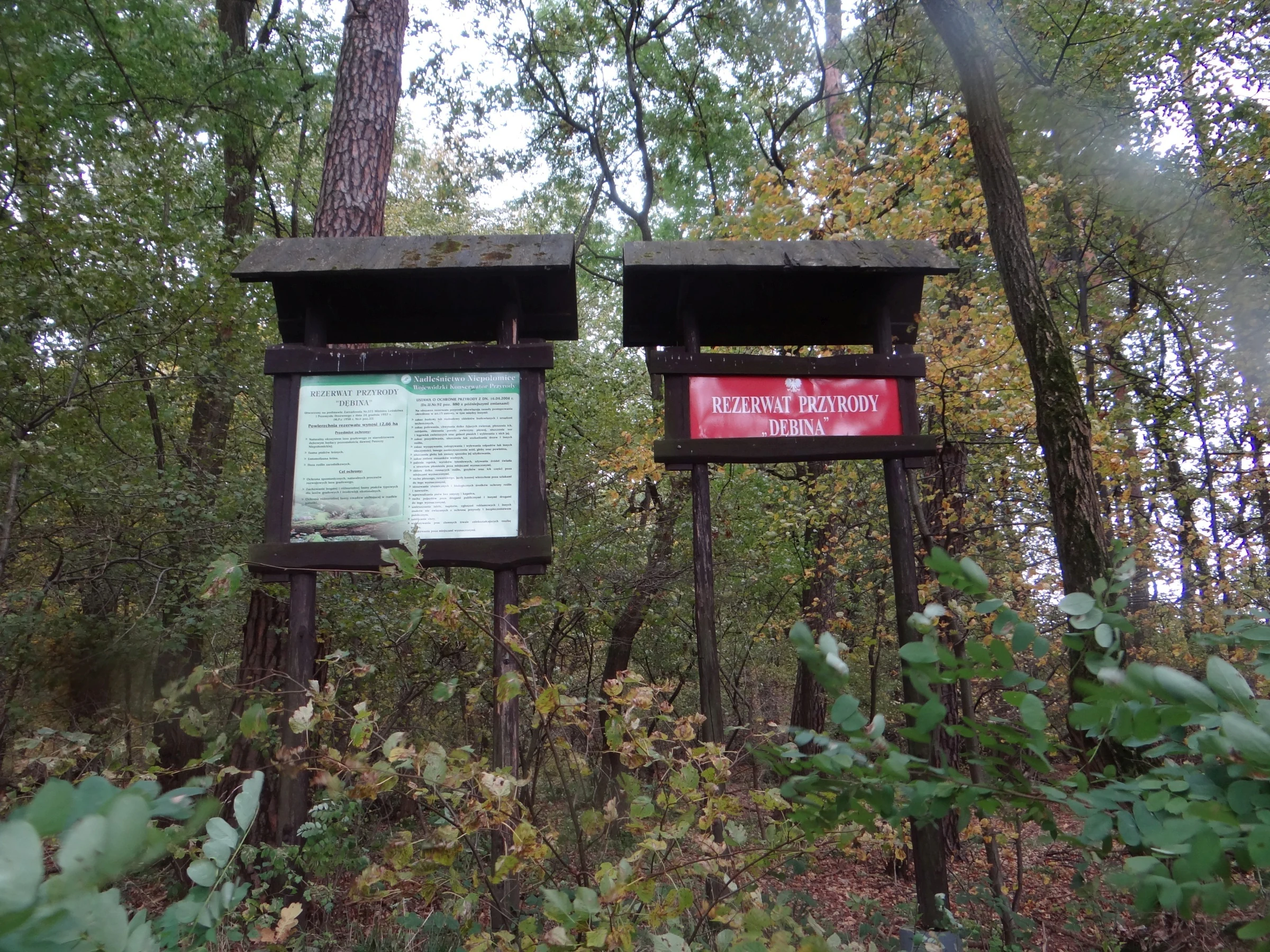
Two wooden sign structures stand in a forest clearing; the left sign contains text information, and the right sign features a red plaque reading Rezerwat Przyrody Dębina.
Information boards and identification signage at the entrance to Rezerwat przyrody Dębina.

Dębina Nature Reserve ecosystems, habitats, and plant life

Ecologically, Dębina is centered on the grąd forest community, a type of fertile lowland deciduous forest typical of Central Europe. The forest here is dominated by mature oak, with the structural and species diversity characteristic of well-developed grąd stands, including varied shrub and herb layers.

Grąd ecosystems like the one in Dębina are notable for their biodiversity: they combine broadleaf canopy trees with rich understory and a diverse spring flora. The reserve's protection of such a community is significant because grąd forests have been heavily reduced across much of their natural range in Poland, surviving mostly in small, fragmented patches.

The strict protection regime in the reserve is intended to maintain the natural processes that shape grąd forests, including natural tree regeneration, the dynamics of deadwood, and ecological succession. This is what gives the site value as a scientific reference: it preserves not only specific species but also the ecological processes of an oak-dominated forest.

Edge effects and ecotonal habitats are also part of the reserve's ecological profile. The transition between the forest interior and the surrounding agricultural and riparian landscape creates habitat variability that supports a richer faunal community. Streams and the riverside zones along Proszowski Potok also contribute aquatic and semi-aquatic ecological elements along the reserve's edges, complementing the forest interior habitats.
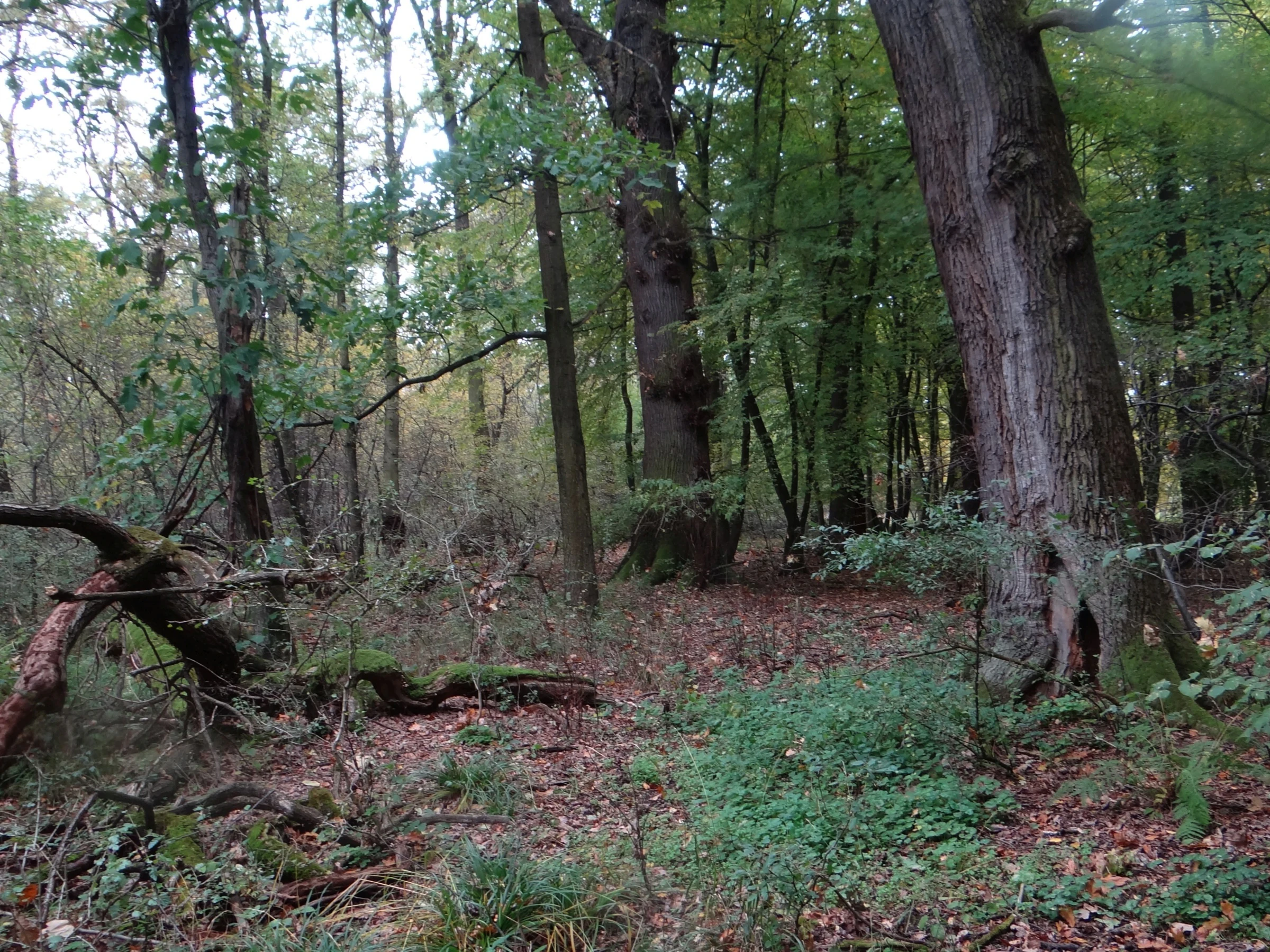
A dense forest interior with large mature oak trees, thick trunks, and a forest floor covered in leaf litter and low vegetation.
A view into the dense, mature oak forest ecosystem of Rezerwat przyrody Dębina.

Dębina Nature Reserve wildlife and species highlights

Wildlife is integral to Dębina Nature Reserve's identity, with emphasis placed on both birds and insects in the site's official conservation framing. The forest bird fauna is one of the key subjects of protection and is described as rich and diverse, with species typical of grąd forests as well as those that use the ecotonal edge habitats around the reserve.

Old oak trees with natural cavities, deadwood, and varied vertical structure create nesting conditions and feeding opportunities for many forest bird species. Even in such a small area, the structural complexity of the oak stand is enough to support a meaningful forest avifauna community by regional standards.

The insect fauna (entomofauna) of the reserve is highlighted as particularly diverse and notably rich in rare species. This insect diversity is linked to the natural character of the oak forest: mature broadleaf trees, deadwood, and the absence of intensive management support complex communities of saproxylic, herbivorous, and predatory insects.

Beyond birds and insects, the reserve's combination of forest interior, edge habitats, and riparian influence along Proszowski Potok supports a broader small-scale fauna typical of lowland deciduous forest fragments, though the small size of the protected area limits populations of larger mammals. The reserve's value for wildlife conservation lies more in the quality of its habitat than in its area alone.

Dębina Nature Reserve conservation status and protection priorities

Conservation is at the heart of Dębina Nature Reserve's purpose. The site was created explicitly to preserve a scientifically important fragment of oak forest considered a remnant of the historical Puszcza Niepołomicka. This framing has shaped its conservation approach from the beginning.

The reserve is managed under strict protection (ochrona ścisła), a status reserved for sites where natural ecological processes are allowed to unfold with minimal direct intervention. This is significant because most Polish forests, including parts of the wider Puszcza Niepołomicka, have been shaped by forestry management. In this context, Dębina offers a reference point for what natural oak forest dynamics look like.

The official conservation objectives focus on three interrelated elements: protecting the natural grąd ecosystem with its old oak trees, safeguarding the rich and diverse bird fauna associated with grąd forests and forest edges, and conserving the varied insect fauna that includes rare species. Each of these objectives reflects the understanding that biodiversity in such a small site depends on ecological processes being preserved as a whole, rather than on single species protection.

Dębina also has a conservation role at the landscape level. As a small strictly protected plot embedded in a much larger, heavily modified region, it preserves genetic, structural, and ecological continuity with the historical Niepołomice Forest. Even though forest management around it has changed, the reserve maintains a living record of the region's natural forest heritage.

Dębina Nature Reserve cultural meaning and human context

Dębina Nature Reserve carries a quiet but meaningful cultural weight, as it represents a relic of the broader Puszcza Niepołomicka, a forest with deep historical resonance in the Niepołomice area. Niepołomice Forest was historically a royal hunting ground, and the image of dense, mature deciduous forest in this region has long been part of local identity.

The act of formally setting aside a fragment of that forest in 1957 reflects a broader post-war pattern of conservation awareness in Poland, when small ecologically valuable patches were protected as scientific reserves to anchor understanding of larger forest complexes. For researchers, foresters, and conservationists, Dębina is therefore not only a biological site but also a piece of regional environmental heritage.

For local communities around Drwinia and Bochnia County, the reserve represents a small but visible reminder of what the natural landscape once looked like before centuries of agricultural and infrastructural change. It is less a site of major cultural tradition than an example of how even a small protected woodland can preserve the memory of an older regional landscape.

Top sights and standout views in Dębina Nature Reserve

Dębina Nature Reserve is a strictly protected forest remnant of around 12.66 hectares, set in the southeastern edge of Puszcza Niepołomicka in southern Poland. Its most distinctive feature is its old oak grąd forest, which reflects the original character of the historical Niepołomice Forest.

The reserve is small but ecologically dense. Old-growth oaks, natural forest dynamics under strict protection, a rich forest bird fauna, and a notably diverse insect community including rare species make it a meaningful site for forest ecology and conservation. Its location at the fork of Proszowski Potok and close to the A4 motorway also makes it a striking example of a small ecological island preserved within a heavily modified landscape.

Best time to visit Dębina Nature Reserve

Because Dębina is a strictly protected nature reserve, visits are essentially restricted to observing the protected area from outside its boundaries rather than walking through the interior, so any visitor experience is more about context and setting than active touring. The surrounding lowland landscape of Lesser Poland is approachable across most of the warmer months of the year.

Spring and early summer are generally the most appealing periods to view the surrounding landscape, when deciduous trees are in leaf and forest bird activity is at its peak across the wider Niepołomice region. Late spring can also be a good time for observing insect diversity in ecotonal edges near forest patches like this one.

Autumn brings color and the strongest visual contrast between the oak-dominated forest fragment and surrounding fields, while winter offers a more skeletal view of the forest structure, though weather conditions and early sunset limit how much of the landscape can be comfortably observed. Because this is a strict reserve, any timing guidance is best understood as relating to viewing the broader Niepołomice Forest setting rather than the protected interior itself.

Monthly climate preview

Long-term representative point measurements tracking monthly temperature and precipitation patterns

Rezerwat przyrody Dębina climate normals and annual temperature rhythm

Representative coordinate records show average temperatures ranging from winter lows below freezing to summer maximums approaching thirty-two degrees alongside changing daily precipitation rates. Examining the full twelve-month profile provides complete monthly climate normals for detailed ecological comparison.
Annual mean8 °C
-3 °C20 °C
Jan-3°
Feb-2°
Mar
Apr
May14°
Jun18°
Jul20°
Aug20°
Sep14°
Oct
Nov
Dec-2°
Warmest month
July

19.8 °C

Coolest month
January

-3.3 °C

Wettest month
July

3.4 mm/day

Driest month
December

1.3 mm/day

Park location guide

Geography guide, regional context, and park location map for Dębina Nature Reserve

Dębina Nature Reserve park geography, regions, and map view in Poland

Understand where Dębina Nature Reserve sits in Poland through a broader geographic reading of the surrounding landscape, nearby location context, and its mapped position within the national park landscape.

How Dębina Nature Reserve fits into Poland

Poland, officially the Republic of Poland, is a Central European country spanning from the Baltic Sea in the north to the Carpathian Mountains in the south. It borders Germany, Czech Republic, Slovakia, Ukraine, Belarus, Lithuania, and Kaliningrad Oblast. The country has a temperate climate, diverse landscapes, and is known for its rich history, cultural heritage, and strong economic position within the EU.

Wider geography shaping Dębina Nature Reserve in Poland

Poland occupies 312,696 km2 in Central Europe, extending from the Baltic Sea coast in the north to the Sudetes and Carpathian Mountains in the south. It borders Germany to the west, Czech Republic and Slovakia to the south, Ukraine and Belarus to the east, and Lithuania and Kaliningrad Oblast to the northeast. The landscape includes lowland plains, uplands, and mountain ranges.

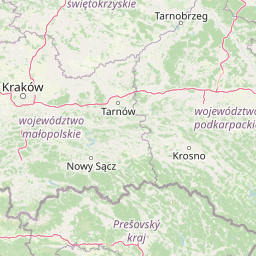
Map view of Dębina Nature Reserve

Use this park location map to pinpoint Dębina Nature Reserve in Poland, understand its exact geographic position, and read its mapped placement within the surrounding landscape more clearly.

Pigeon | © OpenStreetMap contributors

Location context for Dębina Nature Reserve

Lesser Poland Voivodeship

Explore the visual character, old growth canopy structures, and lowland forest habitats of Rezerwat przyrody Dębina.

Rezerwat przyrody Dębina Photos and Scenery: Visualizing the Protected Oak Forest Landscape

Visual documentation captures the old growth oak canopy, structural complexity, and distinct lowland forest habitats preserved within Rezerwat przyrody Dębina. Photographic records reveal the ecological contrast of this strictly protected woodland island set against the surrounding agricultural plains.

A close-up view of a large, woody burl growth on the trunk of an oak tree in an autumn forest floor covered with fallen leaves.

A large, fallen tree trunk covered in green moss lies on the forest floor, surrounded by damp soil and leaf litter in Dębina Nature Reserve.

Two wooden sign structures stand in a forest clearing; the left sign contains text information, and the right sign features a red plaque reading Rezerwat Przyrody Dębina.

A dense forest interior with large mature oak trees, thick trunks, and a forest floor covered in leaf litter and low vegetation.

Park atlas

Compare nearby lowland forests and regional protected landscapes across Lesser Poland.

Other Parks and Protected Areas Near Rezerwat przyrody Dębina

Browse protected areas near Rezerwat przyrody Dębina to examine related woodland remnants and lowland forest reserves in the surrounding region. Comparing adjacent natural habitats helps contextualize strict forest reserves within broader regional geography.
Nature reserveLesser Poland Voivodeship
About 4.8 km away#1 closest

West

Długosz Królewski Nature Reserve: A Geographical Overview of Protected Polish Fern Habitats

Botanical landscape conservation in the Lesser Poland Voivodeship region.

Długosz Królewski Nature Reserve serves as a vital protected area for the rare royal fern, Osmunda regalis, within the humid forest corridors of the Niepołomice Forest. Situated in the Podgórze Bocheńskie mesoregion, this reserve provides a stable micro-climate and moist substrate for diverse acidophilic plant communities. It functions as an integral piece of the Natura 2000 protected network, illustrating the geographic importance of localized forest conservation in the southern Polish landscape.

Area
0.242 km²
Established
1963
Relief
Lowland
Climate
Temperate
Protected landscapeLesser Poland Voivodeship
About 14 km away#2 closest

South

Wiśnicko-Lipnicki Park Krajobrazowy: Atlas and Geography of the Carpathian Foothills

Mapped sandstone outcrops and diverse protected habitats

Wiśnicko-Lipnicki Park Krajobrazowy defines the transition between open agricultural lowlands and forested Carpathian ridges. Within its boundaries, geologic erosion has carved deep stream ravines and isolated mushroom-shaped sandstone tors, while the valley floors host moisture-rich peat bogs and grasslands. This protected area offers a compelling look at the integrated natural and cultural heritage typical of the southern Polish landscape.

Area
142.308 km²
Established
1997
Relief
Upland
Climate
Temperate
A soft watercolor illustration depicting a winding stream flowing through a green mountain valley with forested slopes in the background.
Protected areaLesser Poland Voivodeship
About 32 km away#3 closest

Southeast

Łososina Protected Area: Mapped Landscapes and Riparian Geography in Southern Poland

A concentrated Natura 2000 conservation site in the Pogórze Rożnowskie foothills

The Łososina protected area features a unique sequence of stream-side habitats including grey willow scrub and mature alder floodplain forests. Mapped across four distinct enclaves in the Lesser Poland Voivodeship, the terrain provides essential shelter for the Mediterranean barbel, reflecting a highly intact submontane ecosystem maintained by active mountain stream processes.

Area
3.454 km²
Relief
Upland
Water
Major water bodies
Protected areaLesser Poland Voivodeship
About 35 km away#4 closest

Southeast

Ostoje Nietoperzy okolic Bukowca: Geography and Protected Area Overview

A forest and cave sanctuary in the Lesser Poland Voivodeship.

This protected area represents an ecologically coherent network of forest habitats and hibernation sites across the Pogórze Rożnowskie. It preserves Carpathian woodland remnants and essential roosting environments, offering a detailed look at micro-scale landscape conservation and geological formations like Diabla Dziura in the Polish countryside.

Area
5.863 km²
Established
2008
Relief
Upland
Climate
Temperate
Nature reserveLesser Poland Voivodeship
About 35 km away#5 closest

South

Uroczysko Łopień Nature Reserve: Geography and Protected Habitat Mapping

Beskid Wyspowy mountain landscape and karst cave systems

Uroczysko Łopień represents a concentrated protected landscape within the Beskid Wyspowy, defined by its complex geology, primeval beech forests, and essential bat hibernation caves. The reserve showcases a remarkable density of micro-habitats, including raised peat bogs and sandstone rock formations, providing an essential study in Carpathian mountain conservation geography.

Area
0.445 km²
Relief
Mountain
Climate
Temperate
Access
Highly restricted
Nature reserveŚwiętokrzyskie Voivodeship
About 39 km away#6 closest

North

Ostoja Kozubowska Nature Reserve: Geographic Atlas and Protected Habitat Overview

Mapping the ecological landscape of the Świętokrzyskie region

Ostoja Kozubowska stands as a critical protected landscape in Poland, home to seven distinct European habitat types including peri-Pannonic scrub and xerothermic grasslands. Centered on the Chroberskie Forest, this area showcases the intersection of dry, sun-exposed slopes and rich riparian vegetation within the Nida basin. Access this detailed geographic profile to trace the boundaries and habitat distribution defining this essential nature reserve.

Area
41.815 km²
Scope
Terrestrial
Nature reserveLesser Poland Voivodeship
About 39 km away#7 closest

Southwest

Łąki koło Kasiny Wielkiej: Protected Meadow Habitats in Lesser Poland Voivodeship

Ecological mapping of traditional Carpathian grassland ecosystems.

Łąki koło Kasiny Wielkiej is a specialized nature reserve in the Beskid Wyspowy range, protecting fragmented semi-natural meadows that represent essential habitat types within the European Natura 2000 network. By analyzing the site boundaries and regional landscape context within Lesser Poland Voivodeship, this entry provides insight into how low-intensity farming preserves distinctive grassland flora and terrain structure in the Carpathian foothills.

Area
0.244 km²
Established
2011
Relief
Mountain
Climate
Temperate
A soft, horizontal watercolor illustration depicting a rolling green landscape with distant hills under a light sky.
Nature reserveLesser Poland Voivodeship
About 40 km away#8 closest

West

Rezerwat przyrody Cieszynianka: Protected Woodland and Floristic Reserve in Lesser Poland

Exploring the geographic boundaries and botanical significance of this unique southern Polish site

This nature reserve protects an isolated, island-like population of rare spring-flowering plants within a sheltered beech and birch forest. Situated on the slopes above the Rzepnik stream in the Lesser Poland Voivodeship, the site serves as a prime example of focused botanical conservation within a heavily settled foothill countryside.

Area
0.103 km²
Established
1969
Relief
Upland
Climate
Temperate

Common questions about visiting, size, designation, and location context for Dębina Nature Reserve

Dębina Nature Reserve FAQs for park facts, access, geography, and protected area context

Find quick answers about Dębina Nature Reserve, including protected-area facts, park geography, trail and visitor context, and how the park fits into its surrounding country and regional landscape.
MoriAtlas Explorer

Continue Your Protected Areas Search Across the Global Atlas

Deepen your exploration by continuing the structured search for national parks and protected areas worldwide. Utilize the comprehensive filtering capabilities to compare different conservation landscapes and refine your understanding of global park geography. Discover more about the distribution and characteristics of protected natural areas.

Global natural geography