Why Fish Creek Mountains Wilderness stands out
The wilderness is best known for its dramatic plateau-like appearance above the desert basin, with rugged ridges, twisting canyons, and small valleys that only become apparent on close exploration. Its limestone outcrops, which have resisted erosion, support natural water-holding chutes that sustain desert wildlife long after seasonal storms pass. Another defining feature is the visible remnant of the ancient Lake Cahuilla shoreline, which ties the area to the broader geological and ecological history of the Salton Trough region. Combined with its position in the Colorado Desert and proximity to the Carrizo Impact Area, the wilderness offers a quiet, rugged counterpart to the more heavily visited desert landscapes of southeastern California.
Fish Creek Mountains Wilderness history and protected-area timeline
Fish Creek Mountains Wilderness was formally designated in 1994 as part of the United States wilderness preservation system. Its establishment reflected a broader recognition of the Fish Creek Mountains and surrounding desert landscapes as ecologically and geologically significant, particularly within the context of southern California's Colorado Desert, where lowland areas have been extensively converted to other uses.
The Carrizo Impact Area, within which the wilderness sits in part, has a separate institutional history tied to military use of the desert for training and testing. The closure of that area to the public has, over time, contributed to the relative preservation of the surrounding landscape, including the segments that now form the wilderness.
Beyond modern designations, the region carries deep natural history tied to ancient Lake Cahuilla, a large freshwater body that historically filled the Imperial and Coachella Valleys before receding roughly 500 years ago. The preserved shoreline visible within the wilderness offers a tangible connection to that earlier hydrological era, long predating any contemporary protected-area boundary.
Fish Creek Mountains Wilderness landscape and geographic character
The Fish Creek Mountains present one of the most distinctive massifs in the Colorado Desert: a high, plateau-like block that rises abruptly from the desert basin like a wall, then fractures, on closer inspection, into a complex of jagged ridges, twisting canyons, and small sheltered valleys. From a distance the range appears deceptively uniform, with few dramatic peak silhouettes. Within its interior it becomes a deeply textured landscape of erosional features shaped by flash floods and centuries of weathering.
A defining element of the terrain is its limestone outcrops, which have resisted erosion more effectively than surrounding rock. These outcrops channel water from intense desert cloudbursts into narrow chutes and pools at their base. Because the chutes are shielded from direct sunlight, water persists at these sites long after storms have passed, leaving seasonal tinajas, or natural rock tanks, scattered through the range.
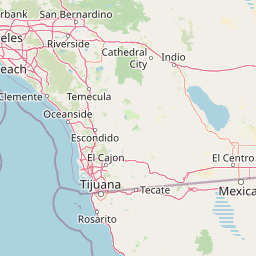
In addition to its rocky terrain, the wilderness contains a preserved segment of the ancient Lake Cahuilla shoreline. This subtle but traceable feature marks a former water level far above the modern desert floor and connects the Fish Creek Mountains to the larger geological story of the Salton Trough and the present-day Imperial and Coachella Valleys. South of the range lies Anza-Borrego Desert State Park, and west lies the flat expanse of the Imperial Valley, emphasizing how sharply the mountains rise above neighboring landscapes.
Fish Creek Mountains Wilderness ecosystems, habitats, and plant life
Vegetation in Fish Creek Mountains Wilderness reflects the broader character of the Colorado Desert, with desert scrub and drought-adapted plants dominating the exposed slopes and lower basins. Higher and more sheltered areas support denser stands of hardy desert vegetation, while the bottoms of canyons and other sheltered environments retain enough moisture to host richer plant life than the surrounding open desert.
Because of the limestone-controlled water catchments described above, certain microsites within the wilderness retain water far longer than typical desert settings. These wetter pockets create localized habitat islands that contrast with the otherwise arid terrain, supporting a more diverse community of plants and animals than the surrounding desert flats.
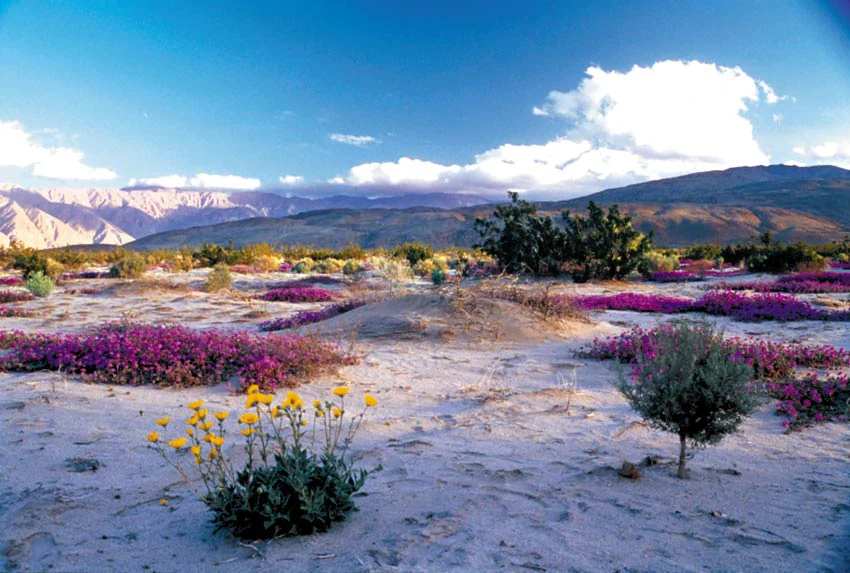
The wilderness falls within the broad ecosystem of the Colorado Desert section of the Sonoran Desert ecoregion, a region renowned for its springtime wildflower displays in favorable years. Although the Fish Creek Mountains themselves are not the most heavily publicized wildflower sites, they share the regional climate patterns, soil types, and elevation gradients that drive the periodic bloom events across southeastern California.
Fish Creek Mountains Wilderness wildlife and species highlights
Wildlife in Fish Creek Mountains Wilderness is shaped strongly by the availability of water in an otherwise arid landscape. The natural rock tanks formed at the bases of limestone chutes serve as critical seasonal and sometimes year-round water sources for desert animals, functioning as wildlife oases within a broader matrix of dry terrain.
A wide range of typical Colorado Desert species can be expected in the area, including desert-adapted mammals, reptiles, and birds that take advantage of both the rugged rocky habitat for shelter and the scattered water sources for survival. The remote, undisturbed character of the mountains, reinforced by the proximity of the off-limits Carrizo Impact Area, helps provide relatively continuous habitat across a sizable block of land.
The canyons, ridgelines, and small valleys of the range also offer varied hunting and nesting niches, allowing species with different habitat preferences to coexist across short distances. For the visitor, this means that even short walks into the range can reveal very different ecological conditions, from hot, exposed ridges to cooler, shaded canyon bottoms.
Fish Creek Mountains Wilderness conservation status and protection priorities
Conservation significance in Fish Creek Mountains Wilderness stems from its formal wilderness designation, its management by the Bureau of Land Management, and its integration into the U.S. National Wilderness Preservation System. This designation places a long-term federal framework around the protection of its natural character, restricting development and ensuring that the area remains substantially undisturbed.
The wilderness is especially important in a regional context. Much of the surrounding lowland in the Colorado Desert region has been transformed by irrigated agriculture, geothermal development, and urban expansion, particularly in the Imperial Valley. By contrast, the Fish Creek Mountains remain a relatively intact block of rugged desert terrain in an otherwise heavily altered region.
The proximity of the Carrizo Impact Area, although closed to the public, has the unintended conservation benefit of reducing access pressures on the adjacent wilderness. Together, the formal designation, the surrounding restrictions, and the persistence of natural water catchments make the wilderness a valuable refuge for Colorado Desert ecosystems, supporting ecological processes that operate across larger and more continuous landscapes than is typical in the modern southeastern California desert.
Top sights and standout views in Fish Creek Mountains Wilderness
The wilderness's most compelling features include its plateau-like silhouette rising abruptly from the desert basin, the intricate network of jagged ridges and twisting canyons hidden within that silhouette, and the persistent natural water catchments formed by limestone outcrops. These rock tanks give the range a distinctive ecological rhythm, supporting wildlife at sites that retain moisture long after seasonal storms.
Equally notable is the preserved shoreline of ancient Lake Cahuilla, a reminder that the dry basin of the modern Imperial and Coachella Valleys was once filled by a vast freshwater lake. Set against the backdrop of the Carrizo Impact Area and its access restrictions, the wilderness offers an unusually quiet, undeveloped desert experience in a region where most lowlands have been reshaped by human activity.
Best time to visit Fish Creek Mountains Wilderness
The cooler months from late autumn through early spring are generally the most comfortable period for visiting Fish Creek Mountains Wilderness, when daytime desert temperatures are milder and conditions for hiking and exploration are more forgiving. Winter and early spring are also the seasons most likely to bring the region's striking wildflower displays in years of sufficient rainfall, including species such as the Mexican gold poppy noted in the surrounding area.
Summer visits are possible but demanding, as the Colorado Desert can experience extreme heat. Travelers choosing that season typically plan for very early starts, careful hydration, and an awareness of the limited shade and intense sun exposure. Because camping is limited to 14 days in any one location and requires relocation afterward, visitors planning longer stays should plan movements carefully across the surrounding public lands.