Mori Atlas logo
Nature reserveFledermausquartier Brauereikeller Frankfurt (Oder)

Examining the ecological boundaries and landscape context of this urban bat hibernation sanctuary.

Fledermausquartier Brauereikeller Frankfurt (Oder): A Protected Nature Reserve in Brandenburg

(Naturschutzgebiet Fledermausquartier Brauereikeller Frankfurt (Oder))

Located in the heart of Frankfurt (Oder), the Fledermausquartier Brauereikeller Frankfurt (Oder) stands as a significant nature reserve built within the ruins of a 19th-century brewery. This protected area serves as a critical node in a larger European bat migration network, utilizing deep cellar vaults to create stable microclimatic conditions for hibernation. The site represents a unique intersection of industrial heritage and urban conservation within the Brandenburg region.

urban nature reservebat sanctuaryhibernation roostindustrial heritageGreater Mouse-eared BatFFH site

Fledermausquartier Brauereikeller Frankfurt (Oder)

Nature reserve

Park overview

Structured park overview, official facts, and landscape profile for Fledermausquartier Brauereikeller Frankfurt (Oder)

Fledermausquartier Brauereikeller Frankfurt (Oder) park facts, protected area profile, and essential visitor context

Review the core facts for Fledermausquartier Brauereikeller Frankfurt (Oder), including designation, size, terrain, visitor scale, habitats, and operating context in one park-focused overview.

About Fledermausquartier Brauereikeller Frankfurt (Oder)

The Fledermausquartier Brauereikeller Frankfurt (Oder) is a compact but ecologically extraordinary protected area in the heart of Frankfurt (Oder), a mid-sized German city on the Oder river bordering Poland. Although it covers only 1.34 hectares, the reserve concentrates almost its entire conservation value on a single structure: the brick ruin of the Ostquell brewery, originally constructed in the 19th century and closed in 1950. The brewery's multi-level vaulted cellars and upper rooms now form one of the most important urban bat roosts in Germany, both as a hibernation site and as a long-term focus for bat research and conservation work in the region.

Ecologically, the site is remarkable for the steady microclimate it provides. The seven main cellar vaults span more than 1,150 square meters and reach up to 8 meters in height, while temperatures remain roughly 5 degrees Celsius year-round and humidity approaches 100 percent. These conditions, combined with the ruin's exposed position on the Oderhang slope and its immediate proximity to the Oder river, which acts as a guiding landscape feature for bats, make it exceptionally attractive for hibernation. The upper floors, once used for storage during the GDR era, are also occupied in smaller numbers, although their many cracks and hidden voids mean the true bat population is higher than direct counts suggest.

The conservation story is equally significant. In 1989, as the dilapidated ruin faced scheduled demolition, local citizens formed an initiative to save it. Initial protection orders by the Bezirk Frankfurt (Oder) in 1989 and 1990 were followed by a 1998 provisional safeguarding ordinance from the city. The site was designated as a Habitats Directive (FFH) site in 2000, formally declared a Naturschutzgebiet (nature reserve) in January 2003, and protected under EU and Brandenburg law. Today the site is managed by the Landschaftspflegeverband Mittlere Oder, owned by the EuroNatur foundation, and integrated into the cross-border Interreg Natura Viadrina+ project that links bat conservation work along the Oder with partners in Poland, including the historic Festungsfront Oder-Warthe-Bogen.

Quick facts and research context for Fledermausquartier Brauereikeller Frankfurt (Oder)

Located in central Frankfurt (Oder), Brandenburg, the Fledermausquartier Brauereikeller is a 1.34-hectare nature reserve encompassing the ruin of the former Ostquell brewery, which ceased operations in 1950. The reserve was formally designated on 26 January 2006 and is separately listed as a 0.25-hectare Fauna-Flora-Habitat (FFH) site, recognized under the EU Habitats Directive. Classified as IUCN Category IV (Habitat/Species Management Area), the site protects a hibernation roost of 1,500 to 2,000 bats (as of 2020) drawn from more than 30 recorded species.

The site's defining feature is its cellar complex, comprising seven vaulted chambers and connecting passages covering more than 1,150 square meters, with ceilings up to 8 meters high. Maintaining temperatures around 5 degrees Celsius and near 100 percent humidity, the cellars provide ideal hibernation conditions. The property has been owned since 2003 by the EuroNatur foundation, with funding support from the German Federal Agency for Nature Conservation (BfN) and the State of Brandenburg. Stewardship is provided by the Landschaftspflegeverband Mittlere Oder.

Protection and recognition

Explore documented terrestrial protection metrics, designation history, and Natura 2000 recognition sources.

Fledermausquartier Brauereikeller Frankfurt (Oder) Protection Status and Designation Records

Fledermausquartier Brauereikeller Frankfurt (Oder) maintains documented terrestrial protection status established in 2006 alongside official Natura 2000 recognition records. Verified database entries compile administrative scope, designation history, and international source data for structured reference.

International recognition

Protection details

Protection scope
Terrestrial
Designated year
2006
Transboundary protection
No
WDPA ID
378081
Park context

Deeper park guide and search-rich context for Fledermausquartier Brauereikeller Frankfurt (Oder)

Fledermausquartier Brauereikeller Frankfurt (Oder) history, landscape, wildlife, and travel context

Explore Fledermausquartier Brauereikeller Frankfurt (Oder) through its history, landscape character, ecosystems, wildlife, conservation priorities, cultural context, and seasonal travel timing in a structured park guide built for atlas discovery and search intent.

Why Fledermausquartier Brauereikeller Frankfurt (Oder) stands out

The Fledermausquartier Brauereikeller Frankfurt (Oder) is best known for being the largest known winter roost of the Greater Mouse-eared Bat (Myotis myotis) in Germany. The ruin of the old Ostquell brewery, built in the 19th century on the Bahnhofsberg slope above the Oder river, hosts between 1,500 and 2,000 hibernating bats each winter, drawn from more than 30 species. Among them, the Greater Mouse-eared Bat is the most numerous and consistent occupant, but the roost also regularly shelters Bechstein's bats, Natterer's bats, pond bats, Daubenton's bats, and Brown long-eared bats. The site's importance extends beyond its size. Many of the hibernating Greater Mouse-eared Bats originate from western Poland, and ringed individuals have been recovered as far away as the Müritz region and the Czech Republic, highlighting the reserve's role as a critical node in a much larger Central European bat migration and hibernation network. The ruin has also become a flagship example of transboundary bat conservation along the Oder, integrated into the German-Polish Interreg Natura Viadrina+ project.
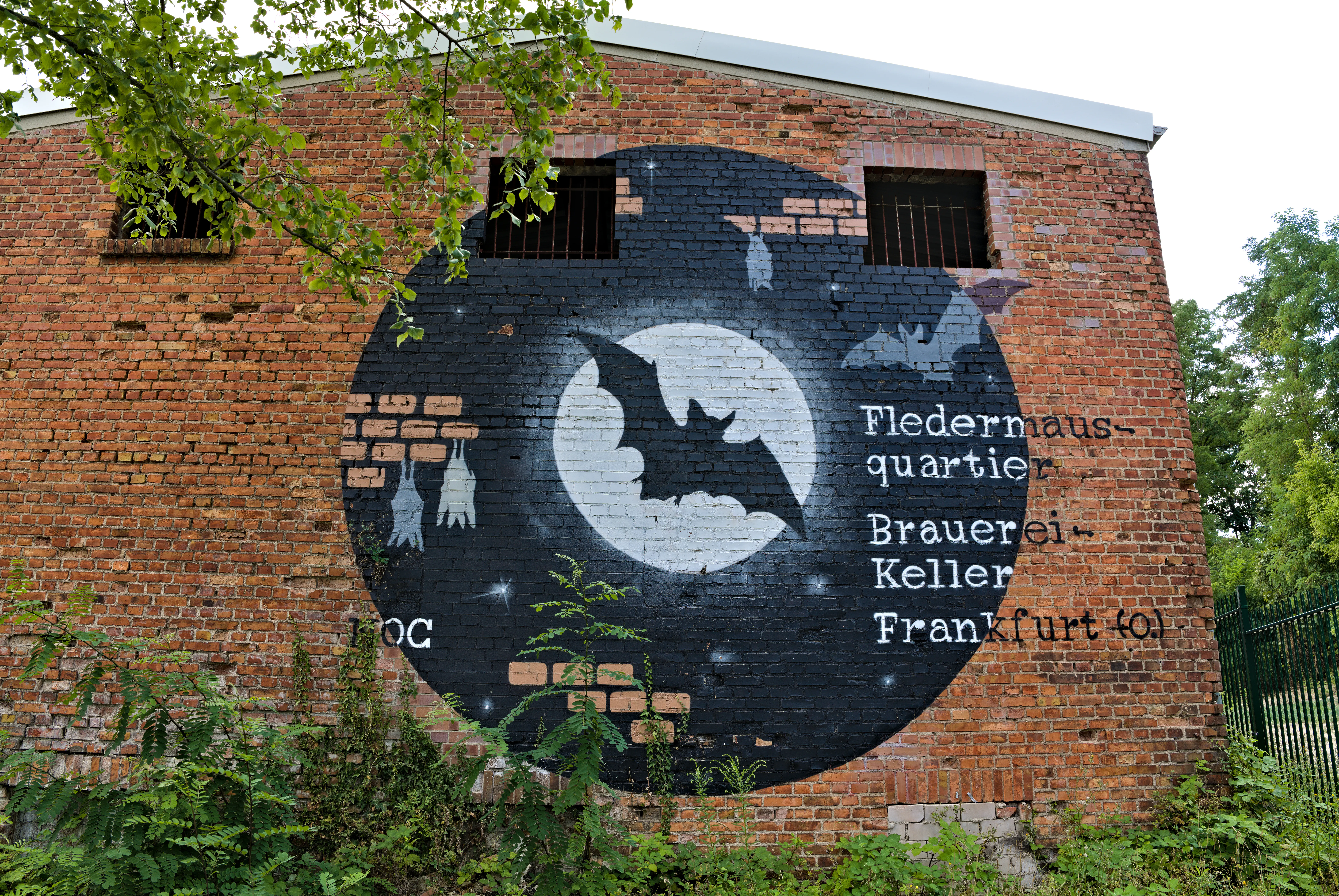
A red brick wall featuring a large circular black mural depicting a bat in front of a white full moon; the German text Fledermausquartier Brauereikeller Frankfurt (Oder) is painted on the right side.
A wall mural at the Brauereikeller in Frankfurt Oder, identifying it as a dedicated bat habitat.

Fledermausquartier Brauereikeller Frankfurt (Oder) history and protected-area timeline

The protected area's history begins not with conservation, but with industrial decline. The Ostquell brewery on Frankfurt (Oder)'s Bahnhofsberg was built in the 19th century and shut down in 1950, after which its cellars and upper floors gradually deteriorated into a structurally unsafe but biologically valuable ruin. For decades, the brewery's abandoned vaults hosted small numbers of hibernating bats, but the ruin was open to the public and only secured by three steel doors. When the first systematic bat count took place in 1987, just 250 bats were recorded across the entire structure.

The turning point came in 1989, when citizens organized to oppose planned demolition of the ruin. That same year, and in 1990, the council of the Bezirk Frankfurt (Oder) issued initial protection orders safeguarding it as a bat sanctuary. In 1988 the first physical security measures began, and after 1989 a chain-link fence, donated by West Germany's BUND (Friends of the Earth), formalized the ruin's protection. The federal German conservation process formally opened in 1998, when the city issued an interim safeguarding ordinance that imposed a building moratorium on the ruin.

Bat numbers rose sharply after the ruin was secured, peaking at roughly 2,500 bats by the late 1990s before stabilizing at between 1,500 and 2,000. The site was designated as an FFH (Fauna-Flora-Habitat) area in 2000, a status its then-owner unsuccessfully challenged in administrative court. After protracted negotiations, the property was sold in 2003 to the EuroNatur foundation, with the purchase financed jointly by EuroNatur, the German Federal Agency for Nature Conservation (BfN), and the State of Brandenburg. In January 2003 the 1.34-hectare site was formally declared a Naturschutzgebiet, and the full nature reserve designation was completed on 26 January 2006. Since 2018 the site has been part of the German-Polish Interreg Natura Viadrina+ project focused on bats, and in summer 2021 a major structural rehabilitation of the ruin's roof and interior supports was completed.

Fledermausquartier Brauereikeller Frankfurt (Oder) landscape and geographic character

The protected area's landscape is unusually compact and almost entirely built around a single human-made structure and its immediate setting. The reserve sits on the Bahnhofsberg, a slope above the Oder river in the center of Frankfurt (Oder), giving it an exposed, elevated position above one of Central Europe's most important river corridors. The brewery ruin itself is a multistory brick shell with deep, vaulted cellars that extend more than 1,150 square meters beneath the building, connected by passageways that allow bats to move between hibernation chambers.

The topography is shaped by the Oderhang, the river slope that rises steeply from the banks of the Oder. This topographic feature is essential to the site: the slope exposes the ruin to natural air drainage, moderates temperature extremes, and channels bat flight lines along the river. Surrounding the ruin, the city has established a 40-meter-wide green buffer strip in its local development plan to protect flight paths and prevent disturbance to the bats' microclimate.

Externally, the reserve blends into an urban landscape of late 19th- and 20th-century buildings, transport infrastructure (the Bahnhofsberg lies near the city's railway facilities), and the open corridor of the Oder river itself. This unusual juxtaposition, an industrial ruin serving as a wildlife sanctuary in the middle of a small European city, defines both the visual and ecological character of the protected area.

Fledermausquartier Brauereikeller Frankfurt (Oder) ecosystems, habitats, and plant life

Although the reserve covers only about 1.34 hectares, its ecological character is defined less by spatial extent than by the microhabitat provided inside the brewery ruin. The frost-free cellar vaults, with stable temperatures around 5 degrees Celsius and humidity approaching saturation, replicate the cave-like hibernation conditions that bats depend on, but do so entirely within an urban historic structure.

The surrounding landscape adds complementary habitat elements. The Oder river corridor functions as a guiding flyway for bats moving between summer roosts and hibernation sites. The green buffer zone around the reserve, combined with the protection of flight lines and hunting areas in the city's planning documents, helps maintain connectivity between the ruin and broader foraging habitats such as the wetlands, woodland patches, and floodplain meadows of the Oder valley. The reserve itself contributes to the conservation of building-dwelling species: modifications to the ruin in 2021 added swift nest boxes and bat niches in the external facade, expanding its value beyond hibernation.

The microclimatic stability inside the ruin, and the layered offerings of deep cellar vaults, intermediate floors, and accessible roof spaces, collectively create a habitat gradient that supports different bat species in different ways, from deep torpor in the most stable lower chambers to more active roosting in upper levels.

Fledermausquartier Brauereikeller Frankfurt (Oder) wildlife and species highlights

The wildlife profile of the Fledermausquartier Brauereikeller Frankfurt (Oder) is dominated by bats, with more than 30 species documented in or near the ruin. The centerpiece of the roost is the Greater Mouse-eared Bat (Myotis myotis), for which the ruin is the largest known winter roost in Germany. In winter 2007/2008, 811 Greater Mouse-eared Bats were counted in the ruin, and the species has been recorded every winter as the most numerous occupant.

Four species occur consistently every winter: Greater Mouse-eared Bat, Natterer's Bat (Fransenfledermaus), Daubenton's Bat (Wasserfledermaus), and Brown Long-eared Bat (Braunes Langohr). Other notable species recorded in the roost include the Pond Bat (Teichfledermaus), Bechstein's Bat (Große Bartfledermaus), and Natterer's/Klein's bat complex (Kleine Bartfledermaus). Banding studies have shown that Greater Mouse-eared Bats hibernating here originate from summer colonies in western Poland, with ringed individuals later recaptured as far away as the Müritz lake district and the Czech Republic, illustrating the ruin's role in a wider Central European bat network.

The protected area also supports breeding birds adapted to old buildings: swift (Mauersegler) nest boxes were fitted to the ruin's exterior during 2021 renovation work, expanding the site's wildlife value beyond hibernating bats. Beyond the ruin itself, the reserve is embedded in a network that protects White Storks, Fire-bellied Toads (Rotbauchunke), and Smooth Snakes (Schlingnatter) under the Interreg Natura Viadrina+ project.

Fledermausquartier Brauereikeller Frankfurt (Oder) conservation status and protection priorities

The Fledermausquartier Brauereikeller Frankfurt (Oder) is a nationally and internationally significant conservation site. It is formally protected as a Naturschutzgebiet (nature reserve) under Brandenburg law, formally designated in 2003 and legally completed on 26 January 2006, with a total area of 1.34 hectares. The site is also designated as a Fauna-Flora-Habitat (FFH) site under the EU Habitats Directive, recognized since 2000 with a 0.25-hectare core area, and is classified in international databases as IUCN Category IV (Habitat/Species Management Area).

Its conservation value rests on the irreplaceable role of the brewery ruin as a hibernation site for bats, particularly the Greater Mouse-eared Bat, which is considered vulnerable across much of its range. Protection extends beyond the structure itself. Frankfurt (Oder)'s planning regulations impose a 40-meter green buffer around the ruin, restrict building heights and setbacks to preserve known flight paths and hunting grounds, and prohibit changes that would alter the microclimate inside the cellar vaults. These legally binding controls have already prevented at least one major development, an 8-story parking garage originally planned within 10 meters of the ruin, from interfering with bat flight lines.

Conservation management is collaborative and cross-border. The site is owned by the EuroNatur foundation and has received restoration and protection funding from the German Federal Agency for Nature Conservation (BfN) and the State of Brandenburg. Day-to-day stewardship is handled by the Landschaftspflegeverband Mittlere Oder, while the ongoing protection of bats in the ruin is integrated into the larger German-Polish Interreg Natura Viadrina+ project, which links the site to broader conservation efforts along the Oder and the Festungsfront Oder-Warthe-Bogen.

Fledermausquartier Brauereikeller Frankfurt (Oder) cultural meaning and human context

The site sits at an unusual intersection of industrial heritage and modern conservation culture. The Ostquell brewery, built on the Bahnhofsberg in the 19th century and shuttered in 1950, embodies the post-war industrial collapse of the GDR era. During GDR times, the upper floors were repurposed by a neighboring leisure business as storage for adhesives, lacquers, and paints, leaving the structure in increasingly fragile condition.

Its conservation story is itself a piece of late-20th-century German cultural history. The citizens' initiative formed in 1989 to block demolition came at a pivotal moment, just months before German reunification, and the subsequent cross-border support from West Germany's BUND in installing protective fencing symbolizes the broader East-West environmental partnerships of that era. The legal struggles over the property, including disputes with the re-formed Ostquell-Brauerei AG and administrative court battles over FFH designation, became part of the wider narrative of how post-reunification Germany integrated East German industrial sites into European conservation law.

The site is also part of Frankfurt (Oder)'s broader sense of place. Together with neighboring protected areas such as the Booßener Teichgebiet, Eichwald und Buschmühle, Fauler See/Markendorfer Wald, Mittlere Oder, Oberes Klingetal, and Oderwiesen nördlich Frankfurt, the Brauereikeller represents one of the city's most distinctive natural-cultural landmarks: a ruin whose ecological future has been deliberately chosen as part of the city's identity.

Top sights and standout views in Fledermausquartier Brauereikeller Frankfurt (Oder)

Among the protected area's standout qualities is the sheer ecological density of a very small footprint: just 1.34 hectares containing what is currently the largest known winter roost of the Greater Mouse-eared Bat in Germany. More than 30 bat species have been recorded, with at least four present every winter, and banded bats ringed in the ruin have been recovered from western Poland, the Müritz, and the Czech Republic, underscoring its importance as a node in a transnational bat network.

The reserve's conservation history is itself a highlight. Saved from demolition in 1989 by a citizens' initiative and protected successively through GDR-era district orders, post-1990 federal safeguarding ordinances, FFH designation in 2000, and full nature reserve status in 2003–2006, the site stands out as an example of long-term, layered legal protection. Its acquisition by the EuroNatur foundation in 2003 and integration into the cross-border Interreg Natura Viadrina+ project give it a uniquely international conservation profile.

Physically, the site is unusual: an urban ruin in the center of Frankfurt (Oder) whose cellar vaults, with stable temperatures of around 5 degrees Celsius and near 100 percent humidity, replicate cave-like hibernation conditions within a 19th-century brick shell. The 40-meter planning buffer, legal flight-path protections, and 2021 renovation that added bat niches and swift nest boxes all make it a model of how a single industrial ruin can be transformed into a functioning modern wildlife sanctuary.

Best time to visit Fledermausquartier Brauereikeller Frankfurt (Oder)

The Fledermausquartier Brauereikeller Frankfurt (Oder) is best appreciated during the cooler months, when the ruin's bat populations are at their highest. Winter is the peak season for observing bat abundance inside the cellar vaults, although the protected ruin is not normally open to visitors and observation is generally limited to conservation-led activities and research counts rather than public access.

For visitors interested in the broader setting, spring and early summer allow easier walking in central Frankfurt (Oder) and along the Oder river slope to view the brewery ruin and its urban context, while milder weather highlights how the surrounding city integrates with the protected buffer zone. Late autumn, before the bats settle into full hibernation, can be a period when researchers are most active at the site. Because the protected area is small, structurally sensitive, and primarily a conservation and research site, planning a visit around educational interpretation or guided conservation events, rather than mass tourism, is generally the most appropriate approach.
Monthly climate preview

Long-term monthly temperature and precipitation patterns recorded at the representative coordinate in Brandenburg

Fledermausquartier Brauereikeller Frankfurt (Oder) Climate Normals and Annual Temperature Rhythm

Representative coordinates record long-term monthly temperature and precipitation data, establishing a baseline annual rhythm for Fledermausquartier Brauereikeller Frankfurt (Oder). Complete twelve-month climate profiles offer granular monthly comparisons across average maximum and minimum temperatures.
Annual mean9 °C
-1 °C20 °C
Jan-1°
Feb
Mar
Apr
May14°
Jun18°
Jul20°
Aug20°
Sep15°
Oct
Nov
Dec
Warmest month
July

20.3 °C

Coolest month
January

-1.1 °C

Wettest month
July

2.5 mm/day

Driest month
April

1.1 mm/day

Park location guide

Geography guide, regional context, and park location map for Fledermausquartier Brauereikeller Frankfurt (Oder)

Fledermausquartier Brauereikeller Frankfurt (Oder) park geography, regions, and map view in Germany

Understand where Fledermausquartier Brauereikeller Frankfurt (Oder) sits in Germany through a broader geographic reading of the surrounding landscape, nearby location context, and its mapped position within the national park landscape.

How Fledermausquartier Brauereikeller Frankfurt (Oder) fits into Germany

Germany is a federal republic in Western and Central Europe with a population of over 83 million across sixteen constituent states. It is Europe's largest economy by nominal GDP and a major global exporter and importer. The capital is Berlin, and the country borders Denmark, Poland, Czech Republic, Austria, Switzerland, France, Luxembourg, Belgium, and the Netherlands.

Wider geography shaping Fledermausquartier Brauereikeller Frankfurt (Oder) in Germany

Germany is located in Western and Central Europe, spanning 357,022 km². It borders Denmark to the north, Poland and the Czech Republic to the east, Austria and Switzerland to the south, and France, Luxembourg, Belgium, and the Netherlands to the west. The country has coastlines on the Baltic Sea and North Sea to the north, with the Alps located in the southern region.

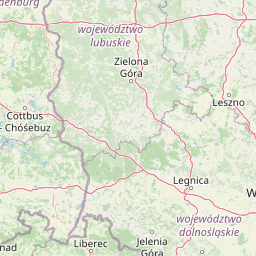
Map view of Fledermausquartier Brauereikeller Frankfurt (Oder)

Use this park location map to pinpoint Fledermausquartier Brauereikeller Frankfurt (Oder) in Germany, understand its exact geographic position, and read its mapped placement within the surrounding landscape more clearly.

Pigeon | © OpenStreetMap contributors

Location context for Fledermausquartier Brauereikeller Frankfurt (Oder)

Brandenburg

Visualizing the industrial ruins, vaulted cellars, and urban river habitats

Fledermausquartier Brauereikeller Frankfurt (Oder) Photos and Landscapes

Visual documentation captures the unique urban landscape, 19th-century brick architecture, and protected river slope surrounding Fledermausquartier Brauereikeller Frankfurt (Oder). Examining these detailed environmental images reveals how industrial ruins function as vital wildlife sanctuaries and specialized hibernation habitats.

A red brick wall featuring a large circular black mural depicting a bat in front of a white full moon; the German text Fledermausquartier Brauereikeller Frankfurt (Oder) is painted on the right side.

A weathered red brick industrial building with a fenced perimeter and informative signs mounted on the wall.

Park atlas

Compare nearby protected areas and regional reserves across the surrounding river landscape

Exploring Fledermausquartier Brauereikeller Frankfurt (Oder) and Related Regional Parks

Visitors exploring Fledermausquartier Brauereikeller Frankfurt (Oder) can browse connected protected landscapes and regional nature reserves located throughout the surrounding river corridor. Expanding the geographic comparison helps place urban wildlife habitats and protected bat sanctuaries within a broader regional conservation network.
Watercolor painting of a soft landscape featuring a calm, pale-pink reflective lake in the foreground and a layered, muted-green forest and hilly horizon in the background.
Nature reserveBrandenburg
3.5 km away#1 closest

Southwest

Fauler See/Markendorfer Wald: Protected Nature Reserve and Woodland Geography

A forest and lake landscape in Brandenburg, Germany.

Fauler See/Markendorfer Wald functions as a key nature reserve within the outskirts of Frankfurt Oder. This 171 hectare protected area combines the Fauler See lake with the adjacent Markendorfer Wald, creating a dense woodland and wetland refuge. The terrain highlights how small scale lowland sites maintain ecological importance within busy regional transport environments.

Area
1.71 km²
Established
2003
IUCN
IV
A watercolor painting showing a quiet wetland with calm water, scattered dark tree stumps, reeds in the foreground, and rolling green hills in the distance under a pale sky.
Nature reserveBrandenburg
5.4 km away#2 closest

Northwest

Booßener Teichgebiet Nature Reserve: Regional Geography and Protected Landscape Analysis

Glacial meltwater valleys and pond ecosystems in eastern Brandenburg

Discover the geographic footprint of Booßener Teichgebiet, a 104-hectare nature reserve in Brandenburg. This protected area features a unique combination of managed stream corridors, impoundment ponds, and xerothermic biotopes nestled within a glacial meltwater valley near the German-Polish border.

Area
1.04 km²
Established
2008
IUCN
IV
Relief
Lowland
Watercolor painting showing a winding river through a wetland with trees and hills in the background.
Nature reserveLubusz Voivodeship
About 12 km away#3 closest

East

Mokradła Sułowskie Nature Reserve: Mapping Wetland Protected Areas in Lubusz Voivodeship

A comprehensive geographic atlas of Polish peatland and forest marsh habitats

The Mokradła Sułowskie nature reserve protects a vital cluster of eutrophic lakes and waterlogged mires in western Poland. This atlas entry provides a detailed look at its unique landscape, where divided northern and southern sections showcase diverse stages of marshland succession and regional biodiversity within the broader Lubusz Voivodeship.

Area
0.451 km²
Established
1990
Water
Water-dominated
Protected landscapePoland
13 km away#4 closest

North

Park Krajobrazowy Ujście Warty: Protected Landscape and River Valley Atlas

Mapping wetland ecosystems and floodplain geography in western Poland

Park Krajobrazowy Ujście Warty preserves a significant lowland river valley landscape characterized by vast open pastures, marshes, and rare riparian oak forests. Located primarily within the Lubuskie region, this protected area offers a clear view into the floodplain processes of the Warta river basin, providing a distinct geographic context for wetland conservation and waterbird habitat mapping in Poland.

Area
194.96 km²
Established
1996
Relief
Lowland
Climate
Temperate
National parkLubusz Voivodeship
25 km away#5 closest

Northeast

Park Narodowy „Ujście Warty” National Park: Regional Geography and Wetland Landscapes

A major protected riparian and floodplain zone in western Poland

Located in the Lubusz Voivodeship, Park Narodowy „Ujście Warty” features an extensive network of wetlands, marshes, and meadows at the Warta and Oder confluence. This atlas entry provides essential geographic context for the park's lowland terrain and riverine ecosystems, which are defined by constant shifts in water levels and seasonal flooding patterns that sustain dense bird populations.

Area
80.74 km²
Established
2001
Visitors
52K annual
Relief
Lowland
Watercolor illustration showing a river winding through rolling green hills with sparse vegetation
National parkLubusz Voivodeship
25 km away#6 closest

Northeast

Warta Mouth National Park: A National Park Protecting Vital European Wetlands

Explore mapped protected areas and bird habitats in Lubusz Voivodeship.

Warta Mouth National Park, located in Poland's Lubusz Voivodeship, is a significant protected landscape safeguarding the ecologically rich confluence of the Warta and Oder rivers. As the nation's most recently established national park, it provides critical habitat for a vast array of migratory and breeding bird species within its extensive marshlands and floodplains. This park offers a unique opportunity for atlas-driven exploration of Central European wetland geography and the mapped boundaries of a vital conservation area.

Area
80.38 km²
Established
2001
IUCN
II
Visitors
52K annual
Protected areaLubusz Voivodeship
About 26 km away#7 closest

Northeast

Ujście Warty Protected Area: Geography and Landscape Atlas of the Warta River Valley

Natura 2000 wetland and floodplain mapping in Lubusz Voivodeship

Examine the physical geography of Ujście Warty, a major lowland protected area in western Poland. This landscape features a unique layering of river arms, alluvial forests, and dry grasslands, serving as a vital ecological corridor within the broader Oder basin. Use this mapped overview to study the terrain features and structural connectivity of these significant floodplain habitats.

Area
332.15 km²
Water
Water-dominated
Nature reserveLubusz Voivodeship
About 29 km away#8 closest

Southeast

Młodno Nature Reserve: Mapped Protected Peatland and Wetland Landscapes in Lubusz Voivodeship

Geographic analysis of lowland mire and pine forest mosaic

Examine the territorial footprint of Młodno Nature Reserve in western Poland. This site offers insight into deep-sediment organic basins and the ecological transition zones between marshland and pine-dominated woodlands within the Torzym Plain.

Area
0.929 km²
Established
1988
Relief
Lowland
Scope
Terrestrial

Common questions about visiting, size, designation, and location context for Fledermausquartier Brauereikeller Frankfurt (Oder)

Fledermausquartier Brauereikeller Frankfurt (Oder) FAQs for park facts, access, geography, and protected area context

Find quick answers about Fledermausquartier Brauereikeller Frankfurt (Oder), including protected-area facts, park geography, trail and visitor context, and how the park fits into its surrounding country and regional landscape.
MoriAtlas Explorer

Continue Your Protected Areas Search Across the Global Atlas

Deepen your exploration by continuing the structured search for national parks and protected areas worldwide. Utilize the comprehensive filtering capabilities to compare different conservation landscapes and refine your understanding of global park geography. Discover more about the distribution and characteristics of protected natural areas.

Global natural geography