
Why Fohlenweide von Dieburg stands out
Fohlenweide von Dieburg is best known for its species-rich wet meadows and the way traditional land management is used to keep that habitat open. Wild orchids grow in the damp grassland, and a herd of Guernsey cattle grazes the meadows each spring to maintain the open, flower-rich character. The reserve is also recognized for its wildlife diversity relative to its modest size. Amphibians, reptiles such as sand lizards and grass snakes, a rich butterfly community, and feeding white storks and grey herons all depend on the mosaic of wet meadow, fallow land, woodland edge, and small streams that the protection order was designed to maintain.
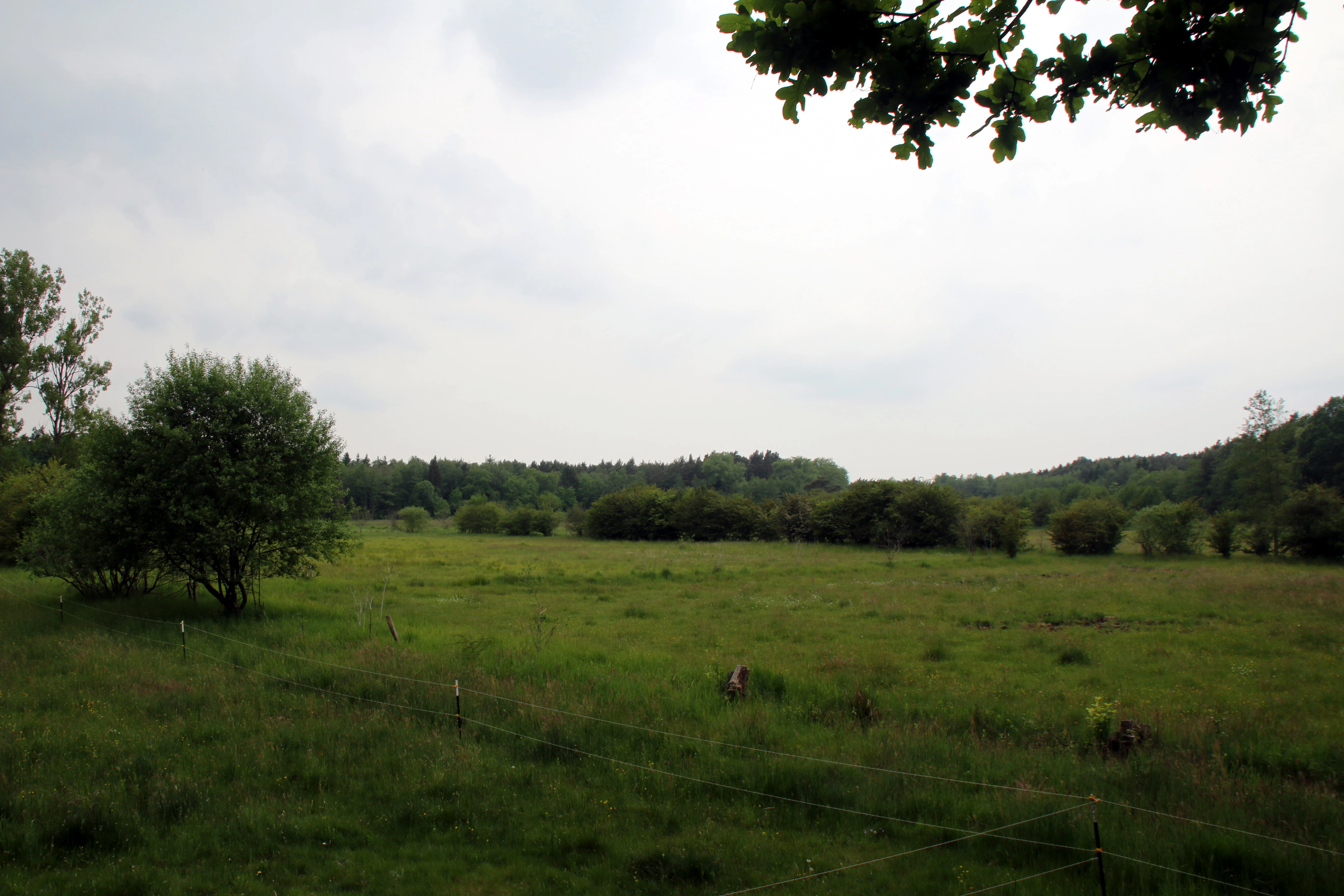
Fohlenweide von Dieburg history and protected-area timeline
Fohlenweide von Dieburg was placed under formal nature protection on 23 October 1989, when the regional authorities of southern Hesse issued a protection order (Verordnung) classifying it as a Naturschutzgebiet. The legal designation recognized the area's existing mosaic of wet meadows, fallow land, flowing watercourses, shrub stands, and forest edges as worthy of long-term conservation.
The protection order set out a clear management intent: to preserve the extensively used wet grassland found on very damp soils, to maintain the fallow and edge habitats that buffer those meadows, and to allow the existing woodland stands to develop into more natural forest. From the outset, the reserve was conceived not as a strict no-intervention area but as a working cultural landscape in which mowing, grazing, and passive rewilding of woodland would all play a role.
Since its designation, Fohlenweide has continued to be managed as a small local conservation site within the Darmstadt-Dieburg district. Its ongoing story is less one of dramatic milestones than of quiet continuity: a periodic mowing regime, seasonal grazing by a small cattle herd, and gradual natural development of the woodland fringe, all aimed at keeping the habitat mosaic open and species-rich.
Fohlenweide von Dieburg landscape and geographic character
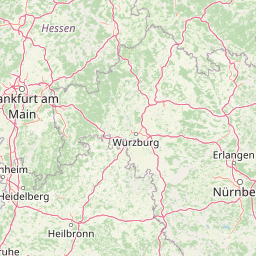
The landscape of Fohlenweide von Dieburg is defined by gentle relief and a patchwork of land cover rather than by dramatic topography. It lies in the Messeler Hügelland, the low, rolling hill country east of Darmstadt that forms part of the wider Hessian hill region. Within this setting, the reserve occupies a wooded position where open wet ground meets the edges of the surrounding forest.
Rather than a single sweeping landform, the area is a mosaic: damp, flat meadow basins where soil moisture stays high through much of the year; low-lying stretches along small flowing waters; patches of fallow land left to develop naturally; and continuous transitions into shrubby margins and woodland. The result is a landscape of subtle contrasts, where the eye reads layers of vegetation rather than elevations and where water and soil moisture shape the visible character more than relief does.
The setting is also shaped by human land use. Former agricultural ground has been allowed to revert partially to rough grassland, and the interface between open meadow, scrub, and forest is maintained as an ecological feature in its own right. Forest edges around the reserve are deliberately kept as habitat zones, not tidied away, contributing to the textured, semi-open character of the protected area.
Fohlenweide von Dieburg ecosystems, habitats, and plant life
Ecologically, Fohlenweide von Dieburg is a textbook example of a small, habitat-rich wetland complex on the edge of a larger forested area. Its protected habitats include extensively used wet meadows on very damp soils (Feuchtwiesen), fallow land, flowing freshwaters, established stands of trees and shrubs, and a network of forest edges. The combination of these elements within a compact area is precisely what gives the reserve its disproportionate ecological value.
The vegetation reflects the moisture gradient that runs through the site. The wettest zones support a species-rich meadow flora characteristic of Central European damp grassland, while drier rises, abandoned field margins, and the forest edge add diversity of structure. The protection order specifically calls for existing woodland to develop naturally, suggesting a long-term trajectory toward more ecologically complex forest stands bordering managed open ground.
Hydrology plays a central role in defining the reserve. The presence of small flowing watercourses and the consistently high soil moisture in the meadows are the conditions that allow wet-meadow specialists, including orchids, to persist, and that draw amphibians and wetland-feeding birds to the site.
Fohlenweide von Dieburg wildlife and species highlights
Fohlenweide von Dieburg supports a varied animal community for its size, shaped by the mix of open wet meadow, watercourse, scrub, and woodland edge habitats. Amphibians use the damp conditions and still water margins for breeding, while reptiles find basking and shelter habitat along the warm, vegetated edges: sand lizards (Zauneidechse) and grass snakes (Ringelnatter) are recorded in the area.
After the meadows are mown, short grass and exposed wet soil attract large wading birds: white storks (Weißstorch) and grey herons (Graureiher) come in to feed on the invertebrates and small vertebrates that become temporarily easier to catch. The reserve is also noted for being rich in butterflies, an indicator of the value of its mosaic of nectar sources and structural diversity for invertebrate life.
The wider ecological role of these species is to highlight the reserve's function as a small patchwork refuge. Each group, from amphibians and reptiles to large feeding birds and pollinating insects, depends on a slightly different combination of the habitats the protection order was designed to preserve, illustrating how the reserve's interconnected landscape features support more biodiversity together than any single habitat type would alone.
Fohlenweide von Dieburg conservation status and protection priorities
From a conservation standpoint, Fohlenweide von Dieburg matters because it preserves a constellation of habitats, wet meadows, fallow land, flowing waters, woodland edges, and shrub stands that have become scarce in the heavily managed landscapes of the Rhine-Main region. By protecting them together in a single small site, the reserve safeguards ecological complexity that larger but more uniform protected areas elsewhere cannot easily replicate.
The protection order explicitly identifies these habitats as refuges for endangered and rare animal and plant species, ensuring that the management aims of the reserve are tied not just to landscape character but to real biodiversity outcomes. The IUCN Category IV designation, Habitat/Species Management Area, reflects this active management approach: the reserve is not left untouched but is shaped through mowing, grazing, and passive rewilding of the woodland so that open, species-rich conditions persist.
Beyond its direct ecological function, Fohlenweide also serves as a local example of how a small rural community can maintain a piece of traditional cultural landscape, in this case damp grassland once used for hay and pasture, as a living conservation asset. Its continued existence contributes to ecological connectivity in the Messeler Hügelland, complementing other nature reserves across the Darmstadt-Dieburg district.
Fohlenweide von Dieburg cultural meaning and human context
Fohlenweide von Dieburg is rooted in the rural land-use traditions of southern Hesse, where small valley bottoms and damp fields were historically maintained as hay meadows and rough grazing. The reserve today is in many ways a continuation of that older agricultural landscape, preserved through conservation rather than abandonment. The presence of a small herd of Guernsey cattle grazing the meadows in spring reflects the recognition that the habitat's character depends on continuing low-intensity land management, not just on fencing the area off.
For the local community around Dieburg and nearby Münster, the reserve is part of a wider network of protected areas in the Darmstadt-Dieburg district that residents and visitors use for quiet outdoor recreation. Its location within walking distance of Dieburg makes it a familiar local landmark, valued less as a tourist attraction than as a piece of shared countryside that anchors regional identity and local environmental awareness.
Top sights and standout views in Fohlenweide von Dieburg
Among the strongest features of Fohlenweide von Dieburg are its compact but high-quality mosaic of wet meadow, fallow land, small streams, and forest edges, and the willingness to manage it actively for biodiversity through mowing and seasonal grazing. Wild orchids in the damp turf, a notably rich butterfly fauna, and sightings of feeding white storks and grey herons after mowing give the small reserve a strong sense of seasonal rhythm.
Equally distinctive is the reserve's role as a working example of small-scale landscape conservation in the Rhine-Main region. Rather than a remote wilderness, Fohlenweide is a local cultural landscape whose ecological value depends directly on continued traditional management, demonstrating how rural land-use history and modern nature protection can reinforce one another.
Best time to visit Fohlenweide von Dieburg
Spring and early summer are generally the most rewarding times to experience Fohlenweide von Dieburg, when the wet meadows come into flower and orchids can be found in the damp turf, and when the spring grazing by the small cattle herd keeps the sward open and varied. This is also a good time to observe butterflies and the full activity of amphibians and reptiles along the moist edges.
Late summer and early autumn are marked by the annual mowing of the meadows, after which the short grass and exposed wet soil attract white storks and grey herons feeding intensively on the site. A visit shortly after the cut can therefore offer some of the most characteristic wildlife observations of the year, although the visual character of the reserve shifts away from flowering meadow to freshly cut open ground during this period.