Mori Atlas logo
National parkGreat Sand Dunes National Park and Preserve

Discover the mapped boundaries and natural terrain of this unique national park in Colorado.

Great Sand Dunes National Park and Preserve: Colorado's Distinct Protected Landscape

Great Sand Dunes National Park and Preserve represents a significant protected area within the geographic context of Colorado. This page serves as your gateway to understanding its distinct landscape, from mapped dunes to surrounding natural terrain, offering valuable insight for atlas-based exploration and appreciating the park's place in regional geography. Engage with structured information detailing its protected boundaries and unique environmental context, vital for any geographic discovery.

sand dunesRocky Mountainsalpine tundrawetlandsmountain peaksgrasslands

Great Sand Dunes National Park and Preserve

National park

Park overview

Structured park overview, official facts, and landscape profile for Great Sand Dunes National Park and Preserve

Great Sand Dunes National Park and Preserve park facts, protected area profile, and essential visitor context
Review the core facts for Great Sand Dunes National Park and Preserve, including designation, size, terrain, visitor scale, habitats, and operating context in one park-focused overview.

About Great Sand Dunes National Park and Preserve

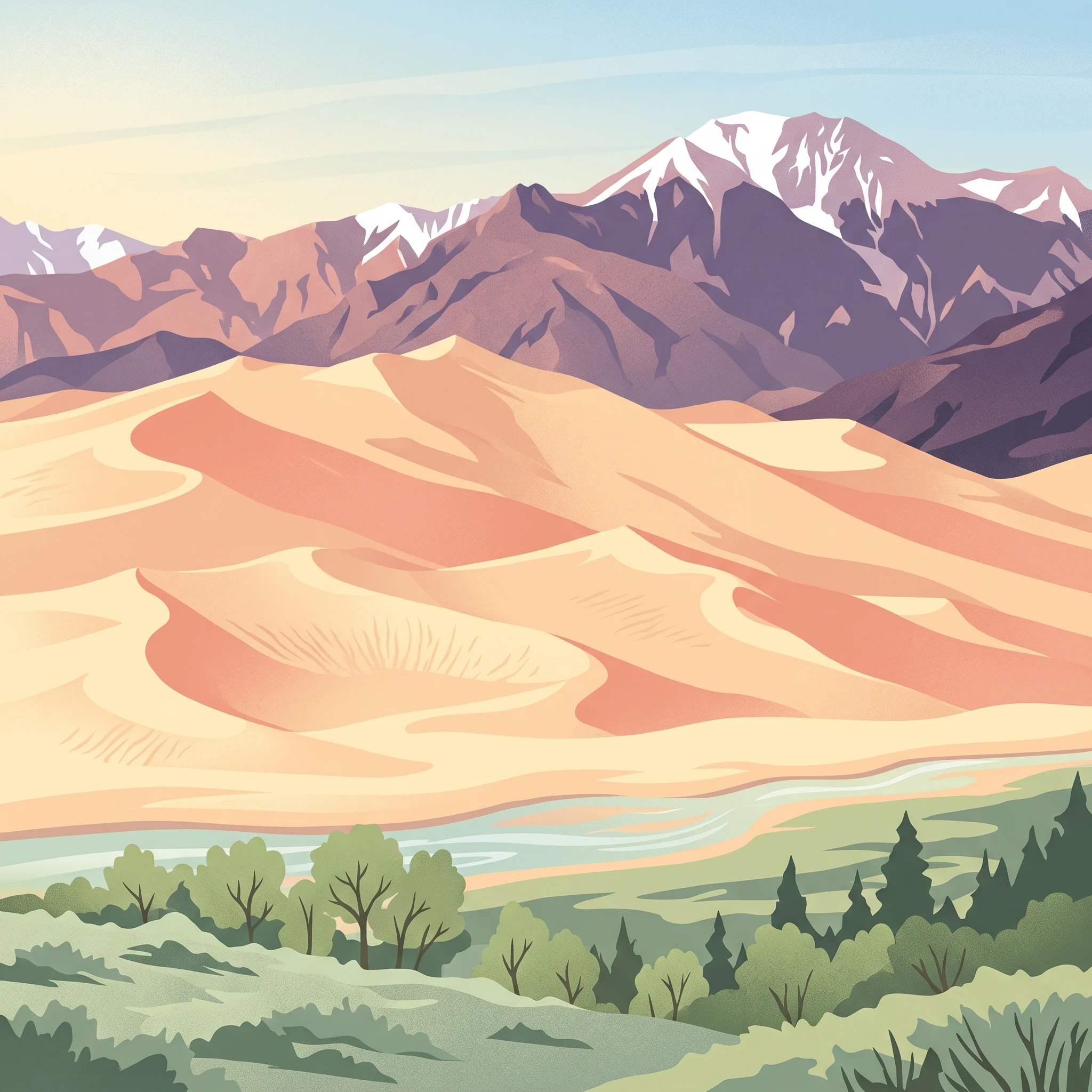
Great Sand Dunes National Park and Preserve represents a rare geological phenomenon in North America, where an extensive sand dune field exists in a high-elevation mountain valley setting rather than in a coastal or desert environment. The San Luis Valley, a large graben between two major mountain ranges, accumulated sediments over millions of years, and when ancient Lake Alamosa drained approximately 440,000 years ago, it left behind the sand deposits that would eventually form these dunes. The dunes sit at approximately 7,694 feet elevation, making them among the highest sand dunes in the world. What makes this dune field particularly dynamic is the combination of opposing wind patterns and the sand-recycling action of Medano and Sand Creeks, which carry sand from the mountains around the dune field and back to the valley floor where it can be blown again into the main dunefield. The national preserve protects the mountainous terrain to the east, including peaks over 13,000 feet, alpine lakes, and forests that form a striking backdrop to the golden dunes. This protected area conserves not just the iconic dunes but an entire mountain watershed ecosystem that feeds the dune system and supports diverse habitats. Visitors experience a landscape of extraordinary visual contrast, with the rippling patterns of wind-shaped sand against the rugged permanence of the Sangre de Cristo Range.

Quick facts and research context for Great Sand Dunes National Park and Preserve

Great Sand Dunes National Park and Preserve sits in Alamosa and Saguache Counties in south-central Colorado at elevations ranging from 7,515 feet in the valley to 13,604 feet at Tijeras Peak. The park was originally established as a national monument in 1932 and redesignated as a national park and preserve in 2004, growing from 35,528 acres to over 149,000 acres. The dune field contains an estimated 1.2 cubic miles of sand, and the system includes four primary components: the mountain watershed, the dune field, the sand sheet, and the sabkha wetlands. The park is classified as IUCN Category V (protected landscape) and contains designated wilderness areas protecting unique ecosystems. The area experiences a cold semi-arid climate with average annual precipitation of about 11 inches on the dunes.

Park context

Deeper park guide and search-rich context for Great Sand Dunes National Park and Preserve

Great Sand Dunes National Park and Preserve history, landscape, wildlife, and travel context
Explore Great Sand Dunes National Park and Preserve through its history, landscape character, ecosystems, wildlife, conservation priorities, cultural context, and seasonal travel timing in a structured park guide built for atlas discovery and search intent.

Why Great Sand Dunes National Park and Preserve stands out

Great Sand Dunes is best known for possessing the tallest sand dunes in North America, with Star Dune reaching 750 feet in height. The dunes are exceptional for their formation mechanism: opposing wind directions from the southwest and from storm systems cause vertical growth, while Medano and Sand Creeks capture and recycle sand, preventing it from leaving the system. The park preserves a complete ecological gradient from alpine tundra through subalpine forests, montane woodlands, and into desert wetlands, all within a compact area. The area is also known for its endemic species, including the Great Sand Dunes tiger beetle, and for the unique surge flow phenomenon in Medano Creek where underwater sand ridges create wave-like water surges.

Great Sand Dunes National Park and Preserve history and protected-area timeline

The history of human interaction with Great Sand Dunes spans approximately 11,000 years, beginning with nomadic hunter-gatherers who followed herds of mammoths and prehistoric bison across the San Luis Valley. These Stone Age peoples used Clovis and Folsom point technologies and moved through the area based on seasonal resource availability. When Spanish explorers arrived in the 17th century, the Southern Ute, Jicarilla Apache, and Navajo peoples were the established tribal groups with cultural connections to the area. Diego de Vargas became the first European on record to enter the valley in 1694, and subsequent explorers including Juan Bautista de Anza, Zebulon Pike, John C. Frémont, and John Gunnison traveled through the region in the 18th and 19th centuries. Settlers began ranching, farming, and mining in the valley in the late 1800s, with the Herard family establishing a homestead along Medano Creek in 1875 and the Trujillo family creating a ranch that later became part of the Nature Conservancy's Medano-Zapata Ranch. Gold and silver rushes brought miners to the region, and speculation about gold in the dunes led to some placer mining operations along Medano Creek in the 1920s and 1930s. Local community concern about potential destruction of the dunes through mining and concrete manufacturing led to the establishment of the national monument in 1932, signed by President Herbert Hoover after advocacy by the P.E.O. Sisterhood and local residents. The monument expanded into a national park and preserve in 2000-2004 following additional land acquisitions, including the Baca Ranch purchase by the Nature Conservancy in 2002.

Great Sand Dunes National Park and Preserve landscape and geographic character

The landscape of Great Sand Dunes National Park and Preserve presents a dramatic environmental contrast defined by its position at the boundary between two distinct geographic zones. The western portion lies within the San Luis Valley, a high-elevation basin at approximately 7,515 to 7,694 feet where the dune field and associated sand sheet dominate the terrain. The main dune field measures roughly 4 miles east-to-west and 6 miles north-to-south, with Star Dune Complex adding an additional 6 square miles to the northwest. The dunes themselves display multiple morphologies including reversing dunes, transverse dunes, barchan dunes, star dunes, and parabolic dunes, each shaped by the complex interaction of wind patterns. The sand sheet surrounding the dunes on three sides contains approximately 90 percent of the total sand deposit and supports grasslands and shrublands. East of the dunes, the terrain rises sharply into the Sangre de Cristo Range, where elevations climb to over 13,600 feet at Tijeras Peak. The preserve encompasses this mountainous terrain, including alpine tundra, subalpine forests, and snow-fed creeks that originate in high basins and alpine lakes. Two spring-fed creeks, Medano and Sand Creeks, flow from the mountains around the dune field and disappear into the sand sheet, creating a critical sand-recycling system. The sabkha wetlands in the southwestern portion represent another unique landscape feature where rising groundwater creates seasonal wetlands with characteristic white alkali deposits.

Great Sand Dunes National Park and Preserve ecosystems, habitats, and plant life

The ecological systems within Great Sand Dunes National Park and Preserve form a complete vertical gradient from valley floor to alpine peaks, supporting remarkable biodiversity within a relatively compact area. The four primary ecological components are the mountain watershed, dune field, sand sheet, and sabkha, each supporting distinct plant and animal communities. The mountain watershed receives heavy snowfall and precipitation that feeds streams descending through alpine tundra, subalpine forests, and montane woodlands before reaching the valley. The dune field itself, while appearing harsh, maintains 7 percent moisture beneath the dry surface layer, supporting specialized species including Ord's kangaroo rat, the endemic Great Sand Dunes tiger beetle, scurfpea, and blowout grass. The sand sheet encompasses extensive grasslands and shrublands varying from wet meadows to desert shrubland depending on groundwater proximity. The sabkha represents a unique wetland type where seasonal groundwater fluctuation creates alkali conditions supporting specialized saltgrass communities and providing habitat for amphibians and shorebirds. Vegetation includes hundreds of species ranging from alpine wildflowers and bristlecone pines at high elevations to pinyon-juniper woodlands and cottonwood-aspen riparian zones in lower areas.

Great Sand Dunes National Park and Preserve wildlife and species highlights

The wildlife communities at Great Sand Dunes reflect the diverse habitats present across the elevation gradient, from alpine tundra to valley wetlands. Mammals range from small species like American pika and yellow-bellied marmot in the tundra to larger mammals including bighorn sheep, black bear, cougar, coyote, mule deer, and elk throughout the forested and grassland areas. The dunes support Ord's kangaroo rat and other desert-adapted species, while the grasslands host pronghorn, badger, and kangaroo rats. Over 2,000 bison are ranched on private Nature Conservancy land within park boundaries. Bird diversity exceeds 250 species, with notable inhabitants including brown-capped rosy finch, white-tailed ptarmigan, peregrine falcon, mountain bluebird, bald eagle, golden eagle, sandhill crane, and great blue heron. The park supports important raptor populations and migratory bird routes through its wetland areas. Reptiles include short-horned lizard, fence lizard, bullsnake, and garter snake. Native fish in Medano Creek include Rio Grande cutthroat trout, Rio Grande sucker, and fathead minnow. Amphibians such as tiger salamander, western chorus frog, northern leopard frog, and several toad species inhabit wetland areas. The park is notable for endemic insects including the Great Sand Dunes tiger beetle and several undescribed arthropod species, with over 1,000 different kinds of arthropods documented.

Great Sand Dunes National Park and Preserve conservation status and protection priorities

Great Sand Dunes holds significant conservation value for multiple reasons, starting with its designation as the tallest dune system in North America and the only major dune field in the continent's interior. The 1976 designation of Great Sand Dunes Wilderness protected 32,643 acres, making it the only wilderness area in the United States protecting a saltbush-greasewood ecosystem. The park preserves an entire ecological gradient from alpine tundra to desert wetlands within a single protected area, conserving habitats for numerous species including several endemics. The Great Sand Dunes tiger beetle and other insects are protected from potential extinction by wilderness designations that prohibit mechanized transport and motorized vehicles. The International Union for Conservation of Nature listed the area as a protected landscape in 2000 and included the wilderness area on their global list of protected wilderness areas. The 2019 designation as an International Dark Sky Park by the International Dark-Sky Association further emphasizes the park's conservation of natural darkness. The collaborative conservation model involving the National Park Service, U.S. Forest Service, U.S. Fish and Wildlife Service, and the Nature Conservancy represents a protected area mosaic approach that combines federal and private conservation efforts.

Great Sand Dunes National Park and Preserve cultural meaning and human context

Great Sand Dunes holds deep cultural significance for multiple Indigenous peoples with historic connections to the San Luis Valley. The Southern Ute Tribe considers the dunes sacred, with the traditional name Saa waap maa nache meaning sand that moves. The Jicarilla Apache called the dunes Sei-anyedi, meaning it goes up and down, reflecting their observation of shifting sands. The Navajo people consider nearby Blanca Peak, just southeast of the dunes, as one of their four sacred mountains, naming it Sisnaajini or White Shell Mountain. The Tewa and Tiwa-speaking pueblos along the Rio Grande maintain traditional narratives about a lake of great spiritual importance near the dunes, called Sip'ophe or Sandy Place Lake, believed to be the springs or lakes immediately west of the dune field. Various tribal groups historically gathered inner bark from ponderosa pine trees for food and medicine in the surrounding mountains. The dunes served as visible landmarks for travelers along historic trails connecting the High Plains with Santa Fe. Historic exploration of the area by Diego de Vargas in 1694, followed by Anza, Pike, Frémont, and others, created written records that document both the landscape and the Indigenous presence in the region.

Top sights and standout views in Great Sand Dunes National Park and Preserve

Great Sand Dunes National Park and Preserve offers extraordinary visual contrast as massive golden dunes rise against the backdrop of snowcapped mountain peaks exceeding 13,000 feet. Star Dune, at 750 feet, stands as the tallest dune in North America, while the dune field's dynamic nature, shaped by opposing wind patterns and creek-based sand recycling, makes it a geological wonder. The park preserves a complete ecological gradient from alpine tundra through forests to desert wetlands, all accessible within a relatively small area. The Medano Creek surge flow phenomenon, where underwater sand ridges create periodic wave-like water surges, provides a unique hydrological display. The Dark Sky Park designation ensures exceptional stargazing opportunities beneath the Milky Way. Hiking trails lead from the dunes through diverse habitats to alpine lakes and mountain passes, while the Mosca Pass Trail follows a historic route used by Indigenous peoples and early settlers.

Best time to visit Great Sand Dunes National Park and Preserve

The best time to visit Great Sand Dunes depends on the experience sought, with each season offering distinct advantages. Late spring, particularly May and early June, brings peak flow in Medano Creek, allowing visitors to walk across the shallow water to reach the dunes while avoiding the extreme heat of midsummer. Summer temperatures on the dunes can reach 150 degrees Fahrenheit, making early morning and evening visits essential during June through August, while afternoon thunderstorms are common in July and August. Fall offers mild daytime temperatures with fewer crowds and the possibility of crisp nights under clear skies. Winter transforms the landscape with snow-covered dunes against the mountains, though daytime highs remain cool and nighttime temperatures drop well below freezing. The park is open year-round, and each season provides different visual experiences, from green spring meadows to golden summer dunes to winter's stark beauty.
Park location guide

Geography guide, regional context, and park location map for Great Sand Dunes National Park and Preserve

Great Sand Dunes National Park and Preserve park geography, regions, and map view in United States of America
Understand where Great Sand Dunes National Park and Preserve sits in United States of America through a broader geographic reading of the surrounding landscape, nearby location context, and its mapped position within the national park landscape.

How Great Sand Dunes National Park and Preserve fits into United States of America

The United States of America is a federal presidential republic and one of the world's largest countries by area and population. It consists of 50 states across a vast territory spanning multiple time zones, with its capital in Washington, D.C. and largest city in New York City. The nation has a diverse economy, influential political system, and significant cultural and military presence globally.

Wider geography shaping Great Sand Dunes National Park and Preserve in United States of America

The United States occupies a vast territory in North America, bordered by Canada to the north and Mexico to the south. The 48 contiguous states stretch from the Atlantic to the Pacific Ocean, while Alaska occupies the northwestern region and Hawaii is an archipelago in the Pacific. The country encompasses diverse terrain including the Rocky Mountains, Appalachian Mountains, Great Plains, and extensive river systems.

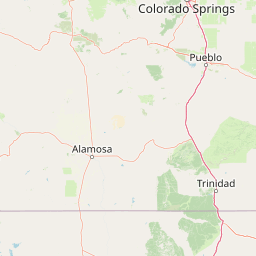
Map view of Great Sand Dunes National Park and Preserve

Use this park location map to pinpoint Great Sand Dunes National Park and Preserve in United States of America, understand its exact geographic position, and read its mapped placement within the surrounding landscape more clearly.

Pigeon | © OpenStreetMap contributors

Location context for Great Sand Dunes National Park and Preserve

Alamosa CountyColoradoSaguache County
Park atlas

Compare protected landscapes and diverse ecosystems across the Rocky Mountains, from alpine peaks to high desert valleys.

Explore Nearby National Parks and Protected Areas Around Great Sand Dunes National Park and Preserve
After exploring Great Sand Dunes National Park and Preserve, discover other national parks and protected areas across Colorado's expansive San Luis Valley and surrounding Rocky Mountain geography. This atlas view facilitates geographic comparison, revealing shared mountain ranges, diverse ecosystems, and distinct conservation landscapes for continued park exploration.
National parkMontrose County

Black Canyon of the Gunnison National Park: Protected Area Geography and Mapped Landscape

Explore the natural terrain and protected boundaries in Montrose County.

Black Canyon of the Gunnison National Park is a national park defined by its profound geological features and its status as a protected landscape. Located within Montrose County, it offers a distinct geographic profile for atlas-based exploration. Users can understand the park's mapped boundaries, its relation to the surrounding regional geography, and the unique natural terrain that defines this protected area, contributing to a structured discovery of its natural landscape identity.

Area
124.4 km²
Established
1999
IUCN
II
Visitors
357.1K annual
National parkMontezuma County

Mesa Verde National Park: Protected Landscape Atlas and Geographic Identity

Discover the mapped terrain and regional context of this national park.

Mesa Verde National Park serves as a critical protected landscape within Montezuma County, offering distinct insights into regional geography and mapped terrain. This entry details the park's identity as a National Park, emphasizing its geographic setting and providing a foundation for atlas-driven exploration. Understand the park's place within the broader landscape context and its significance as a mapped protected area, ideal for focused geographic study.

Area
212.4 km²
Established
1906
IUCN
II
Visitors
463.1K annual
National parkColorado

Rocky Mountain National Park: National Park Protected Landscape in Colorado

Explore its mapped boundaries and regional geographic context.

Rocky Mountain National Park is a designated National Park within Colorado, crucial for understanding the distribution and geographic context of protected areas in the United States. This detail page provides an atlas-oriented perspective, emphasizing the park's mapped boundaries and its place within the natural landscape of the region. It is designed to facilitate a clear understanding of the park's protected status and its contribution to the atlas of natural landscapes, offering factual insights for geographic discovery.

Area
1,074.28 km²
Established
1915
IUCN
II
Visitors
4.2M annual
National parkUtah

Arches National Park: Utah National Park Protected Landscape Exploration

Explore mapped terrain and geographic context.

Delve into the specifics of Arches National Park, a protected national park located in Utah. This atlas-focused entry provides detailed insight into the park's protected landscape features and geographic distribution. Understand the mapped park boundaries and the unique natural terrain that shapes this significant conservation area within the United States' broader regional geography.

Area
310.31 km²
Established
1971
IUCN
II
Visitors
1.5M annual
National parkUtah

Canyonlands National Park: A Mapped Protected Landscape in Utah's Geography

Explore its vast geography and protected area boundaries.

Canyonlands National Park stands as a significant protected entity within the state of Utah, characterized by its immense scale and dramatic geological formations. This page facilitates an atlas-style exploration of its terrain, emphasizing its mapped boundaries and its crucial role as a protected landscape. Gain a deeper appreciation for its unique geographic setting and its place within the broader regional context.

Area
1,366.21 km²
Established
1964
IUCN
II
Visitors
818.5K annual
National parkNavajo County

Petrified Forest National Park: National Park Protected Landscape and Geographic Atlas

Explore its mapped terrain and regional park context.

Petrified Forest National Park represents a significant protected landscape within Navajo County, Arizona, offering focused insights into its unique terrain and geographic distribution. As a national park, it provides valuable data for understanding mapped park boundaries, regional landscape context, and its role within the broader atlas of protected areas. Discover the specific geographic features and natural identity that define this unique natural reserve.

Area
895.94 km²
Established
1962
IUCN
II
Visitors
644.9K annual
National parkUtah

Capitol Reef National Park: Utah National Park Protected Landscape and Geography

Explore Capitol Reef National Park's mapped terrain and boundaries.

Delve into the protected landscape and geographic identity of Capitol Reef National Park, a key national park in Utah. This resource provides detailed context on its mapped terrain and regional setting, supporting a structured understanding of protected areas for atlas exploration. Discover the specific geographic features and park boundaries that define this protected natural area.

Area
978.95 km²
Established
1971
IUCN
II
Visitors
1.4M annual
National parkNew Mexico

White Sands National Park: National Park with Unique Dune Landscape in New Mexico

Explore its protected boundaries and desert geography.

White Sands National Park is a protected national park renowned for its stunning gypsum dunes, offering a unique landscape within New Mexico's geography. This page provides detailed information on its mapped protected area, serving as a valuable resource for understanding the park's specific geographic context and its identity as a significant protected natural landscape.

Area
601.3 km²
Established
2019
IUCN
V
Visitors
729.1K annual

Common questions about visiting, size, designation, and location context for Great Sand Dunes National Park and Preserve

Great Sand Dunes National Park and Preserve FAQs for park facts, access, geography, and protected area context
Find quick answers about Great Sand Dunes National Park and Preserve, including protected-area facts, park geography, trail and visitor context, and how the park fits into its surrounding country and regional landscape.
MoriAtlas Explorer

Continue Your Protected Areas Search Across the Global Atlas

Deepen your exploration by continuing the structured search for national parks and protected areas worldwide. Utilize the comprehensive filtering capabilities to compare different conservation landscapes and refine your understanding of global park geography. Discover more about the distribution and characteristics of protected natural areas.

Global natural geography