
Why Krebsbachtal bei Kaichen stands out
The reserve is distinguished above all by its unusually high density of different habitat types within a small area: wet meadows, low-nutrient dry grasslands, orchard meadows, hedgerow corridors, ponds, and mixed forest all occur together along the Krebsbach valley. This structural richness, unusual for the surrounding region, is the explicit reason the area was placed under formal protection in 1988 and remains its defining feature today.
Krebsbachtal bei Kaichen history and protected-area timeline
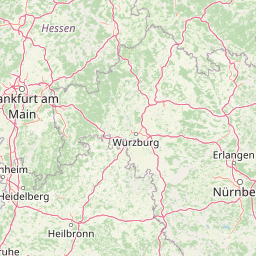
The protected area was formally established on 12 August 1988, when the ordinance creating the Naturschutzgebiet „Krebsbachtal bei Kaichen" was issued. The reserve straddles the boundary between two administrative units: the Kaichen district of the town of Niddatal in the Wetteraukreis and the Erbstadt and Heldenbergen districts of the town of Nidderau in the Main-Kinzig-Kreis.
The stated purpose of the 1988 ordinance was to permanently secure and maintain the scenic beauty of the Krebsbach valley, with its regionally unique structural richness of lean grasslands, wet and moist meadows, hedgerows, orchard meadows, and species-rich forest communities, and to preserve them as habitat for rare plant and animal species. The reserve thus built on, and gave legal protection to, a landscape whose character had already developed over generations through traditional agricultural and forestry use.
Older layers of history remain visible within the reserve. Along the banks of the Krebsbach, old boundary stones inscribed with the letters „KP" (Königreich Preußen, formerly Kurfürstentum Hessen before 1866) and „GH" (Großherzogtum Hessen) recall the historical political border between two former German states that once ran through the valley.
Krebsbachtal bei Kaichen landscape and geographic character
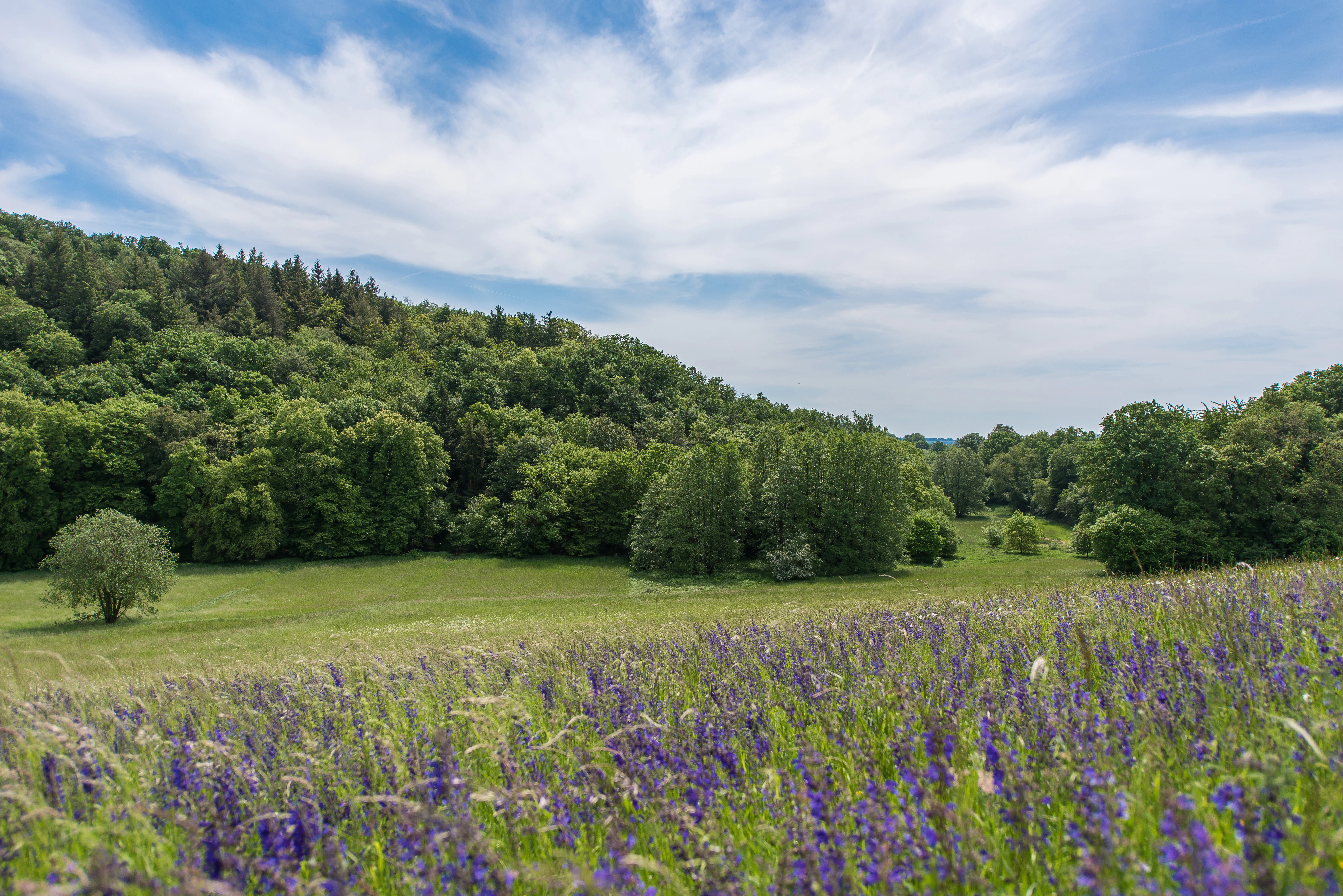
The Krebsbachtal bei Kaichen occupies a shallow, narrow valley in the gently rolling countryside of central Hesse, formed by the Krebsbach stream. The valley runs for roughly 2.5 kilometers between Kaichen to the south and Erbstadt and Heldenbergen to the north. The Hainwald, a mixed forest, follows the valley along its higher slopes, giving the protected area a clear three-part structure: stream and meadow at the bottom, transitional scrub and orchard meadows on the lower slopes, and mixed forest above.
The terrain is modest in elevation but visually varied. Flat or gently sloping wet meadows lie closest to the watercourse, with drier, leaner grasslands occupying slightly higher terraces. Orchards, hedgerows, and small woodland patches break up the slopes, creating a finely textured valley floor that contrasts with the denser, darker woodland of the Hainwald above. Ponds and small wet depressions add further surface variation. Old boundary stones along the Krebsbach are a subtle but distinctive man-made feature of the landscape, marking the historical line between two former German states.
Krebsbachtal bei Kaichen ecosystems, habitats, and plant life
Ecologically, the reserve is defined by its close juxtaposition of multiple habitat types. The stream itself is fringed by wet and moist meadows that flood or stay damp for parts of the year, while drier, low-nutrient lean grasslands exist only a short distance away on better-drained ground. Between these open habitats run hedgerows and traditional orchard meadows, or Streuobstwiesen, with scattered fruit trees that link the grassland and the forest edge.
The Hainwald, the mixed forest that rises along parts of the valley, brings woodland species into contact with the open habitats below. Together, this patchwork of wet meadow, dry grassland, hedgerow, orchard, and mixed forest provides habitat for many rare and legally protected plant and animal species, and it gives the reserve an ecological richness that is unusual for a site of this size in the region. Small ponds and temporary wet depressions add still-water habitats that complement the flowing water of the Krebsbach.
Krebsbachtal bei Kaichen wildlife and species highlights
Although detailed species inventories are not laid out in the source material, the reserve is explicitly described as providing Lebensraum for many rare and protected animal and plant species. The combination of habitats along the Krebsbach valley, including wet meadows, dry lean grasslands, hedgerows, orchard meadows, ponds, and mixed forest, allows for a wide range of animal groups to occur: meadow-dependent insects and grassland flora in the open habitats, amphibians and aquatic invertebrates in and along the stream and ponds, woodland fauna in the Hainwald, and a variety of bird and small mammal species using the hedgerows and orchard trees as corridors and nesting sites. The reserve is recognized locally as an important refuge for species tied to traditional, low-intensity Hessen countryside.
Krebsbachtal bei Kaichen conservation status and protection priorities
Krebsbachtal bei Kaichen was placed under formal protection in 1988 as a Naturschutzgebiet under Hessian nature conservation law because of its regionally exceptional concentration of different habitat types. The 1988 ordinance specifically names the goal of permanently safeguarding the valley's mix of lean grasslands, wet and moist meadows, hedgerows, orchard meadows, and species-rich forests as habitat for rare flora and fauna. In a modern agricultural region where large parts of the landscape have been simplified through intensified land use, the reserve preserves a working example of small-scale, traditional land management, including mown meadows, managed orchards, and mixed woodland, which is itself a key conservation strategy for the many species that depend on these structurally rich, low-intensity habitats.
Krebsbachtal bei Kaichen cultural meaning and human context
The Krebsbachtal is a piece of living cultural landscape. Hedges, orchard meadows (Streuobstwiesen), hay meadows, and mixed forest management reflect generations of low-intensity agricultural and forestry practice in Hesse. Old boundary stones along the Krebsbach, marked „KP" for the Kingdom of Prussia (previously the Electorate of Hesse) and „GH" for the Grand Duchy of Hesse, recall the historical border between these two states that once ran through the valley. Together, the reserve preserves not only natural values but also the more subtle cultural and historical imprint of land use and political geography in central Hesse.
Top sights and standout views in Krebsbachtal bei Kaichen
Within its modest 34 hectares, Krebsbachtal bei Kaichen concentrates a remarkable diversity of habitats: stream and wet meadows, lean dry grasslands, orchard meadows, hedgerows, ponds, and mixed forest of the Hainwald. Designated in 1988, it is recognized as a regionally exceptional example of small-scale Hessen cultural landscape that remains biologically valuable for rare and protected species. Historical boundary stones along the Krebsbach add a layer of visible political history to a reserve whose primary importance today lies in its ecological and landscape values.
Best time to visit Krebsbachtal bei Kaichen
The reserve is described as particularly attractive in spring, when the valley shows its fresh green meadows and blooming orchard trees. Late spring and early summer are also good for observing the contrast between wet and dry grassland habitats and for generally appreciating the diversity of the valley. As a nature reserve, visits are intended to be low-impact; the area is best experienced on foot along the valley and the forest edges, and visiting in mild, dry weather makes the combination of meadow, hedgerow, and woodland habitats most visible.