Why Malochova skalka stands out
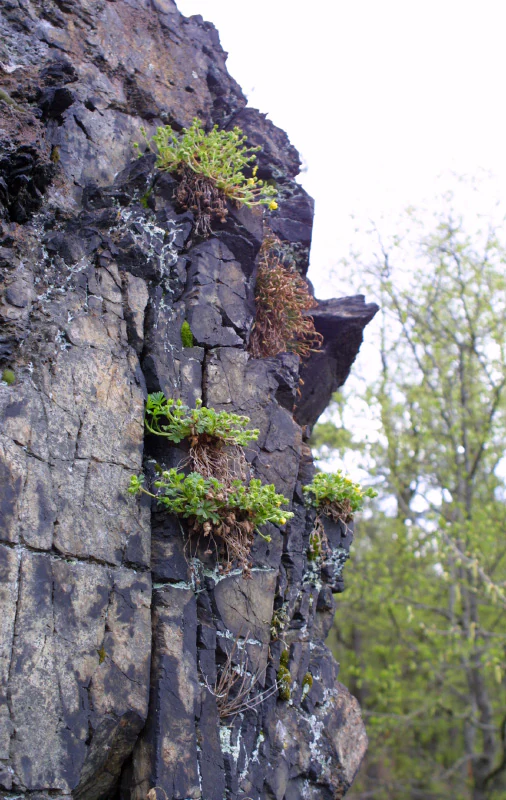
Malochova skalka is primarily known for its thermophilous, calcareous-loving flora growing in an atypical geological setting. The reserve's signature value is the presence of plants usually associated with lime-rich substrates, including Sesleria caerulea (pěchava vápnomilná), Dianthus armeria, Anthericum ramosum, and Potentilla verna, thriving on spilite cliffs embedded in oak-hornbeam forest. This unusual combination of bedrock and vegetation is the core of the site's scientific and conservation interest. The west-facing, sun-exposed rocky slopes create a warm microclimate that supports plant communities which would not normally be expected on the underlying geology, giving the reserve a distinctive botanical character within the broader Berounka valley landscape.
Malochova skalka history and protected-area timeline
Malochova skalka was formally designated as a Czech přírodní památka on 17 December 1970, becoming part of the national system of small-scale protected natural areas managed at the regional level. The original declared area of the reserve was 2.21 hectares, although the area currently shown in the official record has been revised to roughly 1.46 hectares.
The site is named in association with František Maloch, a naturalist connected to the broader cultural and scientific heritage of the Plzeň region. A memorial plaque within the reserve commemorates this connection, and the surrounding area is interpreted through the educational trail Po stopách Františka Malocha. Management responsibility has rested with the Regional Authority of the Plzeň Region, which administers the area as a řízená rezervace (managed reserve), meaning that active intervention is applied where necessary to maintain the specific botanical and geological conditions for which the area was designated.
Because the reserve is small and tightly defined by its bedrock and slopes, its protection history has focused on maintaining the open character of the rock outcrops against natural forest encroachment and on preserving the fragile microhabitats that support its thermophilous flora. The site's scientific significance has been recognized through its continued inclusion in both regional and national records of important natural monuments.
Malochova skalka landscape and geographic character
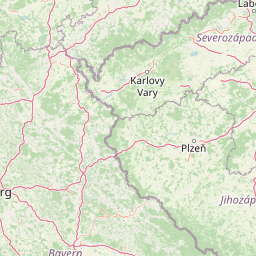
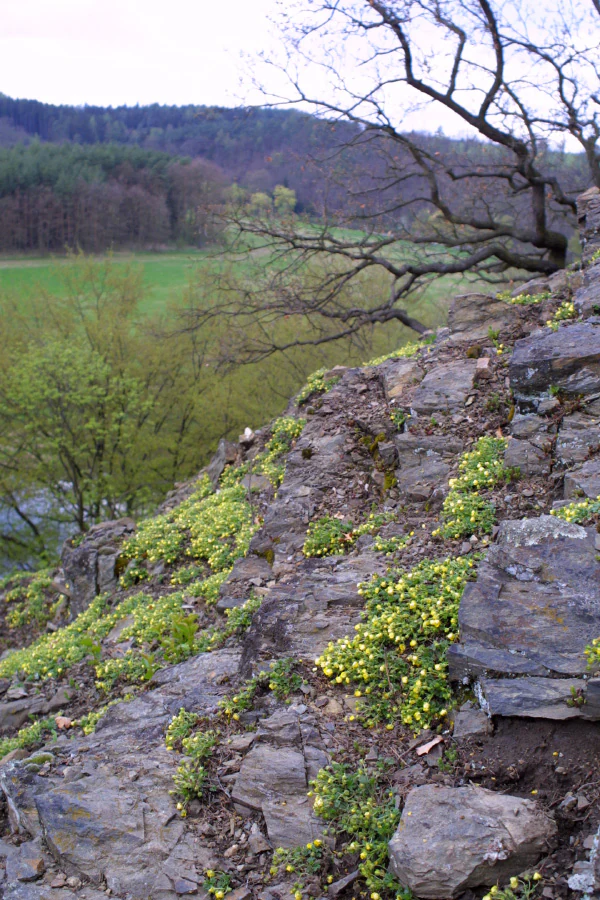
The landscape of Malochova skalka is defined by a short but visually distinct section of the Berounka valley. The left bank rises abruptly from the river corridor in a series of steep, west-facing slopes that expose fragments of ancient volcanic-derived rock. Three named spilite outcrops protrude from the slope, breaking through the surrounding oak-hornbeam woodland that otherwise cloaks the hillside. The exposure of these rocks is what gives the site its skalka character, a term that in Czech refers to a small rocky crag or cliff feature.
The wider setting is shaped by the Berounka River itself, which has carved a broad valley corridor through the surrounding terrain. Slopes alternate between forested sections and agricultural land, while the river creates a distinctive riparian edge at the base of the reserve. The elevation of approximately 300 meters above sea level places the area within the rolling hills typical of the Plzeň-region landscape, where river valleys like the Berounka form long, sinuous breaks in an otherwise densely wooded and farmed terrain.
The interaction between the rocky slope, river, and forest creates an unusually varied topography within a small footprint. Sheltered hollows between rock outcrops, sun-exposed cliff faces, and the wooded upper slope all contribute different microclimates, which is part of why this short stretch of the Berounka valley supports such a distinctive botanical assemblage.
Malochova skalka ecosystems, habitats, and plant life
The nature value of Malochova skalka lies in the unusual combination of exposed bedrock and thermophilous woodland vegetation. The site functions as a small ecological island, where the geology and exposure together produce growing conditions very different from the surrounding lowland and valley forest.
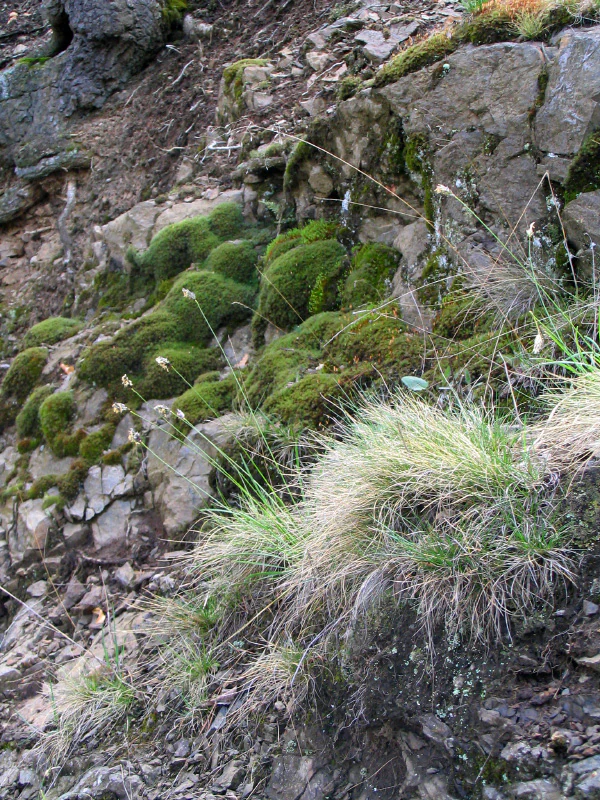
The dominant woodland is a dubohabrový les, an oak-hornbeam forest typical of warm, dry slopes in central Bohemia. On the three spilite outcrops where this canopy opens, the vegetation shifts to rock-steppe communities, moss cushions, and specialized low-growing herbs. The exposed rock surfaces support a thin layer of weathered material and organic debris, enough to sustain species adapted to dry, nutrient-poor conditions but to do so within a forest setting. This interspersion of open rock habitats within a closed broadleaf forest is uncommon in the wider region.
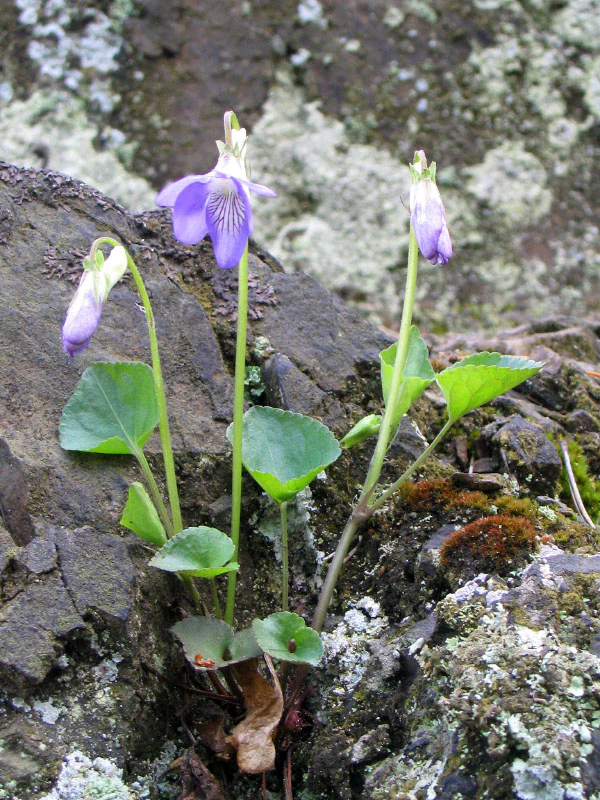
Beyond the headline species for which the reserve is protected, the site also supports broader woodland flora embedded in the oak-hornbeam canopy, including species such as Viola riviniana (the Rivinus violet), which appears in the surrounding forest understory. The overall ecological character is one of transition: from dry open rock communities into mature broadleaf forest, all compressed into a very compact area above the Berounka.
Malochova skalka wildlife and species highlights
Malochova skalka is primarily a botanical rather than a zoological reserve, and its wildlife value is closely tied to its mosaic of rock, woodland, and valley-edge habitats rather than to any single flagship species.
The exposed cliffs, moss cushions, and warm thermophilous vegetation provide habitat for invertebrates adapted to dry rocky environments, including pollinators and rock-dwelling species typical of calcareous and base-rich substrates. The oak-hornbeam woodland above and around the rocks contributes additional habitat layers, supporting typical forest-floor invertebrates, songbirds, and small woodland mammals associated with this type of central European broadleaf forest.
The proximity of the Berounka River corridor adds a riparian element to the site's wider ecological context. Birds and other mobile species associated with both rocky slopes and river valleys are likely to move through the reserve, although the site is not designated for its fauna. As a result, the wildlife value of Malochova skalka is best understood as part of its broader habitat mosaic rather than as a standalone faunal reserve.
Malochova skalka conservation status and protection priorities
From a conservation perspective, Malochova skalka matters because it preserves an unusually small but ecologically coherent example of a habitat that would otherwise be lost through natural succession. The combination of spilite outcrops and warm-loving plant communities in central Bohemia is rare, and the reserve safeguards that combination under formal protection as a přírodní památka, a national category for areas of notable but compact natural significance.
Designated in 1970 under registration number 234, the site has long been part of the Czech system of natural monuments and is internationally classified as IUCN Category IV (Habitat/Species Management Area), reflecting its role in protecting a specific biological feature rather than a broader wilderness landscape.
Management responsibility rests with the Regional Authority of the Plzeň Region, which supervises the area as a řízená rezervace. This means that conservation work focuses on maintaining the open character of the rock outcrops against encroachment by surrounding forest, controlling potentially invasive woody species, and preserving the microclimatic conditions that allow thermophilous flora to persist. The reserve also functions as an educational resource through its integration with the trail Po stopách Františka Malocha, supporting public awareness of the regional natural heritage alongside direct habitat protection.
Malochova skalka cultural meaning and human context
Malochova skalka carries a clear cultural footprint linked to the Czech naturalist František Maloch, to whom the site and the surrounding educational trail owe their name. A commemorative plaque at the reserve recognizes his contribution to regional natural science, and the connected trail Po stopách Františka Malocha weaves the geological and botanical story of the site into a broader narrative about the Berounka valley environment.
The reserve also reflects a wider Czech tradition of recognizing small but scientifically meaningful natural features as protected monuments, rather than focusing solely on large-scale national parks. In this context, Malochova skalka is part of the cultural and scientific identity of the Plzeň region, where local naturalists, educational trails, and formal protection work together to anchor the region's natural heritage within its communities.
Top sights and standout views in Malochova skalka
Malochova skalka is distinguished by its rare, compact combination of spilite rock outcrops and thermophilous broadleaf forest within the Berounka valley.
Its most distinctive features are the small but well-defined cliff communities of Sesleria caerulea, Dianthus armeria, Anthericum ramosum, and Potentilla verna growing directly on volcanic-derived bedrock, and the way this microhabitat mosaic is interpreted through the regional educational trail dedicated to František Maloch.
Best time to visit Malochova skalka
The reserve is at its most visually expressive during late spring and early summer, when the thermophilous flora on the rocks, including the blue-green tussocks of Sesleria caerulea, the flowering spikes of Anthericum ramosum, and the cushion-forming mats of Potentilla verna, are at their peak.
Autumn brings quieter conditions and richer woodland color across the surrounding oak-hornbeam canopy, while winter offers the clearest views of the underlying rock structure once leaf cover has dropped. The exact accessibility of the site depends on local conditions and current management rules; visitors interested in closer access are generally best served by approaching it as part of the educational trail Po stopách Františka Malocha, which links the rocks to the broader Berounka valley landscape around Druztová.