
Why Mechowisko Radość Nature Reserve stands out
The reserve is best known for protecting an alkaline peatland, or calcareous fen, in a bayside setting along the formerly mesotrophic, charophyte-dominated Lake Kielsk. This type of habitat supports a distinctive assemblage of bryophytes and vascular plants, including saxifrage (Saxifraga hirculus), fen orchid (Liparis loeselii), marsh helleborine (Epipactis palustris), and several rare sedges and spike-rushes. It also stands out as the first reserve established specifically to safeguard alkaline fens, a priority Natura 2000 habitat, within the young glacial landscapes of northern Poland.
Mechowisko Radość Nature Reserve history and protected-area timeline
Mechowisko Radość was established relatively recently, on 20 July 2013, through an order issued by the Regional Director of Environmental Protection in Gdańsk on 28 June 2013. Its creation came in response to a formal proposal submitted by the Polish Society of Nature Conservationists, an NGO that has long been active in peatland and fen conservation across Poland.
The reserve was significant as the first site created under the society's dedicated project aimed at protecting alkaline fens, a habitat type listed as a priority under the European Union's Natura 2000 framework, within the young glacial landscapes of northern Poland. This project framed the reserve not as a one-off designation, but as a pilot site within a broader strategy of safeguarding calcareous peatlands in the region. In 2016, a formal protection plan was established for the reserve, with subsequent amendments, formalizing its ongoing active conservation management. The buffer zone was later adjusted, reducing slightly from its original size, reflecting refinement of the reserve's protective infrastructure over time.
Mechowisko Radość Nature Reserve landscape and geographic character
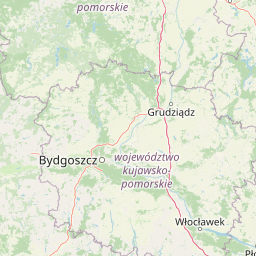
Mechowisko Radość occupies a low-relief, post-glacial setting typical of northern Poland's young glacial landscape. The terrain around and within the reserve is nearly flat, shaped by the infilling of a lakeside bay rather than by dramatic topographic features. The wider Bory Tucholskie mesoregion is characterized by sandy outwash plains, glacial lakes, extensive forests, and scattered peatlands, and the reserve reflects this broader pattern at a small, localized scale.
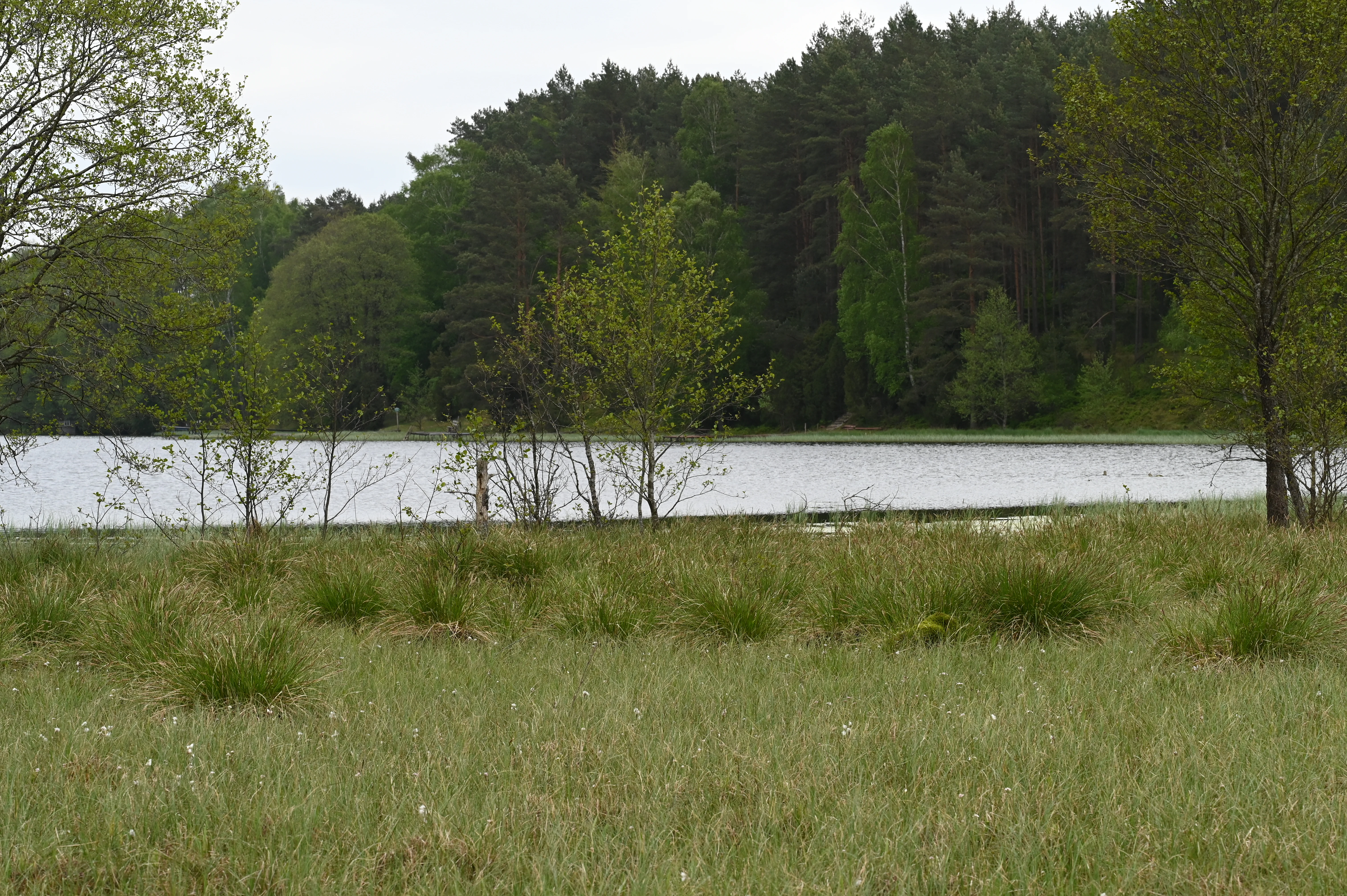
The reserve sits along the western shore of Lake Kielsk, on land that once formed part of the lake's basin. As the bay gradually filled with organic sediments, it transitioned from open water to a peatland plain. Today the lake-facing and central sections of the reserve are essentially flat, supporting a continuous carpet of fen vegetation. Surrounding the reserve are managed forest lands under the Osusznica Forest District, with the buffer zone providing additional spatial context for the hydrological and ecological processes that sustain the peatland.
Mechowisko Radość Nature Reserve ecosystems, habitats, and plant life
The reserve's ecological identity is centered on its alkaline peatland, a calcareous fen habitat considered rare and a conservation priority in Europe. This type of peatland develops in settings where mineral-rich groundwater, often influenced by calcareous glacial deposits, supports a specialized flora adapted to wet, base-rich conditions. At Mechowisko Radość the fen occupies a former bay of Lake Kielsk, and the gradual transition from open water to mire has produced a near-flat surface of peat-forming vegetation.
The site's flora is notable for its combination of rare bryophytes, sedges, orchids, and other vascular plants typical of well-preserved alkaline fens. Among the characteristic species are the marsh saxifrage (Saxifraga hirculus), rare in much of central Europe, and the fen orchid (Liparis loeselii), an orchid species associated with intact calcareous mires. Other notable taxa include marsh helleborine (Epipactis palustris), thick-leaved stitchwort (Stellaria crassifolia), string sedge (Carex chordorrhiza), dioecious sedge (Carex dioica), and few-flowered spike-rush (Eleocharis quinqueflora). The peatland has not been used for agriculture for several decades, contributing to its relatively undisturbed vegetation structure.
Mechowisko Radość Nature Reserve wildlife and species highlights
Mechowisko Radość is primarily valued for its botanical diversity rather than its fauna, but the reserve's overlap with the Bory Tucholskie bird Natura 2000 site means it contributes to a wider landscape that supports important bird populations. Peatlands of this type can also support characteristic invertebrate communities, including dragonflies and other species tied to open, base-rich wet habitats, though the source material does not elaborate on specific fauna in detail. The reserve's protected status and active management aim to maintain open conditions that benefit both specialist plants and the wildlife assemblages associated with them.
Mechowisko Radość Nature Reserve conservation status and protection priorities
From a conservation perspective, Mechowisko Radość is significant for protecting a priority Natura 2000 habitat type, alkaline fens, in one of Europe's most important regions for this habitat, the young glacial landscapes of northern Poland. The reserve is part of two overlapping Natura 2000 areas: the habitat site Ostoja Zapceńska (PLH220057) and the bird site Bory Tucholskie (PLB220009), placing it within a broader European ecological network. Its designation marked the first site established under a focused project by the Polish Society of Nature Conservationists dedicated to conserving calcareous peatlands in this region.
The reserve is managed as an active conservation area under a protection plan adopted in 2016. Active management here means intervention to counteract natural succession: trees, shrubs, and common reed are regularly removed to maintain the open, sunny conditions required by fen specialists. Preserving stable hydrology and preventing woodland encroachment are critical for keeping the alkaline peatland and its rare flora intact long-term.
Mechowisko Radość Nature Reserve cultural meaning and human context
Mechowisko Radość is a young conservation designation without a deep historical or cultural narrative attached to it in the available sources. Its cultural significance lies mainly in its emergence from civil society conservation efforts: the reserve was proposed by a naturalist NGO rather than initiated from forestry administration alone, reflecting the role of grassroots nature conservation in modern Polish protected-area policy. The site lies within the Tuchola Forest cultural landscape, a region long associated with forestry, lake fishing traditions, and rural use of post-glacial terrain.
Top sights and standout views in Mechowisko Radość Nature Reserve
Mechowisko Radość offers a focused example of small-scale, high-value peatland protection. Its core highlights include the rare alkaline fen ecosystem developed in a former lakeside bay, a flora featuring species such as Saxifraga hirculus and Liparis loeselii, and full overlap with two Natura 2000 areas. Active conservation management under a formal protection plan distinguishes it from purely passive reserves, and its origin as the first site in a dedicated fen-protection program gives it additional weight in the regional conservation story of the Bory Tucholskie.
Best time to visit Mechowisko Radość Nature Reserve
Visiting Mechowisko Radość is most rewarding in the warmer half of the year, when wetland plant communities are most visible and accessible. Late spring through early summer is typically the best period for observing fen flowers and sedges in active growth, while summer offers the fullest expression of the open mire landscape. Because the site is a small nature reserve managed for conservation, any visit should aim to minimize disturbance to vegetation and wildlife, especially during the breeding season for birds associated with the wider Natura 2000 bird area.