Why Mieliwo Nature Reserve stands out
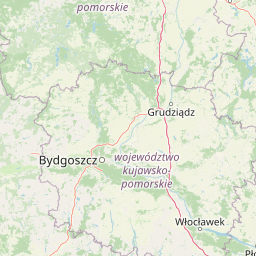
The reserve is best known for protecting a fragment of mixed forest in which European beech grows close to the limit of its natural geographic range. Because the site lies on the Dobrzyń Plateau in the lake country of northern Poland, it represents one of the northernmost localities where beech still forms part of a natural mixed woodland stand, making it a scientifically interesting and educationally valuable reference site for understanding beech distribution in Central Europe. In broader terms, Mieliwo is also valued as a small but ecologically representative part of the Brodnica Landscape Park, contributing to the network of protected forests and lake-district landscapes that define this part of the Kuyavian-Pomeranian region.
Mieliwo Nature Reserve history and protected-area timeline
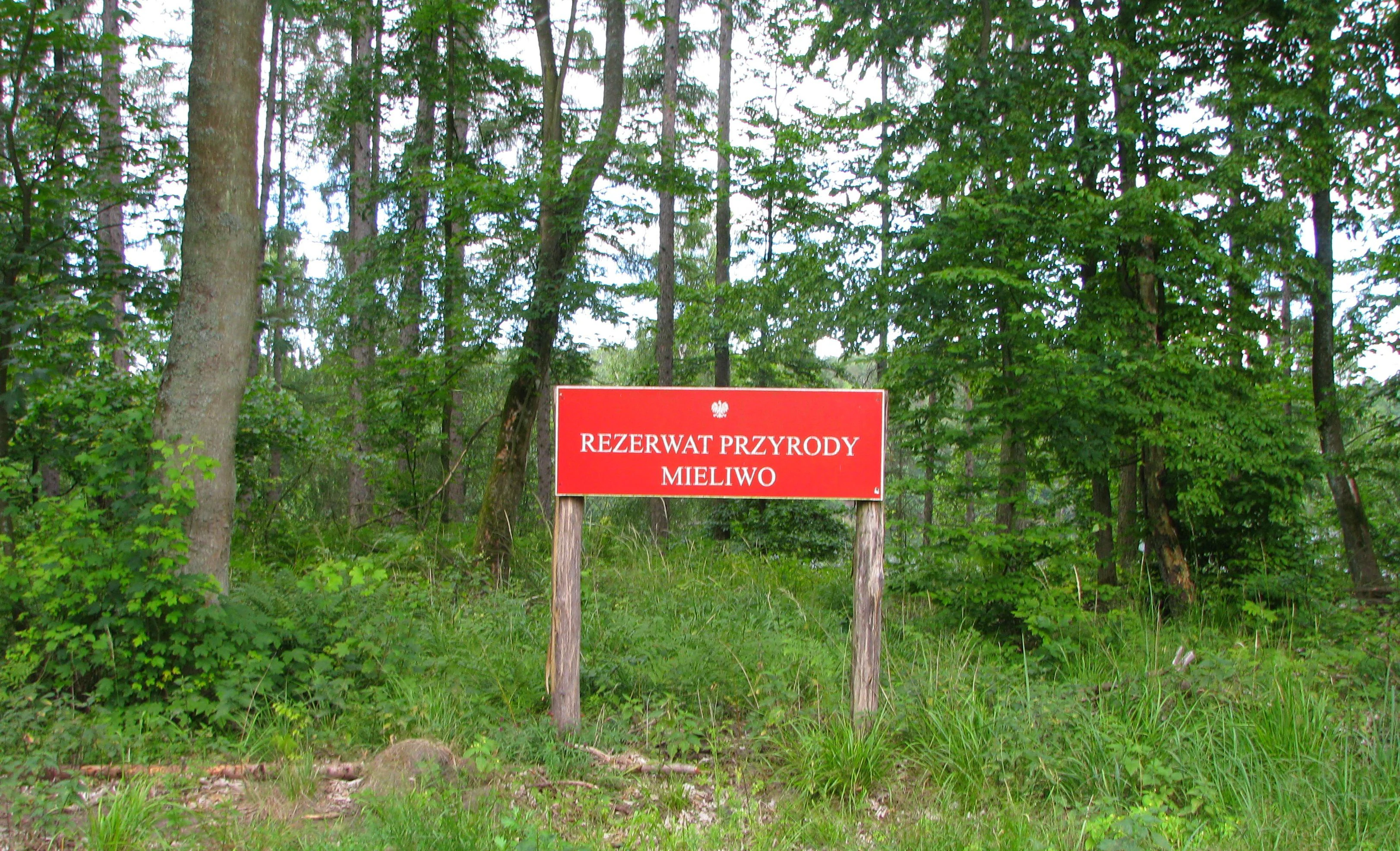
Mieliwo Nature Reserve was established on 23 July 1958 by an order of the Minister of Forestry and the Wood Industry, published in the official gazette Monitor Polski of 1958. According to the founding act, the reserve was created to safeguard, for scientific and educational reasons, a fragment of mixed forest containing European beech located at the boundary of its natural range on the Dobrzyń Plateau.
At the time of its original designation, the reserve covered about 5.37 hectares. In 1983, its boundaries were extended and its area increased to approximately 11.73 hectares. The reserve has continued under active conservation management since then, and it remains part of the Brodnica Landscape Park system. The progression of events, from a small initial protection order through a later enlargement to ongoing active management, illustrates a long-standing institutional commitment to maintaining this scientifically valuable forest fragment as part of the regional network of protected natural areas.
Mieliwo Nature Reserve landscape and geographic character
The reserve occupies a high slope associated with the glacial tunnel valley of Lake Mieliwo. This setting places it within the typical post-glacial lake landscape of the Brodnica Lake District, where the terrain is shaped by former ice-melting processes. Tunnel valleys, steep slopes, and complex small-scale relief are characteristic features of the area, and Mieliwo sits on one of the prominent slope positions that frame such a valley.
The surrounding broader mesoregion is the Pojezierze Brodnickie, part of the Dobrzyń Plateau, a landscape of mixed moraine relief, lake basins, and forest patches. Within this region, the reserve's slope position gives it a slightly different ecological character from the flatter lake lowlands, with thinner soils and conditions that influence the composition of the forest cover. The result is a distinctive small-scale landscape in which glacial landforms and forest ecology directly interact.
Mieliwo Nature Reserve ecosystems, habitats, and plant life
The ecological identity of Mieliwo Nature Reserve centers on mixed forest with a notable share of European beech, an unusual feature this far north in Poland. The reserve is intended to preserve a stand where beech coexists with other broadleaved and coniferous trees, illustrating the transitional character of the forest at the edge of the beech's natural range. Because the site lies on the Dobrzyń Plateau within the lake country of the Brodnica region, environmental conditions such as soil depth, slope exposure, and local climate all influence the vegetation pattern.
The broader vegetation context is that of a central European mixed forest zone, with forest communities typical of the post-glacial lake district. Forest reserves like Mieliwo serve as small refuges that maintain the genetic and structural diversity of woodland plant communities beyond the core range of beech, which is primarily a more southern species in Poland. The reserve's active protection regime aims to keep these ecological characteristics intact, preventing unwanted changes in species composition or forest structure.
Mieliwo Nature Reserve wildlife and species highlights
The source material available for Mieliwo does not provide detailed information on specific fauna. As a small forested reserve, however, it forms part of a broader wooded landscape that supports typical central European forest wildlife, including common forest birds and small mammals associated with mixed and broadleaved woodland. Beyond such general expectations, the available documentation is too thin to support detailed wildlife claims, and this section remains limited to the broader ecological context of small forest reserves embedded within the Brodnica Landscape Park.
Mieliwo Nature Reserve conservation status and protection priorities
Mieliwo Nature Reserve is protected as a forest nature reserve and is managed under active conservation, meaning that specific measures are taken to maintain the character of the forest for which it was designated. Its conservation value lies primarily in the protection of a mixed forest stand in which European beech appears at the boundary of its natural range, making the site important for scientific study, ecological education, and the conservation of forest genetic resources at the edge of species distributions.
The reserve is also significant because it is embedded within the Brodnica Landscape Park, a broader protected area that supports the larger ecological context in which such forest reserves function. Together, the small reserve and the surrounding landscape park help safeguard the biodiversity, habitat structure, and scenic character of the Brodnica Lake District.
Mieliwo Nature Reserve cultural meaning and human context
The cultural context of Mieliwo is closely tied to Polish forest conservation traditions and the long-standing practice of setting aside research and educational forest reserves in regions where woodland reaches an ecological limit. The reserve's founding in 1958 reflects the post-war development of structured nature protection in Poland, with a particular emphasis on sites of scientific interest. Its continued role within the Brodnica Landscape Park also connects it to regional identity around the lake country of northern Poland.
Top sights and standout views in Mieliwo Nature Reserve
Mieliwo is notable for combining a small surface area with a strongly defined scientific purpose: it preserves mixed forest with beech at the edge of its range, on a glacial slope landscape, within a regional landscape park. Its 1958 founding, 1983 expansion, and active protection management all show an enduring effort to maintain its forest character. For visitors interested in forest ecology and the landscape of the Brodnica Lake District, Mieliwo is a compact but meaningful protected site.
Best time to visit Mieliwo Nature Reserve
As a small forest research reserve, Mieliwo is best appreciated in late spring and early summer, when the forest canopy is fully leafed and the diversity of woodland vegetation is most visible, or in early autumn, when leaf colour and forest atmosphere are at their most expressive. Cooler seasons also offer quiet conditions for observation. The broader lake-country landscape of the Brodnica region is attractive in summer, while autumn brings characteristic seasonal change to the surrounding mixed forests.