Why Mierkowskie Suche Bory Nature Reserve stands out
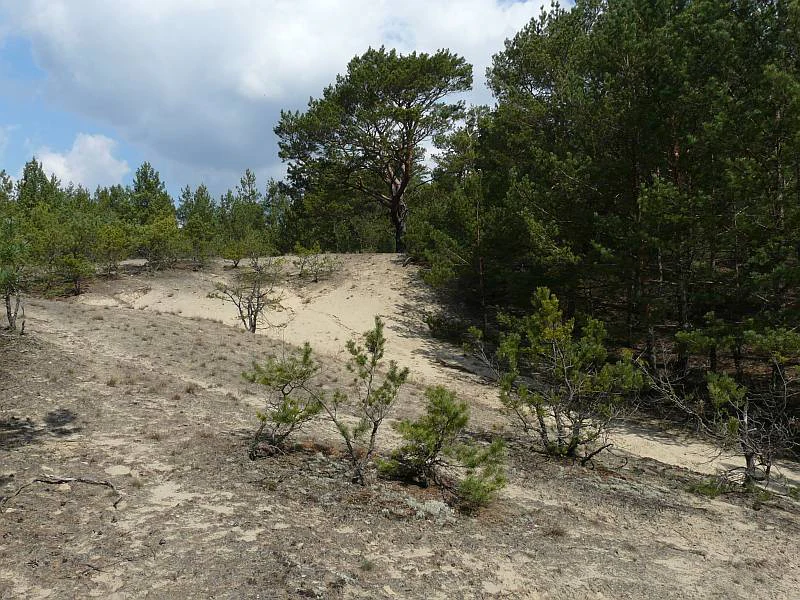
The reserve is best known for its partially exposed inland sand dunes and the exceptionally dry, lichen-rich pine forests that grow on them. It preserves a striking example of the Spergulo-Corynephoretum sand grasslands and Cladonio-Pinetum dry pinewoods, communities that have become rare across much of lowland Poland due to land-use changes and afforestation history. Its highest point is the so-called Białogóra dune, reaching around 86.5 meters above sea level and serving as one of the highest and most scenic viewpoints in the surrounding area. The reserve is also notable among ecological specialists for its rich assemblage of terricolous lichens, including rare species such as Pycnothelia papillaria and Stereocaulon paschale.
Mierkowskie Suche Bory Nature Reserve history and protected-area timeline
The Mierkowskie Suche Bory reserve was formally established on 20 April 2006 through Regulation No. 20 of the Lubusz Voivodeship Governor, creating a protected area of 131.40 hectares over a complex of inland dunes and dry pine forests. From the outset, the reserve was designated for active protection, recognizing that its open sand and lichen-rich communities require human management to maintain their character against natural afforestation and succession.
In 2018, the reserve was expanded under an order of the Regional Director of Environmental Protection in Gorzów Wielkopolski, growing to its current size of around 194.63 hectares. The enlargement incorporated additional forest areas as well as the former ecological site known as Bagna przy Rabym Kamieniu, adding peat-forming depressions and wetland habitats to the protected complex and strengthening its ecological coherence.
Beyond its formal Polish protection status, the reserve gained broader international recognition through its integration into the Natura 2000 ecological network as the Special Area of Conservation Mierkowskie Wydmy (PLH080039). This designation marks the area as significant for European Union habitat conservation objectives.
Mierkowskie Suche Bory Nature Reserve landscape and geographic character
The landscape of Mierkowskie Suche Bory is defined by inland sand dunes that rise above an otherwise flat forested plain in the Lubusz region. These dunes form arc-shaped ridges and elongated mounds, with the highest point, Białogóra, reaching about 86.5 meters above sea level and serving as a natural lookout. Most of the remaining dune crests run between roughly 70 and 75 meters in elevation, while the intervening depressions drop below 65 meters, producing a gently undulating topography within the forested plain.
The substrate is sandy and nutrient-poor, supporting only thin, well-drained soils over much of the area. Between the dune ridges lie low-lying basins where moisture accumulates and organic material slowly accumulates, creating localized bog-like conditions. The combination of dry, exposed sand on the ridges and damp, peat-influenced depressions nearby gives the reserve a striking micro-topographic variety despite its modest size.
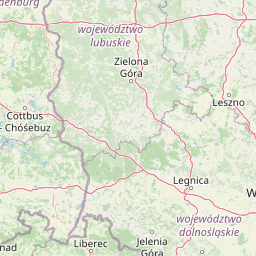
Around the reserve, the broader setting is dominated by a large managed pine forest complex belonging to the Lubsko Forest District, with views occasionally extending toward nearby rural settlements and farmland. The Wzniesienia Gubińskie mesoregion in which the reserve sits forms part of the broader belt of low hills along the Polish-German border.
Mierkowskie Suche Bory Nature Reserve ecosystems, habitats, and plant life
Ecologically, Mierkowskie Suche Bory is shaped by the contrast between extremely dry sandy ridges and the damp hollows between them. Dune tops and upper slopes are dominated by open pioneer sand grasslands of the Spergulo vernalis-Corynephoretum type, with grey hair-grass as the key species. These grasslands grade into the dry, lichen-rich pine forests of the Cladonio-Pinetum association that occupy most of the reserve's surface, forming a landscape that feels more like a subcontinental pine heath than a typical Polish forest.
The vascular plant flora of the reserve is unusually species-poor, with only around 26 species of vascular plants documented across just 16 families. Grasses, composites, and heaths dominate this small list, reflecting the harsh, nutrient-deficient conditions. Botanists regard the presence of the rare and endangered goldenrod-like Aster linosyris as particularly significant in regional conservation terms. The moss flora associated with the dry pinewoods is similarly specialized, with seven characteristic boreal and dry-site moss species recorded.
The reserve's most biologically distinctive asset is its lichen flora. A survey documented roughly 80 lichen taxa within the reserve, of which an exceptional 42 are terricolous, growing on the ground. Several of these, including Pycnothelia papillaria, Cladonia pocillum, Stereocaulon paschale, and Stereocaulon tomentosum, are considered rare across Poland and help give the site its special conservation value.
Mierkowskie Suche Bory Nature Reserve wildlife and species highlights
The wildlife of Mierkowskie Suche Bory is shaped by the open, sandy, and partially forested character of the reserve. Invertebrate diversity is particularly noteworthy, with entomologists having documented multiple rare and declining insect species, especially among the longhorn beetles, which depend on the old, sun-exposed pine wood and dry grassland conditions found here.
The reserve also provides habitat for the broader community of dry pinewood fauna typical of inland dune landscapes in central Europe, including a range of ground-dwelling arthropods, spiders, and other invertebrates adapted to warm, exposed sandy substrates. The boggy depressions added during the 2018 expansion contribute additional wetland-associated invertebrate groups, increasing the site's overall ecological breadth.
Larger mammals typical of large lowland Polish pine forests, such as roe deer and wild boar, are likely present within and around the reserve, and the mosaic of forest and clear sandy openings supports a varied bird community associated with pinewoods and early successional sandy habitats.
Mierkowskie Suche Bory Nature Reserve conservation status and protection priorities
Mierkowskie Suche Bory is valued primarily for protecting a rare inland dune and dry pine forest ecosystem that has been heavily reduced elsewhere in lowland Poland. Its sandy substrates and sparse vegetation cover represent a relict landscape whose open character is maintained through active protection measures, helping prevent the encroachment of shrubs and dense forest that would otherwise shade out the distinctive sand grassland and lichen-pine communities.
The reserve's conservation importance extends well beyond Poland through its designation as the Natura 2000 Special Area of Conservation Mierkowskie Wydmy (PLH080039). This status ties its management to the European Union's habitat protection framework and recognizes the site for its representative dry sandy habitats and associated species. The reserve also lies within the boundaries of the Western Surroundings of Lubsko Protected Landscape Area, adding a regional layer of protection to the broader ecological mosaic surrounding Lubsko.
Long-term monitoring of lichens, mosses, vascular plants, and invertebrates within the reserve contributes to scientific understanding of how these open sandy ecosystems respond to environmental change and active conservation measures.
Top sights and standout views in Mierkowskie Suche Bory Nature Reserve
The core highlights of Mierkowskie Suche Bory center on its inland dunes, its dry lichen-rich pinewoods, and the unusual richness of its ground lichen flora. The combination of open sand, pioneer grasslands, and old pine stands is rare in contemporary lowland Poland and gives the reserve a strongly individual character.
Its integration into the Natura 2000 network and its position at the boundary between two major Polish forest natural regions further reinforce its standing as a conservation reference site. The reserve also offers a scenic, if modest, viewpoint from the Białogóra dune and a quiet example of how small protected areas can preserve landscape features that have largely disappeared elsewhere in the region.
Best time to visit Mierkowskie Suche Bory Nature Reserve
The reserve is best experienced during the warmer half of the year, when the dry sand grasslands and pinewoods are most accessible and the open dune ridges can be appreciated under good light. Late spring through early autumn tends to bring the most stable conditions for walking on the sandy trails, with summer offering the warmest, driest atmosphere that best emphasizes the steppe-like character of the dunes.
For lichen and plant enthusiasts, late spring and early summer are particularly rewarding, as mosses, lichens, and dry-site grasses are most active and visible. Visitors interested in the broader landscape and viewpoints from the highest dunes generally find clear, sunny days between late spring and early autumn the most satisfying for taking in the inland dune scenery. As with any small forest reserve in lowland Poland, weather can shift quickly, and visitors should be prepared for variable ground conditions on sandy paths.