Mori Atlas logo
National parkMingan Archipelago National Park Reserve

Discover the mapped boundaries and regional geography of this Quebec national park.

Mingan Archipelago National Park Reserve: Protected Landscape & Geographic Context

Mingan Archipelago National Park Reserve represents a key protected national park within the Minganie Regional County Municipality, offering a unique opportunity for geographic exploration. This page serves as an atlas-focused entry point, detailing the park's mapped landscape and its specific place within the regional geography of Quebec. Understand the protected area's identity and its context for structured discovery and landscape comparison.

Coastal IslandsLimestone FormationsSeabird ColoniesSubarctic EnvironmentMarine EcosystemsGeological Heritage

Mingan Archipelago National Park Reserve

National park

Park overview

Structured park overview, official facts, and landscape profile for Mingan Archipelago National Park Reserve

Mingan Archipelago National Park Reserve park facts, protected area profile, and essential visitor context
Review the core facts for Mingan Archipelago National Park Reserve, including designation, size, terrain, visitor scale, habitats, and operating context in one park-focused overview.

About Mingan Archipelago National Park Reserve

Mingan Archipelago National Park Reserve represents a remarkable convergence of geological, ecological, and cultural significance along Quebec's northern coast. The reserve protects a distributed chain of islands and rock formations that stretch across the Gulf of St. Lawrence, creating a complex marine and terrestrial protected area. The landscape is dominated by dramatic limestone formations that have been shaped by coastal erosion processes over millions of years, resulting in the iconic monoliths that define the archipelago's visual identity. These formations arise from the Ordovician sedimentary bedrock that underlies the region, with the Romaine and Mingan formations providing the geological foundation for the islands' distinctive character. The reserve encompasses several distinct ecosystem types that coexist within the limited land area of the islands, making it an ecological mosaic of remarkable density. Beyond its natural significance, the archipelago holds cultural importance, with evidence of human occupation spanning at least 2,000 years and historical connections to European maritime activity dating to the sixteenth century. The area was designated as a heritage site by Quebec in 1978, recognizing its outstanding value, and was later established as a national park reserve in 1984.

Quick facts and research context for Mingan Archipelago National Park Reserve

Mingan Archipelago National Park Reserve covers 151 square kilometers along Quebec's northern Gulf of St. Lawrence coast in the Côte-Nord region. The reserve was established in 1984 and is governed by Parks Canada, protecting a chain of islands characterized by Ordovician limestone formations and dramatic erosion monoliths. The area supports subarctic vegetation at the southern edge of its typical distribution, with boreal forest elements including black spruce dominating the island landscapes. The archipelago is renowned for its significant seabird populations, particularly Arctic terns, common terns, and common eiders, which represent the largest concentrations of these species in the St. Lawrence region. Human activity in the area dates back at least 2,000 years, with First Nations, and later European visitors including Basques, exploiting the rich marine resources of these waters.

Park context

Deeper park guide and search-rich context for Mingan Archipelago National Park Reserve

Mingan Archipelago National Park Reserve history, landscape, wildlife, and travel context
Explore Mingan Archipelago National Park Reserve through its history, landscape character, ecosystems, wildlife, conservation priorities, cultural context, and seasonal travel timing in a structured park guide built for atlas discovery and search intent.

Why Mingan Archipelago National Park Reserve stands out

Mingan Archipelago is best known for its extraordinary limestone monoliths, which form the largest concentration of erosion-formed rock pillars in Canada. These dramatic stone towers, carved by millennia of coastal erosion, create a striking and almost otherworldly landscape across the archipelago's islands. The reserve is also famous for its significant seabird colonies, particularly the substantial populations of Arctic terns, common terns, and common eiders that nest on the islands. The geological importance of the area is further underscored by important Ordovician fossil sites within the sedimentary rock formations. Additionally, the archipelago is recognized for its unique combination of subarctic and boreal ecosystems that exist in this coastal setting, including the rare Mingan thistle and other flora adapted to the limestone-rich soils.

Mingan Archipelago National Park Reserve history and protected-area timeline

The Mingan Archipelago region has a rich human history extending back至少 two millennia. First Nations peoples were drawn to the area for its abundant marine resources, engaging in mollusc harvesting, salmon fishing, and seal hunting throughout the archipelago. European interest in the region began in the sixteenth century when Spanish, Portuguese, and Basque visitors arrived to exploit the marine wealth of the Gulf of St. Lawrence. The Basques, in particular, were notably active in the archipelago, conducting cod fishing and whale hunting operations. Archaeological investigations carried out by Parks Canada in 1986 on Mingan Island Nue and Mingan Harbour Island revealed the remains of stone ovens used by Basque whalers to process marine mammal blubber, with evidence suggesting use during the seventeenth and eighteenth centuries. The modern accessibility of the region was transformed by the construction of Highway 138, which was completed to Havre-Saint-Pierre in 1976, opening the previously isolated coastal area. Following this development, conservation advocates proposed establishing the archipelago as a protected area, leading to its formal designation as a national park reserve in 1984, coinciding with the 450th anniversary of Jacques Cartier's arrival in New France.

Mingan Archipelago National Park Reserve landscape and geographic character

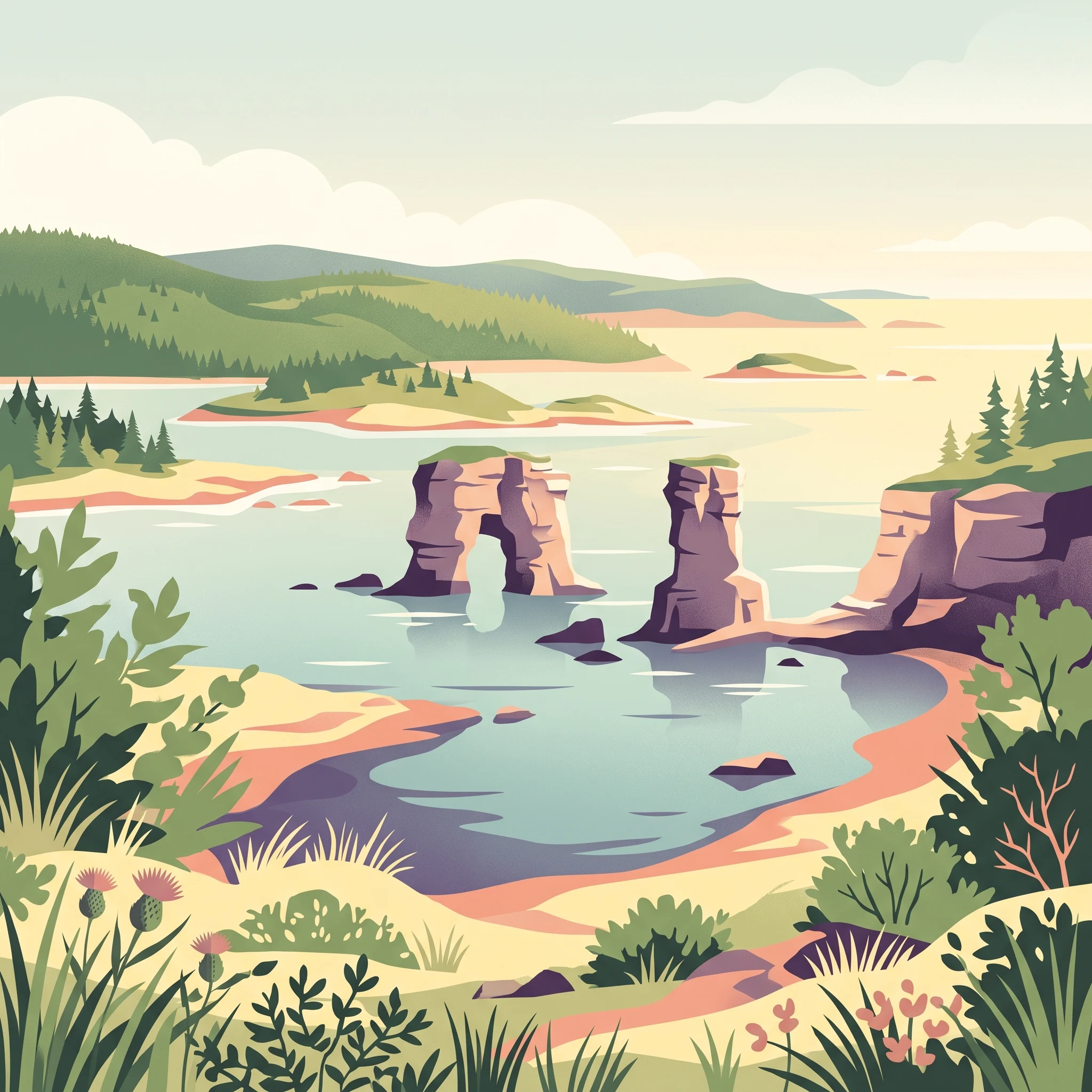
The Mingan Archipelago presents a dramatic coastal landscape defined by its extensive chain of islands, islets, rock formations, cays, and limestone reefs scattered across the Gulf of St. Lawrence. The most visually striking feature of the archipelago is its remarkable concentration of erosion monoliths, towering limestone pillars that have been carved by wind and wave action from the Ordovician sedimentary bedrock. These formations create an almost surreal terrain, particularly on islands such as Niapiskau where the monoliths dominate the shoreline and rise dramatically from the surrounding seascape. The underlying geology consists of Ordovician sedimentary rocks divided into two distinct formations: the lower Romaine Formation, composed primarily of dolomite with some shale and possibly sandstone, and the upper Mingan Formation featuring conglomerate, sandstone, shale, and limestone. The horizontal stratification of these calcareous rocks exerts a profound influence on the landscape character and the vegetation patterns throughout the archipelago. The islands support boreal forest vegetation despite their coastal setting, with black spruce as the dominant tree species, while the proximity to cold Labrador currents contributes to the distinctive subarctic environmental character that sets this region apart from typical boreal landscapes.

Mingan Archipelago National Park Reserve ecosystems, habitats, and plant life

The natural environment of Mingan Archipelago represents a distinctive blend of boreal and subarctic elements existing at the southern edge of their typical geographic range. The vegetation belongs to the Chibougamau-Natashquan boreal forest region, dominated by black spruce, though the high latitude and proximity to cold ocean currents create conditions that support subarctic plant communities more typical of regions further north. The entirely calcareous nature of the underlying limestone bedrock profoundly influences the flora, creating conditions favorable to a remarkable diversity of plant life. The archipelago supports approximately 350 vascular plant species, including two rare endemic taxa: Cirsium foliosum var. Minganense and Cypripedium passerinum var. Minganense, both named for their association with this region. The Mingan thistle represents one of the distinctive plant species found here. Bryophyte diversity includes approximately 150 species, while lichen diversity encompasses around 152 species, with 29 representing new additions to regional catalogues. This botanical richness exists within a relatively limited land area, making the archipelago an ecological hotspot of significant conservation value.

Mingan Archipelago National Park Reserve wildlife and species highlights

The wildlife of Mingan Archipelago reflects the diverse habitats present across the marine, coastal, and terrestrial environments of the reserve. Nearly 200 bird species have been recorded in the area, including significant seabird colonies representing the largest concentrations of Arctic terns, common terns, and common eiders in the St. Lawrence region. The islands support diverse avifauna including warblers, ospreys, passerines, razorbills, waders, bald eagles, Atlantic puffins, and Barrow's goldeneye. Marine mammals are well-represented in the surrounding waters, with three species of seal commonly found: grey seal, harbor seal, and harp seal. The waters beyond the archipelago support several cetacean species attracted by the abundant marine life, including Atlantic white-sided dolphins, harbor porpoises, common minke whales, humpback whales, and fin whales. Terrestrial mammals on the islands include North American beaver, North American river otter, muskrat, red fox, American red squirrel, snowshoe hare, and ermine, with occasional visits from black bears and moose on coastal islands.

Mingan Archipelago National Park Reserve conservation status and protection priorities

Mingan Archipelago National Park Reserve holds IUCN Category II protected area status, reflecting its significance as a national park preserving outstanding natural and cultural values. The reserve protects what is recognized as the most significant concentration of erosion monoliths in Canada, a landscape feature of national importance. The geological significance of the area is further emphasized by important Ordovician fossil sites within the sedimentary formations. The ecological importance of the archipelago is substantial, given the unique blend of subarctic and boreal ecosystems existing in a coastal island setting, with the calcareous bedrock supporting plant communities of remarkable diversity including endemic taxa. The designation of the archipelago as a Quebec heritage site in 1978 acknowledged its outstanding value, while the subsequent establishment as a national park reserve in 1984 provided stronger federal protection under Parks Canada management. The reserve's long coastline and island habitats provide critical protection for significant seabird populations that depend on these coastal environments for nesting.

Mingan Archipelago National Park Reserve cultural meaning and human context

The Mingan Archipelago holds cultural significance spanning thousands of years of human interaction with this coastal landscape. The region's First Nations peoples, particularly the Mi'kmaq and other indigenous groups, maintained long-standing connections to the area, drawn by the abundant marine resources that the Gulf of St. Lawrence provided. These communities engaged in traditional activities including mollusc harvesting, salmon fishing, and seal hunting that shaped their relationship with the archipelago over millennia. European exploration and exploitation began in the sixteenth century when Spanish, Portuguese, and Basque visitors arrived to harvest the rich marine resources of the region. The Basque whaling operations left tangible archaeological evidence on the islands, with stone ovens used for processing whale blubber dating to the seventeenth and eighteenth centuries. The construction of Highway 138 in 1976 transformed the region's accessibility, enabling the conservation movement that led to the park's establishment in 1984. The area also bears the name of the Commission de toponymie du Québec in recognition of its importance as part of the historic route associated with Jacques Cartier's 1534 voyage.

Top sights and standout views in Mingan Archipelago National Park Reserve

The defining highlights of Mingan Archipelago center on its extraordinary combination of geological, ecological, and cultural features within a relatively compact protected area. The limestone monoliths represent Canada's most significant concentration of these erosion-formed rock formations, creating an iconic landscape that defines the archipelago's visual character. The seabird populations, particularly the large colonies of Arctic terns, common terns, and common eiders, represent the most significant concentrations of these species anywhere in the St. Lawrence, making the reserve a destination of particular interest for ornithological observation. The Ordovician fossil heritage embedded in the sedimentary formations provides important scientific insight into ancient marine environments. The botanical diversity, including endemic species such as the Mingan thistle adapted to the unique limestone terrain, adds ecological dimension to the reserve's significance. The cultural layers spanning First Nations occupation through Basque whaling history to modern conservation create a rich historical narrative that complements the natural values.

Best time to visit Mingan Archipelago National Park Reserve

The optimal time to experience Mingan Archipelago depends on what visitors hope to observe, though the summer months of July and August generally offer the most accessible conditions for exploring the islands. During this period, the boreal and subarctic vegetation reaches its full development, wildlife activity is at its peak, and boat access to the islands is most reliable given the ice-free conditions. The seabird nesting season reaches its height in early summer, offering excellent opportunities to observe the significant colonies of terns and eiders that characterize the reserve. The dramatic limestone monoliths can be appreciated throughout the open water season, though the interplay of light and rock creates particularly compelling visual conditions during calm summer evenings. Visitors seeking to avoid the peak season might consider late spring or early fall, though access conditions become more constrained and some services may be limited. The subarctic climate means that even summer temperatures remain moderate, and visitors should be prepared for variable coastal conditions.
Park location guide

Geography guide, regional context, and park location map for Mingan Archipelago National Park Reserve

Mingan Archipelago National Park Reserve park geography, regions, and map view in Canada
Understand where Mingan Archipelago National Park Reserve sits in Canada through a broader geographic reading of the surrounding landscape, nearby location context, and its mapped position within the national park landscape.

How Mingan Archipelago National Park Reserve fits into Canada

Canada is a federal parliamentary constitutional monarchy spanning North America from the Atlantic to the Pacific and Arctic Oceans. With a population of over 41 million, it is officially bilingual in English and French at the federal level. The country gained independence from the United Kingdom through a gradual process culminating in 1982.

Wider geography shaping Mingan Archipelago National Park Reserve in Canada

Canada occupies the northern portion of North America, sharing its longest international border with the United States. The country extends from the Atlantic Ocean to the Pacific Ocean and northward into the Arctic Ocean, giving it the longest coastline of any nation.

Map view of Mingan Archipelago National Park Reserve

Use this park location map to pinpoint Mingan Archipelago National Park Reserve in Canada, understand its exact geographic position, and read its mapped placement within the surrounding landscape more clearly.

Pigeon | © OpenStreetMap contributors

Location context for Mingan Archipelago National Park Reserve

Minganie Regional County MunicipalityQuebec
Park atlas

Compare protected coastal landscapes and park geography across the broader Gulf of St. Lawrence region.

Discover Other National Parks and Protected Areas Near Mingan Archipelago National Park Reserve
After exploring Mingan Archipelago National Park Reserve's unique limestone formations and subarctic environments, you can browse other coastal protected areas and diverse landscapes across the broader Gulf of St. Lawrence. A geographic comparison reveals varied conservation landscapes, enabling you to trace the regional spread of geological heritage, seabird colonies, and marine ecosystems.
National parkQuebec

Forillon National Park: Quebec National Park Protected Landscape and Geography

Explore mapped park boundaries and regional terrain.

Forillon National Park represents a crucial component of Quebec's protected lands, offering a rich subject for geographic discovery and atlas exploration. This national park's specific landscape characteristics and mapped boundaries provide essential context for understanding its role within the wider regional geography of Canada. Dive into the mapped terrain and protected area details that make Forillon National Park a unique element in any natural landscape atlas.

Area
244 km²
Established
1970
IUCN
II
Visitors
164.1K annual
National parkCanada

Gros Morne National Park: A Canadian National Park for Geographic Exploration

Discover its mapped protected boundaries and regional landscape context.

Explore Gros Morne National Park, a designated National Park within Canada, offering deep insights into its protected landscape and geographic significance. This page details its mapped boundaries and natural terrain, providing essential context for understanding its role within Canada's broader atlas of protected areas. Engage with the specific geography of this park to deepen your knowledge of natural landscapes and conservation.

Area
1,805 km²
Established
2005
IUCN
II
Relief
Mountain
National parkNew Brunswick

Kouchibouguac National Park: New Brunswick Protected Landscape Atlas

Mapped protected area boundaries and regional geography.

Kouchibouguac National Park is a designated national park offering a rich canvas for geographic discovery. This entry focuses on understanding its protected landscape, detailing its specific mapped boundaries within New Brunswick. It serves as a vital component for atlas exploration, providing the context needed to grasp the park's natural terrain and its significance within the regional geography.

Area
238 km²
Established
1969
IUCN
II
Visitors
243.5K annual
National parkPrince Edward Island

Prince Edward Island National Park: A Mapped Protected Landscape within Canada's Maritime Region

Discover its geographic context and natural terrain.

Prince Edward Island National Park offers a distinct protected area for exploration within the Canadian Maritimes. As a national park, it represents a commitment to preserving specific natural landscapes and their geographic characteristics. This resource provides insight into its mapped boundaries, regional setting on Prince Edward Island, and its contribution to the broader atlas of protected lands.

Area
27 km²
Established
1937
IUCN
II
Relief
Lowland
National parkNova Scotia

Cape Breton Highlands National Park: Mapped Protected Landscape in Nova Scotia

Discover its national park geography and natural terrain.

Uncover the protected landscape identity of Cape Breton Highlands National Park, a national park situated in Nova Scotia. This atlas-focused content details its mapped boundaries, regional geographic context, and natural terrain. It serves as a definitive resource for understanding the park's protected-area status and its contribution to the mapped natural landscapes of the region.

Area
949 km²
Established
1936
IUCN
II
Visitors
277.2K annual
National parkNewfoundland and Labrador

Mealy Mountains National Park Reserve: National Park Protected Landscape and Map Boundaries

Explore the geography and natural terrain of Newfoundland and Labrador.

Mealy Mountains National Park Reserve represents a key protected landscape within Newfoundland and Labrador, offering detailed insights for atlas-based discovery. This national park's geographic scope and mapped boundaries are crucial for understanding its regional context and natural terrain. Explore the structured facts and landscape characteristics that define this significant protected area, providing a clear view of its protected-land identity.

Area
10,700 km²
Established
2015
IUCN
II
Relief
Mountain
National parkNew Brunswick

Fundy National Park: New Brunswick National Park Atlas and Geographic Exploration

Mapped protected landscape and regional park context.

Fundy National Park represents a vital protected area, offering rich geographic discovery within New Brunswick, Canada. This national park detail provides context for its mapped boundaries and landscape, supporting atlas-based exploration of its regional significance. Understand Fundy National Park's protected status and its contribution to the mapped natural terrain of eastern Canada.

Area
207 km²
Established
1948
IUCN
II
Visitors
303.6K annual
Watercolor painting showing a river landscape with green trees, rolling hills, and mountains in the background
National parkNova Scotia

Kejimkujik National Park: Detailed Protected Landscape and Regional Geography

Explore mapped boundaries and geographic context in Nova Scotia.

Kejimkujik National Park offers a dedicated entry for understanding protected natural areas. As a national park in Nova Scotia, its geographic features and protected boundaries are detailed here to support atlas-based exploration. Discover the park's unique landscape context and its positioning within regional geography, providing a factual basis for comprehending its role as a conservation area.

Area
404 km²
Established
1967
IUCN
II
Visitors
75.3K annual

Common questions about visiting, size, designation, and location context for Mingan Archipelago National Park Reserve

Mingan Archipelago National Park Reserve FAQs for park facts, access, geography, and protected area context
Find quick answers about Mingan Archipelago National Park Reserve, including protected-area facts, park geography, trail and visitor context, and how the park fits into its surrounding country and regional landscape.
MoriAtlas Explorer

Continue Your Protected Areas Search Across the Global Atlas

Deepen your exploration by continuing the structured search for national parks and protected areas worldwide. Utilize the comprehensive filtering capabilities to compare different conservation landscapes and refine your understanding of global park geography. Discover more about the distribution and characteristics of protected natural areas.

Global natural geography