Why Mójka Nature Reserve stands out
Mójka is best known for its well-preserved beech-fir forest community (a classic Carpathian foothill habitat) combined with wetland communities occupied by European beaver. Botanical richness is also a defining trait, with 340 vascular plant species documented, including a notable share of legally protected plants.
Mójka Nature Reserve history and protected-area timeline
Mójka Nature Reserve was formally established in 1997 through a regulation published in Monitor Polski of that year (No. 56, item 542), which set the legal framework for its protection. The founding instrument recorded the reserve's area as 285.56 hectares, while later measurements place it at 288.41 hectares. The reserve was designated as a forest nature reserve of the phytocenotic, forest-community subtype, with the explicit protection of a beech-fir forest stand and beaver-occupied wetland communities.
The reserve was integrated into the existing Hyżnieńsko-Gwoźnicki Protected Landscape Area, embedding it within a broader landscape protection framework that provides additional safeguards around the strict reserve borders. From its creation, it has been managed under the Kąkolówka forest district within the Strzyżów Forest Management Unit, the state forestry body responsible for active stewardship.
Botanical surveys carried out in and around the reserve documented 340 vascular plant species, including 24 protected species (18 of them strictly protected), reinforcing the scientific basis for the reserve's protected status and helping to shape ongoing management attention to both the forest canopy and the wetland understory.
Mójka Nature Reserve landscape and geographic character
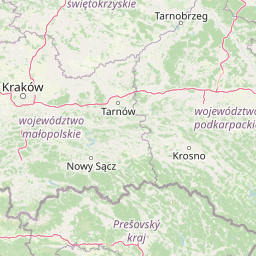
Mójka sits on the Pogórze Dynowskie, a sub-Carpathian foothill mesoregion characterized by rolling terrain at the transition between the lowlands of the Subcarpathian region and the higher Carpathian ranges to the south. The reserve's landform context is shaped by this foothills setting, with forest cover occupying hilly terrain dissected by small valleys.
Within the reserve, the landscape combines upland forest stands of beech and fir on the better-drained slopes with wetland communities in the lower, water-retaining parts of the terrain. The wetland zones are not static features; beaver activity actively modifies local hydrology, creating and maintaining open, waterlogged habitats within an otherwise forested matrix. The result is a patchwork of dry-ground forest, moist forest, and beaver-influenced wetland that gives the reserve a noticeably varied micro-topography despite its modest overall size.
Mójka Nature Reserve ecosystems, habitats, and plant life
Ecologically, Mójka is defined by its beech-fir forest community, a classic Central European Carpathian foothill woodland formation. This forest type combines broadleaf European beech with the more shade-tolerant silver fir, creating a multilayered canopy with a rich herb and shrub understory. The reserve's phytocenotic, forest-community subtype designation reflects this primary focus on protecting a representative example of this community.
Alongside the dry-ground forest, the reserve protects wetland communities (zbiorowiska wodno-błotne) that occupy valley bottoms and water-retaining terrain within the reserve's borders. These wetlands support a distinctive plant flora and sustain the beaver population that is explicitly named in the founding protection act, tying animal conservation directly to habitat conservation within the reserve.
The vascular plant flora recorded at Mójka comprises 340 species, among them 24 legally protected taxa, with 18 of these under strict protection. This high proportion of protected plants relative to total species richness signals unusually strong botanical value in the understory of both the beech-fir forest and the wetland zones, and is the principal floristic justification for the reserve's protected status.
Mójka Nature Reserve wildlife and species highlights
The defining wildlife feature of Mójka Nature Reserve is the resident population of European beaver, which is explicitly named in the reserve's founding act as a subject of protection within the wetland communities. Beaver presence is ecologically significant because their activity shapes local hydrology, opens up waterlogged areas, and creates the very wetland conditions that the reserve is intended to protect.
Beyond the beaver, the reserve's broader wildlife value is tied to the mosaic of beech-fir forest and wetland habitat. Carpathian foothill woodlands support communities of forest birds, small forest mammals, and typical amphibian and invertebrate assemblages associated with both the forest floor and the wetland systems. Although specific species inventories beyond beaver were not detailed in the source material, the protected status of the wetland and forest mosaic provides continuous habitat for a range of typical Carpathian foothill fauna.
Mójka Nature Reserve conservation status and protection priorities
Mójka's conservation significance rests on the formal protection of a beech-fir forest stand together with its associated wetland communities, recognized in the reserve's founding documentation. The combination of dry-ground forest and waterlogged habitats within a single legally protected entity is relatively uncommon in the Subcarpathian foothills and allows for more integrated ecological management than would be possible under separate forest-only or wetland-only protections.
The high botanical richness strengthens the reserve's conservation case: 340 vascular plant species have been documented, with 24 protected taxa and 18 under strict protection, indicating that the site functions as a refugium for forest and wetland flora under formal legal safeguard. Membership in the Hyżnieńsko-Gwoźnicki Protected Landscape Area further extends protection beyond the reserve's borders, providing a buffer zone that reduces edge pressures.
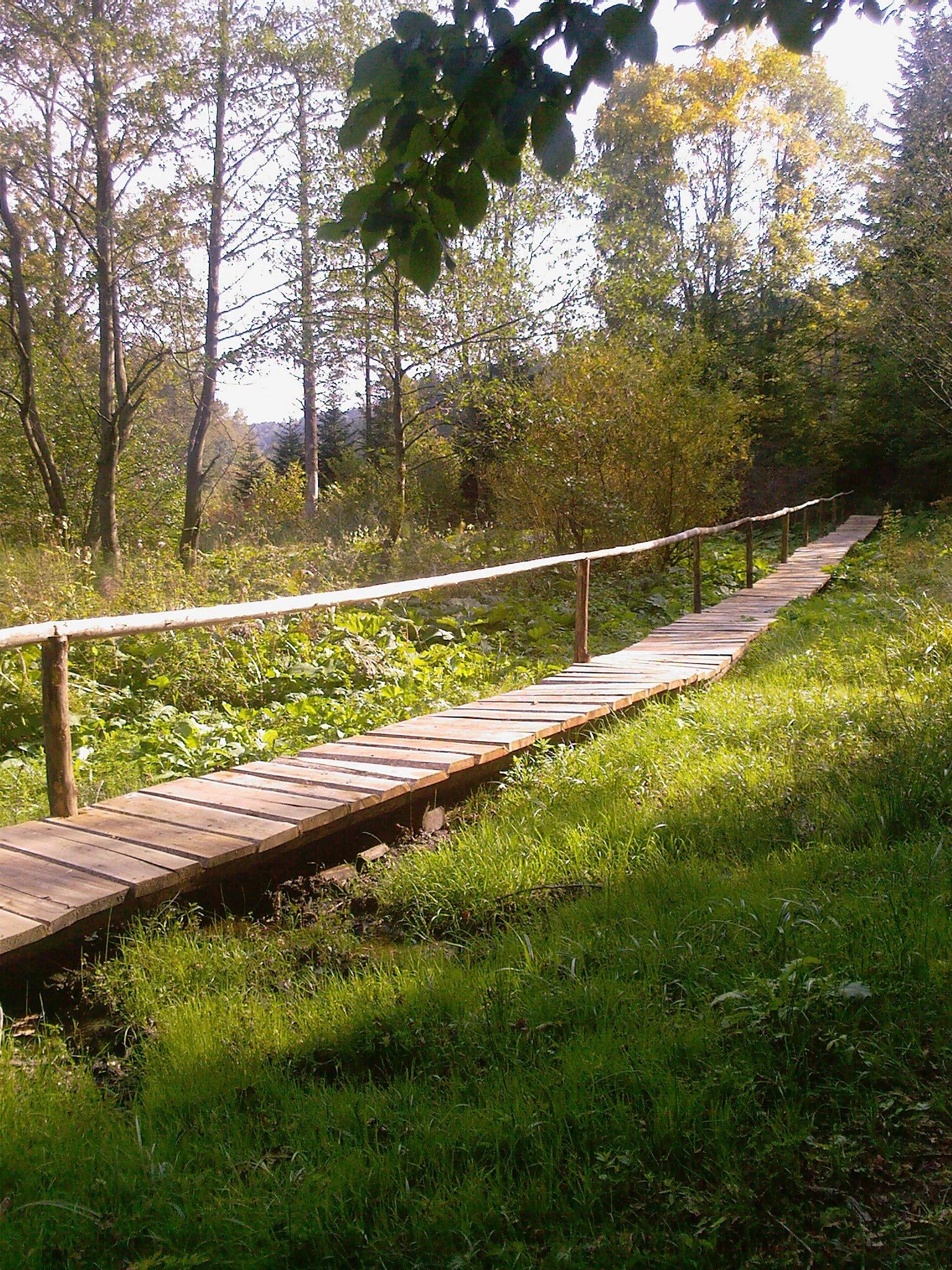
Active management is exercised through the Kąkolówka forest district under the Strzyżów Forest Management Unit, ensuring that forest stewardship, hydrological conditions, and the continued viability of the beaver population are addressed within an institutional framework. The presence of a nature education trail adds an interpretive layer, using the reserve as a platform for raising awareness of Carpathian foothill forest and wetland conservation.
Top sights and standout views in Mójka Nature Reserve
Mójka Nature Reserve offers a compact but ecologically rich example of Carpathian foothill protection in southeastern Poland. Its principal highlights are the protected beech-fir forest stand, the wetland communities occupied by European beaver, and the documented botanical richness of 340 vascular plant species with a high share of legally protected taxa. The reserve is paired with an on-site nature education trail and sits within the broader Hyżnieńsko-Gwoźnicki Protected Landscape Area, giving it both strict and landscape-level protections.
Best time to visit Mójka Nature Reserve
As a forest and wetland reserve in the Carpathian foothills, Mójka can be visited through much of the year, but the growing season from late spring through early autumn is when the forest understory and wetland flora are most observable and when the nature education trail is most rewarding for botanical interest. Wetland communities can be especially vivid in spring, while the beech-fir canopy offers the strongest seasonal character in autumn, when foliage colors define the landscape. Winter visits are possible for those interested in forest structure and beaver signs in the wetland zones, though trail accessibility may vary with conditions.