
Why Naryn Nature Reserve stands out
Naryn Nature Reserve is best known as one of the strictest protected areas in Kyrgyzstan, guarding landscapes of the inner Tien Shan where high mountain terrain, plateau ecosystems, and wildlife habitats of central Asia converge. The reserve is particularly associated with conservation of large mountain mammals and with the protection of rare geological formations within its boundaries. Its establishment history illustrates the typical Soviet and post-Soviet Kyrgyz model of using game reserves and later full nature reserves to safeguard animal breeding populations in remote upland terrain. The maral breeding enclosure within its borders also gives it a distinctive profile compared with purely wild-landscape reserves.
Naryn Nature Reserve history and protected-area timeline
The origins of Naryn Nature Reserve lie in an earlier protective designation that preceded the current reserve by nearly a decade. In 1975, a game reserve (zakaznik) was established on roughly the same territory with the explicit purpose of conserving and reproducing valuable wild animals and plants, while also preserving rare geological formations identified in the planned reserve area. This interim designation allowed protective measures and baseline ecological work to begin before full reserve status was granted.
On 29 December 1983, the Council of Ministers of the Kirghiz SSR issued Resolution No. 671, formally establishing the Naryn State Nature Reserve on this foundation. The 1983 designation converted the earlier game reserve approach into a stricter, more comprehensive conservation framework with dedicated zoning, including core protected land, a guard zone around the core, and a maral-breeding enclosure tasked with maintaining a population of Asiatic red deer.
Since its establishment, the reserve has functioned as one of the main instruments of nature protection in the Naryn Region, contributing to the wider system of protected natural areas in Kyrgyzstan. Even after the dissolution of the Soviet Union and the transition to independent statehood, the reserve preserved its institutional identity and continues to operate as a state-managed strict nature reserve within the country's network of especially protected natural territories.
Naryn Nature Reserve landscape and geographic character
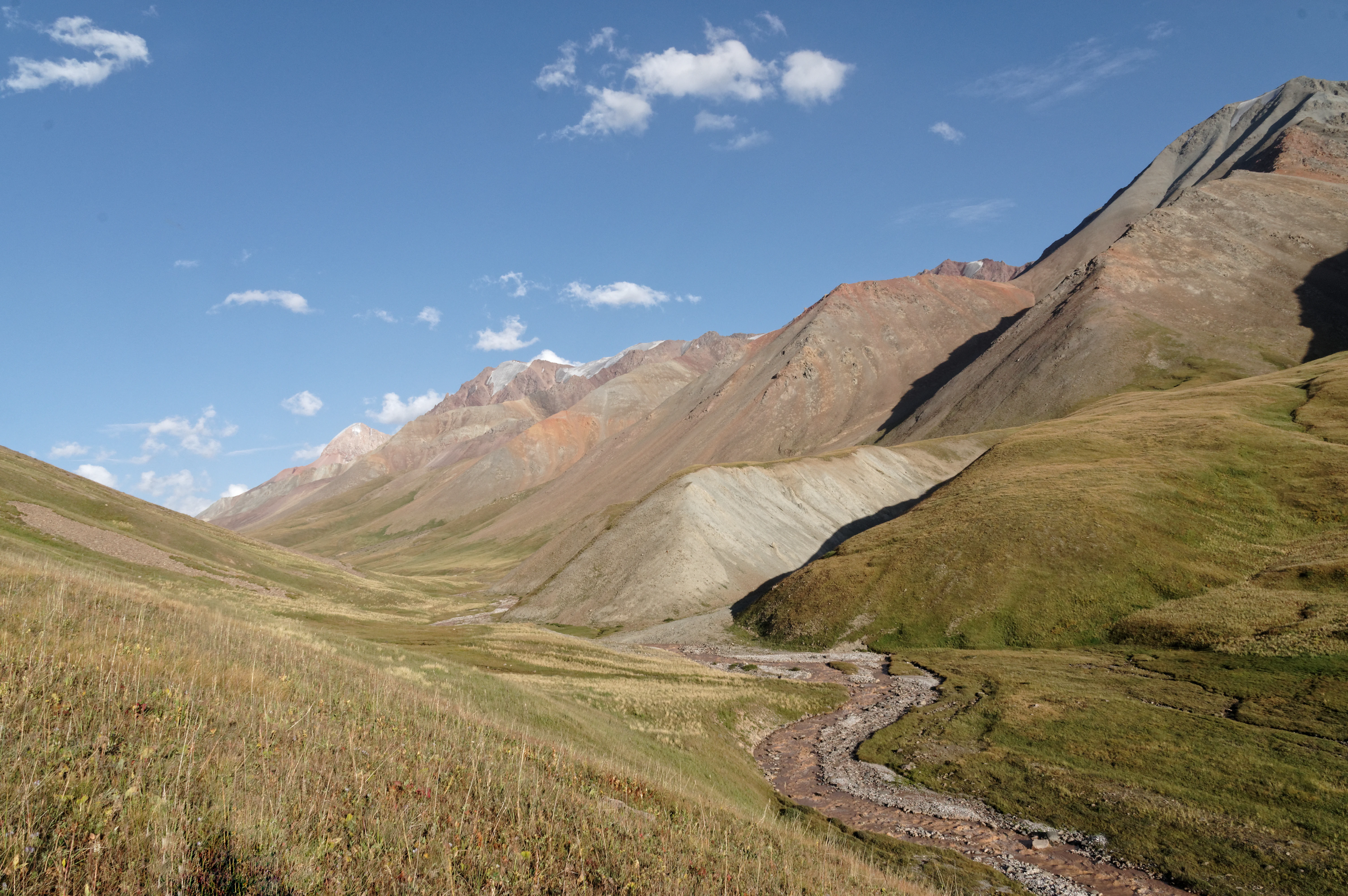
The landscape of Naryn Nature Reserve is shaped by the interior Tien Shan, where uplift and erosion have combined to produce a rugged mosaic of high-altitude landforms. Elevations across the reserve span the conditions of foothill valleys through to true mountain and high plateau zones, with terrain that alternates between open valleys, dissected ridges, rocky slopes, and isolated upland basins. This interior setting places the reserve well away from densely populated lowlands and gives its topography a remote, expansive character.
Water features are defined by the upper Naryn River system and its tributaries, which carve through the terrain and create the hydrological backbone of the protected area. These river valleys concentrate biological activity within the broader mountain mosaic, while surrounding slopes and plateaus support drier steppe-influenced and alpine-type vegetation, depending on elevation and exposure. The combination of valley, slope, and upland terrain produces strong local contrasts in microclimate, exposure, and land cover across relatively short distances.
Among the more distinctive elements of the reserve are its geological formations, which were specifically highlighted in pre-reserve planning as features deserving protection. Rocky outcrops, unusual mineral or structural formations, and erosion-shaped landforms contribute to a landscape identity that is as much geological as it is ecological. Together, these features form a continuous, largely unmodified natural environment characteristic of the inner Tien Shan.
Naryn Nature Reserve ecosystems, habitats, and plant life
The ecological character of Naryn Nature Reserve is tied closely to the harsh continental climate and altitudinal range of central Kyrgyzstan's Tien Shan interior. Vegetation in the reserve is shaped by dry conditions, strong seasonality, and elevation: lower zones tend to carry steppe and dry-grassland communities, mid-elevations support shrub and open woodland transitions, and higher elevations pass into cold, exposed alpine-type environments. The reserve thus preserves a layered ecological gradient across its territory.
Plant communities across this gradient are adapted to drought, cold winters, and short growing seasons, producing vegetation patterns that are often sparse but ecologically distinctive. The protected status of the reserve allows these communities to persist without the additional pressures of grazing, fuelwood collection, or land conversion that affect surrounding areas. Within the wider Kyrgyz conservation landscape, this makes Naryn an important reference site for understanding the natural state of inner Tien Shan plant assemblages.
Wildlife habitats in the reserve track these vegetation zones, with seasonal movement between slopes, valleys, and uplands shaping the ecology of large mammals, smaller fauna, and birds. The combination of a strict core zone, a broader buffer zone, and the maral-breeding enclosure means that ecological processes can operate relatively undisturbed in much of the territory, while certain species receive targeted conservation support within the enclosure lands.
Naryn Nature Reserve wildlife and species highlights
Wildlife is one of the central reasons for the reserve's establishment and continued existence. The 1975 game reserve that preceded the strict reserve was created specifically to protect and reproduce valuable wild animal species, and this purpose carried directly into the 1983 designation. Large mountain mammals form a particularly important component of the reserve's fauna, reflecting its position within the wider Tien Shan mammal community that includes species adapted to cold, dry, high-altitude terrain.
Asiatic red deer, known locally as maral, are especially notable. The reserve includes a dedicated maral-breeding enclosure, a feature that reflects the historical importance of this species in mountain Central Asia and the longstanding practice of managing red deer populations for both conservation and traditional use. This enclosure gives Naryn a distinctive conservation profile compared with reserves focused solely on wild-landscape protection.
Beyond deer, the reserve sustains predator-prey systems and a range of smaller mammals and birds typical of the inner Tien Shan. Large carnivores, ungulates, and smaller herbivores all depend on the same mosaic of valley, slope, and high plateau habitats that the reserve preserves. Birds of prey and upland bird communities add a further faunal layer, and the combination of protected core, buffer zone, and managed enclosure allows different species to benefit from different management intensities across the reserve.
Naryn Nature Reserve conservation status and protection priorities
As an IUCN Category Ia Strict Nature Reserve, Naryn Nature Reserve sits at the most protective tier of conservation classification, intended primarily for ecosystem preservation, scientific research, and the maintenance of natural processes. Its management framework is built around a core protected zone, where intervention is minimized, surrounded by a wider buffer or guard zone that moderates external pressures. This zoning reflects the standard approach for strict reserves, where the most sensitive ecological values are concentrated in the core and surrounding lands serve to reduce disturbance.
The reserve's conservation significance extends beyond its category alone. It lies within one of the most important mountain regions of Central Asia, the inner Tien Shan, where watershed integrity, ungulate population viability, and steppe-alpine transitions have regional implications. By protecting upper-Naryn landscapes, the reserve contributes to broader watershed stability and to the long-term persistence of habitats that span the Naryn and At-Bashy districts.
A distinctive conservation feature of Naryn is its inclusion of a maral-breeding enclosure, which adds a species-recovery function to the otherwise strict protection regime. This combination of strict ecological protection, zoning, and targeted ungulate management illustrates how a single reserve can host multiple, complementary conservation roles. The reserve's foundation in a 1975 game reserve and its 1983 upgrade also demonstrates a layered approach: interim protective measures preceded the formal strict-reserve designation, allowing ecological knowledge and infrastructure to develop alongside legal protection.
Top sights and standout views in Naryn Nature Reserve
Naryn Nature Reserve stands out as one of the strictest protected areas in Kyrgyzstan, anchoring conservation in the upper Naryn basin where the country's longest river system begins. Its landscape combines interior Tien Shan mountain terrain with rare geological formations that were explicitly called out for protection before the reserve was formally established. The maral-breeding enclosure within its territory adds a unique conservation and cultural dimension, linking modern biodiversity protection to the long-standing regional importance of Asiatic red deer.
The reserve's tiered structure of core, buffer, and breeding zones means it functions simultaneously as a wilderness reference site and as an active species-management area, making it a useful model of strict-reserve design adapted to the realities of central Asian mountain conservation.