Why Scherfbachtal Nature Reserve stands out
The Scherfbachtal Nature Reserve is best known for protecting a near-natural, structurally rich spring landscape along the Scherfbach stream system, with a particular emphasis on high-quality spring basins, spring flush vegetation, and diverse brook valley habitats. Its network of converging little streams, flanked by wet grassland and small slope woodlands, represents a typical and ecologically valuable example of the small-scale valley landscapes found throughout the Bergisches Land. The reserve is also recognized for its role as a regionally significant habitat corridor, linking wet meadows, spring communities, and forest patches within an otherwise settled cultural landscape. This combination of ecological function and landscape character, rather than any single dramatic feature, defines what the area is known for.
Scherfbachtal Nature Reserve history and protected-area timeline
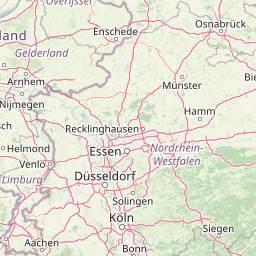
The Scherfbachtal Nature Reserve was formally designated in 2012, as part of the broader framework of nature conservation planning under the landscape plan of the municipality of Kürten. Its designation reflects an effort to secure and systematically protect a near-natural valley landscape that had retained much of its ecological integrity despite the surrounding agricultural and settlement land uses.
The reserve was established and is managed by the lower landscape authority of the Rheinisch-Bergischer Kreis, which coordinates protected-area objectives across the district. The underlying purpose of the designation was to safeguard a complex of spring basins, spring flushes, wet meadows, slope forests, and floodplain woodland as a coherent ecological unit, rather than to create a new park from undeveloped land. In that sense, the reserve is a continuation of long-standing regional efforts to maintain stream valley ecosystems in the Bergisches Land, formalized through modern German nature protection instruments.
Scherfbachtal Nature Reserve landscape and geographic character
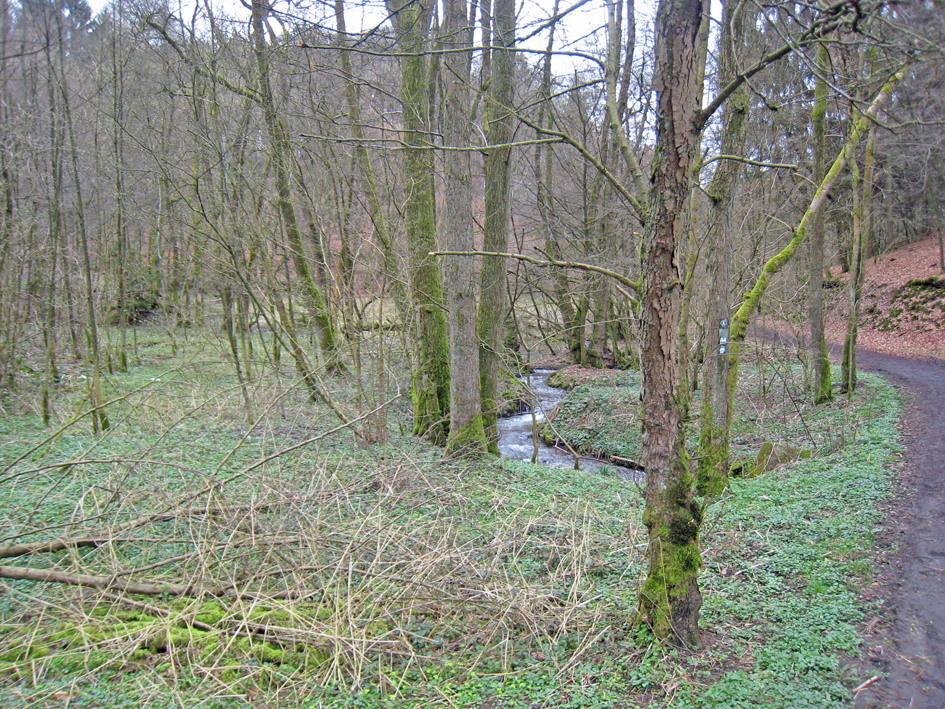
The landscape of the Scherfbachtal Nature Reserve is defined by a series of narrow, converging stream valleys typical of the Bergisches Land. The terrain features gently to moderately sloping hillsides descending toward small brook courses, with the upper valley heads marked by moist depressions and characteristic spring basins. Rather than a single dramatic landform, the area is shaped by the repetition of these small valley segments and the mosaic of habitats they create.
Wooded slopes, mostly dominated by broadleaf forest, frame the streams and give the landscape a sheltered, intimate character. The valley floors alternate between wet meadows, moist grasslands, and patches of broader riparian woodland, while the upper edges of the reserve transition gradually into the surrounding agricultural and settlement landscape. This fine-grained mixing of forest, grassland, and small watercourses gives the Scherfbachtal its quietly distinctive character.
Scherfbachtal Nature Reserve ecosystems, habitats, and plant life
Ecologically, the Scherfbachtal Nature Reserve is dominated by spring-associated and stream-associated habitats. The cornerstone of the protected area is a network of near-natural spring basins and spring flush zones, where groundwater emerges to form the headwaters of the Scherfbach and its tributaries. Around these springs, the habitat mosaic includes wet and moist grassland, quaking-mire-like vegetation, and small communities of moisture-loving plants, all of which depend on the consistent water supply from the springs.
The valley slopes carry mixed broadleaf woodland with elements of slope forest and, nearer the stream, floodplain forest influenced by occasional high water. Together with the wet meadows along the stream courses, the area forms a layered ecological system in which aquatic, semi-aquatic, grassland, and forest habitats are closely interlinked. This habitat diversity within a small area is a major reason for the reserve's ecological value.
Scherfbachtal Nature Reserve wildlife and species highlights
The Scherfbachtal Nature Reserve's wildlife is shaped primarily by its spring and stream habitats, which support amphibians, aquatic invertebrates, and a range of moisture-dependent animal species. Small streams and their immediate surroundings provide breeding and feeding grounds for amphibians such as frogs, while the wet meadows and flush zones offer habitat for invertebrates and small wetland fauna.
The continuous transition from wet grassland to slope forest creates edge habitats that are valuable for woodland birds, small mammals, and a variety of insect groups. The reserve's function as a connected refuge for these species within a populated agricultural landscape is as important as the presence of any single animal, reflecting the reserve's role within the regional ecological network rather than its appeal for charismatic wildlife sightings.
Scherfbachtal Nature Reserve conservation status and protection priorities
The conservation significance of the Scherfbachtal Nature Reserve lies in its role as a protected near-natural valley ecosystem in an otherwise heavily used cultural landscape. By safeguarding spring basins, spring flushes, wet meadows, slope forests, and floodplain woodland together as a single unit, the reserve protects ecological processes and habitat structures that are otherwise increasingly rare in the region. It is classified under IUCN Category IV, underscoring its focus on habitat and species management.
The designated conservation objectives of the reserve include securing its function as a biotope-connectivity area of outstanding regional importance, preserving and developing near-natural spring communities, maintaining the diverse brook valleys as a characteristic landscape near settlements, and protecting the water quality of the spring sources and the Scherfbach itself. These aims reflect a long-term strategy of protecting ecological function rather than relying on single-species measures, and they position the reserve as a meaningful component of the wider protected-area network of the Rheinisch-Bergischer Kreis.
Scherfbachtal Nature Reserve cultural meaning and human context
The Scherfbachtal Nature Reserve sits within the Bergisches Land, a region with a long cultural history of small-scale farming, milling along brooks, and dispersed settlement in valleys between wooded ridges. Although the reserve itself is now primarily defined by its ecological values, its physical setting, with converging stream branches, mills such as the Liesenberger Mühle at the valley edge, and village locations like Kochsfeld, Bechen, Schnappe, and Herweg, reflects this classic Bergisches Land pattern in which watercourses shaped both daily life and land use.
The reserve's protected status can be understood as an effort to preserve the natural components of this older cultural landscape, retaining intact streams, springs, and valley forests that have historically been part of the everyday environment of nearby communities.
Top sights and standout views in Scherfbachtal Nature Reserve
The Scherfbachtal Nature Reserve stands out for its combination of near-natural spring basins, intricate small-stream valley structure, and close integration of wet meadows, slope forests, and floodplain woodland within a compact protected area. It offers a textbook example of how a small valley landscape in the Bergisches Land can retain ecological integrity and serve as a connectivity hub within the regional ecological network.
Equally notable is the reserve's position close to settled areas, demonstrating that meaningful habitat protection can succeed in a working cultural landscape. The combination of designated protection objectives, established management under the municipal landscape plan, and the continued ecological function of the springs and stream makes the Scherfbachtal a quietly significant component of North Rhine-Westphalia's protected-area system.
Best time to visit Scherfbachtal Nature Reserve
The Scherfbachtal Nature Reserve can be experienced across the seasons, with each period offering a different character. Spring is the most dynamic season ecologically, when groundwater-fed flushes are at their wettest and valley vegetation awakens early. Early summer brings lush green growth in the meadows and full foliage in the slope woodlands, while the wet ground at spring heads remains a defining visual feature.
Late summer and autumn reveal the structural character of the reserve more clearly, as grasses change color and leaf fall opens up views into the valley floors and stream corridors. Winter, with bare deciduous trees, highlights the network of small valley branches and stream channels that together form the reserve's defining landscape pattern. Visitors interested in the ecological character of a spring-fed valley will find the reserve most rewarding during the wetter months, while those focused on landscape structure may prefer the clearer light of late autumn or winter. Visited respectfully on existing paths, the reserve is best appreciated at a quiet walking pace rather than as a destination for dramatic vistas.