
Why Naturschutzgebitt Aarnescht stands out
Aarnescht is best known for its species-rich calcareous dry grasslands, often referred to as Halbtrockenrasen, which support an exceptional concentration of orchids within a small protected area. Around 20 orchid species have been recorded here, representing a major share of Luxembourg's native orchid flora. Beyond the orchids, the reserve is recognized for the broader ecological mosaic that surrounds them: traditional orchards, oak low-forest remnants, beech and pine stands, and pipe-grass wet meadows in erosion gullies. This diversity, combined with a long history of scientific study led by Léopold Reichling, gives Aarnescht a strong reputation as a key reference site for calcareous grassland conservation in Luxembourg.
Naturschutzgebitt Aarnescht history and protected-area timeline
The history of Naturschutzgebitt Aarnescht is closely linked to the scientific work of Professor Léopold Reichling, who recognized the area's exceptional plant and animal diversity during research in the 1970s. Reichling's publications became the foundation for the official classification dossier that ultimately led to formal protection.
On 23 June 1973 the site was included in the supplementary inventory of classified monuments, an early step in recognizing its heritage and natural value. Formal nature reserve status followed years later, when the area was placed under national protection through the Grand Ducal regulation of 1 February 1988, creating an initial core zone of around 48 hectares and a buffer zone of about 27 hectares.
Today Aarnescht is counted among Luxembourg's earliest designated nature reserves, a distinction that reflects both the long awareness of its ecological importance and the role Reichling's pioneering research played in shaping Luxembourg's approach to protecting calcareous grasslands. A monument commemorating Reichling was inaugurated at the reserve in June 2011, anchoring the site's place in the country's conservation history.
Naturschutzgebitt Aarnescht landscape and geographic character
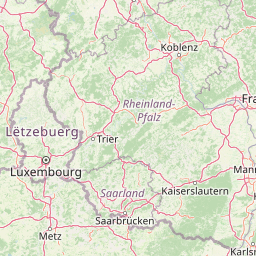
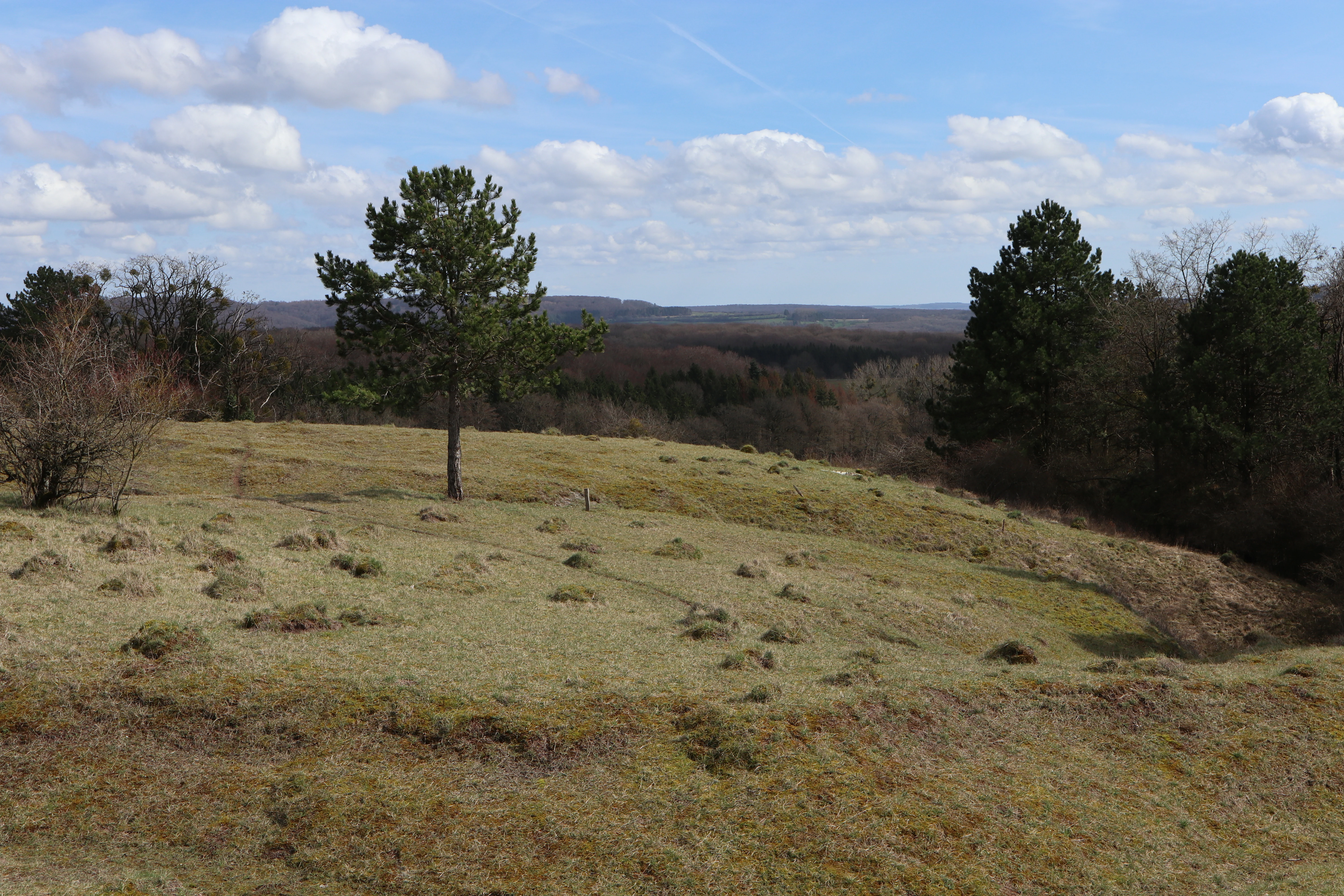
The landscape of Aarnescht is defined by a sunny, gently sloping hillside northeast of the village of Oberanven. The reserve sits at elevations between roughly 300 and 360 metres within Luxembourg's general leveling system, on terrain shaped by an unusual local geological transition from Luxembourg Sandstone to Keuper sediments.
Most of the protected area lies on Steinmergelkeuper, a relatively soft rock layer that weathers into shallow, calcareous, nutrient-poor soils. Erosion by water and wind has gradually uncovered the calcareous base of the site, while small patches of younger sandstone layers still survive in the extreme northern part of the reserve. The result is a landscape of thin, dry, lime-rich soils that absorb and store heat efficiently, ideal for calcareous grassland species.
Above and around these open slopes, the broader landscape composition includes a mosaic of habitat types. Calcareous dry grasslands dominate the centre and southern part of the reserve, traditional orchards cover much of the southwestern slope forming the buffer zone, and the plateau above carries oak low-forest mixed with beech, pine, and spruce stands. A heat-loving oak forest edge sits beside the oak low-forest, while pipe-grass wet meadows occupy the wetter depressions and erosion gullies, giving the reserve a varied, multi-textured topography.
Naturschutzgebitt Aarnescht ecosystems, habitats, and plant life
The nature of Aarnescht centres on a finely balanced mosaic of calcareous grassland habitats, traditional orchard systems, and forest communities. At its ecological core are the Halbtrockenrasen, semi-dry calcareous grasslands whose shallow, lime-rich soils host their characteristic low-growing, stress-tolerant plant communities.
These grasslands emerged only through long human influence: the original forest cover was cleared historically and replaced by meadows and pastures. Without regular management, the open grasslands would slowly revert through scrub to a locally adapted oak forest. To preserve them, conservation work regularly removes young black pines and aggressive shrubs such as blackthorn, allowing the more delicate, competition-weak species to persist.
Surrounding the grasslands, traditional orchards play an important ecological role as part of the buffer zone, providing old fruit trees with cavities and bark features used by specialist species. Oak low-forest, oak forest edge, beech, pine, and spruce stands occupy the plateau, while pipe-grass dominated wet meadows occupy the moist depressions and erosion gullies. This combination of dry and wet microhabitats gives Aarnescht its broad ecological character within a relatively small area.
Naturschutzgebitt Aarnescht wildlife and species highlights
The wildlife of Aarnescht reflects the richness of its flower-rich grasslands and traditional orchards. The dry meadows and surrounding habitats support a notably diverse insect fauna, including more than 130 butterfly species, around 22 cricket and grasshopper species, over 100 bug species, and roughly 48 moth species.
This abundance of insects in turn supports several birds of prey, including the Eurasian hobby and the European honey buzzard, both of which hunt over the reserve. In the orchards, the old fruit trees offer nesting cavities and foraging opportunities for species such as the Eurasian wryneck and the little owl, while the same orchards host small mammals like the European hedgehog, the hazel dormouse, the garden dormouse, and the edible dormouse.
Larger mammals also use the reserve, with the European badger recorded on the site. Open-ground species typical of low-intensity farmland and grassland, including the European hare and the grey partridge, have become rare elsewhere in Luxembourg but still find refuge on the Aarnescht slopes.
Naturschutzgebitt Aarnescht conservation status and protection priorities
Aarnescht holds an important place in Luxembourg's conservation history as one of the country's earliest formally designated nature reserves. Its protection rests on the Grand Ducal regulation of 18 March 1988, which established a core zone of roughly 48 hectares and a surrounding buffer zone of about 27 hectares, for a total protected area of around 75 hectares.
The reserve's conservation value lies in its concentration of calcareous dry grassland, an internationally recognized habitat type that supports many specialized plant and insect species. Roughly 63 percent of Luxembourg's orchid flora has been recorded here, a striking figure for a site of this size. The grassland itself is a cultural product, dependent on regular mowing or grazing; without active management it would gradually be lost to scrub and woodland succession.
Management of the reserve is carried out in cooperation with naturalist associations such as the Amicale de l'Aarnescht, forestry authorities, and the commune of Niederanven. Key tasks include controlling invasive woody growth such as young black pine and blackthorn to maintain open grassland, conserving the traditional orchard buffer zone, and maintaining the reserve's nature trail and interpretive infrastructure for visitor education.
Naturschutzgebitt Aarnescht cultural meaning and human context
Aarnescht is closely woven into the surrounding cultural landscape of Niederanven, with its protected grasslands themselves a product of centuries of traditional land use. The open calcareous meadows exist because the area was once cleared of forest and managed as hay meadow and pasture, a pattern that has shaped much of central Luxembourg's farmed countryside.
Traditional orchards on the southwestern slopes form a major part of the reserve's buffer zone, preserving not only biodiversity but also a piece of regional orchard heritage. A memorial to the biologist and botanist Léopold Reichling, inaugurated in June 2011 near the information pavilion, ties the site's cultural memory to the researcher whose 1970s work first revealed its ecological significance.
A 4 km nature trail completed in 2003, developed jointly by the Amicale de l'Aarnescht, the forestry administration, and the commune of Niederanven, extends this cultural dimension by interpreting the reserve's habitats, its landscape history, and its role in Luxembourg's broader natural heritage.
Top sights and standout views in Naturschutzgebitt Aarnescht
Aarnescht stands apart as one of Luxembourg's earliest designated nature reserves and as a reference site for calcareous dry grassland conservation in the country. Its combination of species-rich orchids, flower-filled meadows, traditional orchards, and small-scale forest mosaic gives it an unusually concentrated ecological value within a compact protected area.
The reserve is also notable for its strong interpretive infrastructure, from the dedicated nature trail and information panels developed in 2003 to the Reichling memorial, helping connect the site's scientific, cultural, and natural heritage for visitors and researchers alike.
Best time to visit Naturschutzgebitt Aarnescht
Aarnescht rewards visits that align with its ecological highlights. Late spring and early summer are typically the most rewarding period for visitors interested in orchids and other flowering plants of the calcareous grasslands, when semi-dry meadows are at their brightest and insect activity is increasing.
Autumn offers a quieter atmosphere with softer light over the orchards and surrounding hills, while the nature trail and interpretive panels can be enjoyed across much of the year as long as paths are accessible. Cold winter months tend to be quieter, with limited floral display but a calm atmosphere for walking the reserve's lower-intensity landscapes.