Why Robertson Nature Reserve stands out
Robertson Nature Reserve is best known for being a small but ecologically significant remnant of warm temperate rainforest on the Illawarra Escarpment. Its surprisingly low canopy, despite rich basaltic soils and very high rainfall, gives the reserve a distinctive forest character that differs from both the cool temperate rainforests of the higher escarpment and the subtropical forests of the coast. The reserve is also valued for the way it preserves a fragment of the historic Yarrawa Brush, a much larger forest that has been drastically reduced by clearing. A short, wheelchair-accessible walking track and interpretive signage make it a convenient place to experience this kind of rainforest close to Robertson in the Southern Highlands.
Robertson Nature Reserve history and protected-area timeline
Robertson Nature Reserve was formally gazetted as a protected area in January 1979, placing a small but ecologically significant rainforest fragment under the management of what is now the NSW National Parks and Wildlife Service. Its establishment was part of broader efforts to conserve remnants of the Yarrawa Brush, a once extensive forest community on the Illawarra Escarpment that had been reduced to a small fraction of its original size by clearing for agriculture and settlement.
The reserve is the last significant surviving piece of that original 2,450-hectare forest system, and its protected status reflects growing recognition, during the late twentieth century, of the importance of even very small rainforest remnants in highly cleared landscapes. Its small footprint and long history of exposure to surrounding land use have also shaped its current conservation challenges, particularly the steady pressure from invasive weeds moving in from neighbouring farms and roadsides.
Robertson Nature Reserve landscape and geographic character
The landscape of Robertson Nature Reserve is shaped by its position on the inland edge of the Illawarra Escarpment, a long, dramatic cliff range that runs along the coast of New South Wales. The reserve lies at about 750 metres above sea level, on undulating country that drops away toward the coastal fall. Despite this elevation, the local terrain is gentle within the reserve itself, allowing a dense rainforest to develop on relatively sheltered, basalt-influenced soils.
Rainfall is exceptionally high for this part of the Southern Highlands, averaging around 1,600 millimetres a year. Combined with cool temperatures and frequent mist, this creates the persistently moist conditions that have allowed rainforest trees, tree ferns, and a thick understorey of ferns and mosses to persist. The surrounding landscape, by contrast, is dominated by cleared pastoral land, which makes the small, dark green block of the reserve stand out sharply against the agricultural patchwork around it.
Robertson Nature Reserve ecosystems, habitats, and plant life
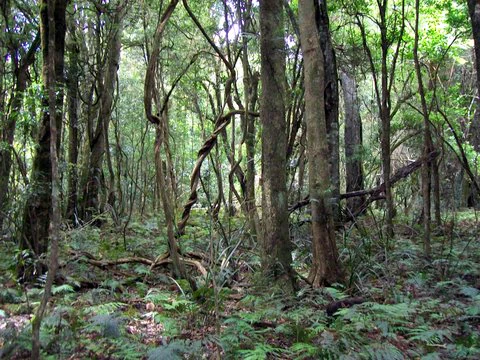
Ecologically, Robertson Nature Reserve is a small patch of warm temperate rainforest set within a heavily cleared rural landscape. Its vegetation is unusually species rich for such a tiny area, with a canopy that blends elements of subtropical and temperate rainforest communities. The relatively rich basaltic soils and very high rainfall would normally support tall forest, but the canopy here is unusually low at about 15 metres, lending the rainforest a compact, dense appearance.
The rainforest includes a distinctive mix of species. Canopy trees such as golden sassafras, coachwood, Lilly Pilly, Native Daphne, Possumwood, Beefwood, Featherwood and Blackwood give the upper layer a varied structure, while the understorey and ground layer are dominated by ferns, mosses, and shade tolerant shrubs. The presence of Brown Beech, typically associated with more tropical and subtropical forests, hints at the warmer character of this particular rainforest community, distinguishing it from the cooler temperate rainforest found elsewhere on the escarpment.
Robertson Nature Reserve wildlife and species highlights
Because of its small size and the limited detail available in published sources, Robertson Nature Reserve is best described in terms of its habitat rather than its individual species. The cool, moist rainforest interior and dense fern understorey provide shelter for invertebrates, ground dwelling forest creatures, and the typical range of small mammals and birds associated with remnant rainforest patches in the Illawarra region. Interpretive signage along the walking track highlights local plants and animals, suggesting that visitors can learn more about the reserve's fauna on site.
The reserve's connectivity to surrounding habitat is limited, which shapes the wildlife community it can support. Forest dependent birds are likely to feature prominently, as the dense canopy and edge contrast with adjacent farmland create rich bird viewing opportunities, particularly for species adapted to both forest interior and forest edge environments.
Robertson Nature Reserve conservation status and protection priorities
Robertson Nature Reserve holds clear conservation value as one of the few surviving remnants of the historic Yarrawa Brush, which once covered a far larger area of the Illawarra Escarpment. Reduced to a 5.3-hectare fragment embedded in a heavily cleared agricultural landscape, the reserve serves as a genetic and ecological reservoir for warm temperate rainforest species that would otherwise have disappeared from the local area.
Its small size and isolation also make it vulnerable. The reserve is under constant pressure from invasive weeds moving in from surrounding farmland, with Chinese Privet, Glossy Privet, Holly and Himalayan Blackberry identified as particularly troublesome species. Ongoing management by the NSW National Parks and Wildlife Service is therefore focused on protecting the rainforest community from further degradation and maintaining the integrity of this rare fragment of the original Yarrawa Brush.
Robertson Nature Reserve cultural meaning and human context
Robertson Nature Reserve is closely tied to the identity of the village of Robertson and the broader Southern Highlands region. The Yarrawa Brush, of which the reserve is the last major fragment, was historically significant to local communities as a prominent landscape feature and resource in an area that has otherwise been heavily cleared for dairy and other farming. Today, the reserve functions as a small but important point of local pride and a tangible link to the pre-clearance landscape of the Illawarra Escarpment foothills.
Top sights and standout views in Robertson Nature Reserve
A surviving fragment of the historic Yarrawa Brush, preserved as a tiny but species rich warm temperate rainforest in the Southern Highlands. Unusually low canopy of around 15 metres, despite high rainfall and fertile basaltic soils, giving the forest a distinctive, dense character. A mix of rainforest species more often associated with warmer forests, including Brown Beech alongside coachwood, golden sassafras and Lilly Pilly. A short, wheelchair accessible 600 metre walking track with interpretive signs, making the reserve easy and informative to visit. High conservation significance, as one of the few remaining rainforest patches in an otherwise heavily cleared rural landscape.
Best time to visit Robertson Nature Reserve
Robertson Nature Reserve can be visited year round, but the rainforest experience is most atmospheric in the cooler, wetter months, when frequent mist and high rainfall keep the ferns and mosses lush and the forest interior damp and shaded. Spring and early summer bring fresh growth in the understorey and active birdlife, while autumn offers cooler, quieter conditions for walking the short track. Summer visits are still rewarding thanks to the dense canopy shade, although visitors should be prepared for the higher rainfall typical of the escarpment at this time of year.