Why Soběšické rybníčky stands out
Soběšické rybníčky is best known as a small amphibian breeding refuge embedded in the forested outskirts of Brno. The site's defining trait is its combination of shaded forest ponds with wetland soils, which supports breeding populations of common toads, brown frogs, agile frogs, and alpine newts within a very compact area. The protection of the ponds was driven by this amphibian importance, rather than by open-water or large-lake characteristics, and ongoing management has even included periodic removal of fish that would otherwise affect amphibian reproduction.
Soběšické rybníčky history and protected-area timeline
The natural monument at Soběšické rybníčky was formally established on 1 November 1987. The original rationale for protection was the presence of two small ponds that functioned as a refuge for breeding amphibians in an otherwise heavily forested and gradually urbanizing landscape on the northern edge of Brno.
In the years that followed, the upper pond's dam was breached, which reduced the site's capacity to support the very amphibians it had been designated to protect. Between 2007 and 2010, a restoration effort created three shallow pools as substitute breeding habitat and removed shading woody vegetation around the open water to improve conditions for amphibians.
Fish removal has also been incorporated into ongoing management planning, reflecting the continued focus on maintaining the ponds as an effective amphibian refuge rather than as a recreational or ornamental water feature.
Soběšické rybníčky landscape and geographic character
The landscape of Soběšické rybníčky is shaped by a narrow, shaded valley incised into the Soběšice Highlands, a forested ridge belonging to the larger Drahanská vrchovina system in central Moravia. The protected area sits at elevations between roughly 290 and 330 meters above sea level, where the valley floor flattens out enough to hold small ponds while the surrounding slopes remain cloaked in mixed forest.
Geologically, the setting is defined by biotite granodiorite of the Brno massif, weathered and partially covered by fluvial sediments washed down by the small local watercourse. Soils transition from wetland gley types along the pond margins to more typical cambisols on the better-drained slopes, producing the characteristic contrast of boggy depressions and firmer forested slopes that defines the local scenery.
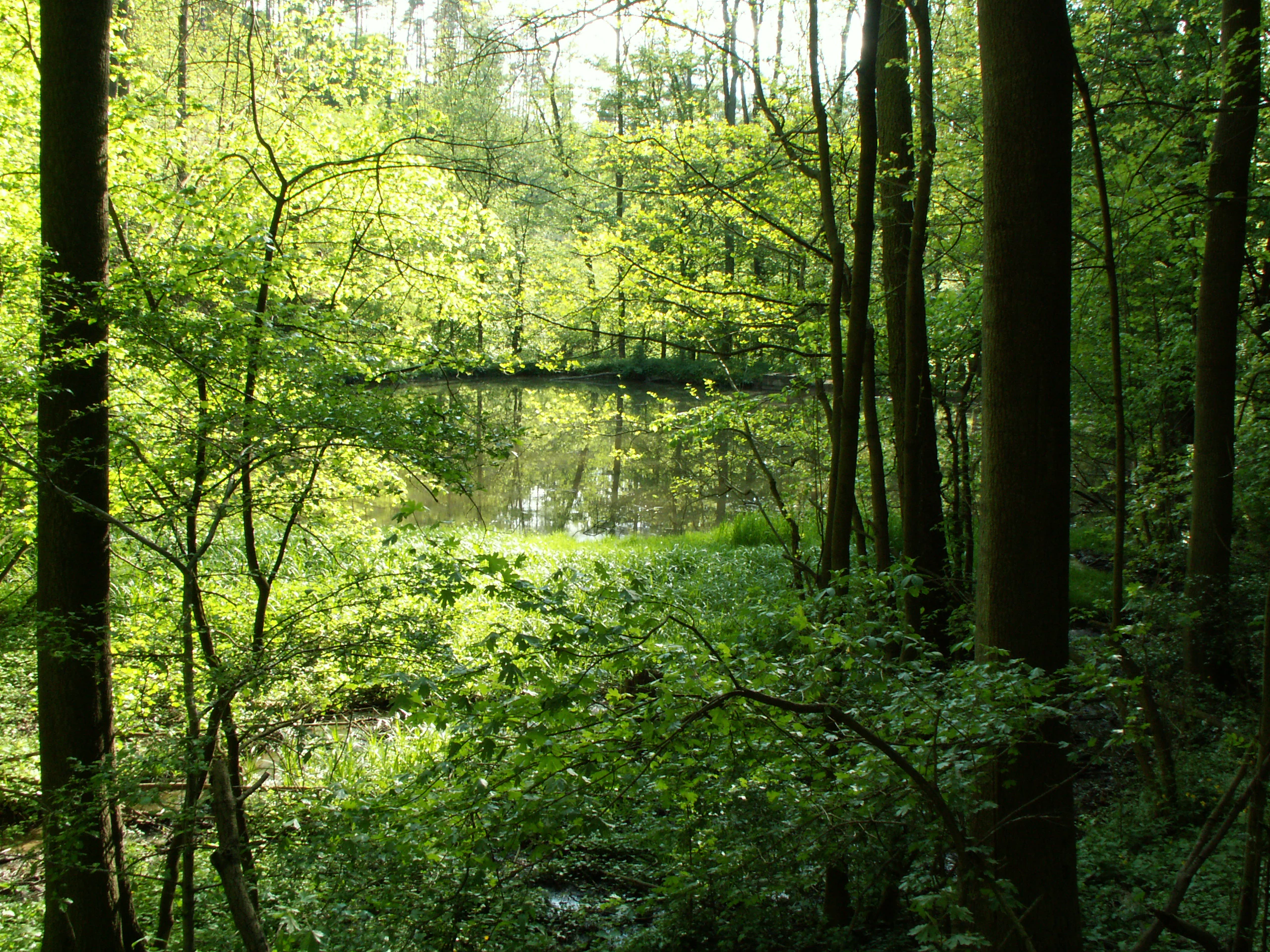
Because the valley is narrow and the canopy is dense, the immediate landscape feels enclosed and intimate. The ponds themselves are small, and their surfaces are often partly shaded by overhanging alder and willow, lending the site a quiet, secluded character that contrasts with the busy suburban edge of Brno just beyond the ridge.
Soběšické rybníčky ecosystems, habitats, and plant life
Ecologically, Soběšické rybníčky represents a compact but well-developed example of a Central European forest wetland. The combination of small open-water surfaces, marshy margins, and surrounding hardwood forest creates a layered habitat that supports a distinctive set of species in a very limited area.
The woody vegetation is dominated by black alder, with hornbeam, ash, small-leaved lime, field maple, hazel, hawthorn, goat willow, and elder contributing to a structurally diverse canopy and shrub layer. The herb layer is equally varied, with characteristic wetland species such as cyperus sedge, woodland forget-me-not, creeping bent grass, curled pondweed, plicate glyceria, and water plantain appearing along the pond margins and wet zones.
The wet soils, dominated by gley and pseudogley types, and the forested catchment ensure that water levels remain relatively stable across the year, sustaining both the ponds and the saturated soils that support the wetland flora. Even though the protected area is tiny, the forest matrix around it, part of the broader Soběšice forest complex, extends the effective habitat for amphibians and forest-dependent species well beyond the official boundary.
Soběšické rybníčky wildlife and species highlights
The defining wildlife importance of Soběšické rybníčky lies in its amphibian populations. The ponds serve as a key breeding site for common toads and for two frog species, the common frog and the agile frog, with alpine newts also confirmed. This concentration of breeding amphibians in such a small water body is the central reason the site was protected in the first place.
The surrounding alder-dominated forest supports a small but characteristic mammal community. Species recorded include the European pine vole, a small burrowing rodent typical of moist woodlands, and the pygmy shrew, one of the smallest European mammals. Among birds, the grey-headed woodpecker has been documented in the area, reflecting the value of older broadleaf trees for specialist woodland species.
Fish are present in the lower pond, notably rudd and common roach, but their presence is considered ecologically problematic for the site's primary conservation goal. Because fish predate amphibian eggs and larvae, periodic fish removal is carried out as part of the site's management plan to preserve conditions favorable for amphibian reproduction.
Soběšické rybníčky conservation status and protection priorities
Soběšické rybníčky is protected as a přírodní památka, a Czech natural monument designation broadly aligned with the IUCN Category IV framework for habitat and species management areas. The site's conservation purpose is centered on maintaining and improving its function as an amphibian refuge within the partially urbanized landscape on the edge of Brno.
Management has been active as well as reactive. After the upper pond's dam was breached, an intervention between 2007 and 2010 created three shallow pools specifically designed to restore breeding habitat for amphibians, while overhanging woody vegetation was cleared from the water's edge to ensure adequate light and warmth for amphibian reproduction. The control of fish populations in the lower pond is another deliberate management measure, reflecting a conservation strategy that prioritizes amphibians over other aquatic uses.
The site is administered by the Regional Authority of the South Moravian Region, which is responsible for implementing the site's care plan. The protected area sits within the broader landscape context of the Soběšice forest, and although the official footprint is small, the conservation value of Soběšické rybníčky lies in its role as a high-quality breeding pocket within a much larger forest matrix.
Top sights and standout views in Soběšické rybníčky
Soběšické rybníčky is a textbook example of a tiny protected area with disproportionate ecological value, demonstrating how a shaded forest valley with small ponds can support a thriving amphibian community on the edge of a major Central European city. Its long history of deliberate management, from 1987 designation to the post-2007 restoration of breeding pools, shows a sustained commitment to amphibian conservation.
What makes the site distinctive is the combination of classical Central European hardwood forest, wetland soils, and a small but stable water body, all packed into just over a hectare. The presence of alpine newts alongside common toads and two frog species, together with grey-headed woodpeckers in the older trees, gives the site a biodiversity profile that punches well above its modest size.
Best time to visit Soběšické rybníčky
Because Soběšické rybníčky is a small, forested wetland site, seasons strongly shape the experience. Spring is the most ecologically active period, when amphibians move to the ponds to breed and the wetland flora around the margins comes into growth. Visiting in late spring or early summer tends to offer the richest combination of fresh foliage, visible water surfaces, and active wildlife.
Late summer and early autumn can also be rewarding for those interested in the broader forest character, with mature canopy conditions and more subdued pond levels. Winter brings quieter conditions and bare deciduous trees that make the small ponds easier to observe, though the dense forest surround and low light keep the atmosphere cool and sheltered year-round.