
Why Teichlandschaft Buchwäldchen-Muckwar stands out
The reserve is best known for its system of historic fishponds, originally created by Cistercian monks, set within a mosaic of alder swamp woodland, oak-hornbeam forest, pine stands, and wet meadows. It is also recognized as a refuge for rare amphibians such as the red-bellied toad and the northern crested newt, and as breeding or hunting habitat for the common crane, the black stork, and the white-tailed eagle. Its second defining trait is the active restoration work being carried out on its forests, where commercial pine and non-native Douglas fir are being phased out in favor of native broadleaf species such as sessile oak, gradually reshaping the wooded character of the protected area.
Teichlandschaft Buchwäldchen-Muckwar history and protected-area timeline
The history of the reserve is closely tied to the long tradition of pond-based fish farming in Lower Lusatia. The nine ponds that define the area were originally laid out centuries ago by Cistercian monks, who used them to raise fish in a region where wet ground and slow-flowing streams made pond cultivation a natural form of land use. The largest of the ponds, the Großer Paul, had already been singled out as a particularly valuable natural monument in the 1933 register of natural monuments for the Province of Brandenburg.
During the second half of the twentieth century, the hydrology of the area was strongly affected by the lignite opencast mining that transformed much of the Lusatian landscape. The lowered water table caused the Großer Paul to dry out between 1987 and 1993, and the pond had to be artificially refilled in order to prevent the loss of its ecological values. The episode illustrates how vulnerable the historical pond system is to changes in groundwater levels brought about by regional industrial activity.
Formal protection came in 1997, when the area was designated as the Naturschutzgebiet Teichlandschaft Buchwäldchen-Muckwar. In 2004, 38 hectares of the reserve were transferred to the Stiftung Naturschutzfonds Brandenburg, allowing a long-term program of habitat management to begin. Since then, the foundation has led the conversion of pine-dominated stands toward more natural mixed forests, the establishment of new small water bodies for amphibians, and the gradual development of structured, ecologically valuable forest edges.
Teichlandschaft Buchwäldchen-Muckwar landscape and geographic character
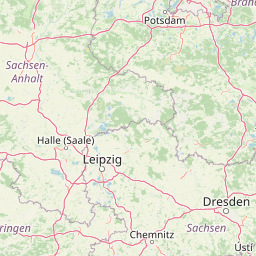
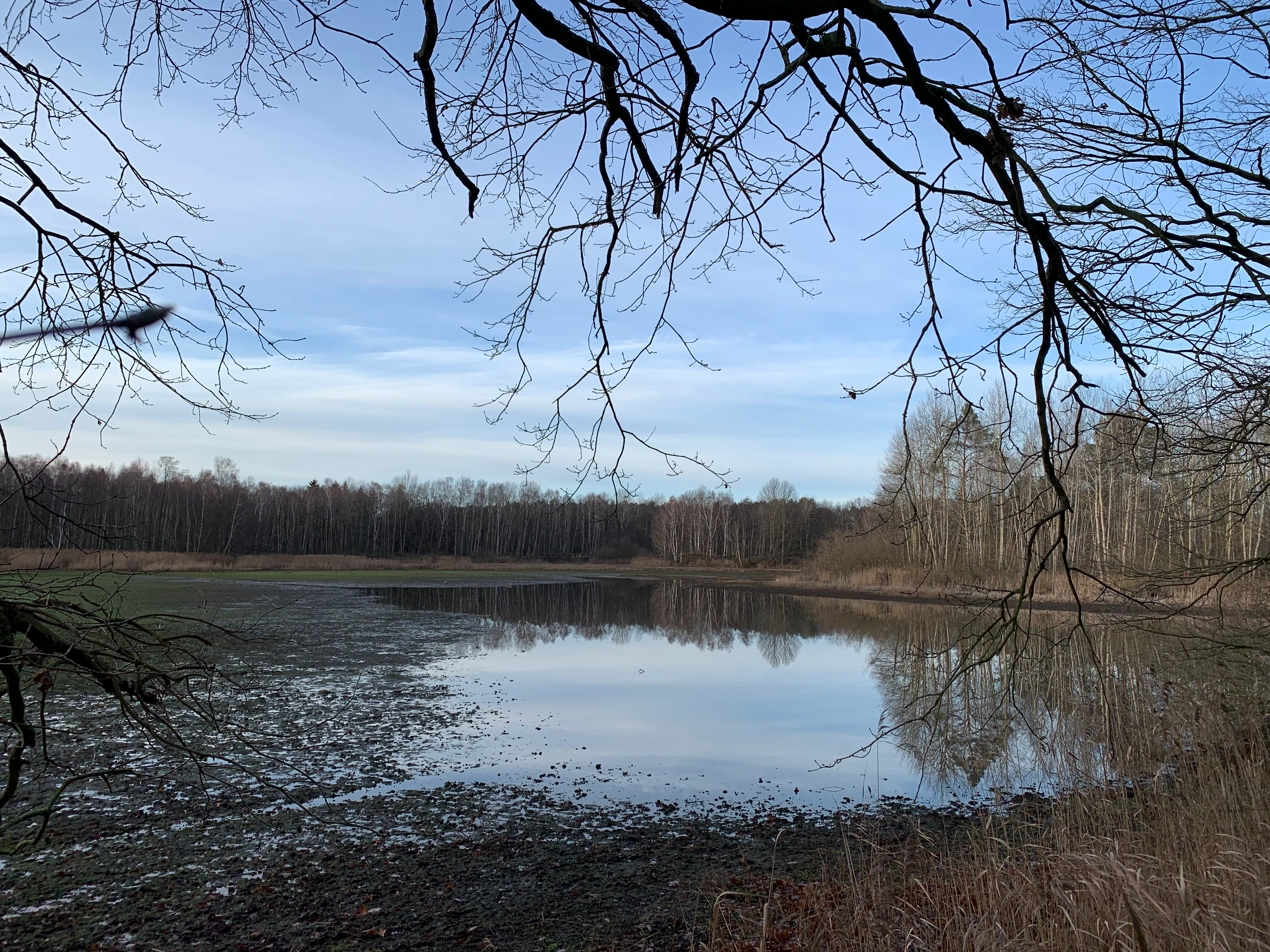
The landscape of Teichlandschaft Buchwäldchen-Muckwar is shaped by a gentle interplay of water and woodland typical of the Lusatian region. The ponds themselves vary considerably in size, with the Großer Paul and the Kleiner Paul forming the central core of the system, supported by Borschteich to the west and a cluster of smaller ponds in the north and south, including the Großer and Kleiner Brauerteich, Frauenteich, Herrenteich, Bindeteich, and Krummetteich. Flowing water is just as important as standing water: a network of ditches links the ponds and conveys their water into the Vetschauer Mühlenfließ, creating a continuous hydrological chain.
Beyond the water surfaces, the terrain is largely wooded. Below the Großer Paul lies a stretch of alder swamp forest, complemented by oak-hornbeam stands and patches of alluvial forest along the wetter ground. Much of the remaining area is covered by pine forest, some of it established through historical afforestation and including non-native species such as Douglas fir. Between the forested patches, the relief opens up into grass meadows, wet herbaceous fringes, and lowland hay meadows, producing a fine-grained mosaic of habitats that shifts visibly across short distances.
The broader setting is gently rolling rather than dramatic, with the railway line to the west and the open agricultural surroundings of the Oberspreewald-Lausitz district framing the reserve. The result is a calm, intimate landscape in which water, forest edge, and meadow alternate in a pattern that has been continuously shaped, yet repeatedly reshaped, by human activity over the centuries.
Teichlandschaft Buchwäldchen-Muckwar ecosystems, habitats, and plant life
Ecologically, the reserve functions as a small-scale refuge for habitat types that have become scarce in the surrounding agricultural landscape. The pond network, with its associated ditches and wet ditches draining to the Vetschauer Mühlenfließ, provides a suite of aquatic and semi-aquatic habitats ranging from open-water surfaces through reed margins to periodically fluctuating water bodies. This hydrological variety is the foundation on which the rest of the reserve's biodiversity is built.
The forest communities reflect the same fine-grained pattern. Below the Großer Paul, alder swamp forest dominates, grading into oak-hornbeam woodland and small patches of alluvial forest. Much of the remainder carries pine forest, partly of older origin and partly the product of afforestation that has, in places, relied on non-native conifers such as Douglas fir. Where the canopy opens, the reserve holds small open habitats of high ecological value, including Molinia grass meadows, wet tall-herb communities, and lowland hay meadows, each supporting a distinct set of plants and invertebrates.
Botanically, the area is notable for several threatened species. The royal fern, the marsh calla, and the broad-leaved marsh orchid have all been documented here, reflecting the combination of acidic boggy ground, calcareous influences, and unimproved grassland that the reserve manages to maintain within a relatively small footprint.
Teichlandschaft Buchwäldchen-Muckwar wildlife and species highlights
The wildlife profile of Teichlandschaft Buchwäldchen-Muckwar is anchored by its amphibians, which benefit directly from the mosaic of ponds, ditches, and small water bodies maintained across the reserve. The red-bellied toad and the northern crested newt are both present in the pond systems, and the management work of recent years has deliberately added small new water bodies to strengthen their habitat. Tree frogs also use the wet margins, while the European otter moves along the connecting waterways, using the ditches and the Vetschauer Mühlenfließ as a travel corridor through the landscape.
The reserve is also an important site for reptiles, with grass snakes recorded on land and using the pond edges as foraging habitat. Among birds, the area is notable for larger, sensitive species whose presence often depends on a combination of open water, undisturbed forest, and traditional land use. The common crane uses the area, the black stork breeds in the sheltered woodland, and the white-tailed eagle ranges over the reserve as a hunting species, taking advantage of the rich mosaic of water, meadow, and forest edge.
Overall, the wildlife value of the reserve lies less in any single species than in the way its habitat mosaic supports a relatively dense community of pond-associated amphibians, wetland-using reptiles, and forest- and water-dependent birds within a very compact area, neighboring agricultural land, and active forestry.
Teichlandschaft Buchwäldchen-Muckwar conservation status and protection priorities
From a conservation perspective, Teichlandschaft Buchwäldchen-Muckwar is a textbook example of small-scale, targeted habitat management within a historically shaped landscape. The site is officially classified under IUCN Category IV as a habitat and species management area, a designation that reflects the active, intervention-led character of its protection rather than purely passive conservation.
A central element of the conservation strategy is forest conversion. The Stiftung Naturschutzfonds Brandenburg, which took over ownership of 38 hectares in 2004, has been gradually removing pine trees and, where appropriate, non-native conifers such as Douglas fir, replacing them with native broadleaf species. On particularly degraded areas, a preliminary planting with sessile oak was carried out in 2009 to re-establish a natural broadleaf-dominated canopy. The medium-term aim is a near-natural mixed forest better suited to the local soil and hydrological conditions.
Alongside woodland work, the foundation has created new small water bodies specifically to improve the habitat of the red-bellied toad, and it has begun to develop the forest edge to provide a structured zone of food, breeding, and retreat habitat for both plants and animals. Together, these measures are turning the reserve into a working example of how a culturally rooted pond landscape can be brought back into ecological balance while preserving its historical character.
Teichlandschaft Buchwäldchen-Muckwar cultural meaning and human context
The reserve sits within a region whose cultural identity has long been tied to water and fish farming. The nine ponds that define the site were originally laid out by Cistercian monks, whose monastic communities shaped much of the rural land use across Central Europe, and the continued presence of the ponds is a direct legacy of this medieval agricultural tradition. The historical importance of the ponds is acknowledged in the long-standing recognition of the Großer Paul as a natural monument from as early as 1933.
Equally important is the human geography of the reserve itself. The nature reserve takes its name from two localities, Muckwar and Buchwäldchen, with a third, now-deserted settlement, Berlinchen, lying within its boundaries. The presence of this lost village is a quiet reminder of the demographic and economic shifts that have marked the Lusatian countryside over the past century, alongside the broader transformation of the region by lignite mining. Together, the monastic pond system, the place-name heritage, and the layered settlement history give the reserve a cultural depth that complements its ecological value.
Top sights and standout views in Teichlandschaft Buchwäldchen-Muckwar
Among the most memorable features of Teichlandschaft Buchwäldchen-Muckwar is the Großer Paul itself, a centuries-old fishpond already listed as a natural monument in 1933 and saved from permanent drying by artificial refilling after the lignite mining era. The chain of nine ponds linked by ditches into the Vetschauer Mühlenfließ is, in itself, an unusually compact and well-preserved example of the Lusatian pond landscape.
Equally distinctive is the active forest conversion underway on the site, in which pine and non-native conifer stands are being replaced step by step with native broadleaf species, including a 2009 preliminary planting of sessile oak. Combined with small new water bodies for the red-bellied toad and a developing forest edge, this gives the reserve the character of a working, evolving landscape rather than a static monument.
Best time to visit Teichlandschaft Buchwäldchen-Muckwar
Because Teichlandschaft Buchwäldchen-Muckwar is valued primarily for its ecological character, the seasons shape its atmosphere in distinctly different ways. In spring, rising water levels and warmer temperatures bring amphibians, including the red-bellied toad and the northern crested newt, into active breeding behavior in the ponds, while wet meadows and tall-herb fringes begin to green up. Late spring and early summer are also when forest birds, including the black stork, are most actively present around woodland edges and canopy gaps.
In summer, the mixed character of the reserve, with open water, wet meadows, and shaded forest, gives a layered, lush impression, and dragonflies, damselflies, and reed margin species are at their most visible. Autumn brings changes in the broadleaf component as oak-hornbeam trees color up against the darker conifer stands, while crane movements overhead often become noticeable as the season advances. Visiting in winter emphasizes the openness of the pond surfaces, the structure of the forest edges, and the quiet of the surrounding Lusatian countryside.