Why Vehlovické opuky stands out
Vehlovické opuky is best known as a fossil-rich opuka locality within the Bohemian Cretaceous Basin. Its yellowish upper opuka bed has yielded a notable assemblage of Upper Cretaceous fish, crustacean, and bivalve fossils preserved in the Jizera Formation, including species such as Hoplopteryx zippei, Macropoma speciosum, and Inoceramus lamarcki. A second defining trait is its set of historical underground mining galleries. The site preserves a rare technique of subterranean opuka extraction that left narrow, accessible passages rather than open quarry faces. These galleries now double as a winter refuge for bats, including the lesser horseshoe bat, giving the site a combined paleontological, geological, mining-historical, and faunal significance.
Vehlovické opuky history and protected-area timeline
Vehlovické opuky has a documented history of stone extraction dating back to the 1870s. Historical sources from that period record that the opening of large quarries at Vehlovice was driven by the construction of the Polabská dráha, the railway line connecting Lysá nad Labem and Ústí nad Labem. Opuka was needed in volume for this construction and related building work, and the Vehlovice deposits proved well suited to the purpose.
Two horizons were worked. The lower opuka and the upper yellowish horizon, locally nicknamed žloutek, were both exploited. The yellowish opuka was particularly valued for the production of tiles, paving slabs, and troughs, and was also the focus of underground gallery (štoła) mining because of the quality and density of its layers. It is also the most fossiliferous level.
By the late 20th century the locality had fallen into serious neglect. By 1996, when it was proposed for protection, much of the area had been used as informal dumping ground and had effectively become an overgrown waste site, with the galleries largely inaccessible. Protection was formally declared on 1 January 2002 by the Mělník District Office.
After designation, the area was brought back to an appropriate condition. The entrances to the underground galleries, which host the bat colony, were fitted with grilles to allow continued bat access while preventing uncontrolled human entry. Since then, the monument has been managed by the Central Bohemian Regional Authority, and the site has remained a small but scientifically significant reference point for Bohemian Cretaceous geology and historical opuka mining.
Vehlovické opuky landscape and geographic character
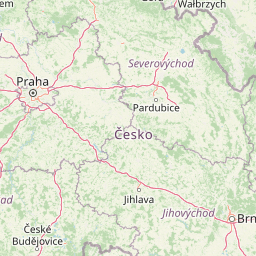
The landscape of Vehlovické opuky is defined less by sweeping scenery than by the surface expression of small-scale former quarrying and the hidden architecture of underground galleries. Above ground, the protected area consists of low, disturbed terrain made up of former quarry faces, spoil, and access workings around the old mines. The setting is gently undulating lowland typical of the Polabí region north of Mělník, where the Elbe lowland meets the lower hills edging the Bohemian Cretaceous Basin.
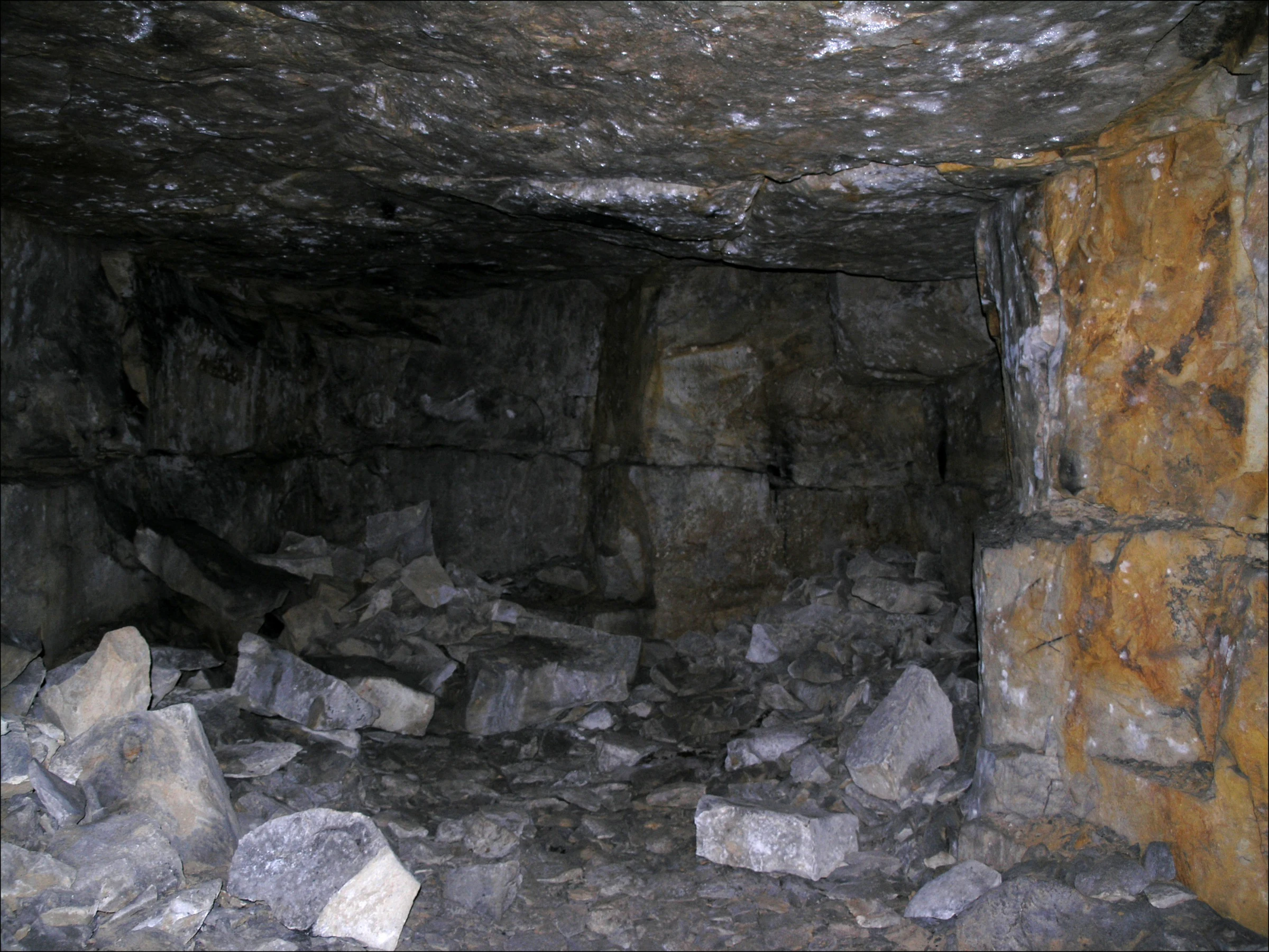
The defining physical feature, however, is underground. Vehlovické opuky preserves a network of stoła, or gallery-style mines, cut into the yellowish upper opuka horizon. These passages are narrow and follow the bedding of the rock, giving them a stratified, layered profile. The walls preserve clear exposures of Cretaceous sedimentary structure, including the finely bedded, fossil-rich opuka that gives the site its name.
Because of the very small surface footprint of the protected area, the broader landscape surrounding Vehlovické opuky is more relevant than the reserve's own landforms. The site sits in farmland and lowland countryside a few kilometers north of Mělník, a region shaped by both the Elbe lowland and the geological fringe of the Bohemian Cretaceous Basin.
Vehlovické opuky ecosystems, habitats, and plant life
Ecologically, Vehlovické opuky is not a habitat-rich reserve in the conventional sense. Above ground, the surface is small and largely disturbed by historical quarrying and later dumping, so most of the site's nature value is concentrated underground rather than in surface vegetation or open habitats.
The dominant natural asset is the network of underground galleries, which functions as a stable microclimate refuge. The stoła maintain cool, humid, and sheltered conditions through the year, but they become especially important in winter, when they serve as a hibernation site for cave-dwelling bats. Conditions in the galleries are stable enough to support several bat species, including the lesser horseshoe bat.
The surface context provides limited but typical Central Bohemian lowland vegetation around former quarry margins. The most meaningful ecological story of the reserve is therefore not a surface biotope but a sheltered subterranean one, linked to and dependent on the preserved opuka galleries.
Vehlovické opuky wildlife and species highlights
Wildlife is a defining element of the site's protected status, even though most of the relevant fauna lives underground rather than in the open landscape. The galleries of Vehlovické opuky are a recognized bat refuge, used during winter by species that require cool, stable, and undisturbed subterranean conditions.
Among the recorded species, the lesser horseshoe bat (Rhinolophus hipposideros) is explicitly highlighted in the monument's conservation objectives. The presence of horseshoe bats and other bats in the stoła is one of the reasons the entrances are managed with grilles: to keep human disturbance low while still allowing the animals free access to the roost.
Beyond bats, the site does not present itself as a major general wildlife locality. Its ecological role is highly specialized: maintaining a quiet, secure hibernation site inside a network of historical mining galleries, at a scale small enough that microclimate and disturbance level matter far more than habitat area.
Vehlovické opuky conservation status and protection priorities
Vehlovické opuky was designated primarily for geological reasons, and its conservation significance reflects that. The site protects two complementary scientific assets: a fossil-rich exposure of the Jizera Formation within the Bohemian Cretaceous Basin, and a rare historical example of underground opuka extraction. Together these make the monument an unusually dense reference point for Cretaceous stratigraphy, paleontology, and Central Bohemian mining history.
A second conservation role is chiropterological. By maintaining quiet, undisturbed galleries, the site helps protect local bat populations that depend on subterranean roosts in winter. The installation of grilles at gallery entrances is a deliberate compromise: bat access is preserved, while uncontrolled human entry and disturbance are reduced.
At landscape scale, Vehlovické opuky is not a habitat-connector or large ecosystem reserve. Its conservation value is best understood as point-based and reference-based: a small locality that anchors knowledge of Bohemian Cretaceous geology and preserves a piece of regional quarrying heritage. The fact that such a small area was raised to natural monument status reflects the strength of its geological and paleontological material rather than ecosystem size.
Vehlovické opuky cultural meaning and human context
The cultural context of Vehlovické opuky is shaped by industrial and railway history rather than by settlement or traditional land use. The opening of the quarries in the 1870s is directly tied to construction of the Polabská dráha, the railway between Lysá nad Labem and Ústí nad Labem, which created strong demand for building stone in the region. The yellowish upper opuka, locally nicknamed žloutek, became a known local material used for paving slabs, tiles, and troughs.
Later, the underground galleries also acquired a different kind of local memory. Some sources reference the labyrinthine stoła as a place where local people sheltered during wartime air raids, adding an extra dimension of 20th-century social history to the site.
In the broader Central Bohemian context, Vehlovické opuky represents a small but characteristic piece of the region's building-stone heritage. Opuka has long been one of the most widely used local stones in Central Bohemia, and Vehlovice was one node in that wider quarrying tradition. The monument thus links paleontology, geology, mining technique, and everyday material culture into a single compact locality.
Top sights and standout views in Vehlovické opuky
Vehlovické opuky stands out for three combined strengths rather than for any single dramatic feature. Its fossil content is unusually rich within the Bohemian Cretaceous Basin, with an identifiable fauna of Cretaceous fish, crustaceans, and large bivalves such as Inoceramus lamarcki preserved in the Jizera Formation.
Its stratigraphic and mining-historical value is equally notable. The walls of the underground stoła expose a clear section of Cretaceous sedimentary rock, while the galleries themselves preserve a rare technique of underground opuka extraction. Few sites in Central Bohemia combine such geology with such direct, walkable evidence of historical quarrying.
Finally, the same galleries now shelter winter bat colonies, including the lesser horseshoe bat, making Vehlovické opuky a place where geology, fossils, mining heritage, and bat conservation overlap within just under one hectare of protected land.
Best time to visit Vehlovické opuky
Vehlovické opuky is a small protected geological monument rather than a landscape-scale destination, so seasonal timing matters mainly for comfort and accessibility rather than for dramatic scenery shifts. The site is most easily appreciated in the milder months of late spring, summer, and early autumn, when surface access to the small protected area around the old quarry is most comfortable and the surrounding lowland countryside around Mělník is at its most accessible.
Winter conditions in Central Bohemia can make the short visit uncomfortable, and the underground galleries, which host hibernating bats, are not open to general public access for conservation reasons. Therefore, while the monument itself is a year-round reference point for geology, the practical window for surface-level interest and surrounding countryside is wider in the warmer half of the year.