
Why Velatická slepencová stráň stands out
The site is best known for its thermophilous steppe vegetation growing directly on Culm conglomerate rocks. In spring, the best-preserved patches produce dense, colorful carpets of low-growing iris and pasqueflower species, which are among the protected plants that define the monument's botanical importance. Beyond the showy spring blooms, the slope is recognized for a broader assembly of dry-grassland plants, including several feathergrass species, a regional chickpea-bearing milk vetch, and old-field knapweeds, marking it as a compact stronghold of southeastern Moravian steppe flora.
Velatická slepencová stráň history and protected-area timeline
The site was first declared a protected area on 5 June 1951 by the Ministry of Education, Sciences and Arts, an early act of formal recognition for dry-grassland habitats in what was then newly centralized Czechoslovakia.
It was later re-designated as a přírodní památka, or natural monument, through a decree of the South Moravian Region that took effect on 1 January 2015, aligning it with the current Czech system of regional protected-area categories and updating its administrative basis.
Velatická slepencová stráň landscape and geographic character
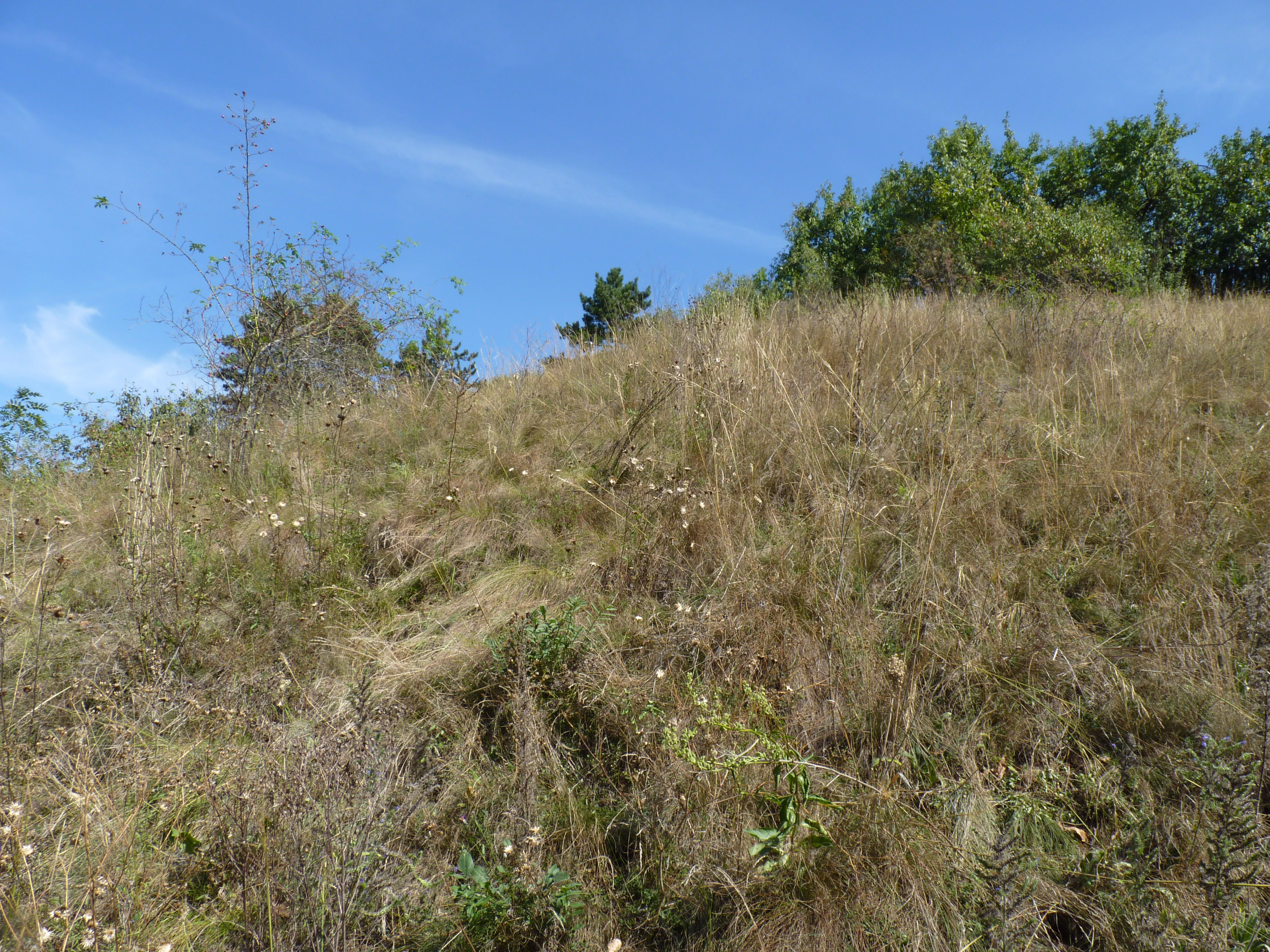
The protected area is built around a short but pronounced segment of hillside, with steep gradients that face roughly west to southwest. The slope's inclination and exposure combine to create conditions that are unusually dry and warm for this part of Moravia, allowing open ground to persist without reverting to forest.
The defining geological feature is the Culm conglomerate bedrock. Where the conglomerate is exposed, it forms small rocky outcrops on the slope, breaking the otherwise continuous grassland cover. Between these outcrops, shallow soils support a mosaic of low herbaceous vegetation and widely spaced woody plants, giving the site its characteristic semi-open appearance.
Velatická slepencová stráň ecosystems, habitats, and plant life
Ecologically, Velatická slepencová stráň belongs to the continental steppe and dry-grassland flora, a vegetation type that in central Europe is strongly tied to warm, south-facing slopes and base-rich, well-drained substrates. The Culm conglomerate provides exactly that kind of substrate, and the resulting plant community is unusually rich for such a small area.
More than twenty species of woody plants have been recorded, but the understory is the main reason the site is protected. Together, the dry-loving grasses, legumes, and spring-flowering herbs form a compact community that reflects centuries of grassland continuity rather than recent rewilding. Such sites function as refuges for plant species that have largely disappeared from the surrounding agricultural plain.
Velatická slepencová stráň wildlife and species highlights
The site is primarily valued for its plant communities, but its meadows and scattered shrubs also provide habitat for insects and other invertebrates typical of dry grasslands, which in turn support small vertebrates. The steppe vegetation offers cover and forage for pollinators and ground-dwelling fauna suited to warm, open terrain, though specific wildlife inventories are limited.
Velatická slepencová stráň conservation status and protection priorities
Within the Czech protected-area hierarchy, the site is designated as a přírodní památka, or natural monument, the category used for smaller sites focused on specific natural features. It is also classified at the international level as an IUCN Category IV protected area, an area primarily managed to protect particular species or habitats.
The conservation aim is explicitly defined as safeguarding thermophilous steppe communities on Culm conglomerates and the protected plant species they support. Because the site is small and surrounded by agricultural and settlement land, its long-term value depends on maintaining open, dry conditions and preventing succession toward closed shrubland or forest.
Top sights and standout views in Velatická slepencová stráň
The strongest feature of Velatická slepencová stráň is the combination, on a very compact site, of Culm conglomerate geology, warm southwesterly exposure, and intact steppe flora. The spring bloom of irises and pasqueflowers in the best-preserved patches is the most visually distinctive moment of the year.
Equally notable is the unusually diverse herb layer for such a small area, with multiple feathergrass species, characteristic legumes, and a substantial woody-plant count all packed into a few hectares of hillside.
Best time to visit Velatická slepencová stráň
Late spring is the most rewarding season to see the site, when the most intact sections of the slope produce colorful carpets of low-growing irises and pasqueflowers. Early summer extends the interest into the broader steppe flora, including feathergrasses and knapweeds. Outside of these periods, the value of a visit is more botanical than scenic, and the open, dry character of the slope can be appreciated in any frost-free season.