
Mori Atlas logo
Natural monumentVelikonoční rybník

A critical refuge for rare amphibians and dragonfly species within the Slavkov Forest uplands

Velikonoční rybník Natural Monument and Protected Wetland Landscape in Karlovy Vary District

(Přírodní památka Velikonoční rybník)

Velikonoční rybník represents a significant natural monument situated in the Karlovy Vary District of the Czech Republic. This protected wetland serves as an essential habitat for diverse amphibian populations and rare dragonfly assemblages, thriving within the elevated landscape of the Slavkov Forest. The site demonstrates the ecological value of unmanaged water bodies, providing a stable, high-altitude refuge for moisture-dependent species.

wetlandpondnatural monumentSlavkov Forestamphibiansdragonflies

Velikonoční rybník

Natural monument

Park overview

Structured park overview, official facts, and landscape profile for Velikonoční rybník Natural Monument

Velikonoční rybník Natural Monument park facts, protected area profile, and essential visitor context

Review the core facts for Velikonoční rybník Natural Monument, including designation, size, terrain, visitor scale, habitats, and operating context in one park-focused overview.

About Velikonoční rybník Natural Monument

Velikonoční rybník is a small but ecologically rich protected pond set within the Slavkov Forest Protected Landscape Area, a region of forested uplands and drained peatlands in western Bohemia. Although it spans only about 1.75 hectares, the site carries a status that reflects far more than its physical size: it is a natural monument, a designation reserved for areas of notable natural significance.

The pond is located roughly one kilometer west of the village of Měchov, at an elevation of around 679 to 680 meters. The surrounding landscape is characteristic of the Slavkov Forest, a region shaped historically by peat extraction, former fishpond networks, and centuries of human use. Within this context, Velikonoční rybník represents an unusual case: a former fishpond that was abandoned from active management for several decades and, as a result, gradually recovered a natural, species-rich wetland character.

What makes the site distinctive is the richness of its amphibian and dragonfly fauna. The pond supports important populations of protected amphibians including the European spadefoot toad (Pelobates fuscus), the moor frog (Rana arvalis), the pool frog (Pelophylax lessonae), and three species of newts. Twenty species of dragonflies have been recorded here, including two species of particular conservation importance: Leucorrhinia rubicunda and Leucorrhinia pectoralis.

The conservation aims of the site focus on maintaining the natural water regime, preserving the well-developed submerged, floating, and shoreline vegetation, keeping nutrient levels in the water low, and ensuring that the shallow wetland margins remain exposed to sunlight. These conditions are exactly what allow the mosaic of breeding, foraging, and sheltering habitats for amphibians and dragonflies to persist.

Quick facts and research context for Velikonoční rybník Natural Monument

Velikonoční rybník is a natural monument (přírodní památka) located in the Slavkov Forest Protected Landscape Area, in the Karlovy Vary district of the Czech Republic. The site lies about one kilometer west of the village of Měchov and covers roughly 1.75 hectares at an elevation of around 679 to 680 meters above sea level.

It was formally designated in May 2014 by the administration of the protected landscape area, primarily to protect populations of rare amphibians and dragonflies. The pond's ecological value developed because it was abandoned from active fishpond management for several decades, allowing natural wetland vegetation to re-establish.

Protection and recognition

Explore the terrestrial protection framework and formal designation records for Velikonoční rybník.

Velikonoční rybník Protection Status and Documented Conservation Scope

Velikonoční rybník maintains a documented terrestrial protection scope within the regional protected area framework. Structured conservation facts provide clear administrative context regarding the official environmental status of the protected landscape.

Protection details

Protection scope
Terrestrial
Park context

Deeper park guide and search-rich context for Velikonoční rybník Natural Monument

Velikonoční rybník Natural Monument history, landscape, wildlife, and travel context

Explore Velikonoční rybník Natural Monument through its history, landscape character, ecosystems, wildlife, conservation priorities, cultural context, and seasonal travel timing in a structured park guide built for atlas discovery and search intent.

Why Velikonoční rybník Natural Monument stands out

Velikonoční rybník is best known for hosting one of the more remarkable assemblages of protected amphibians and dragonflies in the Slavkov Forest, despite its very small size. The site harbors important populations of species such as the European spadefoot toad, moor frog, pool frog, and three newt species, along with a dragonfly community of about twenty recorded species. Among the dragonflies, two species in particular stand out: the rare Leucorrhinia rubicunda and Leucorrhinia pectoralis, both of which are among the key reasons the site received formal protection. The combination of untouched aquatic vegetation, low nutrient water conditions, and solar exposure created a habitat profile that is now rare in the intensively managed Czech landscape.
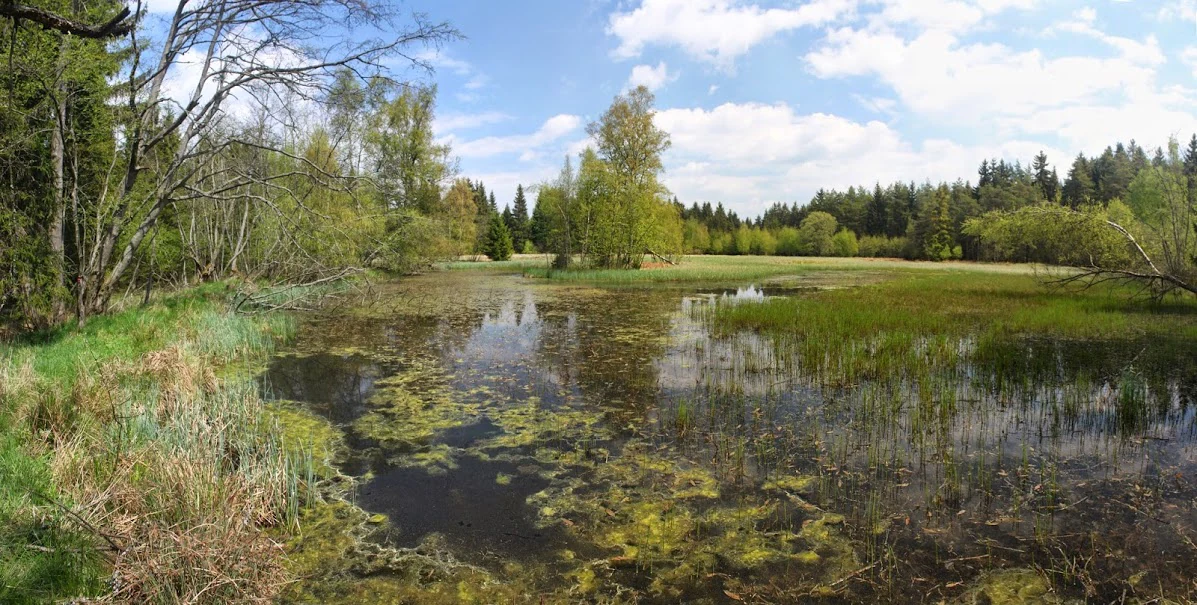
A panoramic landscape view of a calm pond surrounded by trees, marshy vegetation, and grasses on a bright spring day.
A wide view of the Velikonoční rybník pond during spring.

Velikonoční rybník Natural Monument history and protected-area timeline

The pond that became Velikonoční rybník was, for much of its earlier existence, an unnamed component of the broader fishpond network in the Slavkov Forest region. Like many small water bodies in the area, it was originally subject to fishpond management, which typically involved regular manipulation of water levels, vegetation, and fish stocking.

That changed gradually when the pond was abandoned from active management and left undisturbed for several decades. During this period, the natural vegetation of the water body returned: submerged plants, floating plants, and shoreline wetland communities re-established themselves without the disturbance associated with traditional fishpond operations.

The site's natural importance was discovered at Easter 2009, when naturalists identified its exceptional ecological value. The fact that this discovery happened during Easter is the origin of the name Velikonoční rybník, which translates as Easter Pond. Following this discovery, advocacy for formal protection led to the site being designated as a natural monument by the administration of the Slavkov Forest Protected Landscape Area on 9 May 2014, securing its water regime and ecological character for the long term.

Velikonoční rybník Natural Monument landscape and geographic character

The landscape around Velikonoční rybník reflects the broader character of the Slavkov Forest: a mosaic of gently undulating forested uplands, former peatland areas, historical fishponds, and small agricultural clearings. The pond itself sits within this setting at an elevation of approximately 679 to 680 meters above sea level, which is unusually high for a Czech pond ecosystem and gives the site a cooler, more slow-moving seasonal character.

The body of water is very small, just 1.75 hectares, but it shows a complete zonation typical of natural wetland systems. Submerged vegetation occupies the open water, floating plants close to the surface, and a diverse shoreline community of wetland plants lines the edges. The exposure of these margins to sunlight is a critical feature of the landscape's ecological value.

Surrounding terrestrial habitats include forest stands, meadows, and peat-influenced soils, giving the pond a distinct insular ecological character. Although the topography of the immediate area is relatively gentle, the combination of pond, marginal wetland, and forest edges creates a clearly defined micro-landscape where moisture-loving species can thrive.
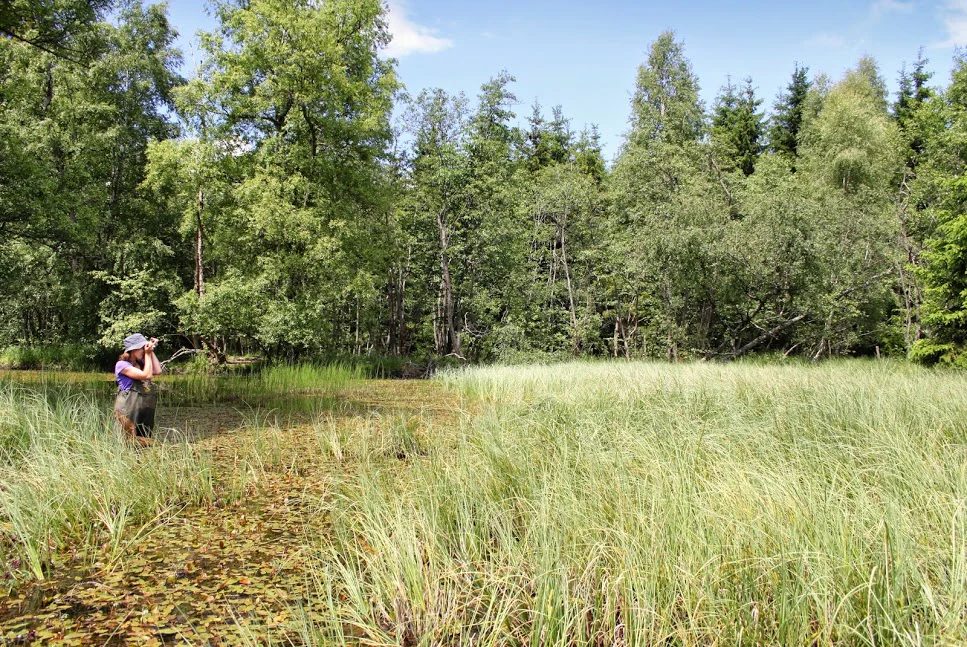
A person wearing a sun hat stands in a marshy wetland area, photographing or observing wildlife near a pond bordered by tall grasses and dense forest.
A visitor observing nature at Velikonoční rybník.

Velikonoční rybník Natural Monument ecosystems, habitats, and plant life

Ecologically, Velikonoční rybník is defined by its aquatic and wetland vegetation, which has developed without intensive management pressures for several decades. The vegetation profile includes well-developed submerged plants, floating species, and a structured shoreline community of wetland plants. The water is low in nutrients, supporting a clear and biologically productive system without the algal blooms that characterize more enriched fishponds.

Among notable plant species, the site supports the floating bur-reed (Sparganium natans), a species associated with clean, undisturbed water, as well as Carex elata, a tall tufted sedge that forms characteristic raised tussocks in shallow, sun-exposed wetlands. These plants create the structural habitat complexity that the site's amphibian and dragonfly fauna depend on.

The habitat mosaic of open water, floating and submerged vegetation, sedge-dominated margins, and sun-exposed shallow areas produces a layered ecological system. Each layer provides different microhabitats for breeding amphibians, larval dragonflies, and invertebrate prey species
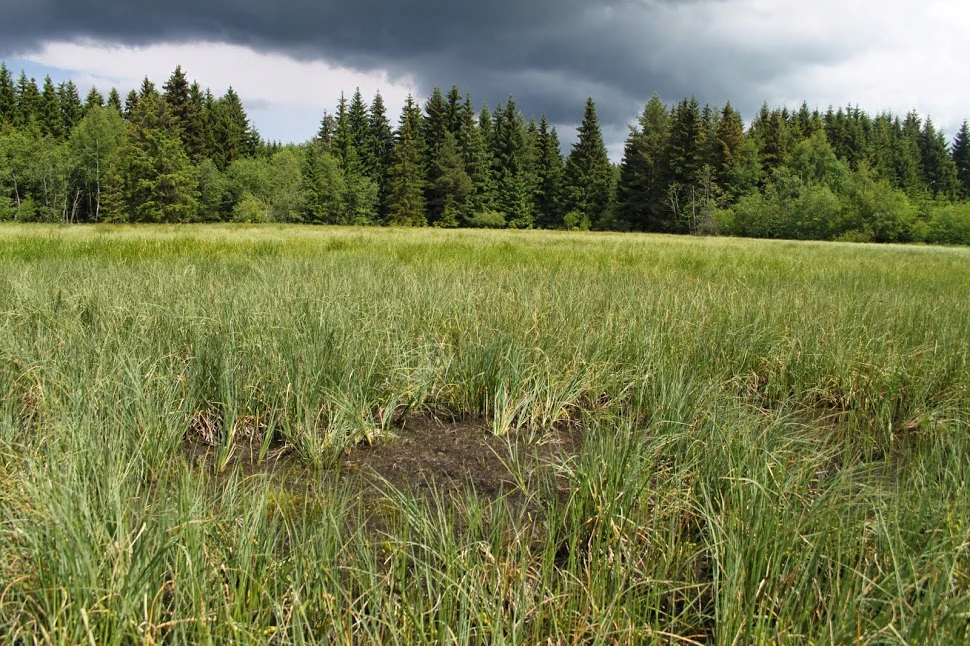
A grassy, swampy wetland area with a dense coniferous forest in the background under a cloudy, stormy sky.
A view of the wetland habitat at Velikonoční rybník.

Velikonoční rybník Natural Monument wildlife and species highlights

The defining feature of Velikonoční rybník's wildlife is its amphibian community, which is unusually rich for such a small site. Protected species that breed here include the European spadefoot toad (Pelobates fuscus), the moor frog (Rana arvalis), and the pool frog (Pelophylax lessonae). The pond also supports three species of newts: the great crested newt (Triturus cristatus), the alpine newt (Ichthyosaura alpestris), and the smooth newt (Lissotriton vulgaris). Spring is the peak period for amphibian breeding activity at the site.

The dragonfly fauna is equally significant. A total of twenty dragonfly species have been documented at the pond, a remarkable count given the site's tiny size. Early summer is typically the best period for observing dragonflies here, when adults are active around the water.

Two dragonfly species are of particular conservation interest. Leucorrhinia rubicunda, a dark-spotted whiteface, is nationally rare and highly dependent on undisturbed acidic wetlands, while Leucorrhinia pectoralis, the yellow-spotted whiteface, is an internationally protected species associated with clean, vegetation-rich ponds. The presence of both species is one of the main reasons the site received formal protection.

Velikonoční rybník Natural Monument conservation status and protection priorities

The conservation significance of Velikonoční rybník lies in the fact that it represents a working example of how an abandoned fishpond can recover into a biologically valuable wetland when left undisturbed. Because it was free from active management for several decades, the site developed vegetation structure and water conditions that are now rare in the intensively managed Czech countryside.

Designation as a natural monument in 2014 was motivated primarily by the need to protect the site's amphibian populations and its dragonfly diversity, with a particular focus on two rare whiteface dragonflies. The protected status allows the administration of the Slavkov Forest Protected Landscape Area to manage surrounding land use and water regimes to safeguard these populations.

Key conservation objectives are preserving the natural water regime, maintaining low nutrient levels in the pond, sustaining the well-developed submerged, floating, and shoreline vegetation, and ensuring that the shallow margins remain open to sunlight. These conditions support the maintenance of high biodiversity in a landscape that is otherwise heavily influenced by forestry, peatland alterations, and historical fishpond management.

Top sights and standout views in Velikonoční rybník Natural Monument

Velikonoční rybník stands out primarily for what it represents in conservation terms: a tiny, formerly managed fishpond that, after decades of abandonment, has developed into one of the most important small amphibian and dragonfly habitats in the Slavkov Forest.

Another distinctive feature is its origin as a conservation site. The pond was discovered to be of exceptional natural value at Easter 2009, an event that gave the site its name. The story of its rediscovery and the subsequent 2014 formal protection gives the site a small but clear place within the regional history of natural heritage conservation.

Best time to visit Velikonoční rybník Natural Monument

The character of Velikonoční rybník shifts notably with the seasons. April is particularly significant because it is the main period when amphibians gather at the pond to breed, with choruses of frogs and active newts visible in and around the water. Visitors interested in amphibians tend to find spring the most rewarding time.

Early summer, around June, is generally regarded as the best period for dragonfly observation, when adults of various species, including the two rare Leucorrhinia species, are active along the shoreline. The combination of established aquatic vegetation and sun-exposed margins makes this season especially rich for insect observation. Because the site is small and ecologically sensitive, visits are best kept short, quiet, and on established paths.

Monthly climate preview

Long-term representative point measurements tracking monthly averages and precipitation cycles.

Velikonoční rybník Climate Normals and Measured Annual Temperature Rhythm

Historical data records monthly temperature variations alongside daily precipitation rates across the representative coordinate. Examining the complete twelve-month profile provides deeper context into the conservation landscape and regional meteorological patterns.
Annual mean8 °C
-3 °C19 °C
Jan-3°
Feb-2°
Mar
Apr
May12°
Jun16°
Jul19°
Aug18°
Sep13°
Oct
Nov
Dec-2°
Warmest month
July

18.6 °C

Coolest month
January

-2.8 °C

Wettest month
June

2.5 mm/day

Driest month
February

1.2 mm/day

Park location guide

Geography guide, regional context, and park location map for Velikonoční rybník Natural Monument

Velikonoční rybník Natural Monument park geography, regions, and map view in Czechia

Understand where Velikonoční rybník Natural Monument sits in Czechia through a broader geographic reading of the surrounding landscape, nearby location context, and its mapped position within the national park landscape.

How Velikonoční rybník Natural Monument fits into Czechia

Czech Republic is a landlocked Central European country with a population of approximately 10.9 million people. The nation was established as an independent state on January 1, 1993, following the dissolution of Czechoslovakia. Its capital and largest city is Prague, with other major urban centers including Brno, Ostrava, Plzeň, and Liberec.

Wider geography shaping Velikonoční rybník Natural Monument in Czechia

The Czech Republic is a landlocked country in Central Europe. It is bordered by Germany to the west, Austria to the south, Poland to the northeast, and Slovakia to the southeast. The landscape is predominantly hilly, with the territory covering 78,871 square kilometers.

Map view of Velikonoční rybník Natural Monument

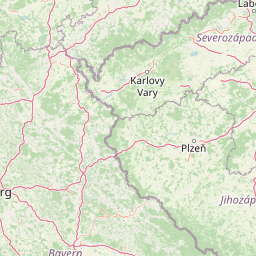
Use this park location map to pinpoint Velikonoční rybník Natural Monument in Czechia, understand its exact geographic position, and read its mapped placement within the surrounding landscape more clearly.

Pigeon | © OpenStreetMap contributors

Location context for Velikonoční rybník Natural Monument

Karlovy Vary District

Visual exploration of wetland habitats and Slavkov Forest scenery

Velikonoční rybník Photos and Protected Wetland Landscapes

Visual documentation captures the protected wetland habitats and surrounding forested uplands that define Velikonoční rybník. Examining field photography reveals the characteristic shoreline vegetation and aquatic zones supporting rare amphibian and dragonfly populations.

A panoramic landscape view of a calm pond surrounded by trees, marshy vegetation, and grasses on a bright spring day.

A small pond covered in floating aquatic plants, surrounded by lush green grasses and a dense forest of evergreen trees under a bright blue sky.

A person wearing a sun hat stands in a marshy wetland area, photographing or observing wildlife near a pond bordered by tall grasses and dense forest.

A grassy, swampy wetland area with a dense coniferous forest in the background under a cloudy, stormy sky.

Park atlas

Compare nearby reserves and wetland habitats across the regional geography

Other Parks Near Velikonoční Rybník and Surrounding Protected Landscapes

Explore related protected areas and wetland reserves located near Velikonoční rybník in the Slavkov Forest. Continuing across the regional park network reveals comparable conservation zones and diverse upland habitats.
A stylized vector-style illustration showing a man and a child standing on the grassy bank of a pond, watching a swimmer in the middle of the water, with a waterfall and forest in the background.
Natural monumentKarlovarský kraj
About 11 km away#1 closest

Northwest

Na Vážkách Natural Monument: Mapping Protected Forest Landscapes in Karlovarský kraj

A rare oligotrophic pond and wetland habitat in Western Bohemia.

Na Vážkách provides a unique example of small-scale landscape protection, featuring clear, sandy-bottomed waters within the broader forest mosaic of Karlovarský kraj. Designated in 2017, this natural monument is recognized for its significant dragonfly populations and its role in preserving historical aquatic water systems.

Area
0.026 km²
Established
2017
IUCN
III
Relief
Upland
A soft, impressionistic watercolor painting depicting a wide, marshy landscape with green fields, low hills in the distance, and a small meandering stream.
Nature reserveKarlovarský kraj
About 11 km away#2 closest

Southwest

Prameniště Teplé Nature Reserve: Protected Wetland and River Source Geography

A diverse springhead sanctuary in Karlovarský kraj

Prameniště Teplé stands as a significant nature reserve protecting the essential wetland mosaic surrounding the source of the Teplá River. Featuring a delicate balance of bogs, meadows, and forest fringes, this protected area preserves the ecological character of western Bohemian water-dominated landscapes through its unique spring-fed geography.

Area
0.429 km²
Established
1993
IUCN
IV
Relief
Upland
Natural monumentKarlovarský kraj
About 13 km away#3 closest

Northeast

Viklan Natural Monument: A Geological Landmark in the Karlovarský kraj Landscape

Exploring the historic balancing granite boulder and surrounding pastoral terrain

Viklan functions as a compact yet iconic natural monument, shielding a prominent 3.5 meter granite boulder from modern disturbance. Set amidst the rolling, short-grass pastures of the Karlovarský kraj, the site serves as a vital point for geological mapping and historical study, documenting both natural weathering processes and long-standing regional folklore tied to this unusual stone formation.

Established
1979
IUCN
III
Relief
Upland
Access
Easy access
Natural monumentKarlovarský kraj
About 14 km away#4 closest

Southwest

Milhostovské mofety: Geological Atlas of Natural Monuments in Karlovarský kraj

Cold mofette gas vents and wetland floodplain habitat.

Milhostovské mofety is a specialized natural monument protecting a cluster of carbon dioxide mofettes in the Cheb District. This site offers insight into regional post-volcanic phenomena, featuring shallow craters, alder carr landscapes, and amphibolite bedrock structures that illustrate the unique geological character of the Slavkov Forest territory.

Area
0.002 km²
Established
1993
IUCN
III
Relief
Lowland
Natural monumentKarlovarský kraj
About 31 km away#5 closest

Northeast

Valeč Natural Monument: Geologic and Ecological Landscapes in the Karlovarský kraj

Tracing volcanic terrain and fossil sites in the Doupovské Hory

Valeč Natural Monument offers a deep look into the volcanic geology and protected wilderness of western Bohemia. Known for its historical paleontological finds and diverse forest cover, this landscape provides an essential case study for mineralogical research and habitat preservation within the wider regional geography.

Area
5.436 km²
Established
1992
IUCN
IV
Relief
Mountain
Natural monumentKarlovy Vary District
About 31 km away#6 closest

Northeast

Valečské sklepy Natural Monument and Protected Bat Hibernation Site in Karlovy Vary

Volcanic terrain and critical wildlife infrastructure in western Bohemia

Valečské sklepy represents a unique form of protected landscape in the Karlovy Vary District, where historical underground cellars function as a specialized natural monument. The site maintains a crucial role as a winter hibernation refuge for the critically endangered western barbastelle, embedded within the volcanic geomorphology of the Doupovské hory region.

Established
2016
IUCN
III
Relief
Mountain
Climate
Temperate
A watercolor painting showing a river valley with coniferous trees, rocky riverbanks, and distant rolling hills in a soft, pastel palette.
Protected landscapeCzechia
About 32 km away#7 closest

East

Přírodní park Horní Střela: Protected Landscape and Geography in Czechia

Geological canyons and basalt uplands in western Bohemia

Přírodní park Horní Střela showcases a layered landscape shaped by the Střela River. The area features deep canyons, rocky slate slopes, and characteristic basalt-topped summits that create a diverse ecological mosaic within the Czech landscape.

Area
99.92 km²
Established
1978
Relief
Upland
Climate
Temperate
Natural monumentÚstí nad Labem Region
About 34 km away#8 closest

Northeast

Vrbina u Nové Vsi Natural Monument: Protected Habitat Mapping and Geographic Overview

Wetland and meadow conservation in the Ústí nad Labem Region

Vrbina u Nové Vsi provides a deep look into the habitat mosaic of the Doupov Mountains foothills. This protected area stands out for its concentrated distribution of ten distinct biotopes, ranging from wet alder woodlands to orchid-rich meadows, providing a comprehensive example of lowland conservation within a larger volcanic terrain context.

Area
0.113 km²
Established
2016
IUCN
IV
Relief
Upland

Common questions about visiting, size, designation, and location context for Velikonoční rybník Natural Monument

Velikonoční rybník Natural Monument FAQs for park facts, access, geography, and protected area context

Find quick answers about Velikonoční rybník Natural Monument, including protected-area facts, park geography, trail and visitor context, and how the park fits into its surrounding country and regional landscape.
MoriAtlas Explorer

Continue Your Protected Areas Search Across the Global Atlas

Deepen your exploration by continuing the structured search for national parks and protected areas worldwide. Utilize the comprehensive filtering capabilities to compare different conservation landscapes and refine your understanding of global park geography. Discover more about the distribution and characteristics of protected natural areas.

Global natural geography