Why Wälder im Solling bei Lauenberg stands out
The reserve is chiefly known for its ancient oak pasture woodland, in which oaks thought to be between four hundred and six hundred years old persist as living relics of former "Hutewald" grazing forests. These veteran oaks, together with a high proportion of old and dead wood, support one of the most diverse saproxylic beetle faunas in the Solling. It is also distinguished by being home to the highest densities of woodpeckers recorded anywhere in the Solling, with black, grey, middle-spotted, and lesser-spotted woodpeckers all breeding in the old oak stands. The combination of cultural landscape history, ancient trees, and exceptionally rich deadwood ecology makes the site a reference point for low-mountain oak woodland conservation in northwest Germany.
Wälder im Solling bei Lauenberg history and protected-area timeline
The forest landscape protected today has its roots in the medieval and early modern practice of "Hutewald," or woodland pasture, when commoners allowed cattle, pigs, and other livestock to forage beneath widely spaced oaks. Many of the oldest oaks still standing in the reserve, estimated at four hundred to six hundred years of age, originate from this period of intense human use, when the trees were valued more for their acorn mast than for timber.
Formal protection history began in 1975, when the smaller nature reserve "Eichenhudewälder bei Lauenberg" was designated to safeguard the most exceptional oak stands. In the decades that followed, recognition grew that a broader conservation framework was needed to protect not only the ancient oaks but also the surrounding beech forests, open meadows, spring brooks, and riparian woodland that together form the reserve's ecological coherence.
On 15 October 2020, the current larger nature reserve "Wälder im Solling bei Lauenberg," designated NSG BR 169 and covering about 322 hectares across three parcels, was officially established. It absorbs the 1975 reserve and replaces the earlier landscape protection area "Solling" in its overlap zone, with the Landkreis Northeim serving as the responsible lower nature protection authority. The site is also identical in extent to a Habitats Directive (FFH) area, embedding it in the European Natura 2000 network.
Wälder im Solling bei Lauenberg landscape and geographic character
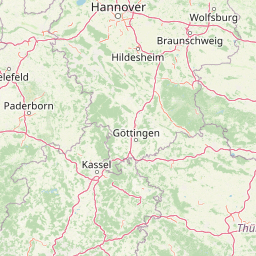
The reserve occupies a gently rolling section of the northeastern Solling, with elevation profiles shaped by ridges such as the Großer Ohrenberg and Birkenberg. The terrain falls gradually westward toward the valley of the Dieße, a small river cutting through the broader Solling massif. Three forest parcels follow this topography, leaving room between them for the open meadows of the Wakenbornwiese and Ochsenwiese.
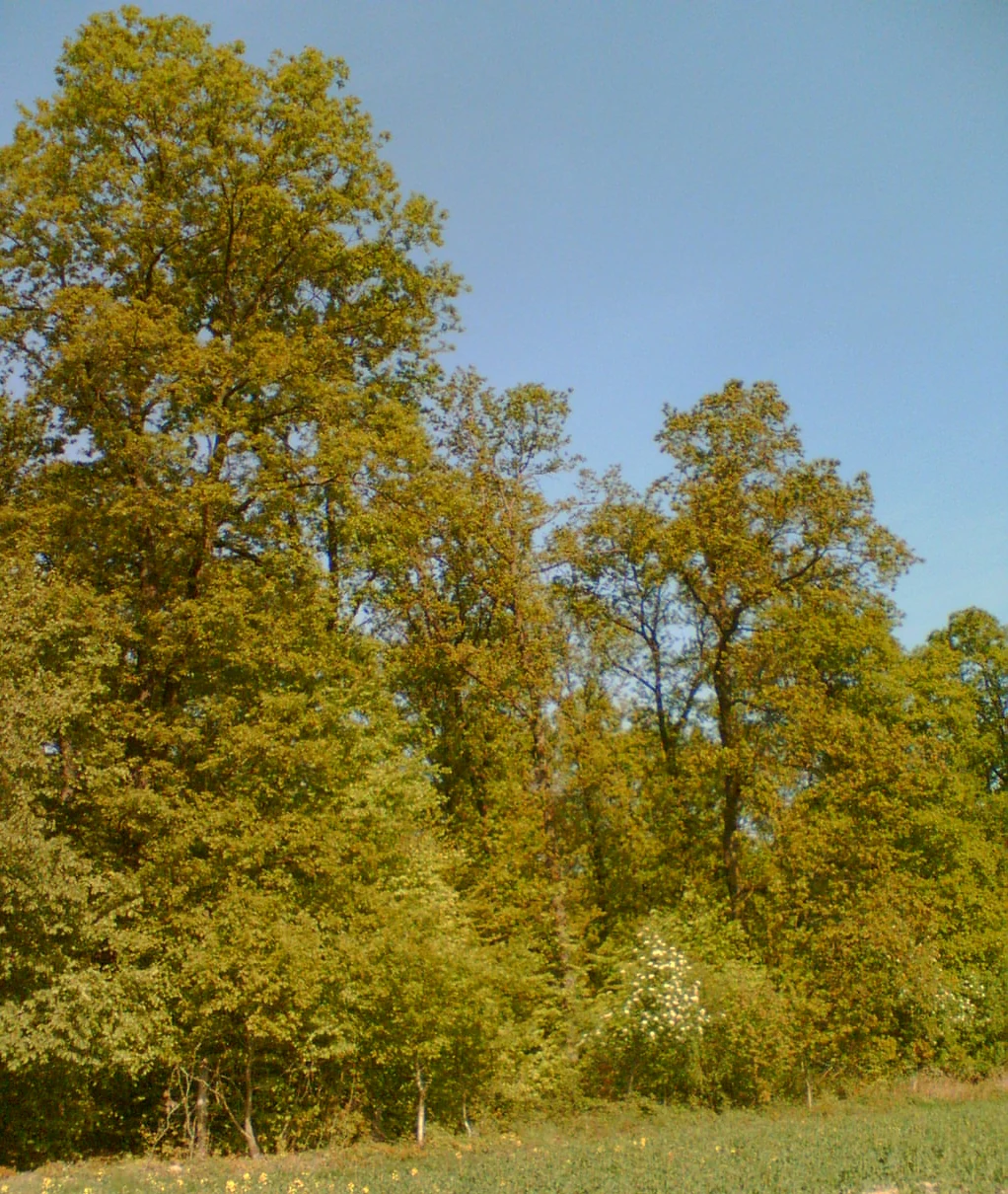
The dominant scenery is that of a structurally diverse deciduous forest, where centuries-old oaks rise above a matrix of younger oaks, beech, hornbeam, and birch. Open clearings and hay meadows break the closed canopy, while narrow, spring-fed brook valleys with tall-herb vegetation and alder-ash gallery forest add vertical and textural contrast. The overall impression is of a historically worked, semi-open woodland landscape rather than a uniform commercial forest, with permanent open-land elements woven into the forested matrix.
Wälder im Solling bei Lauenberg ecosystems, habitats, and plant life
The ecological core of the reserve is its old oak-dominated mixed forest, rich in ancient trees and large volumes of standing and fallen dead wood. This substrate sustains one of the most diverse deadwood beetle communities recorded in the Solling, including rare saproxylic species such as the hermit beetle, the stag beetle, and the ship-timber beetle, alongside a wide array of false darkling beetles, click beetles, bark beetles, and checked beetles.
Vegetation patterns reflect the transition between several woodland types. Acidic, luzula-type beech forest occupies parts of the canopy, while oak-hornbeam woodland layers add species like ash and sycamore maple. The ground flora changes markedly from closed beech stands, where pill sedge and wood sorrel prevail, to spring brook corridors where lady fern and opposite-leaved saxifrage thrive in permanently moist conditions.
Mosses such as the common haircap moss and various feather mosses, lichens including the script lichen and common pore lichen, and characteristic fungi of old oak forests, including chanterelles, horn of plenty, oak liverwort, and bracket fungi such as the oak fire sponge, all indicate the continuity and quality of the woodland habitat.
Wälder im Solling bei Lauenberg wildlife and species highlights
The reserve is a stronghold for mammals at the upper end of the European forest food chain. Both lynx and wildcat are documented within its boundaries, a notable presence for a comparatively small protected area in central German low mountain country. Several bat species also use the site, including the greater mouse-eared bat.
Birdlife is exceptional for the region. The old oaks and high deadwood share support one of the densest woodpecker communities in the Solling, with black, grey, middle, and lesser-spotted woodpeckers all present in unusually high numbers. Larger raptors such as black stork, red kite, and common buzzard also nest or regularly forage in the area.
In damp brook valleys and forest pools, fire salamanders occur as a characteristic amphibian of mature deciduous woodland. Below the canopy, the invertebrate fauna is dominated by the rich saproxylic beetle assemblage already noted, but the reserve also supports a wide range of associated insects, fungi, and lichens that together mark this as one of the biologically richest forest sites in the Solling.
Wälder im Solling bei Lauenberg conservation status and protection priorities
The reserve's conservation significance rests on the unusual combination of ancient oak pasture woodland, high deadwood volumes, and a directly overlapping FFH designation under the EU Habitats Directive. This means that conserving the reserve simultaneously fulfils obligations under both German nature protection law and European habitat conservation policy, embedding the site in the broader Natura 2000 network.
Key protection priorities include maintaining the veteran oaks and the continuity of deadwood in the canopy, preserving the structural diversity of the mixed oak and beech stands, and keeping the small open-land elements, including the species-rich hay meadows and spring brook corridors, in sympathetic management. Because the surrounding landscape protection area has been partially superseded by the reserve, the site also provides a hardened buffer around the most ecologically valuable forest core.
The rare saproxylic beetle fauna is particularly central to the conservation case. Species such as the hermit beetle and the stag beetle are considered indicators of long ecological continuity, and their strong presence here suggests that parts of the woodland have been undisturbed for centuries. Together, the fauna, flora, and habitat structures make the reserve a reference site for old broadleaf forest conservation in the Weser-Leine uplands.
Wälder im Solling bei Lauenberg cultural meaning and human context
The wooded landscape around Lauenberg carries the long shadow of historical commons and pasture rights. For centuries, villagers exercised the right to graze cattle and pigs in the oak forests of the Solling, a practice that shaped the very structure of the woodland that now forms the reserve. Many of the oldest oaks are not merely natural trees but cultural artefacts, deliberately nurtured as a source of acorn mast for livestock.
Names of features within the protected area, such as Wakenbornwiese and Ochsenwiese, reference this pastoral past. Meadow names incorporating livestock terms recall the days when cattle grazed these openings within the forest. Even the name "Hudewald" itself, embedded in the predecessor reserve's designation "Eichenhudewälder bei Lauenberg," preserves the memory of an older, integrated land-use system in which forest, meadow, and grazing were inseparable.
Today, the surrounding villages of Dassel, Moringen, and Lauenberg remain small rural communities whose identity is closely tied to the Solling forest. The reserve thus sits not just as a piece of natural heritage but also as a cultural landscape in which centuries of human use have left a legible, and now protected, mark on the woodland.
Top sights and standout views in Wälder im Solling bei Lauenberg
Three forest parcels totaling roughly 322 hectares in the northeastern Solling, coinciding with an FFH site. Centuries-old oaks aged four hundred to six hundred years, surviving from former woodland pasture use. A beech and oak-hombeam matrix layered with hay meadows, spring brook corridors, and alder-ash gallery forest. One of the highest woodpecker densities in the Solling, including all four classic European woodpecker species. A remarkably rich saproxylic beetle fauna supported by extensive old and dead wood.
Best time to visit Wälder im Solling bei Lauenberg
Late spring and early summer bring the hay meadows of the Wakenbornwiese and Ochsenwiese into peak flower, with cow parsley, buttercups, and clovers creating color along the forest edges. These same weeks are when deciduous canopy species are in full leaf, making the contrast between dense oak-beech stands and the open meadows most striking.
Early autumn is also rewarding for visitors interested in fungi and lichens, as chanterelles and bracket fungi become visible on veteran oaks, while the relevant beetle fauna is most evident in older dead wood. Cooler months can be quieter, but the open structure of the woodland means that even winter visits reveal the park's defining feature: the scattered monumental oaks rising above the surrounding younger forest.