Why Wasservogelreservat Northeimer Seenplatte stands out
The reserve is best known for its exceptional waterbird diversity in a compact floodplain setting. Over 170 bird species have been documented here, with the former gravel-pit lakes functioning as breeding grounds for great crested grebes, greylag and Egyptian geese, little ringed plovers, penduline tits, and kingfishers, as well as hosting a cormorant colony. The lakes are equally important for migratory and wintering birds, attracting terns and little gulls in passage, and a wide range of diving ducks, grebes, mergansers, and even sea ducks such as velvet and common scoters during the colder months.
Wasservogelreservat Northeimer Seenplatte history and protected-area timeline
The Wasservogelreservat Northeimer Seenplatte was formally designated as a Naturschutzgebiet on 2 March 1984, giving it the protected-area identifier NSG BR 042. It was, however, already recognized at the European level a year earlier, in 1983, when the EU listed it as a special area for the conservation of natural habitats (FFH-related recognition). This early European recognition reflects the fact that the lakes, formed through years of gravel extraction, had already developed into a habitat of considerable ecological interest by the early 1980s.
The reserve was established within a broader effort to protect the Leine floodplain near Salzderhelden, and it is fully integrated into the EU Bird Directive Special Protection Area "Leinetal bei Salzderhelden". It was also designed to function ecologically alongside neighboring floodplain protected sites, including the Leineniederung Salzderhelden reserve and Polder I of the Salzderhelden flood retention basin. Today, the area is administered by the Landkreis Northeim as the responsible lower nature conservation authority, with the Niedersächsischer Landesbetrieb für Wasserwirtschaft, Küsten- und Naturschutz (NLWKN) acting as the state-level coordinating body.
In 2000, the reserve gained an additional interpretive layer when a themed trail, the "Themenpfad Wasser" (Water Theme Path), was laid through the area as part of the Expo 2000 project in Hannover. The trail included observation points, embedding the site within a wider program of public environmental education along the Leine valley.
Wasservogelreservat Northeimer Seenplatte landscape and geographic character
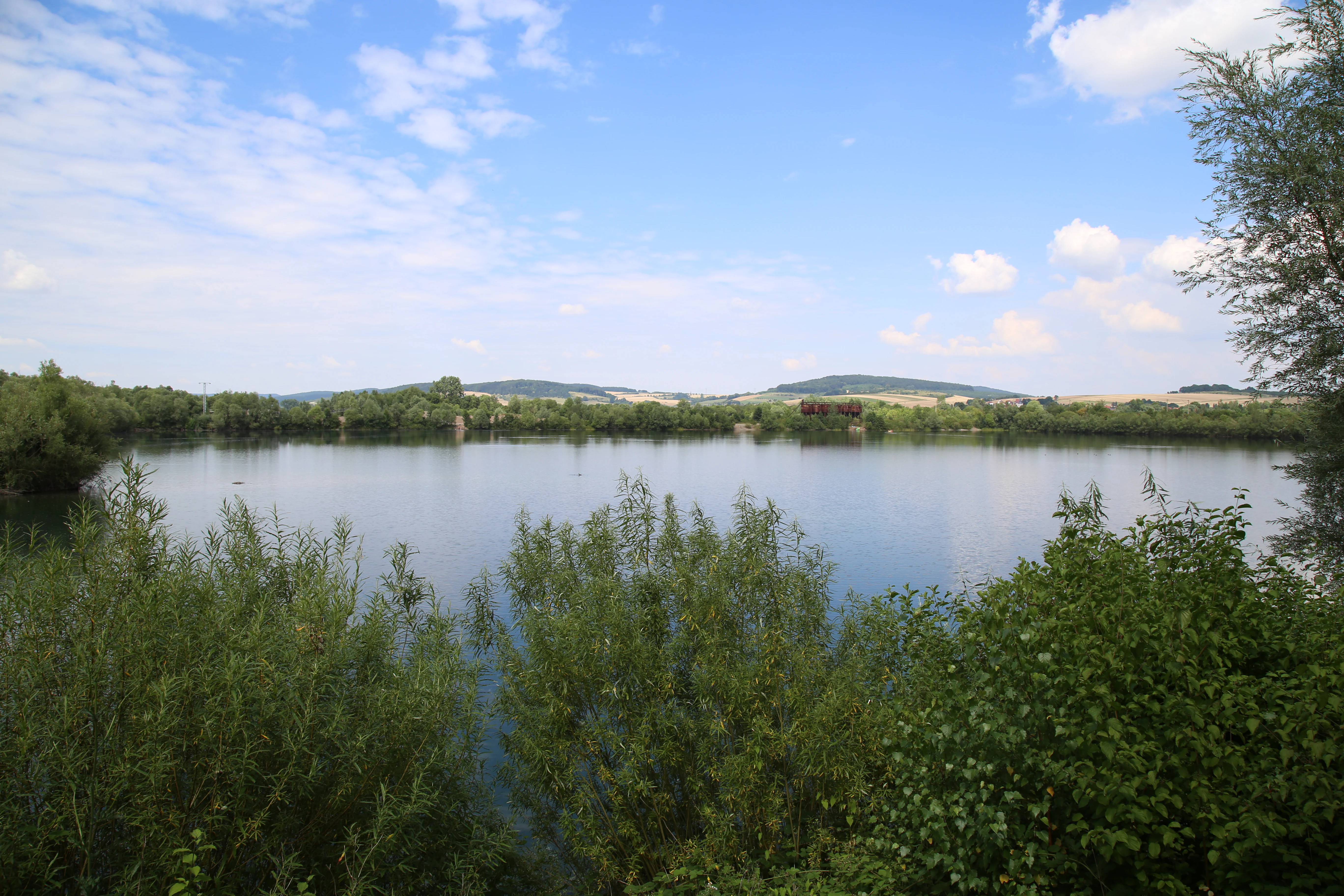
The landscape of the Wasservogelreservat Northeimer Seenplatte is essentially a lowland floodplain mosaic of lakes, fringing vegetation, and agricultural fields. The central feature is a chain of Baggerseen, open-water lakes created through historic gravel mining in the Leineaue. Although these pits were originally industrial, their steep shorelines, variable depths, and disturbance-free character have made them ecologically attractive, and most extraction has since ceased across much of the reserve.
Surrounding the lakes, the western and northern parts of the reserve are still shaped by agricultural land use, with sections maintained as grassland and arable fields. This mixture gives the area a sharp contrast between open cultivated ground and the still, reflective surfaces of the lakes. The terrain lies at a relatively uniform low elevation between roughly 107 and 111 meters above sea level, characteristic of the flat Leine valley near Salzderhelden.
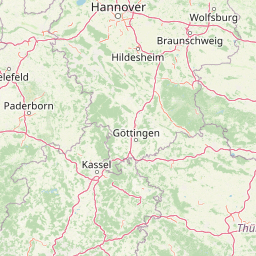
The reserve's boundary is defined almost entirely by major human-made features. The A7 motorway runs along its southern edge, the Hannover–Würzburg high-speed rail line and the associated north-south rail corridor lie to the east, a regional road (L 572) passes along the western side, and the embankment of Polder V of the Salzderhelden flood retention system defines part of the northwestern margin. Together, these features frame an unusually compact, self-contained wetland complex in the middle of an otherwise heavily used landscape.
Wasservogelreservat Northeimer Seenplatte ecosystems, habitats, and plant life
Ecologically, the Wasservogelreservat Northeimer Seenplatte is fundamentally a water-and-meadow complex. The lakes themselves are the ecological anchor, providing open-water, shoreline, and shallow-water habitats that support a wide range of water-dependent species. Around and between the lakes, fringing vegetation, wet meadows, and arable margins add structural diversity, while the wider grassland and farmland areas to the west and north contribute open-ground habitat.
The birdlife is the dominant ecological signal of the reserve. With over 170 recorded species, the lakes are widely used both as breeding habitat and as a staging site during migration. The mix of habitats, including open water, reed-fringed shoreline, grassland, and adjacent cultivation, allows the reserve to support species with very different ecological requirements within a very small area, and reinforces its role within the larger Leinetal bei Salzderhelden Special Protection Area.
The reserve functions as one of several complementary floodplain protected sites around Salzderhelden. Its integration with the Leineniederung Salzderhelden nature reserve and the Polder I site means that the ecological value of the Wasservogelreservat is amplified by the surrounding network of floodplain, meadow, and retention habitats. This network character is a defining aspect of the area's natural identity.
Wasservogelreservat Northeimer Seenplatte wildlife and species highlights
Wildlife interest in the Wasservogelreservat Northeimer Seenplatte centers overwhelmingly on birds. More than 170 species have been recorded, a striking figure for a reserve of about 80 hectares. Many species breed on site. The breeding community includes great crested grebes, greylag geese, Egyptian geese, little ringed plovers, penduline tits, and the strikingly colored kingfisher, along with a resident cormorant colony that uses the area as a breeding site.
During spring and autumn migration the reserve takes on a particularly dynamic character. Little gulls pass through, along with a suite of terns that includes common, Sandwich, black, and little terns. A wide variety of grebes also use the lakes during passage, including black-necked, red-necked, little, and horned grebes, and divers such as red-throated and black-throated (Pacific) divers may also appear. Sea ducks, normally associated with marine coasts, are occasional visitors in the form of common, velvet, and king eiders, scoters, and long-tailed ducks.
In winter, the reserve becomes a stronghold for waterfowl. Diving ducks such as common pochard and tufted duck overwinter on the lakes, joined by goldeneyes and a range of sawbills including goosander, smew, and red-breasted merganser. Coots and great crested grebes are regular winter presences, and the reserve also supports wintering bitterns, a notably secretive heron species. This combination of breeding, migrating, and wintering waterbirds in one small area gives the site an unusually rich and varied ornithological profile.
Wasservogelreservat Northeimer Seenplatte conservation status and protection priorities
The reserve's conservation significance lies in its role as a compact but exceptionally rich waterbird refuge embedded within the larger Leine floodplain protected-area network. It is formally designated as a Naturschutzgebiet under German nature conservation law and classified at the international level as an IUCN Category IV Habitat/Species Management Area, recognizing that the primary objective is the active management of habitats and species rather than purely strict protection.
Internationally, it is fully integrated into the EU Birds Directive Special Protection Area "Leinetal bei Salzderhelden", giving its habitats and species a formal layer of European protection. Its ecological role is closely tied to its neighbors, especially the Leineniederung Salzderhelden nature reserve and Polder I of the Salzderhelden flood retention basin, which together provide a buffer of complementary floodplain, grassland, and retention habitat. This spatial integration is itself a conservation feature: the reserve draws much of its value from functioning as one node in a coherent protected floodplain system rather than as an isolated site.
The fact that the lakes originated from gravel extraction makes the reserve a notable example of post-industrial habitat conservation. After mining largely ended, the pits were allowed to develop into ecologically valuable open water with fringing vegetation, demonstrating how former extraction sites can be repurposed for biodiversity. Active management is provided by the Landkreis Northeim as the responsible lower nature conservation authority and by the NLWKN at state level, ensuring that the reserve remains connected to larger habitat protection and water management programs in the region.
Wasservogelreservat Northeimer Seenplatte cultural meaning and human context
The reserve does not carry a deep cultural heritage dimension of its own, but it sits within a landscape shaped by a long history of human use. The lakes themselves are the product of gravel mining, an industrial activity that reshaped the local Leine floodplain over a period of decades. When extraction ended, the former pits were gradually embraced as a nature conservation asset, illustrating a wider pattern in Lower Saxony where post-industrial sites have been repurposed for biodiversity and recreation.
The area also has a public-facing cultural role through the "Themenpfad Wasser" walking trail, which was developed for Expo 2000 in Hannover. The themed path, together with several observation points, connects the site to a broader program of environmental education and regional identity around water and floodplain landscapes in southern Lower Saxony, and gives the reserve a modest but real place in regional nature-tourism and educational heritage.
Top sights and standout views in Wasservogelreservat Northeimer Seenplatte
The defining highlight of the Wasservogelreservat Northeimer Seenplatte is the density of waterbird life concentrated in a relatively small area: over 170 recorded bird species, a cormorant colony, breeding great crested grebes and kingfishers, and notable wintering populations of diving ducks, sawbills, and bitterns, all framed by man-made gravel-pit lakes in the Leine floodplain.
Best time to visit Wasservogelreservat Northeimer Seenplatte
Because the reserve hosts breeding, migrating, and wintering waterbirds, it offers distinct seasonal character throughout much of the year. Spring brings breeding display and the arrival of terns, little gulls, and a wide range of grebes and divers on passage. Autumn is the most dynamic passage season, with regular sightings of uncommon grebes, divers, and even sea ducks as they move through the Leine valley. Winter concentrates large numbers of diving ducks, sawbills, coots, grebes, and bitterns on the lakes, making it a strong period for waterbird observation. As with all small wetland reserves, visits are most rewarding when water levels and weather allow open sightlines across the lakes and shoreline margins.