Why Amboseli National Park stands out
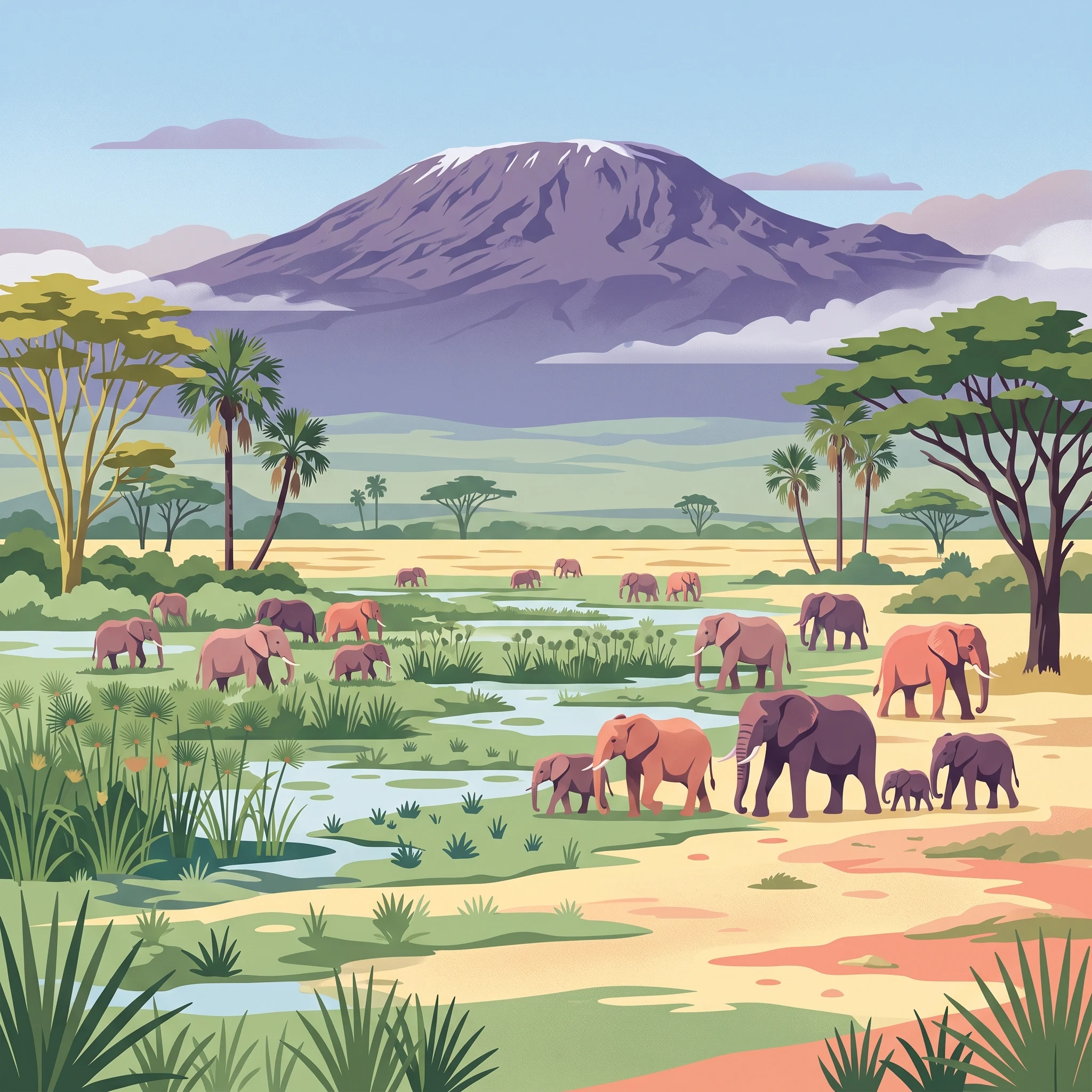
Amboseli is best known for its iconic views of Mount Kilimanjaro rising behind vast savanna wetlands, and for its population of African bush elephants that have been the subject of decades of groundbreaking research. The park gained international fame through Echo, the most studied elephant in the world, whose life and family were documented by conservationist Cynthia Moss for nearly four decades. The combination of the mountain backdrop, the swamp ecosystems, and the large elephant herds creates one of Africa's most photographed wildlife landscapes. The park also stands out for its bird diversity, supporting over 400 species including water birds and 47 raptor species.
Amboseli National Park history and protected-area timeline
The first European to enter the region was Jeremy Thompson in 1883, who penetrated what was known to outsiders as the feared Maasai region of Empusel, meaning 'salty, dusty place' in the Maa language. Thompson was astonished by the extraordinary array of wildlife and the stark contrast between the dry lake bed and the swamp oases, a contrast that remains today. In 1906, the British colonial administration set aside the area as the Southern Reserve for the Maasai people. In 1948, the reserve was returned to local control and redesignated as a game reserve. The area gained national park status in 1974 to protect the core of this distinctive ecosystem. In 1991, Amboseli was designated as a UNESCO site, recognizing its international significance. A notable development occurred in 2005 when Kenyan President Mwai Kibaki declared that park control should transfer from the Kenya Wildlife Service to the Olkejuado County Council and the Maasai community, a decision that generated legal challenges and debates about the future of community-based conservation in Kenya.
Amboseli National Park landscape and geographic character
The landscape of Amboseli is defined by a striking juxtaposition of environments. The park sits on the floor of a former Pleistocene lake, now a vast expanse of dusty, cracked earth and alkaline flats that reflect the intense equatorial sun. Interspersed across this arid base are the permanent swamps, fed by underground seepage from Mount Kilimanjaro's melting glaciers, which create islands of lush vegetation and open water. The surrounding savanna is dominated by semiarid grasslands and thorny scrub, with occasional acacia trees providing shade. The horizon is dominated by Kilimanjaro's snow-capped peak, which rises dramatically to 5,895 meters and influences the local climate through its effect on wind patterns and precipitation. The swamps themselves support tall bulrushes and papyrus, creating habitat that contrasts sharply with the dusty plains, and seasonal rains transform the dry lakebed into a shallow wetland that attracts enormous flocks of waterfowl.
Amboseli National Park ecosystems, habitats, and plant life
The ecological significance of Amboseli stems largely from its wetland system, which provides critical habitat in an otherwise semiarid region. The two main swamps serve as permanent water sources that sustain wildlife throughout the year, drawing animals from the surrounding plains during the dry season and supporting breeding populations of water birds. The ecosystem exists within a larger 8,000-square-kilometer transboundary area that includes parts of Tanzania, allowing for wildlife movements across international boundaries. The park's position at the foot of Mount Kilimanjaro creates a unique altitudinal gradient from the mountain's slopes through savanna to the lake basin. The semiarid vegetation consists mainly of grassland and bushland, with species adapted to the seasonal rainfall patterns and the alkaline soils of the old lakebed. This mix of habitats supports the remarkable bird diversity for which the park is known, with over 400 species recorded, including pelicans, kingfishers, crakes, hamerkops, and numerous raptors.
Amboseli National Park wildlife and species highlights
Amboseli is home to a remarkable assembly of large mammals, with African bush elephants being the most iconic residents. The park's elephant population gained worldwide attention through Echo, a matriarch whose family was studied continuously for almost four decades by American conservationist Cynthia Moss. Echo became the subject of numerous books and documentaries, and her death in 2009 at approximately 60 years old marked the end of an era in elephant research. The park supports healthy populations of other megafauna including Masai giraffes, Cape buffalo, blue wildebeest, and Grant's zebra. Predators include lions, cheetahs, and spotted hyenas, while primates such as yellow baboons are common around the swamp edges. The birdlife is exceptionally diverse, with over 400 species documented, including substantial populations of water birds like pelicans and herons, as well as 47 raptor species. The combination of wetland and savanna habitats creates ideal conditions for both resident and migratory species.
Amboseli National Park conservation status and protection priorities
Amboseli's conservation significance stems from its role as a protected core area within a larger transboundary ecosystem, and from its unique wetland resources in an arid region. The park's designation as a UNESCO site in 1991 reflected its international importance for biodiversity conservation. The governance structure involving the Kenya Wildlife Service, the Olkejuado County Council, and the Maasai community represents a model of collaborative management that seeks to balance wildlife protection with community benefits. The park's elephant population has been the subject of intensive research that has contributed significantly to understanding elephant behavior, social structures, and conservation needs. The challenges facing the ecosystem include pressures from growing human populations, climate change impacts on the Kilimanjaro glaciers that feed the swamps, and the ongoing debates about community versus state management of protected areas.
Amboseli National Park cultural meaning and human context
The Maasai people are the traditional inhabitants of the Amboseli region, and their pastoralist culture remains deeply connected to the landscape. The park sits within land that historically served as grazing grounds for Maasai herds, and the relationship between the Maasai and this environment predates the establishment of formal protection. The name 'Amboseli' is derived from a Maasai term reflecting the area's dusty, saline character, though the Maasai have long understood and utilized the value of the permanent swamps. The park's governance structure intentionally includes the Maasai community, recognizing that effective conservation requires local buy-in and that the community has legitimate claims to the land and its resources. This approach reflects evolving thinking about conservation that acknowledges indigenous rights and the importance of community-based natural resource management.
Top sights and standout views in Amboseli National Park
The defining highlight of Amboseli National Park is the view of Mount Kilimanjaro rising behind wetland scenery teeming with elephants, a combination that has become one of Africa's most recognizable natural images. The opportunity to observe large elephant herds, particularly families led by experienced matriarchs, offers insights into complex social behaviors developed through decades of research. The birdlife is spectacular, with the wetland areas providing excellent opportunities to observe water birds and raptors. The contrast between the dusty, ancient lakebed and the lush green swamps creates a visually striking landscape that changes dramatically with the seasons. Visitors can experience the Maasai culture through community-based tourism initiatives that offer authentic cultural exchanges.
Best time to visit Amboseli National Park
The best time to visit Amboseli depends on what visitors hope to experience. The dry seasons from June to October and January to February typically offer easier wildlife viewing as animals concentrate around the permanent water sources. The long rainy season from March to May can make some roads impassable but transforms the landscape into lush green, and the birdlife is especially active during migration periods. The short rains from November to December bring temporary flooding to the dry lakebed, creating ephemeral wetlands that attract diverse bird species. Kilimanjaro is most visible during dry periods when cloud cover is reduced, though the mountain's appearance changes throughout the year. The cooler months from June to August may offer more comfortable conditions for game drives, while the hotter period from September to November can be intense but coincides with optimal wildlife viewing opportunities.