
Why Bikin National Park stands out
Bikin National Park is best known for being one of the final major refuges of the Amur tiger, hosting a substantial share of the remaining global population of this endangered subspecies. The Bikin River valley is often described as the heart of the living range of the Amur tiger in Russian Far East, and the park's forests, prey base, and remote character make it critical for the species' long-term survival. Equally distinctive is the park's botanical character: the Bikin forests represent a rare meeting point between northern taiga species and southern Manchurian flora. Side by side grow cedar, birch, ash, and walnut alongside ginseng, eleutherococcus, Daurian rhododendron, actinidia, and aralia. This ecological blend, set within a single continuous wilderness of the Sikhote-Alin range, gives the park a botanical and zoological profile found in few other places in Russia.
Bikin National Park history and protected-area timeline
Bikin National Park was established on 3 November 2015 through a decree of the Government of the Russian Federation, as part of the federal program focused on conservation of the Amur, or Siberian, tiger. Its creation drew together the territory of the former Verkhne-Bikinsky regional wildlife refuge, a recognized zakaznik, with part of the Bikinskaya area of traditional nature use, consolidating these protections under a single federal national park framework.
The park's foundation was driven by the recognition that the Bikin River valley represented one of the last fully functional strongholds for the Amur tiger, and that effective long-term conservation required not only ecological protection but also recognition of the land rights and traditional practices of the indigenous peoples who inhabited it. Local and national conservation organizations worked to ensure the park's design supported both biodiversity goals and the cultural landscape of the Udege and Nanai.
In 2018, at the 42nd session of the UNESCO World Heritage Committee held in Manama, Bahrain, the park was formally incorporated into the existing World Heritage Site Central Sikhote-Alin, which had been inscribed in 2001. This extension recognized the Bikin territory as a critical component of the broader Sikhote-Alin ecosystem and elevated the park's international profile, reinforcing its role in global conservation of mixed broadleaf-conifer forests and Amur tiger habitat.
Bikin National Park landscape and geographic character
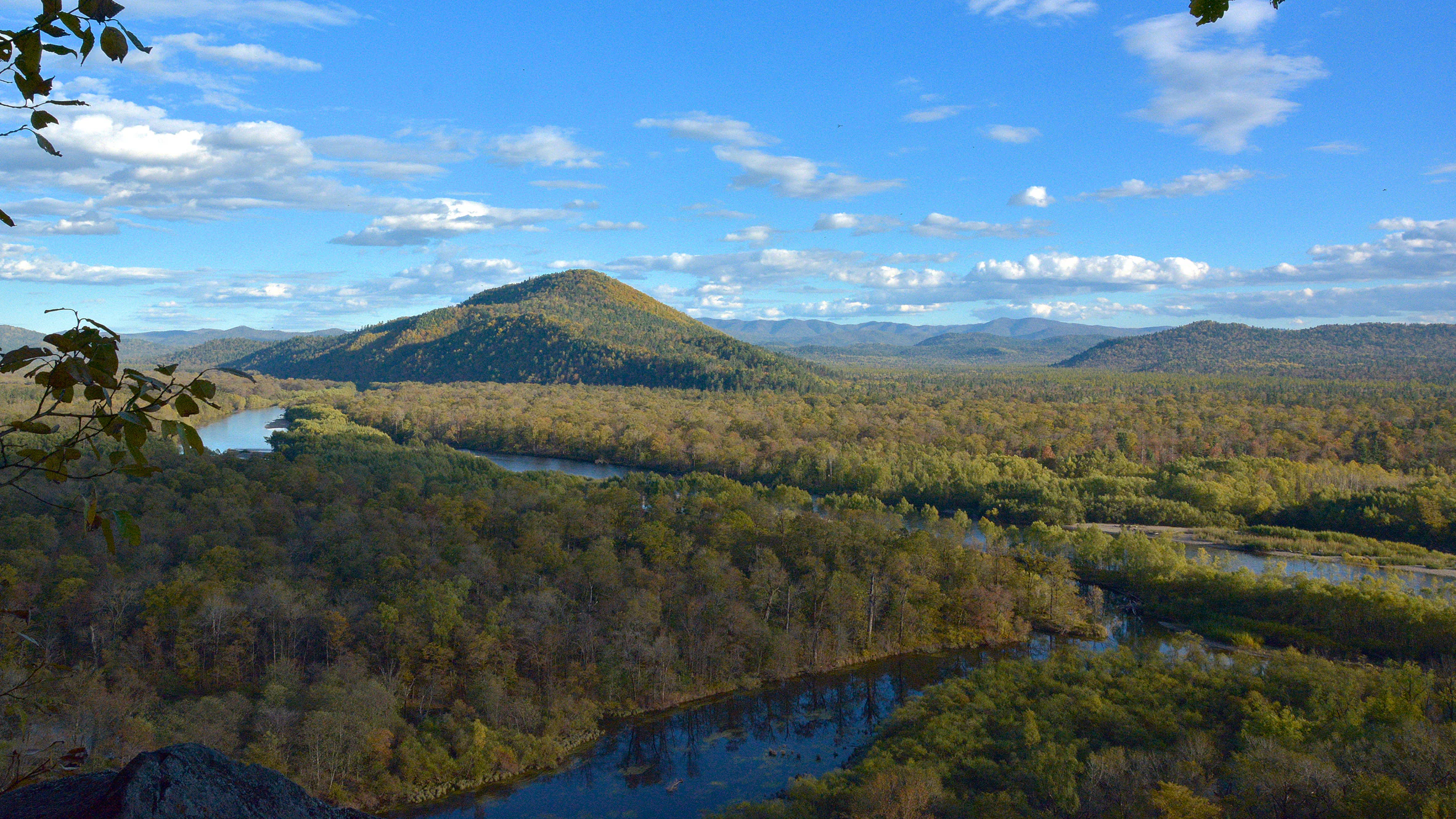
Bikin National Park occupies the western macroslope of the Sikhote-Alin mountain range, where elevation drops from high summits down to the floor of the Bikin River valley. The terrain is defined by steep ridges, deeply cut valleys, and forested slopes that descend through successive vegetation zones. Elevation varies substantially across the park, ranging from the low river valley up to high mountain peaks, and the relief creates a mosaic of microhabitats shaped by slope, aspect, and altitude.
The Bikin River itself is the geographic heart of the park. It flows in a generally northwesterly direction through the protected area, flanked by terraces and ancient floodplain features, and its tributaries dissect the surrounding ridges in narrow forested corridors. The river valleys support broadleaf and mixed forests with relatively open canopies and rich understory, while the upper slopes transition toward denser coniferous stands and, in the highest elevations, alpine and subalpine formations.
Climatically, the park sits at a transition between northern continental influences and warmer Pacific air masses, which contributes to the unusual botanical character of the region. This setting gives the landscape its defining quality: a continuous forest wilderness broken only by the river and its tributaries, with virtually no settlements, roads, or human infrastructure inside the park boundaries.
Bikin National Park ecosystems, habitats, and plant life
The natural environment of Bikin National Park is defined by forests of exceptional diversity, shaped by the convergence of northern and southern floras in central Sikhote-Alin. In the lower and middle elevations, the vegetation is dominated by mixed broadleaf and broadleaf-cedar forests, where species typical of the taiga share the canopy with Manchurian and East Asian hardwoods. This unusual botanical mixture is one of the park's most important ecological signatures.
In the canopy and middle layers, trees such as Korean pine, birch, ash, and various nut-bearing species provide both structural complexity and a rich food base for herbivores and omnivores. The understory includes a remarkable suite of plants more commonly associated with warmer temperate regions, including ginseng, eleutherococcus, Daurian rhododendron, actinidia, and aralia. The result is a multi-layered forest ecosystem where arboreal, shrub, and herbaceous diversity are unusually high for the latitude.
Above the mixed forests, vegetation transitions through subalpine and alpine communities as elevation increases, eventually giving way to open rocky terrain near the highest peaks. The park's watersheds, anchored by the Bikin River, sustain freshwater habitats that support fish, amphibian, and invertebrate communities. Together, these features form an ecological continuum that ranges from river valley to alpine summit within a single protected landscape, supporting an unusually complete representation of central Sikhote-Alin's natural systems.
Bikin National Park wildlife and species highlights
Wildlife is the most visible expression of the park's ecological richness, and Bikin National Park is internationally recognized primarily as a refuge for the Amur, or Siberian, tiger. The park's forests and abundant prey base support a significant share of the global population of this endangered subspecies, and the territory is considered one of the last fully functional core areas for tiger survival in the wild. The presence of tigers also reflects the health of the broader ecosystem, since their populations depend on stable numbers of large ungulates and intact forest cover.
Beyond the tiger, the park hosts a diverse mammal community documented across dozens of species, including ungulates such as Siberian deer and wild boar, smaller carnivores, and a range of other forest mammals. The mix of broadleaf and cedar forest provides both food resources and shelter, supporting complex predator-prey dynamics typical of intact Sikhote-Alin ecosystems.
The park's birdlife is also notable, with roughly two hundred recorded species, including several listed in the Red Data Book of Russia such as the black stork, the scaly-sided merganser, and Blakiston's fish owl. Reptiles, amphibians, and freshwater fish are present as well, contributing to a faunal assemblage that is unusually complete for the region. Together, these communities make the park a key site for understanding the wildlife of the Russian Far East and the population dynamics of some of Asia's rarest species.
Bikin National Park conservation status and protection priorities
Bikin National Park was established with the explicit goal of conserving one of the last major habitats of the Amur tiger, and protection of this subspecies remains its central conservation priority. The park's size, contiguity with surrounding forests, and the quality of its habitat make it a cornerstone of long-term tiger conservation in Russia, complementing neighboring protected areas in central Sikhote-Alin.
Beyond tigers, the park protects the extraordinary botanical transition zone between northern taiga and southern Manchurian floras. The presence of species such as Korean pine, ginseng, and rare rhododendrons, alongside more common boreal trees, gives the area high conservation value at both landscape and species level. The watershed of the Bikin, with its full range of elevation and habitat zones, is preserved as a relatively undisturbed ecological system.
Since 2018, Bikin has been part of the UNESCO World Heritage Site Central Sikhote-Alin, a designation that recognizes both its natural values and the cultural landscape maintained by indigenous peoples. The park's management approach combines protection of biodiversity with support for the traditional livelihoods of the Udege and Nanai, recognizing that long-term conservation in this region depends on maintaining the human-ecological relationship that has shaped these forests for centuries. This integration of ecological and cultural protection is itself a defining feature of the park's conservation model.
Bikin National Park cultural meaning and human context
The territory of Bikin National Park is the ancestral homeland of the Udege and Nanai peoples, indigenous communities of the Russian Far East whose cultures are closely tied to the forests and rivers of Sikhote-Alin. The Udege belong to the Tungusic-Manchu linguistic family and have historically inhabited the central Ussuri taiga, with distinct local groups including the Bikin Udege, known by the regional name Bikinca. Until the late nineteenth century, the Udege and the Oroch were often regarded as a single people.
Traditional livelihoods in this region have long centered on hunting, fishing, and gathering, with knowledge of forest resources, animal behavior, and river ecology passed down through generations. These practices are deeply adapted to the seasonal rhythms of the taiga and the behavior of its wildlife, including the Amur tiger, which holds a sacred place in Udege cosmology and is regarded as a spiritually significant animal.
The park contains numerous natural and historical sites of cultural importance, including ancient camp sites, ceremonial locations, and other features that form the material basis of Udege and Nanai ethnic identity. The inclusion of the park within the UNESCO World Heritage framework explicitly acknowledges the inseparability of the cultural and natural values of this landscape. By respecting indigenous land use and integrating traditional ecological knowledge into park management, Bikin represents a model in which indigenous presence is understood not as an obstacle to conservation but as an essential part of the cultural landscape being protected.
Top sights and standout views in Bikin National Park
Bikin National Park stands out as one of the most ecologically and culturally significant protected areas in the Russian Far East. Its scale, continuity with surrounding wilderness, and role as a core habitat for the Amur tiger place it at the center of international efforts to conserve this iconic subspecies. The park's forests, which combine northern boreal and southern Manchurian elements, are a botanical highlight rarely matched elsewhere, supporting an unusually diverse community of plants, mammals, birds, and freshwater species.
The UNESCO designation of Central Sikhote-Alin, extended in 2018 to include Bikin, highlights the park's role as a key component of one of the best-preserved mixed forest ecosystems in temperate Asia. Simultaneously, the park's recognition of the ongoing presence and rights of the Udege and Nanai peoples gives it a distinctive model of how conservation and indigenous cultural heritage can be combined rather than treated as separate goals.
Best time to visit Bikin National Park
The character of a visit to Bikin National Park changes meaningfully with the seasons, in ways that reflect both climate and ecology. The summer months bring warm weather, full leaf cover, and active wildlife, making this period the most accessible time for experiencing the mixed broadleaf and cedar forests in full bloom and for observing the abundance of mammals and birds that thrive in the productive river valleys. River levels are generally favorable for travel along the Bikin and its tributaries during this period.
Autumn offers cooler temperatures, lower humidity, and the coloration of the broadleaf forests, with traditional activity patterns of forest communities historically tied to harvest seasons. In this season, wildlife is often more visible as animals prepare for winter, and the landscape takes on a quieter, more contemplative character. Spring brings gradual warming, river flooding, and the return of migratory birds, including rare species such as black stork and scaly-sided merganser, making it a particularly notable time for birdwatching.
Winter transforms the park into a snow-covered wilderness with stable conditions for tracking wildlife and observing animal activity, especially large mammals and signs of the Amur tiger. Each season therefore offers a different perspective on the landscape, and the choice depends on whether the focus is botanical diversity, wildlife observation, or the broader experience of an intact Sikhote-Alin forest in its quieter stages.