

Mori Atlas logo
National parkDiriá National Park

Mapped protected areas and natural landscape identity within Guanacaste Province.

Diriá National Park: Guanacaste Province National Park Atlas and Geographic Context

Diriá National Park represents a key protected national park landscape situated in the Guanacaste Province of Costa Rica. This page offers a detailed view of its geographic setting and mapped boundaries, providing essential context for understanding its place within the regional natural terrain. Explore the atlas-style data to grasp the park's unique protected-area identity and its contribution to the broader Guanacaste Province geography.

National ParkCosta RicaDry ForestCloud ForestNicoya PeninsulaGuanacaste

Diriá National Park

National park

Park overview

Structured park overview, official facts, and landscape profile for Diriá National Park

Diriá National Park park facts, protected area profile, and essential visitor context
Review the core facts for Diriá National Park, including designation, size, terrain, visitor scale, habitats, and operating context in one park-focused overview.

About Diriá National Park

Diriá National Park occupies a distinctive geographic position in northwestern Costa Rica, forming part of the Tempisque Conservation Area within the Guanacaste Province. The park's terrain is defined by a complex system of valleys carved by the Diriá, Tigre, Verde, and Enmedio rivers, creating a landscape of steep slopes and deeper drainage channels that descend from the central highlands of the Nicoya Peninsula toward the lower-lying coastal zones. This topographic variation supports an ecological gradient that transitions from seasonally dry tropical forest in the lower elevations through transitional forest zones to humid montane forest at higher elevations. The park was originally designated as a protected zone in 1991, subsequently upgraded to national wildlife refuge status in 1993, and ultimately redesignated as Diriá National Park in 2004, reflecting Costa Rica's ongoing commitment to protected area management and expansion. The protected area serves as an important watershed for the four river systems that originate within its boundaries, providing downstream water resources for surrounding agricultural lands and communities.

Quick facts and research context for Diriá National Park

Diriá National Park occupies 28 square kilometers in the Guanacaste Province of Costa Rica, occupying the central highlands of the Nicoya Peninsula. The park was originally established as a protected zone in 1991, later becoming a national wildlife refuge before achieving full national park status in 2004. The protected area encompasses watersheds serving four river systems and features dramatic terrain of steep-sided valleys. The park is administered by Costa Rica's National System of Conservation Areas (SINAC) and holds IUCN Category II protection status. A ranger station serves as the visitor center and offers basic overnight accommodation.

Park context

Deeper park guide and search-rich context for Diriá National Park

Diriá National Park history, landscape, wildlife, and travel context
Explore Diriá National Park through its history, landscape character, ecosystems, wildlife, conservation priorities, cultural context, and seasonal travel timing in a structured park guide built for atlas discovery and search intent.

Why Diriá National Park stands out

Diriá National Park is best known for its remarkable ecological transition zone where dry tropical forest meets humid cloud forest along an elevational gradient. The park protects endemic plant species found nowhere else on Earth, including the Pitcairnia bromeliad and a distinctive Stenocereus cactus, both confined to the Nicoya Peninsula. The Brasil Waterfall trail provides one of the park's signature natural attractions, while the area supports populations of howler monkeys, anteaters, peccary, and deer. The park's location in the Guanacaste dry forest ecosystem makes it particularly significant for conservation of this increasingly rare habitat type.

Diriá National Park history and protected-area timeline

Diriá National Park traces its origins to 1991 when the area was first established as a formally protected zone within Costa Rica's national protected areas system. The initial designation reflected growing recognition of the Nicoya Peninsula's ecological significance and the need to preserve the unique transition between dry and humid tropical forests. Two years after its initial protection, in 1993, the area was upgraded to national wildlife refuge status, providing additional regulatory framework for conservation management. The transformation from wildlife refuge to full national park status came in 2004, when the official name changed from Diriá National Forest Wildlife Refuge to Diriá National Park. This evolution represents the broader pattern of Costa Rica's protected area development, which has progressively strengthened legal protection for ecologically significant lands and expanded the national park network. The park now operates under the management of the National System of Conservation Areas (SINAC), Costa Rica's unified protected areas management authority.

Diriá National Park landscape and geographic character

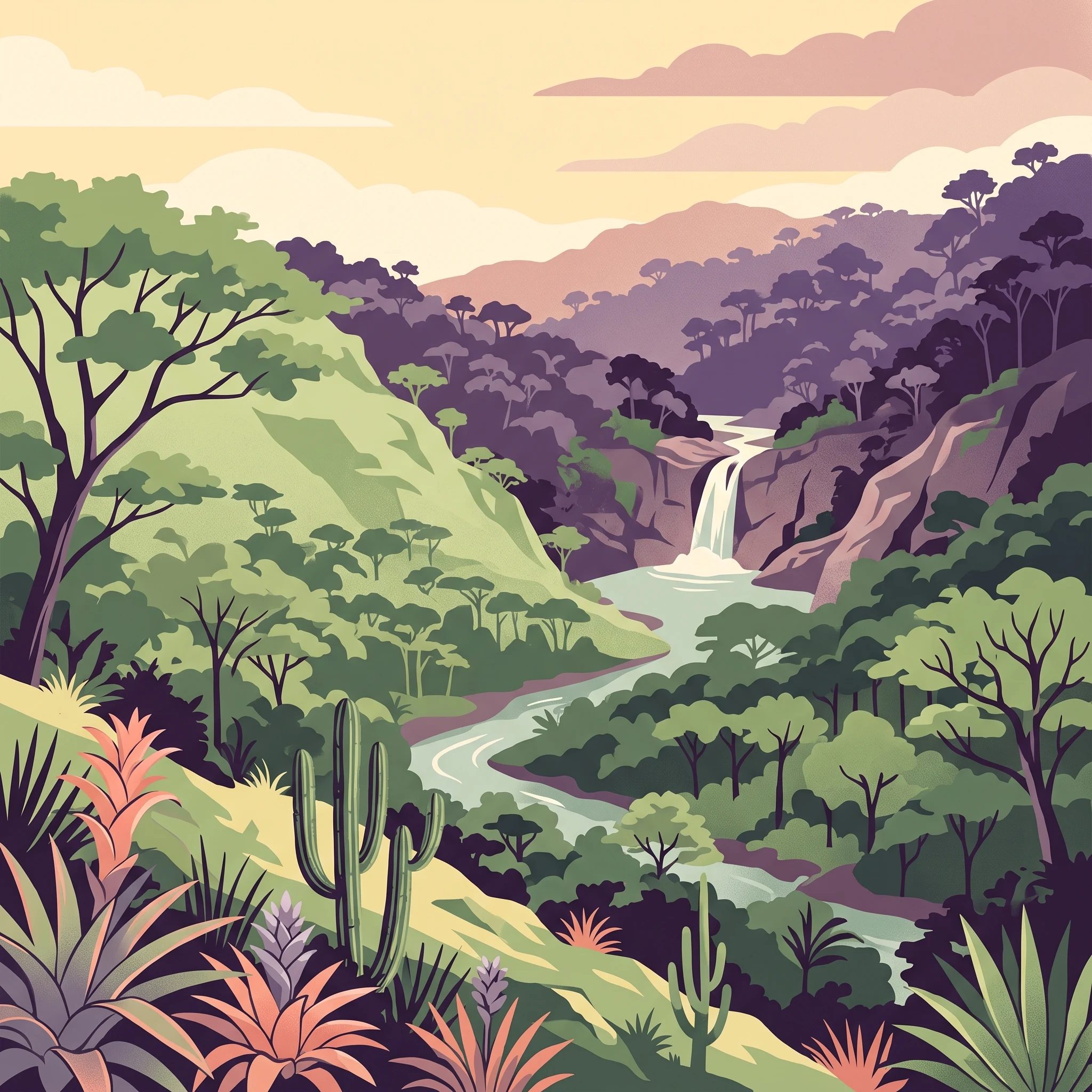
The landscape of Diriá National Park is characterized by rugged terrain formed by the erosive action of four major watersheds that drain the central highlands of the Nicoya Peninsula. The Diriá, Tigre, Verde, and Enmedio rivers have carved deep valleys into the underlying geology, creating a terrain of steep slopes and narrow drainage corridors that contrast with the more gentle terrain of the surrounding lowlands. The elevational range within the park supports distinct ecological zones, with dry forest dominating the lower elevations and transitioning through increasingly humid zones toward the higher elevations where montane conditions prevail. The terrain's complexity creates varied microclimates and habitat conditions that contribute to the park's biological diversity. Visible water features include the Brasil Waterfall, accessible via one of the park's maintained trails from the ranger station.

Diriá National Park ecosystems, habitats, and plant life

The nature of Diriá National Park is defined by its position at an ecological crossroads between dry and humid tropical forest systems. At lower elevations within the park, the vegetation reflects the Guanacaste region's characteristic dry forest ecosystem, characterized by deciduous trees adapted to seasonal drought conditions. As elevation increases, the forest composition shifts toward more evergreen species adapted to higher humidity and cloud immersion typical of montane forest zones. This ecological gradient creates a mosaic of habitat types within a relatively compact protected area. The park is notable for its endemic plant species, particularly the Pitcairnia bromeliad and a Stenocereus cactus species, both confined to the Nicoya Peninsula and found within the park's boundaries. These endemic species represent evolutionary isolation and the unique ecological conditions that the park protects.

Diriá National Park wildlife and species highlights

The wildlife population in Diriá National Park reflects the park's diverse forest habitats and its position within the broader Guanacaste ecosystem. The park supports populations of several mammalian species characteristic of Central American dry forests, including howler monkeys that vocalize prominently from the forest canopy, peccary herds that traverse the understory, anteaters foraging in the leaf litter, and deer that browse in forest openings and edge habitats. Avian diversity is particularly notable, with 134 bird species documented within the park's boundaries. This bird community includes both resident species adapted to year-round forest habitation and migratory species that utilize the park as a seasonal resource. The combination of dry forest and humid forest habitats within the protected area supports this diverse vertebrate community, making Diriá an important area for wildlife conservation in the Guanacaste region.

Diriá National Park conservation status and protection priorities

Diriá National Park plays an important role in Costa Rica's national conservation strategy, representing one of the protected areas that preserve the country's remarkable biodiversity. The park's designation as IUCN Category II reflects its primary objective of protecting natural ecosystems while allowing for sustainable visitation and environmental education. The protection of the four river watersheds within the park provides ecological benefits that extend beyond the protected boundary, including watershed protection for downstream agricultural lands and communities. The preservation of endemic plant species, including the Pitcairnia bromeliad and Stenocereus cactus, represents conservation of genetic resources found nowhere else in the world. The park's position within the Tempisque Conservation Area connects it to a broader network of protected lands that collectively preserve the Guanacaste region's distinctive dry forest ecosystem, which has been significantly reduced by agricultural conversion outside protected boundaries.

Diriá National Park cultural meaning and human context

Diriá National Park is situated within the Guanacaste Province, a region with a distinct cultural identity shaped by its history of cattle ranching and agricultural development. The Nicoya Peninsula has been inhabited for centuries, with indigenous communities maintaining connections to the landscape prior to Spanish colonization. The park's establishment in 1991 represented a modern conservation response to ongoing environmental pressures on the region's forests and watersheds. The continued presence of local communities in the surrounding landscape creates both opportunities and challenges for park management, requiring coordination between conservation objectives and the livelihood needs of rural populations. The basic visitor infrastructure at the ranger station, including overnight accommodation, reflects a management approach that welcomes controlled visitation while maintaining the park's conservation focus.

Top sights and standout views in Diriá National Park

The Brazil Waterfall ranks among the park's signature natural attractions, accessible via maintained trail from the ranger station. The park's ecological transition zone, where dry tropical forest meets humid cloud forest, creates remarkable biodiversity within a small area and represents the park's defining characteristic. Endemic species including the Peninsulalimited Pitcairnia bromeliad and Stenocereus cactus distinguish Diriá from other protected areas. The howler monkey populations, audible throughout the forest canopy, provide a memorable auditory experience for visitors. The deep valley landscapes carved by the four river systems create scenic topographic diversity uncommon in lowerelevation Guanacaste parks. The park's relatively compact size and accessible trail system make it manageable for day visitors while the basic dormitory allows for longer stays.

Best time to visit Diriá National Park

The optimal time to visit Diriá National Park corresponds to the dry season typically spanning December through April, when visitor access is most convenient and trail conditions are most favorable. During this period, the weather is characterized by lower humidity and minimal rainfall, allowing visitors to explore the park's trails with greater ease. The dry season also brings the dry forest into its most distinctive appearance, with deciduous trees often bare of leaves, creating a different visual character than the greenwet forest of the wet season. The wet season from May through November brings higher rainfall and humidity, though the park remains accessible and the increased moisture supports lusher vegetation. The park's ranger station operates daily from 8am to 4pm, allowing visitors to plan their exploration within these hours regardless of season.
Park location guide

Geography guide, regional context, and park location map for Diriá National Park

Diriá National Park park geography, regions, and map view in Costa Rica
Understand where Diriá National Park sits in Costa Rica through a broader geographic reading of the surrounding landscape, nearby location context, and its mapped position within the national park landscape.

How Diriá National Park fits into Costa Rica

Costa Rica is a Central American country with coastlines on both the Caribbean Sea and Pacific Ocean. It gained independence from Spain in 1821 and operates as a unitary presidential republic with no standing military. The economy has diversified from agriculture into finance, pharmaceuticals, and ecotourism.

Wider geography shaping Diriá National Park in Costa Rica

Costa Rica is located in Central America, bordered by Nicaragua to the north, the Caribbean Sea to the northeast, Panama to the southeast, and the Pacific Ocean to the southwest. It shares a maritime boundary with Ecuador. The terrain includes coastal plains, mountain ranges, and volcanic landscapes.

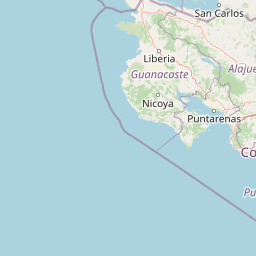
Map view of Diriá National Park

Use this park location map to pinpoint Diriá National Park in Costa Rica, understand its exact geographic position, and read its mapped placement within the surrounding landscape more clearly.

Pigeon | © OpenStreetMap contributors

Location context for Diriá National Park

Guanacaste Province
Park atlas

Explore protected landscapes and unique ecosystems across Costa Rica's Guanacaste Province and Nicoya Peninsula, offering geographic context to Diriá.

Discover Nearby National Parks and Protected Areas Beyond Diriá National Park for Regional Exploration
Continue your exploration beyond Diriá National Park by browsing other national parks and protected areas located across Costa Rica's Guanacaste Province and the Nicoya Peninsula. Compare the distinct dry forest and humid cloud forest ecosystems, tracing the mapped terrain and varied conservation landscapes in the surrounding region for deeper atlas-style discovery.
National parkCosta Rica

Barra Honda National Park: Costa Rican Protected Landscape and Geographic Atlas

Mapped boundaries and regional park geography.

Barra Honda National Park stands as a notable protected area, offering a distinct geographic profile within Costa Rica. Its designation as a national park underscores its importance for landscape conservation and atlas exploration. This entry details the park's mapped terrain and its contribution to understanding the regional geography, providing a focused view for those interested in protected land distribution and natural context.

Area
23 km²
Established
1974
IUCN
II
Relief
Mountain
National parkCosta Rica

Palo Verde National Park: Costa Rica's Protected Landscape Geography and Map Context

Explore mapped park boundaries and regional natural landscapes.

Delve into the geographic identity of Palo Verde National Park, a protected area within Costa Rica. This detail entry focuses on its mapped landscape, providing context for its protected boundaries and regional setting. Understand how Palo Verde National Park fits into the broader atlas of Costa Rican geography, offering a factual basis for exploring its specific natural terrain and its significance as a national park within Central America's rich biodiversity.

Area
184 km²
Established
1978
IUCN
II
Relief
Lowland
National parkGuanacaste Province

Las Baulas Marine National Park: Protected Marine Landscape Atlas in Guanacaste Province

Explore its mapped boundaries and regional geographic context.

Las Baulas Marine National Park represents a vital protected marine territory within Costa Rica. This entry offers an atlas-oriented perspective, detailing the park's geographic scope and its specific mapped boundaries. Users can explore its significance as a protected landscape, understand its relationship to the broader regional geography of Guanacaste Province, and utilize this information for structured natural landscape discovery.

Area
175 km²
Established
1991
IUCN
II
Relief
Mixed relief
National parkCosta Rica

Miravalles Jorge Manuel Dengo National Park: Costa Rica National Park Geographic Context

Mapped protected landscape and regional park geography.

Miravalles Jorge Manuel Dengo National Park offers a focused lens for understanding protected natural areas within Costa Rica. Explore its specific geographic footprint and the surrounding regional context to appreciate its significance as a mapped protected landscape. This detailed view supports a structured discovery of the park's identity, helping users grasp its place within the national atlas.

Area
43 km²
Established
2019
IUCN
II
Relief
Mountain
National parkGuanacaste Province

Rincón de la Vieja National Park: Costa Rican National Park Atlas Entry

Mapped protected landscape and regional geography.

Gain a structured understanding of Rincón de la Vieja National Park as a key protected area within Guanacaste Province. This detail page offers an atlas-focused perspective, highlighting its mapped boundaries and regional geographic significance. Explore how this national park contributes to the protected landscapes of Costa Rica, providing essential context for geographic discovery.

Area
141.61 km²
Established
1973
IUCN
II
Climate
Tropical
National parkGuanacaste Province

Santa Rosa National Park: Guanacaste Province National Park Protected Area

Mapped natural landscape and regional geography.

Santa Rosa National Park is a vital protected area within Costa Rica's Guanacaste Province. This detail page offers an atlas-focused view of the park, highlighting its geographic setting and mapped boundaries. It serves as a primary resource for understanding the park's protected landscape identity and its contribution to regional conservation geography, supporting structured exploration for users interested in natural areas.

Area
815.31 km²
Established
1966
IUCN
II
Climate
Tropical
National parkGuanacaste Province

Guanacaste National Park: A Protected Landscape within Guanacaste Province's Geography

Explore mapped park boundaries and regional natural landscape context.

Delve into the protected landscape of Guanacaste National Park, a significant national park located within Guanacaste Province. This entry provides a focused view of its geographic features, mapped protected areas, and its role within the regional terrain. Understand the park's specific natural landscape character and its placement in the broader atlas of conservation lands.

Area
340 km²
Established
1991
IUCN
II
Relief
Mixed relief
National parkCosta Rica

Arenal Volcano National Park: Costa Rica National Park Atlas and Mapped Terrain

Detailed geography and protected landscape context for a Costa Rican national park.

Gain a structured understanding of Arenal Volcano National Park, a protected natural area situated in Costa Rica. This page provides detailed geographic information, focusing on its mapped boundaries and landscape characteristics. It serves as a key resource for exploring the park's specific regional context and its role within the country's network of protected lands.

Area
121.24 km²
Established
1991
IUCN
II
Relief
Mountain

Common questions about visiting, size, designation, and location context for Diriá National Park

Diriá National Park FAQs for park facts, access, geography, and protected area context
Find quick answers about Diriá National Park, including protected-area facts, park geography, trail and visitor context, and how the park fits into its surrounding country and regional landscape.
MoriAtlas Explorer

Continue Your Protected Areas Search Across the Global Atlas

Deepen your exploration by continuing the structured search for national parks and protected areas worldwide. Utilize the comprehensive filtering capabilities to compare different conservation landscapes and refine your understanding of global park geography. Discover more about the distribution and characteristics of protected natural areas.

Global natural geography