Why Iztaccíhuatl, Popocatépetl National Park stands out
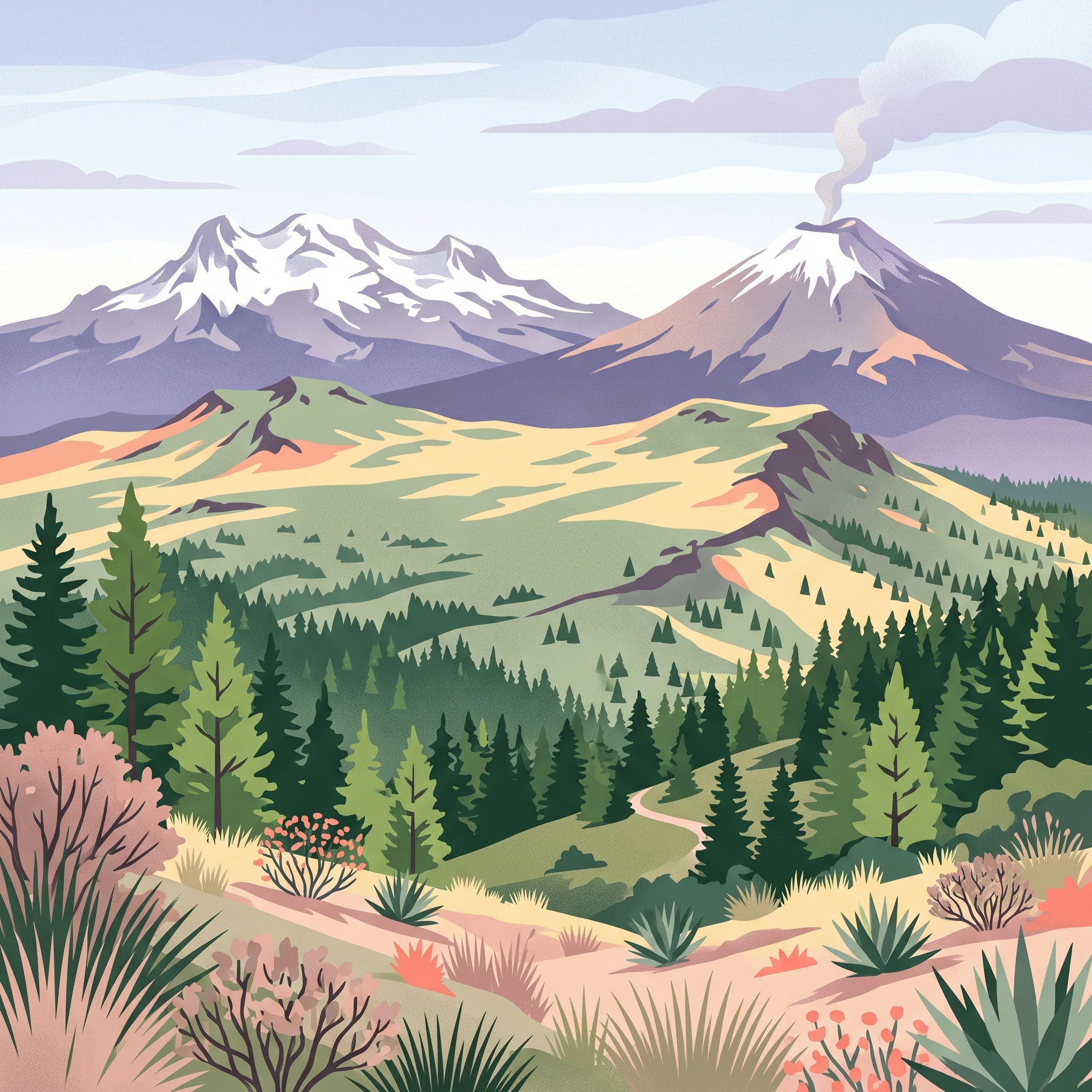
Iztaccíhuatl, Popocatépetl National Park is best known for protecting the two most iconic volcanoes in Mexico, whose silhouettes have defined the nation's visual identity for centuries. Popocatépetl is renowned as one of North America's most active volcanoes, with continuous fumarolic activity since 2005 that occasionally produces ash falls on surrounding communities. The park is also celebrated for its exceptional ecological gradients, transitioning from pine-fir forests through pine woodlands to alpine grasslands known as zacatonal, ultimately giving way to permanent snow and glaciers at the highest elevations. The endangered volcano rabbit, found only on four central Mexican volcanic peaks including Iztaccíhuatl and Popocatépetl, makes this park critically important for the survival of this species.
Iztaccíhuatl, Popocatépetl National Park history and protected-area timeline
The national park was created on November 8, 1935, through a decree by President Lázaro Cárdenas, making it one of Mexico's earliest protected areas. The original decree aimed to protect the upper watersheds that supply water to the Mexico City valley and the Puebla-Tlaxcala region, while also preserving the forests, soils, flora, and fauna, along with the area's outstanding natural beauty. A second decree in March 1937 confirmed the inclusion of the forest lands of the Hacienda of Zoquiapan in the northern part of the park. In 1948, President Miguel Alemán Valdés issued a decree that shifted the boundary to the 3,600-meter contour, reducing the park's size. That same year, the Mexican government established an industrial forest exploitation unit to supply wood pulp to the San Rafael paper factory from trees harvested in what had been removed from the park. This industrial unit was finally abolished in 1992. The park was closed to the public from March 2020 to March 2021 due to the COVID-19 pandemic in Mexico. The park is now administered by the National Commission of Protected Natural Areas under the Secretariat of Environment and Natural Resources.
Iztaccíhuatl, Popocatépetl National Park landscape and geographic character
The park encompasses a dramatic volcanic landscape characterized by steep pyramidal peaks, deep barrancas, and high-altitude plateaus. The Sierra Nevada forms the backbone of the park, with Popocatépetl occupying the southern position as the highest point in the park and the second-highest in Mexico. Iztaccíhuatl rises immediately to the north, its profile distinctly resembling a sleeping woman with her face, chest, knees, and feet outlined in snow. The northern section of the park contains the Sierra de Río Frío, a smaller volcanic range featuring Mount Tláloc at 4,120 meters, Telapón at 4,060 meters, and Papayo at 3,600 meters. The valley of Río Frío, through which Mexican Federal Highway 150 passes between Mexico City and Puebla, marks the northern terminus of the Sierra Nevada. The landscape transitions dramatically with elevation, from forested slopes through alpine grasslands to barren rock and permanent ice above 4,350 meters. Numerous mountain streams originate from rain, snowfall, and glacial melt, creating spectacular waterfalls such as Cascada de El Salto.
Iztaccíhuatl, Popocatépetl National Park ecosystems, habitats, and plant life
The park supports a remarkable sequence of ecological zones determined by altitude and exposure. Montane conifer forests dominate the lower slopes, with pine-fir forests occurring between 3,000 and 3,700 meters, characterized by oyamel fir (Abies religiosa), Mexican white pine, Montezuma pine, and Hartweg's pine. Above 3,400 meters, pure pine forests prevail with Mexican mountain pine as the dominant species. The alpine and sub-alpine grasslands known as zacatonal occupy elevations between 3,500 and 4,350 meters, consisting of dense grasslands rarely exceeding 50 centimeters in height. Above 4,350 meters, the vegetation gives way entirely to barren rock, permanent snow, and glaciers covering the upper reaches of both volcanoes. The park represents the most important remnant of high-mountain conifer forests and alpine grasslands in central Mexico. Its position at the boundary between the Nearctic and Neotropical biogeographic regions contributes to its exceptional biological diversity, with over 1,645 species of plants and animals recorded within the park boundaries.
Iztaccíhuatl, Popocatépetl National Park wildlife and species highlights
The park supports substantial biodiversity despite its high-altitude setting. Forty-eight species of mammals have been recorded, with the most notable being the endangered volcano rabbit (Romerolagus diazi), a species endemic to four volcanic peaks in central Mexico and the park's emblematic species. Other mammals include bobcats, coyotes, gray foxes, American badgers, skunks, raccoons, bats, rabbits, gophers, squirrels, mice, and shrews. The Orizaba long-tailed shrew and Phillips's kangaroo rat represent limited-range species found within the park. Bird diversity is exceptional, with 161 species recorded, of which 75 percent are residents and 25 percent are migratory or occasional visitors. Notable resident birds include red-tailed hawks, peregrine falcons, long-tailed wood partridge, white-naped swift, Aztec thrush, Sierra Madre sparrow, and bumblebee hummingbird. The park is recognized as an Important Bird Area by CONABIO. Amphibians include the ridged tree frog and four species of salamanders, while reptile diversity includes 10 species of snakes and lizards.
Iztaccíhuatl, Popocatépetl National Park conservation status and protection priorities
Iztaccíhuatl–Popocatépetl National Park holds significant conservation value at multiple levels. It forms the core zone of the Los Volcanes Biosphere Reserve, designated by UNESCO in 2010, which spans 171,774 hectares across 22 municipalities in four states. Within the park, 59 species are listed under some category of risk according to Mexico's official species protection list (NOM-059), and five fungi species are considered threatened. The park's conservation significance extends beyond its borders as a critical watershed supplying water to millions of people in the Mexico City metropolitan area and surrounding cities. The volcano rabbit's presence makes the park globally important for the survival of this critically endangered species. However, the park faces ongoing challenges from urban expansion, particularly on the México state side, where the external transition zone is experiencing pressure from settlement growth. Sustainable forestry practices in the buffer zone and management of the boundary between conservation and human development remain key challenges.
Iztaccíhuatl, Popocatépetl National Park cultural meaning and human context
The twin volcanoes hold profound cultural significance in Mexican indigenous cosmology and continue to be important in contemporary heritage. The volcanoes are considered living beings in the cosmovision of Mexico's indigenous cultures, with a mythological past involving divine and heroic narratives. The most famous legend is the Legend of the Volcanoes, a pre-Hispanic tale of ill-fated love between the princess Iztaccíhuatl and the warrior Popocatépetl, whose figures were transformed into the mountains. The volcanoes were revered as manifestations of Tláloc, the god of rain, with numerous archaeological sites including shrines and offerings documented within the park. Twenty archaeological sites have been recorded, the majority dedicated to Tláloc worship. Spanish chroniclers Diego Durán and Bernardino de Sahagún documented the major festivals held in honor of these mountains during the colonial period. Today, local specialists who understand atmospheric phenomena continue the ancestral tradition of ascending the mountains to invoke rain for crops. The landscape has inspired countless artists, poets, painters, and writers, making it perhaps the most represented landscape in Mexican culture.
Top sights and standout views in Iztaccíhuatl, Popocatépetl National Park
The park's primary highlight is the opportunity to witness two of Mexico's most sacred and visually striking volcanic peaks up close, with Iztaccíhuatl's distinctive sleeping woman silhouette and Popocatépetl's continuous volcanic activity creating an unforgettable backdrop. The ecological gradient from subtropical forests through conifer woodlands to alpine grasslands offers remarkable habitat diversity within a relatively small area. The chance to see the endangered volcano rabbit in its natural high-elevation grassland habitat represents a unique wildlife viewing opportunity found nowhere else on Earth. The panoramic views from Paso de Cortés reveal not only these two volcanoes but also the Pico de Orizaba, the Malinche, the Nevado de Toluca, and the valleys of Puebla, Tlaxcala, and Mexico. The park's cultural layer, from pre-Hispanic mythology to its role as one of Mexico's first national parks, adds historical depth to the natural experience.
Best time to visit Iztaccíhuatl, Popocatépetl National Park
The park can be visited throughout the year, though conditions vary significantly by season and elevation. The dry season from November to April generally offers clearer skies and more stable weather for hiking and landscape photography, though temperatures at high elevations can drop well below freezing. The warmer months from May to October bring the rainy season, when afternoon thunderstorms are common and trails can become muddy and slippery. This period, however, brings lush green landscapes and the best conditions for observing wildflowers in the alpine grasslands. Wildlife viewing is often better during the dry season when animals are more active around water sources. Visitors should be aware that Popocatépetl's activity level can affect access to certain areas, and the park may temporarily close sections during periods of increased volcanic activity. The Iztaccíhuatl summit is suitable for experienced alpinists, while lower-elevation trails offer hiking opportunities for visitors without technical climbing skills.