
Why Naturschutzgebiet Oberes Diemeltal stands out
The reserve is best known for protecting an undeveloped section of the upper Diemel and its floodplain in a landscape dominated by the Diemelsee reservoir and surrounding forests. Its tributaries, particularly the Rhene, give the area a branching river network where floodplain meadows, alder woods, and wetland fringes meet. It also stands out for the presence of locally rare floodplain plants such as yellow monkshood (Gelber Eisenhut) and blue monkshood (Blauer Eisenhut), which have made the Diemel valley a focus of conservation attention and plant habitat protection within the Marsberg region.
Naturschutzgebiet Oberes Diemeltal history and protected-area timeline
The reserve was formally designated in 2001, when the Hochsauerlandkreis incorporated it into the Hoppecketal landscape plan as a Naturschutzgebiet. This designation was preceded by recognition of the upper Diemel valley as an area of notable rarity, character, and landscape beauty, the standard criteria applied to nature reserves in Germany.
In 2004 the reserve became part of the larger FFH area Gewässersystem Diemel und Hoppecke, aligning it with the European Habitats Directive framework and broadening its conservation mandate beyond purely national protection. In 2023 it was further incorporated into the bird protection area Vogelschutzgebiet Diemel- und Hoppecketal mit angrenzenden Wäldern, reflecting the growing recognition of the Diemel valley's importance for avifauna.
Since 2020 active renaturation measures have been carried out within the reserve. In 2020 two side channels were reconnected to the main river downstream of their original outlets, and in 2021 sections of bank reinforcement were removed and large stones from the old bank protection were repositioned within the river as current deflectors. These interventions are aimed at restoring more natural flow patterns and improving habitat diversity along the Diemel.
Naturschutzgebiet Oberes Diemeltal landscape and geographic character
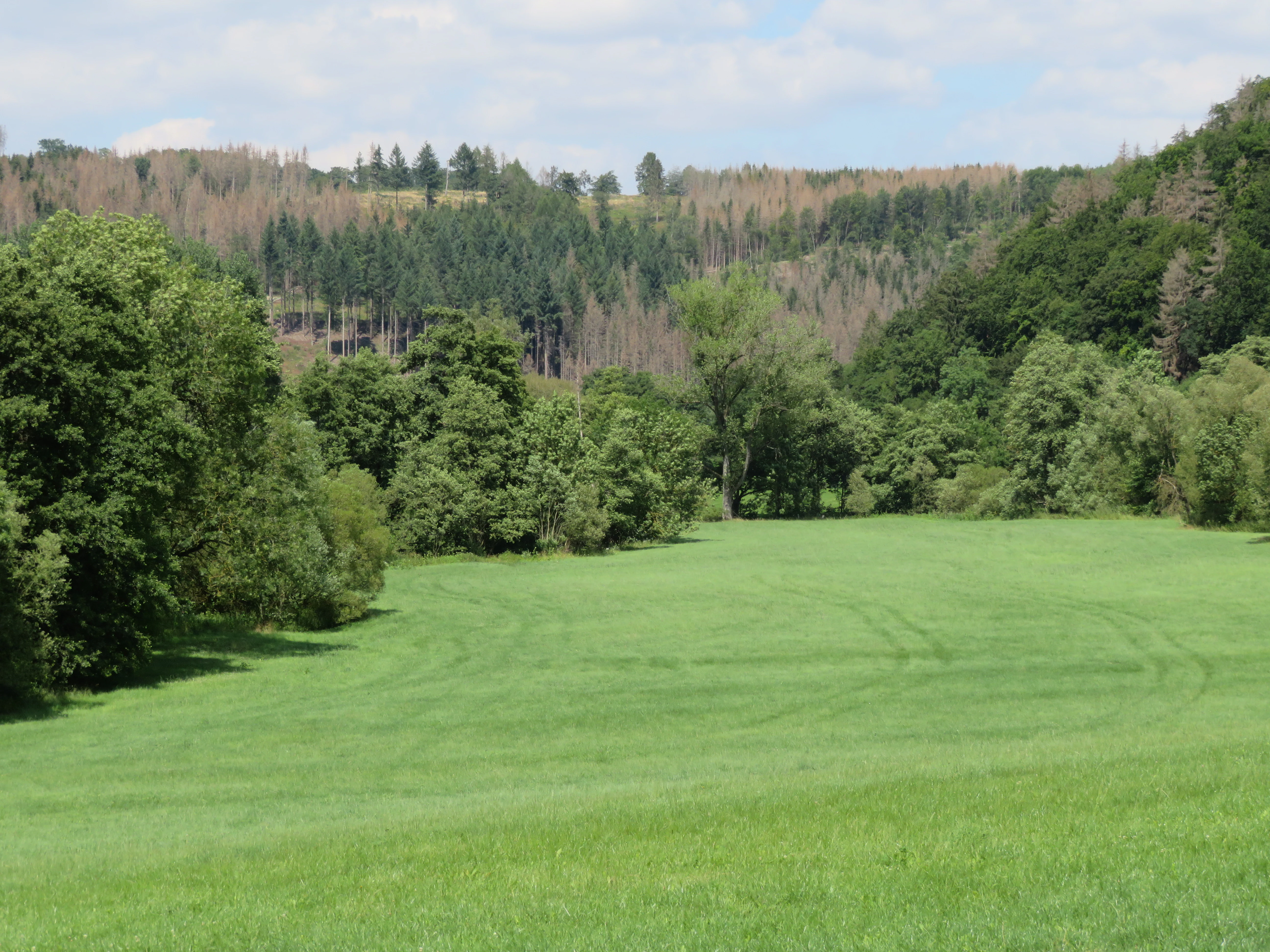
The landscape of the Oberes Diemeltal is shaped by the valley of the upper Diemel as it moves through the eastern Sauerland. The river here flows in a relatively open valley, bordered by floodplain meadows, alder-dominated wet woodland, and gently sloping valley edges that transition into the broader forested hills of the surrounding Hochsauerland.
The terrain reflects the transition zone between the upland character of the Sauerland and the more low-lying Diemel lowlands further downstream. Although the valley is not dramatic in relief, it is visually defined by the contrast between the flowing river and its associated water meadow vegetation on one side, and the denser mixed and coniferous forests that rise from the valley margins on the other.
Key visible landscape elements include the open Diemel channel itself, sections of tributary valley such as the Rhene, reed- and herb-rich bank vegetation, wet meadows, and pools. Upstream, the reserve is visually linked to the broader open water of the compensation basin east of the Diemelsee, while downstream it merges into the Giershagen area where industrial land use along the Wepa Papierfabrik marks the boundary of the protected landscape.
Naturschutzgebiet Oberes Diemeltal ecosystems, habitats, and plant life
Ecologically, the reserve is centered on the still semi-natural sections of the Diemel and its tributaries, together with their associated floodplain habitats. These include riparian alder woods, wet meadows, herbaceous riverbank vegetation, and small standing-water features that together form a coherent complex of riverine and wetland ecosystems.
This habitat mosaic is relatively unusual in the Hochsauerlandkreis, where forests and upland grasslands dominate the protected-area portfolio. The presence of more lowland-influenced floodplain species gives the reserve a distinctive ecological flavor compared to the surrounding protected sites.
Particular botanical importance attaches to rare floodplain plants such as yellow monkshood (Gelber Eisenhut) and blue monkshood (Blauer Eisenhut), which find suitable conditions along the Diemel's banks and adjacent meadows. The presence of such species has been one of the key arguments for protecting the valley and for active habitat management, including the removal of bank reinforcements and the restoration of side channels.
Naturschutzgebiet Oberes Diemeltal wildlife and species highlights
The reserve's wildlife interest is closely tied to its riverine and wetland habitats. The Diemel and its tributaries provide habitat for aquatic and semi-aquatic species, while the wet meadows, reed beds, and adjacent forests support a range of bird, mammal, and insect life. The designation of the valley within a bird protection area in 2023 reflects the site's recognized value for breeding and migratory birds in a landscape where forest and open water habitats intersect.
Mammals typical of wet woodland and floodplain habitats, such as wild boar, use the alder stands and meadows along the Diemel, especially where riparian cover is dense. Wildfowl are present in the river and along its margins, and the wider landscape context of forests, fields, and the nearby Diemelsee reservoir supports a diverse bird community across seasons.
The combination of flowing water, wet meadows, and fringing woodland also provides habitat for amphibians and invertebrates associated with floodplain environments, although detailed species records are not described in the available source material.
Naturschutzgebiet Oberes Diemeltal conservation status and protection priorities
The reserve's conservation significance lies in its protection of one of the less disturbed stretches of the upper Diemel and its floodplain within a region otherwise affected by reservoir management, forestry, and agricultural land use. Its designation under the Hoppecketal landscape plan, and its later integration into the FFH site Gewässersystem Diemel und Hoppecke and the Diemel- und Hoppecketal bird protection area, place it within both national and European conservation frameworks.
Active conservation management began in 2020 through renaturation measures. The reconnection of two side channels in 2020 expanded the area of flowing and standing water habitat, while the removal of bank reinforcements and the placement of flow-deflecting stones in 2021 aim to restore more natural hydrological dynamics along the Diemel.
The reserve has also faced documented threats, including illegal gold panning in the river, dumping of grain meal as wildlife bait in adjacent wetland and forest areas, and the inappropriate tipping of asphalt road rubble into nearby forest, wetland, and river habitats during local roadworks. These incidents underline the vulnerability of the floodplain habitats and the need for ongoing monitoring and enforcement by the local nature protection authority.
Naturschutzgebiet Oberes Diemeltal cultural meaning and human context
The upper Diemel valley has a long history of human use shaped by small-scale agriculture, forestry, and, more recently, industrial activity such as the Wepa Papierfabrik north of Giershagen. Traditional meadow management along the river has helped maintain the open character of the floodplain, while local hunting practices continue to interact with the reserve's wildlife management.
The area is part of the cultural landscape of the Hochsauerland, where small villages like Helminghausen and Giershagen have shaped the rural environment around the river for centuries. The contrast between this traditional rural setting and the industrial edge near the paper factory gives the protected stretch of valley a particular local identity as a remaining natural corridor within an otherwise heavily used landscape.
Top sights and standout views in Naturschutzgebiet Oberes Diemeltal
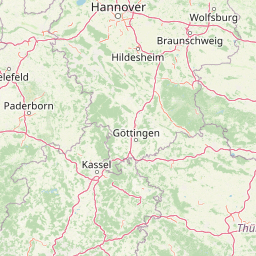
The reserve combines rare floodplain flora, a free-flowing section of the Diemel, and active renaturation measures within a compact 187-hectare area. Its location at the transition between the Diemelsee reservoir landscape and the Marsberg urban-industrial fringe gives it both ecological and landscape-planning significance, while its inclusion in the FFH network and the Diemel- und Hoppecketal bird protection area places it firmly within European conservation frameworks.
Its direct continuity with the neighboring Unteres Diemeltal reserve also makes the upper Diemel one of the more important river-focused protected-area complexes in the Hochsauerlandkreis, offering a comparatively natural river corridor in a region dominated by forests and reservoirs.
Best time to visit Naturschutzgebiet Oberes Diemeltal
The reserve is best experienced in late spring and early summer, when the floodplain meadows and riverbanks are at their most floristically rich and the foliage of alder and riparian woodland is fully developed. This period also tends to be the most rewarding for birdwatching, as breeding activity along the river and in adjacent woodland peaks.
Late summer and autumn can offer quieter conditions and a different character, with lower water levels and visible signs of management activity, while winter visits emphasize the structure of the river channel itself and the surrounding beech and mixed forests that frame the valley. Visiting conditions generally favor milder weather, as the floodplain meadows can be wet underfoot, especially after rainfall.