
Why Pöllwitzer Wald stands out
The Pöllwitzer Wald is best known as a historically layered coniferous forest landscape along the Thuringian-Saxon border, marked by the remnants of medieval and early modern log-floating infrastructure, an FFH-protected habitat area, and a moorland discovery area with an observation tower and circular walkway.
Pöllwitzer Wald history and protected-area timeline
The history of the Pöllwitzer Wald reaches back at least to 1359, when the forest was first documented under the name Gehörne. In the High Middle Ages it formed part of the territorial holdings of the Vögte von Weida, a regional aristocratic dynasty that shaped the political structure of the eastern Thuringian uplands. By the late sixteenth century the forest had become a focal point of regional competition between several branches of the Reuss lordship: in 1596 Heinrich the Elder of Obergreiz, Heinrich the Middle of Schleiz, and Heinrich Posthumus of Gera signed a division agreement that regulated forest use among the various Reuss territories.
The city of Gera, roughly 30 kilometers away, was particularly interested in securing timber supplies from the forest. In 1603 the Gera administration purchased the village of Pöllwitz from Greiz in order to control forest management directly on the ground, and soon negotiated a ten-year contract for the construction of a Flößgraben, a floating channel linking the forest to the Weiße Elster river system via the Triebes and Weida waterways. Through this infrastructure Gera was able to receive up to 1,500 Klafter of split firewood annually by water, a significant economic advantage over the more expensive overland transport routes. Beyond firewood, charcoal, pitch, and honey were also produced in the forest and delivered to Gera by floating.
The Flößholzgraben required continuous maintenance, and a sophisticated system of reservoirs, plank walkways, pack-animal tracks, and weirs was developed. The Gera council had to pay fees to neighboring lordships for transit rights; the expansion of the Pöllwitzer Teich alone was recorded as costing 514 Gulden. Toward the end of the Thirty Years' War the value of the forest rose sharply because many communities required construction timber, and disputes over payments escalated into the blockade of the floating channel by riparian villages, which was forcibly reopened by armed servants sent from Gera. After mediation by the territorial lord, the conflict was resolved and a second floating channel was constructed on an alternative route; between 1665 and 1700 up to 3,000 Klafter of firewood per year reached Gera. Floating on the Triebes was finally discontinued in 1825.
Forestry practices themselves shaped the structural character of the Pöllwitzer Wald over centuries. The original Hercynian mixed mountain forest contained large amounts of silver fir, spruce, and beech, but high demand for construction timber and fuel reduced the share of silver fir drastically, from an estimated 1,500 to 2,000 hectares in the 13th century to barely 100 hectares by about 1850. Dependence on natural regeneration, combined with the continued grazing rights of neighboring villages, transformed parts of the western forest into open heathland. Only around 1800 did systematic yield regulation begin, through a full survey and the division of the forest into equal rectangular compartments; at that time the area still measured about 6,036 Ackern (the regional unit of the Principality of Reuss).
From 1964 onward, a part of the forest was assigned to the NVA (National People's Army) of the GDR as a shooting range and restricted military zone. Several forestry and forestry worker houses had to be abandoned, and the area remained inaccessible to the public until after German reunification. Only after the decontamination of the former military grounds in 1990 did the broader population regain access, and the area was then developed with hiking trails and educational paths. The economic management of the state forest now lies with the Thüringer Landesforstverwaltung.
Pöllwitzer Wald landscape and geographic character
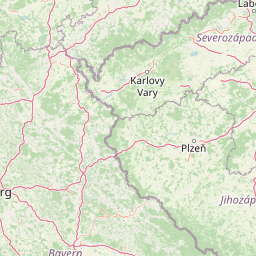
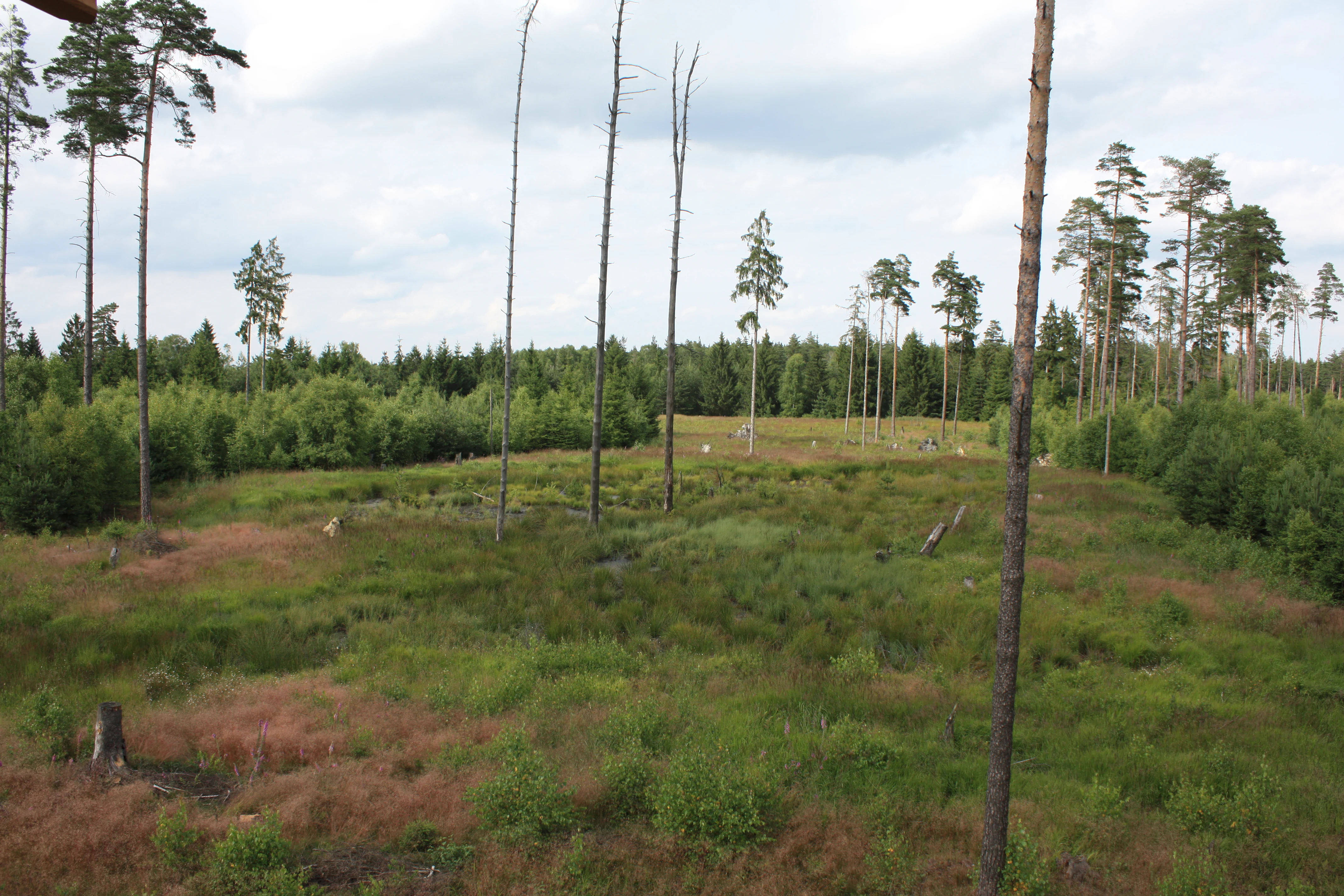
The Pöllwitzer Wald occupies a middle-elevation landscape at roughly 450 meters above sea level, set in the rolling uplands of the northern Vogtland along the border between Thuringia and Saxony. The terrain is shaped by gently undulating plateaus of coniferous forest, small valleys carved by local streams, and open or semi-open heathland transitions along the western edge, where centuries of grazing and exploitation produced open areas within the formerly closed woodland.
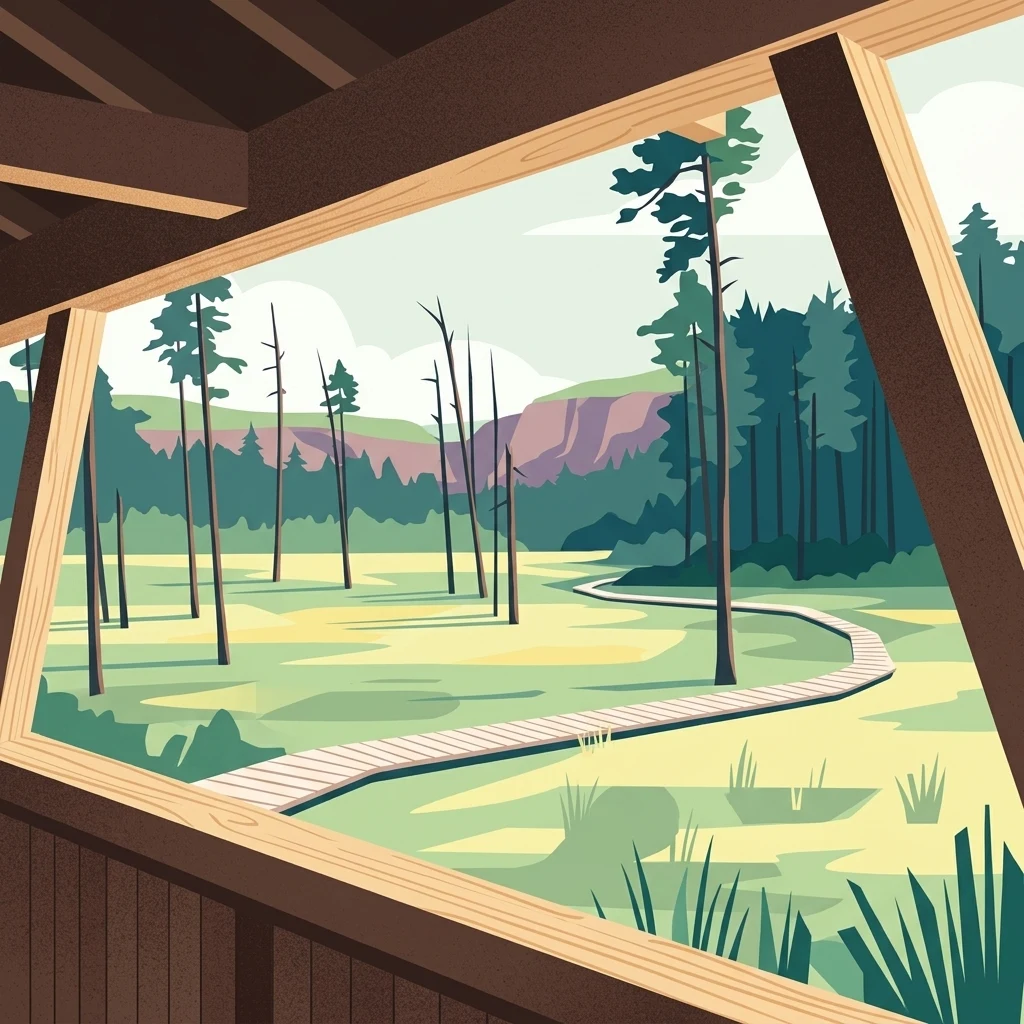
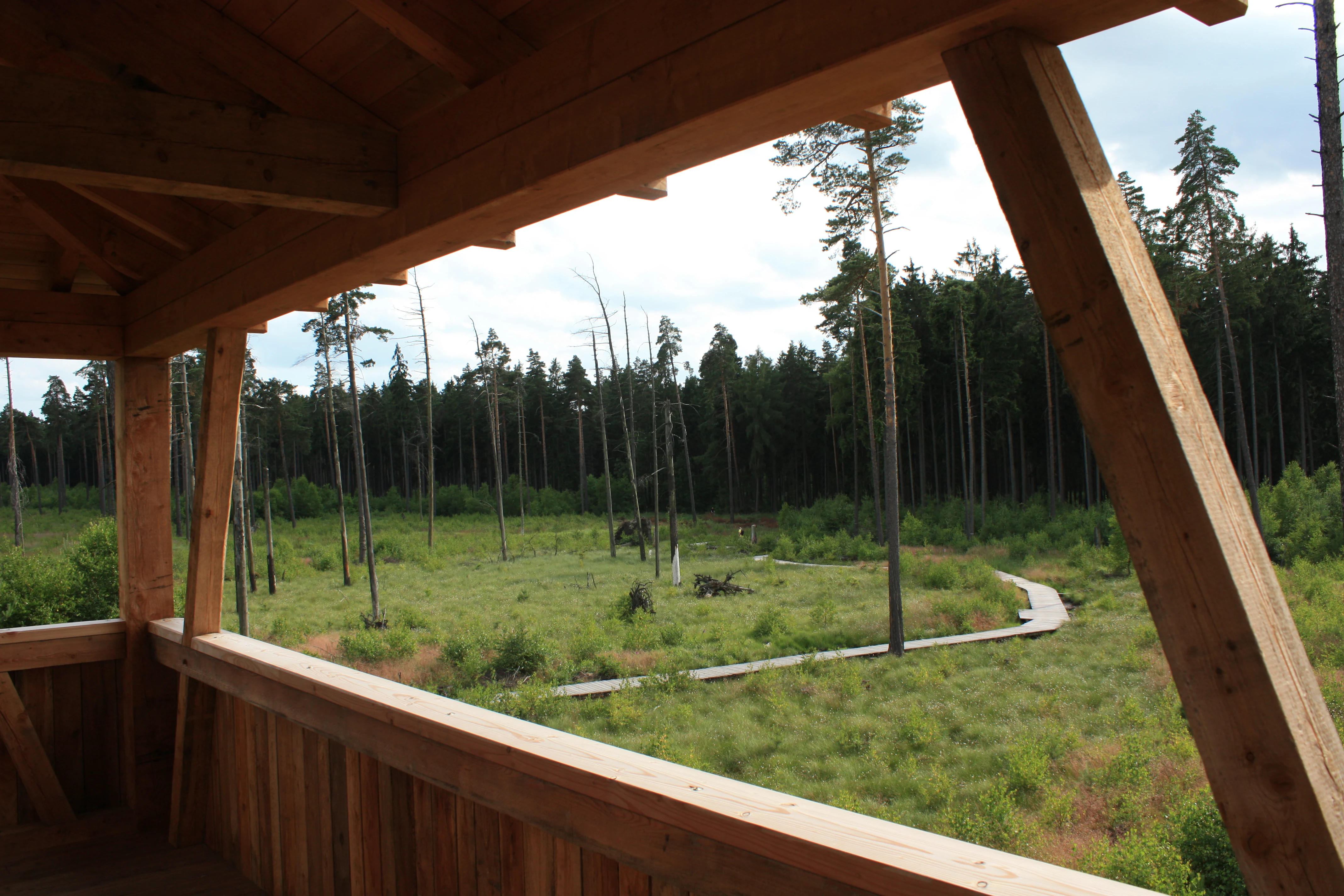
At the heart of the landscape the moorland experience area introduces a distinct wetland character: a moor basin crossed by a circular raised walkway and overlooked by an observation tower. This combination of dry coniferous forest, former heath transitions, and wetland moorland gives the Pöllwitzer Wald a varied visual profile in a relatively compact geographic setting, with forest tracks and educational paths threading through the different terrain types.
Pöllwitzer Wald ecosystems, habitats, and plant life
The ecological profile of the Pöllwitzer Wald reflects multiple phases of land-use history. The present-day forest is dominated by planted spruce stands, often mixed with larch and pine, while the original mixed mountain forest character of silver fir, spruce, and beech survives only in remnant form. Earlier planting experiments with oak failed because of the local soil conditions, leaving spruce as the structural backbone of the forest.
Parallel to the coniferous stands, the western sections of the forest retain an open heathland character derived from long historic grazing pressure. The protected FFH area of approximately 962 hectares also includes the forested wetland habitats around the Pöllwitzer Teich and the moorland experience area, adding peatland and wet woodland communities to the site. The combination of planted coniferous forest, surviving relict mixed forest elements, heath transitions, and wetland habitats forms a compact mosaic of habitat types within a relatively small area.
Pöllwitzer Wald wildlife and species highlights
Source coverage of the wildlife of the Pöllwitzer Wald is limited, reflecting its character as a working forest rather than a species-celebrity reserve. The forest is nonetheless mentioned in the context of a historically larger mammal fauna: a bear was sighted in the Pöllwitzer forest for the last time in 1662, an indication that larger mammals once belonged to the local fauna. The current wildlife emphasis of the area is embedded in the FFH designation and the DBU Naturerbe transfer, which focus on habitat-based rather than species-headline conservation.
Pöllwitzer Wald conservation status and protection priorities
Conservation in the Pöllwitzer Wald is organized primarily through the FFH habitat protection framework. The Pöllwitzer Wald FFH site (No. 150), covering about 962 hectares, was notified to the European Commission in the year 2000 and establishes site-defined usage restrictions grounded in scientific criteria. This designation governs both forestry practice and recreation in the protected core of the forest.
In 2015 the Pöllwitzer Wald and adjacent heath areas were transferred to the DBU Naturerbe GmbH, an organization dedicated to long-term conservation of ecologically valuable landscapes. Alongside the moorland experience area, with its observation tower and elevated walkway, this transfer marked a shift toward integrated habitat, visitor, and forest management under a strengthened conservation mandate.
Pöllwitzer Wald cultural meaning and human context
The Pöllwitzer Wald carries deep cultural significance as a forest whose internal place names still echo abandoned settlements and former hunting and forestry houses, while surviving forester infrastructure documents centuries of structured wood economy. The 1596 division agreement between the Reuss lords and the long-running Gera timber contracts shaped both the political geography and the everyday economy of the region.
The Flößgraben tradition is particularly prominent in local identity: the floating channel linked Pöllwitz to Gera via the Triebes and Weida rivers and gave rise to a complex system of reservoirs, plank walkways, packing trails, and weirs. Disputes over floating rights, the construction of a second Flößgraben, and the eventual end of floating in 1825 together mark an entire chapter of regional economic culture. The later NVA military use of part of the forest between 1964 and 1990, including the displacement of forest workers and the long-term closure of the area, adds a more recent layer to this cultural landscape.
Top sights and standout views in Pöllwitzer Wald
A defined FFH habitat protection area covering about 962 hectares, notified to the European Commission in 2000 and transferred to the DBU Naturerbe GmbH in 2015 alongside adjacent heath areas. A moorland experience area combining an observation tower, a circular raised walkway, and the broader Pöllwitzer Teich basin, offering an accessible point of contact with the wetland side of the forest. A historical forestry landscape marked by remnants of the great Gera log-floating infrastructure, including two successive Flößgraben routes and a sophisticated system of reservoirs and weirs. A survival landscape in which the original Hercynian mixed mountain forest character of silver fir, spruce, and beech still survives in remnant form, set against a now spruce-dominated working forest.
Best time to visit Pöllwitzer Wald
The Pöllwitzer Wald functions primarily as a quiet regional recreation area, and visits are most rewarding when conditions allow the forest and moorland experience area to be comfortably explored on foot. The moderate elevation of roughly 450 meters and the prominence of coniferous stands and heath transitions suggest that the warmer half of the year, when the trails are dry and the observation tower offers clear views across the moor, generally provides the most engaging conditions for both nature observation and broad landscape appreciation. Specific month-by-month weather or operational guidance is not supported by the source material.