
Why Réserve naturelle régionale du site des carrières de Tercis-les-Bains stands out
The reserve is best known internationally for hosting the stratotype of the Campanian-Maastrichtian boundary, the global geological reference point separating two stages of the late Cretaceous period. This makes the former quarry a cornerstone site for stratigraphy, paleontology, and the study of Earth's geological timescale. It is also recognized for the exceptional density and continuity of its Cretaceous fossil record. The exposure preserves hundreds of meters of well-dated sedimentary layers, offering researchers a rare continuous window into the biological and environmental conditions of the late Cretaceous, including associated features such as the salt-driven structural geology of the Tercis Ridge and the Paleocene-aged 'Mur de Bédat' outcrop along the Adour.
Réserve naturelle régionale du site des carrières de Tercis-les-Bains history and protected-area timeline
The reserve's history begins long before its formal protection. The site shows evidence of human activity dating back to the Paleolithic, and subsequent Gravettian-era occupants are known to have produced lithic armatures at Tercis, a topic addressed in dedicated archaeological studies of the site's prehistoric workshop.
In the modern era, the area was developed as an industrial quarry by the Société des Ciments Français. Argillaceous limestone extracted here was transported across the Adour by conveyor belt to supply the cement plant at Angoumé. Quarrying continued through much of the twentieth century before ceasing in 1993, at which point the commune of Tercis-les-Bains acquired the site.
Two decades later, the site received formal protection. In 1995, it was proposed at the Brussels Cretaceous Stratigraphy Congress as a candidate stratotype for the Campanian-Maastrichtian boundary, beginning its recognition within the international stratigraphic community. On 6 July 2015, the site was officially classified as a Réserve naturelle régionale, consolidating its transition from industrial quarry to protected scientific and natural heritage site.
Réserve naturelle régionale du site des carrières de Tercis-les-Bains landscape and geographic character
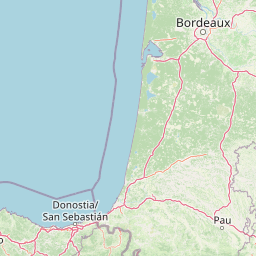
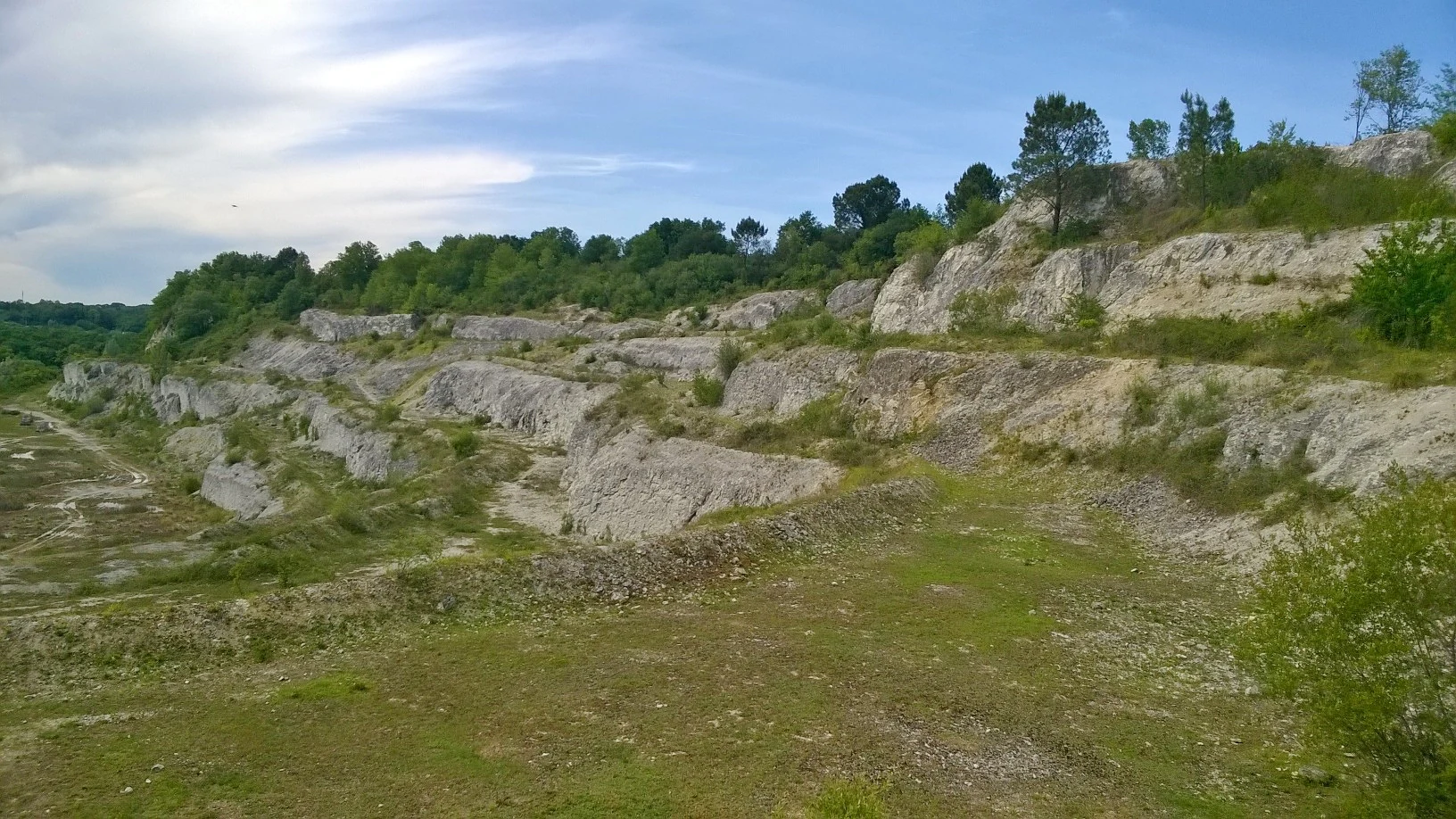
The landscape of the reserve is shaped by its geological past and its industrial past. The terraced walls of the former quarry cut sharply into the hillside, exposing layered sedimentary rock that would otherwise remain hidden beneath vegetation and soil. These artificial cliffs and benches form the visual signature of the site, viewed against the wooded slopes of the surrounding Landes countryside and the river corridor of the Adour.
Structurally, the reserve lies within the 'Ride de Tercis,' a faulted anticlinal ridge associated with deeper Triassic salt movements. The result is an unusual local relief in which older Cretaceous and even Paleocene strata have been brought toward the surface, creating exposure that geologists prize but that gives the area a distinctive, almost excavated topography. Along the riverbank, the 'Mur de Bédat' adds another dramatic vertical face of rock, displaying early Paleocene sediments directly above the older Cretaceous sequence.
Réserve naturelle régionale du site des carrières de Tercis-les-Bains ecosystems, habitats, and plant life
Although the reserve is best known for its geology, its ecological character is shaped by the interplay between abandoned quarry, recovering vegetation, and the Adour river corridor. The quarry benches and slopes have been left to recolonize naturally, generating a mosaic of open rocky habitats, scrub, and pioneer woodland that contrasts with the surrounding Landes forest landscape.
The small portion of the reserve that extends into the public fluvial domain of the Adour adds a riparian dimension to the site's nature. Together, these features create a transitional environment where exposed rock, regenerating vegetation, and riverside habitat meet, supporting a localized but distinctive set of ecological conditions for the region.
Réserve naturelle régionale du site des carrières de Tercis-les-Bains wildlife and species highlights
The reserve's specific wildlife profile is shaped primarily by its mosaic of rocky outcrops, regenerating scrub, and riverside habitat along the Adour rather than by extensive natural forest cover. The exposed quarry walls, fallow benches, and river-edge zones create microhabitats that host fauna adapted to open, mineral-rich environments.
A formal biodiversity inventory for the reserve is not elaborated in the available source material, so detailed species lists are not provided here. The site's ecological value is best understood in combination with its conservation and landscape context: a small protected area where habitat diversity arises from the meeting of geological exposure, plant recolonization, and riparian influence.
Réserve naturelle régionale du site des carrières de Tercis-les-Bains conservation status and protection priorities
The reserve's conservation significance lies primarily in the protection of geological heritage of international scientific importance. By classifying the former quarry as a regional nature reserve in 2015, France formally safeguarded the stratotype of the Campanian-Maastrichtian boundary, ensuring that this globally referenced geological section remains available for ongoing stratigraphic and paleontological research.
Classified under IUCN Category IV, the reserve operates within a habitat and species management framework, even though its central focus is the preservation of an in-situ geological record. The protection also extends to the broader site context, including part of the public fluvial domain along the Adour, allowing integrated management of rock exposures, reclaimed quarry habitats, and riverbank environments. The reserve thus occupies a distinctive niche within the French regional nature reserve network by prioritizing stratigraphic integrity and scientific access alongside ecological and landscape values.
Réserve naturelle régionale du site des carrières de Tercis-les-Bains cultural meaning and human context
Cultural context at the reserve is unusually long and layered for such a small protected area. Human presence at the site extends back to the Paleolithic, and the area has been the subject of Gravettian-era archaeological research focused on lithic knapping and the production of stone armatures. This prehistoric dimension gives the reserve a heritage value that overlaps with, but extends beyond, its geological significance.
In the more recent past, the site's industrial use under the Société des Ciments Français shaped both the local economy and the visible character of the quarry terraces, transporter routes, and former extraction zones. Once operations ceased in 1993, the transition to municipal and then regional natural reserve status reflected a deliberate local and regional choice to convert an industrial landscape into a space for science, education, and heritage.
Top sights and standout views in Réserve naturelle régionale du site des carrières de Tercis-les-Bains
Among the reserve's standout features is the global Campanian-Maastrichtian stratotype, a defining reference for late Cretaceous stratigraphy, physically marked on the quarry wall. The site's continuous sedimentary exposure and its documented record of over 900 fossil species place it among the most important Cretaceous reference localities in Europe.
Other highlights include the dramatic quarry terraces of the former limestone extraction site, the structural complexity of the underlying Tercis anticlinal ridge and its associated salt tectonics, and the Paleocene 'Mur de Bédat' outcrop along the Adour. Layered on top of these geological features is a much older human story, with the reserve preserving traces of Paleolithic and Gravettian activity that connect the deep time of the Cretaceous to the more recent history of human occupation in southwestern France.
Best time to visit Réserve naturelle régionale du site des carrières de Tercis-les-Bains
The reserve's appeal is largely geological and scientific rather than seasonal, so timing is more a matter of comfort and accessibility than of dramatic seasonal transformation. Spring and early autumn typically offer milder weather for outdoor fieldwork or guided visits along the quarry terraces and the Adour riverbank, when vegetation is active but heat and tourist congestion are lower than in mid-summer.
Winter visits are also feasible for those interested in seeing the rock exposures with minimal vegetation cover, which can help highlight the layered stratigraphy of the quarry walls. Those planning a research or educational visit should generally confirm current access arrangements in advance, as the reserve is managed as a protected scientific site rather than as a mass tourism destination.